
HSE-211 · Lesson 3 of 12 · 25 min
Identifying, classifying and inventorying confined spaces
You cannot control a hazard you have not found. The first job of any confined space program is to find every confined space at the workplace, decide what kind of space each one is, record its hazards and make sure people know about it. This lesson explains how workplaces build a confined space inventory, how spaces are classified, how warning signs and barriers are used, and how the first and best control, avoiding entry altogether, fits in.
Walking the site
A confined space survey is usually done by a competent or qualified person who knows the processes at the site, often with help from maintenance staff, operators and the health and safety committee. The survey team walks the whole site, including roofs, basements, yards, utility corridors and areas that are rarely visited. For each space that might qualify, they ask the definition questions from lesson 1:
- Can a person bodily enter and do work in it?
- Is entry or exit limited or restricted, for example by a manhole, a ladder, a small hatch, a long crawl or obstructions inside?
- Is it designed for continuous occupancy, with normal doors, lighting, ventilation and space to move?
If the answers are yes, yes and no, the space is a confined space. The team then looks at the hazards: what the space contains or has contained, what lines and equipment connect to it, what work is done in it, what could flow into it, and what its shape is like inside. Drawings, process information, safety data sheets, maintenance records and past incident reports all help. Interviews with the people who actually work in and around the space are often the most useful source of all, because they know which valves leak, which sumps collect water and which tanks are entered more often than the paperwork suggests.
Spaces that are easy to miss
Survey teams regularly find confined spaces that no one had thought of. Typical examples include:
- pits under machines, vehicle hoists and presses, which collect heavy vapors and water;
- the inside of large ducts, plenums, hoods and dust collectors;
- crawlspaces, attics and ceiling spaces in older buildings;
- sumps, catch basins, interceptors and lift stations;
- cooling tower basins and the inside of cooling towers;
- electrical and communications vaults, including cable vaults and transformer vaults at data centers and substations;
- rooms that become confined spaces when their normal ventilation is shut down, such as some fire suppression rooms protected by inert gas systems;
- temporary spaces created during construction, such as a tank being built, a deep formwork cavity or a newly installed vault before its permanent ventilation works;
- vehicles and equipment such as tanker trailers, rail cars, hoppers, mixers and the hulls of boats.
A space does not stop being a confined space because it is entered rarely, and it does not become safe because the people who enter it are experienced.
Classifying spaces
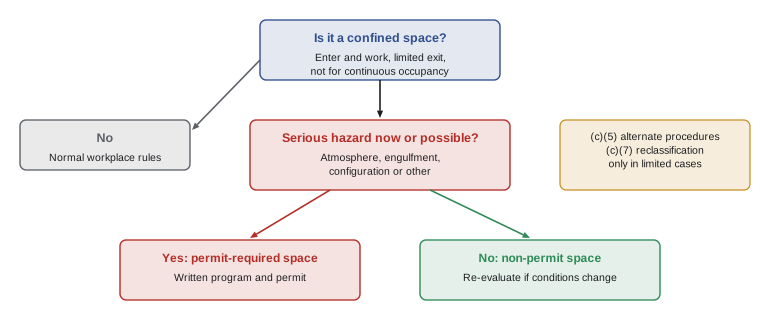
Once a space is identified, it is classified so the right controls can be applied. Under 1910.146, every confined space is either a permit-required confined space or a non-permit confined space. A permit space has one or more of these characteristics: it contains or has the potential to contain a hazardous atmosphere; it contains material that could engulf an entrant; it has an internal configuration, such as inwardly converging walls or a floor that slopes down and tapers to a smaller cross-section, that could trap or asphyxiate an entrant; or it contains any other recognized serious safety or health hazard. A non-permit confined space has none of these hazards and no potential for them. Subpart AA uses the same classification for construction.
Hazards to consider for each space
A good assessment looks at every type of hazard, not only the atmosphere. A typical assessment checklist includes:
| Hazard group | Questions to ask |
|---|---|
| Atmosphere | Could oxygen be low or high? Could flammable or toxic gases, vapors or dusts be present or be produced by the work? |
| Engulfment and drowning | Does the space hold grain, sand, sludge, powders or liquids? Could material or water flow in? |
| Configuration | Do walls converge, floors slope or openings narrow so a person could be trapped or wedged? |
| Energy and moving parts | Are there agitators, augers, mixers, conveyors, fans or pumps? What energy feeds them? |
| Connected lines | What pipes, ducts and chutes enter the space? Could steam, chemicals or product be released? |
| Physical conditions | Heat, cold, noise, poor lighting, slippery surfaces, falls during vertical entry, falling objects |
| The work itself | Will welding, cutting, coating, cleaning or solvent use change the atmosphere or create fire risk? |
| Biological | Could there be sewage, mold, animal waste, bird droppings, needles or other biological hazards? |
| Access and rescue | How large are the openings? How would an injured worker be removed, and how quickly? |
Alternate procedures and reclassification
1910.146 offers two routes to simpler controls. Under the alternate procedures in paragraph (c)(5), a permit space can be entered without a full permit system when the only hazard is an actual or potential hazardous atmosphere, continuous forced-air ventilation alone keeps the space safe, the employer has monitoring and inspection data to show this, and the entry is preceded by testing and monitored continuously. Under reclassification in paragraph (c)(7), a permit space can be treated as a non-permit space when there are no actual or potential atmospheric hazards and all other hazards are eliminated without entry, or are eliminated during an entry under a permit, with the basis documented and certified. Controlling a hazard, for example with ventilation, is not the same as eliminating it: a space that needs ventilation to stay safe cannot be reclassified. If hazards arise again, the space reverts to a permit space.
Signs, labels and barriers
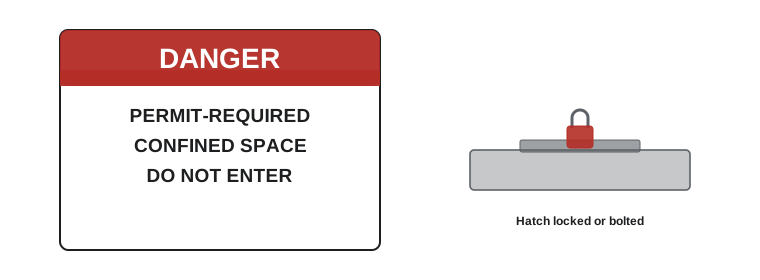
Once spaces are identified, people must be warned. Permanent danger signs at each entrance are the usual method, supplemented by locks, bolted covers, barriers and training. A typical sign reads 'DANGER, CONFINED SPACE, DO NOT ENTER' or, in US practice, 'DANGER, PERMIT-REQUIRED CONFINED SPACE, DO NOT ENTER'. Signs should be in the languages used at the workplace and should use recognizable symbols.
Signs alone do not stop entry. Spaces that are easy to open, such as hatches on tanks or covers on pits, should be locked, bolted or otherwise secured so that only authorized people can open them. When a cover is removed for work, the opening must be guarded with a barrier, railing or temporary cover to prevent falls and keep unauthorized people out. Rescue and entry equipment should not block the barrier.
The confined space inventory
The results of the survey are recorded in an inventory or register. A good inventory lists, for each space:
- a unique identification number and the location, often with a photograph and a map reference;
- a description of the space, its size, its openings and its normal contents;
- its classification and the hazards identified;
- the energy sources, lines and equipment that must be isolated;
- the expected atmospheric tests and acceptable values;
- the ventilation method, if any;
- the entry and rescue method, including any anchor points and the size of the openings;
- the date of the last assessment and the person who did it.
The inventory is a living document. It must be updated when spaces are added, removed or modified, when processes change, and after any incident or near miss. Many employers link each entry in the inventory to a space-specific entry plan or procedure, so that the person preparing a permit starts with an accurate description of the space.
Worked example: sorting a site's spaces
Worked problem
A small food plant's survey
A survey at a small food plant finds: a 5,000-gallon syrup storage tank with a top manhole; a dry ingredient hopper with a sloping bottom and an auger; a pit under a filler machine about 4 ft deep with no ventilation; a walk-in cooler with a normal door; and an electrical vault reached by a ladder. Which are confined spaces, and what are the main hazards of each?
Show solution
- Syrup tank: enterable, limited entry through a manhole, not designed for occupancy. Confined space. Hazards: residues, cleaning chemicals, possible oxygen depletion if fermentation occurs, connected lines, slippery surfaces.
- Ingredient hopper: enterable for cleaning, limited entry, not designed for occupancy. Confined space. Hazards: engulfment in powder, sloping walls that can trap, the auger (lockout), combustible dust.
- Filler pit: enterable, limited exit, not designed for occupancy. Confined space. Hazards: heavier-than-air gases such as carbon dioxide or refrigerant collecting, cleaning chemicals, water.
- Walk-in cooler: designed for people to walk in and out through a normal door. Not usually a confined space, although refrigerant leaks and entrapment from inside should still be addressed.
- Electrical vault: enterable, ladder access, not designed for occupancy. Confined space. Hazards: electrical, possible gas from sewers or cable faults, falls on the ladder.
Answer: Four of the five are confined spaces (tank, hopper, pit and vault), each with different main hazards. The cooler is not, but its hazards still need controls.
Avoiding entry
The best way to protect people from confined space hazards is to keep them out. Before planning an entry, ask whether the work can be done from outside. Examples include:
- using cameras, drones or remote probes to inspect tanks and pipes;
- cleaning tanks with spray balls, high-pressure nozzles or vacuum trucks from outside;
- moving instruments, filters and valves outside the space so routine maintenance does not require entry;
- fitting bin sweeps and vibrators so workers do not need to enter grain bins to make grain flow;
- designing new spaces with larger openings, permanent ventilation, sloped floors that drain and external access to equipment.
Eliminating the need for entry sits at the top of the hierarchy of controls. When entry cannot be avoided, the controls in the rest of this course apply.
Finally, the survey is not a one-time exercise. New equipment, renovations, changes in what is stored, and new contractors bringing their own tanks or vessels onto site can all create new confined spaces. Many programs require a brief confined space check as part of every management of change review and every new construction or renovation project, so that spaces are identified while they are still on the drawings, when it is cheapest to add larger openings, permanent ladders, anchor points and ventilation connections.
Common mistakes
MistakeSurveying only obvious spaces such as tanks and silos.
InsteadWalk the whole site and ask the definition questions about pits, ducts, vaults, crawlspaces and temporary spaces.
MistakeClassifying a space once and never reviewing it.
InsteadUpdate the inventory when processes, contents or equipment change and after incidents.
MistakeReclassifying a space because ventilation keeps it safe.
InsteadControlling a hazard is not eliminating it; such spaces may use alternate procedures but not reclassification.
MistakeRelying on signs alone to keep people out.
InsteadLock, bolt or barricade openings and train everyone to recognize confined spaces.
MistakePlanning an entry without asking whether the work can be done from outside.
InsteadAvoiding entry is the most effective control.
Summary and key terms
- Every confined space program starts with a site survey to find all confined spaces.
- Survey teams ask the definition questions and gather information from drawings, records and the people who work there.
- Pits, ducts, vaults, crawlspaces, sumps and temporary construction spaces are often missed.
- Under 1910.146, spaces are permit-required or non-permit, depending on serious hazards.
- Assessments consider the atmosphere, engulfment, configuration, energy, connected lines, physical conditions, the work and rescue.
- Signs warn; locks, bolted covers and barriers prevent casual entry.
- An up-to-date inventory supports permits, and avoiding entry altogether is the best control.
- Confined space inventory
- A register listing each confined space, its location, classification, hazards and controls.
- Hazard assessment
- A documented evaluation of the hazards of a space and the work to be done in it.
- Non-permit confined space
- In US rules, a confined space with no actual or potential serious hazards.
- Restricted space
- In Alberta, a space with restricted access but no atmospheric hazard.
- Internal configuration hazard
- A shape, such as converging walls or a tapering floor, that could trap or asphyxiate an entrant.
- Hierarchy of controls
- The ranking of controls from elimination and substitution to engineering, administrative controls and PPE.
- Danger sign
- A permanent sign at the entrance warning that the space is a confined space and must not be entered without authorization.
- Space-specific plan
- A written procedure for entering one space or a group of similar spaces.
- Bin sweep
- Equipment that moves grain to the outlet without a worker entering the bin.
- Reassessment
- A new hazard assessment when conditions, processes or the work change.
Practice problems
Work each problem on paper first, then reveal the answer to check.
What three definition questions does a survey team ask?
Show answer
Can a person enter and work? Is entry or exit limited? Is it not designed for continuous occupancy?
Give three spaces that are often missed in surveys.
Show answer
Pits under machines, large ducts or dust collectors, crawlspaces, sumps, vaults or temporary construction spaces.
Why are interviews with operators valuable?
Show answer
They know which spaces are entered, which valves leak and what conditions really occur.
What is an internal configuration hazard?
Show answer
A shape such as converging walls or a tapering floor that could trap or asphyxiate someone.
What is a non-permit confined space?
Show answer
A confined space with no actual or potential serious hazards.
Why are signs not enough on their own?
Show answer
People may ignore or not see them; openings should be locked, bolted or barricaded.
List four items in a confined space inventory.
Show answer
ID and location, description, classification and hazards, isolation points, tests, ventilation, rescue method, last assessment date.
When should the inventory be updated?
Show answer
When spaces or processes change and after incidents or near misses.
Give two ways to avoid entering a tank.
Show answer
Remote cameras or probes, spray-ball or vacuum cleaning from outside, moving equipment outside.
Why is controlling a hazard different from eliminating it?
Show answer
If the control fails, the hazard returns, so the space still needs full entry controls.
Lesson quiz · 5 questions
Score 60% or more to complete this lesson.
Create a free account to save your progress, take quizzes and earn a certificate.