
HSE-104 · Lesson 9 of 12 · 26 min
Foot and leg protection
Feet carry us through every working day, often over uneven ground, wet floors, sharp debris and around heavy loads and moving equipment. Foot injuries include crushed toes and feet from falling or rolling objects, punctures from nails and sharp scrap, cuts from chainsaws and other tools, burns from molten metal, hot surfaces and chemicals, electrical shock, and sprains, fractures and other injuries from slips, trips and falls. Many foot injuries are serious: a crushed foot can mean months off work and permanent disability. Protective footwear is required in many workplaces, and choosing the right footwear depends on understanding the hazards and the markings that show what a particular boot or shoe has been tested to resist. This lesson covers foot hazards, the Canadian and US footwear standards and markings, metatarsal protection, slip resistance, electrical properties, chainsaw and leg protection, fit and comfort, and inspection and care.
Foot hazards and controls
Common foot hazards include objects falling onto the feet, such as tools, parts, pipes and pallets; objects rolling onto the feet, such as carts, hand trucks and vehicles; compression between objects; sharp objects underfoot, such as nails, screws, glass and metal scrap; hot, molten or corrosive materials; electrical hazards from live conductors or static build-up; slippery, uneven or unstable walking surfaces; and cutting tools such as chainsaws and brush cutters. Controls before PPE include good housekeeping to remove debris, separating pedestrians from forklifts and vehicles, using carts and lifting aids instead of carrying heavy items, safe stacking and storage, anti-slip flooring and drainage, and machine guarding. Protective footwear protects against what remains.
Parts of protective footwear
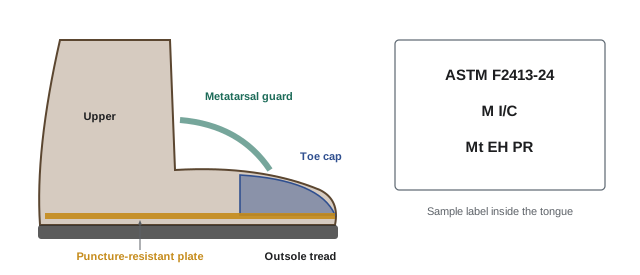
Protective footwear combines several protective components with a comfortable, supportive boot or shoe:
- A toe cap of steel, aluminum or composite material such as fiberglass, carbon fiber or plastic, built into the toe to resist impact and compression.
- A puncture-resistant midsole plate of steel or flexible composite fabric that resists nails and other sharp objects penetrating the sole.
- A metatarsal guard, internal or external, that protects the upper part of the foot between the toes and the ankle.
- An outsole made of rubber or other compounds, with a tread pattern that provides grip and may resist heat, oil and chemicals.
- Electrical properties provided by the materials of the sole and construction, either insulating against shock or dissipating static electricity.
- The upper, made of leather, rubber or synthetic materials, which supports the foot and ankle and may resist water, chemicals, heat or cuts.
Composite toe caps and plates are lighter than steel, do not conduct heat or cold as readily, and do not set off metal detectors, which is useful in some workplaces. Steel caps are thinner for the same protection, so boots can be less bulky.
Footwear standards and markings
In the United States, OSHA's 1910.136 requires protective footwear where there is a danger of foot injuries from falling or rolling objects, objects piercing the sole, or electrical hazards, and requires footwear to meet ASTM F2412 (test methods) and ASTM F2413 (performance requirements), or to be equally protective. The current edition of ASTM F2413 was published in 2024. Rather than colored symbols, ASTM F2413 uses a short text label, usually printed inside the tongue or on the side of the boot, made up of lines that identify the standard, the protections provided and the gender of the footwear.
| ASTM F2413 marking | Meaning | Typical use |
|---|---|---|
| ASTM F2413-24 | Standard and year of the edition met | Identifies the requirements |
| M or F | Male or female footwear | Sizing and test levels |
| I/C | Impact and compression resistant toe (75 ft-lb and 2,500 lb) | Falling and rolling objects |
| Mt | Metatarsal protection | Heavy objects striking the top of the foot |
| EH | Electrical hazard resistant sole | Incidental contact with live circuits |
| PR | Puncture resistant sole | Nails and sharp debris |
| SD | Static dissipative | Where static discharge is a hazard |
| Cd | Conductive | Where static charges must be grounded |
| CS | Chainsaw cut resistant | Chainsaw work |
| DI | Dielectric insulation | Electrical work with higher insulation needs |
Not all footwear sold as work boots is protective footwear. Fashion boots with a reinforced toe, or work boots without certification marks, may not meet any standard. Workers and employers should look for the certification mark of an accredited body and the correct symbols or label, not just a description in a catalog.
Metatarsal protection
The metatarsal bones form the top of the foot between the toes and the ankle. A toe cap does not protect them, so a heavy object dropped on the top of the foot can still cause serious fractures. Metatarsal guards are recommended or required where there is a risk of heavy objects striking the top of the foot, as in foundries, steel mills, heavy fabrication, rail and pipe handling, and demolition. Internal metatarsal guards are built into the boot and are less likely to snag, while external guards are strapped over the laces and can be added to existing boots, though they may catch on objects and be less comfortable.
Slip resistance
Slips, trips and falls on the same level cause a large share of workplace injuries. Footwear outsoles influence slip resistance through their compound, hardness, tread pattern and wear. Softer compounds tend to grip better on smooth surfaces, while deep, open tread patterns help on mud and snow but can trap debris. On oily or greasy floors, compounds and tread designs made for oil resistance and grip are needed. Some footwear is tested for slip resistance using standards such as ASTM F2913 or ISO 13287, which measure the coefficient of friction on test surfaces such as wet ceramic tile or steel with glycerin. In winter conditions, ice cleats or footwear with integrated studs can reduce slips outdoors but must be removed before walking on smooth indoor floors, where they can make slipping more likely. Worn treads should be a trigger for replacement.
Electrical properties of footwear
Footwear with electrical properties falls into two opposite categories, and confusing them can be dangerous:
- Electric shock resistant or electrical hazard footwear has insulating soles that provide a secondary source of protection against accidental contact with live electrical conductors at low voltages under dry conditions. It is not a primary protection; workers on energized equipment must still follow electrical safety procedures, and its protection is reduced by wet conditions, wear, cuts and embedded conductive objects such as metal shavings.
- Static dissipative footwear reduces the build-up of static electricity by conducting it from the body to the ground through the sole at a controlled rate, and conductive footwear provides a very low-resistance path to ground for work with explosives or sensitive electronics. Both allow current to pass, so they must never be used where workers may contact live electrical conductors.
Choosing between insulating and dissipative footwear depends on whether the main hazard is shock from live circuits or ignition and equipment damage from static discharge.
Chainsaw and leg protection
Chainsaw operators face a high risk of serious leg and foot injuries, because the saw's chain can contact the legs during kickback or if the saw slips. Chainsaw protective trousers, chaps and leggings contain layers of long, strong fibers that are pulled out by the chain and wrap around the drive sprocket, stopping the chain in a fraction of a second. Chainsaw-rated boots contain similar materials in the upper. These garments must be certified to a recognized standard, must cover the front of the legs from the waist to the top of the boots, and must be replaced if cut, because the protective fibers pulled out by a cut are no longer available. They do not make the operator invulnerable; proper technique, chain brake, chain catcher and training are essential. Other leg protection includes leggings and spats for foundry and welding work, which protect against molten metal and sparks entering the boots, knee pads for kneeling work, and shin guards for work with heavy materials.
In the United States, OSHA's logging standard, 1910.266, requires leg protection covering the full length of the thigh to the top of the boot for chainsaw operators, and chainsaw protective boots and leg wear are commonly tested to ASTM F1897 and ASTM F2413 (CS).
Selecting, fitting and breaking in footwear
Selecting protective footwear starts from the hazard assessment: which toe protection grade, puncture resistance, metatarsal protection, electrical properties, slip resistance, chemical resistance, heat resistance, waterproofing, insulation and ankle support the job requires. Fit matters as much as protection. Footwear should be tried on at the end of the day, when feet are slightly swollen, with the socks that will be worn at work. The toe cap should not press on the toes, and there should be about a thumb's width of space in front of the longest toe. The heel should be held firmly without slipping, and the widest part of the foot should match the widest part of the boot. Workers who stand or walk for long periods may benefit from cushioned insoles, though only insoles approved by the manufacturer should be used in electrical hazard or static dissipative footwear, because others can change the electrical properties. Breaking in new boots gradually reduces blisters and discomfort.
Worked problem
Choosing footwear for a warehouse and loading dock
A warehouse worker handles cartons and pallets, works alongside forklifts, walks on smooth concrete that is sometimes wet near the dock doors, and occasionally enters a room with sensitive electronic equipment where static discharge can damage components. There is no nail or puncture hazard, and no live electrical work. What footwear features are needed?
Show solution
- Falling pallets and rolling forklifts: Grade 1 toe protection, and consider metatarsal protection if heavy items are handled.
- No puncture hazard: a puncture-resistant sole is not essential but may be chosen if debris is present.
- Wet smooth concrete: a slip-resistant outsole rated for wet surfaces.
- Sensitive electronics: static dissipative footwear for the electronics room, recognizing that it is not suitable near live conductors, which are not present here.
- Long periods standing: good cushioning and fit.
Answer: Footwear labeled I/C for impact and compression, SD for static dissipation, and a slip-resistant outsole, fitted for comfort, with PR added if debris is present.
Inspection, care and replacement
Protective footwear should be inspected regularly for cracks or holes in the uppers, separation of the sole from the upper, exposed or dented toe caps, worn treads, cuts in the sole, embedded metal or stones, and loss of waterproofing. A toe cap that has taken a heavy impact or compression may be deformed even if no damage is visible from the outside, and the footwear should be replaced. Electrical hazard footwear loses insulating ability when the sole is worn, cut or wet, and static dissipative footwear can lose its properties when dirty or when non-approved insoles are used, so some workplaces test static dissipative footwear daily with a tester. Leather boots should be cleaned and treated to keep the leather supple, dried at room temperature rather than on heaters, and stored away from heat and chemicals. Footwear exposed to chemicals should be decontaminated or discarded as the safety data sheet and manufacturer advise.
Chemical, heat and cold hazards to the feet
Rubber and PVC boots protect against water, chemicals and wet concrete, and are available with toe caps and puncture-resistant soles. Boots for chemical work should be chosen from the manufacturer's resistance data, just like gloves, and trouser legs should be worn outside the boots so liquids run off rather than into them. Workers near molten metal need boots without laces or with quick-release fastenings, so they can be removed quickly if metal gets inside, together with spats or leggings. Insulated boots rated for low temperatures protect against cold and frostbite, while heat-resistant soles protect workers who stand on hot surfaces such as asphalt and furnace floors.
Socks, insoles and foot health
Foot comfort affects safety as well as wellbeing. Workers who stand or walk all day on hard floors are prone to sore feet, heel pain and back problems, and tired workers are more likely to slip or lose concentration. Moisture-wicking socks of wool or synthetic blends keep feet drier than cotton and reduce blisters and fungal infections. Rotating between two pairs of boots allows each pair to dry fully between shifts. Anti-fatigue mats at workstations reduce strain, and workers with foot conditions should seek advice from a health professional about orthotics, choosing protective footwear that accepts them without affecting certification.
Common mistakes
MistakeBuying work boots without checking certification marks.
InsteadLook for the ASTM F2413 label with the right codes.
MistakeWearing static dissipative boots near live conductors.
InsteadUse shock-resistant footwear where live contact is possible.
MistakeKeeping boots after a heavy toe impact.
InsteadReplace footwear whose toe cap may be deformed.
MistakeRelying on toe caps against top-of-foot impacts.
InsteadAdd metatarsal protection where needed.
MistakeKeeping chainsaw chaps after a cut.
InsteadReplace cut chainsaw protective garments.
Summary and key terms
- Foot injuries come from impact, compression, puncture, cuts, burns, electricity and slips.
- Protective footwear combines toe caps, plates, guards, outsoles and electrical properties.
- ASTM F2413 uses label codes such as I/C, Mt, EH and PR.
- Metatarsal guards protect the top of the foot.
- Shock-resistant and static dissipative footwear are opposites and must not be confused.
- Chainsaw protective garments stop the chain by fibers clogging the sprocket.
- Inspect footwear and replace it when damaged, worn or after heavy impact.
- Toe cap
- Built-in protective cap over the toes.
- Puncture-resistant plate
- Midsole layer that resists sharp objects.
- Metatarsal guard
- Protection for the top of the foot.
- Outsole
- Bottom of the shoe that contacts the ground.
- Grade 1 toe protection
- Higher level of toe impact resistance in CSA Z195.
- Electric shock resistant
- Insulating sole providing secondary shock protection.
- Static dissipative
- Sole that drains static charge at a controlled rate.
- Conductive footwear
- Footwear providing a low-resistance path to ground.
- Chainsaw protection
- Fibers that stop a chain on contact.
- Slip resistance
- Ability of an outsole to resist slipping.
Practice problems
Work each problem on paper first, then reveal the answer to check.
Name four foot hazards.
Show answer
Falling objects, rolling objects, punctures, chemicals, electricity, slips, chainsaws.
What does PR mean on an ASTM F2413 label?
Show answer
Puncture-resistant sole.
What does EH mean?
Show answer
Electric shock or electrical hazard resistant sole.
Why is static dissipative footwear unsuitable near live circuits?
Show answer
It allows current to pass.
What does a metatarsal guard protect?
Show answer
The top of the foot.
How do chainsaw chaps work?
Show answer
Fibers pulled out by the chain clog the sprocket and stop it.
When should boots be tried on?
Show answer
At the end of the day with work socks.
Why use only approved insoles in EH or SD footwear?
Show answer
Others can change the electrical properties.
Advantage of composite toe caps?
Show answer
Lighter, less heat conduction, no metal detector alarms.
When should ice cleats be removed?
Show answer
Before walking on smooth indoor floors.
Lesson quiz · 5 questions
Score 60% or more to complete this lesson.
Create a free account to save your progress, take quizzes and earn a certificate.