
HSE-104 · Lesson 2 of 12 · 26 min
PPE law and standards in the US
In the United States, the duty to provide and use personal protective equipment comes mainly from the Occupational Safety and Health Act of 1970 and the standards issued by the Occupational Safety and Health Administration (OSHA), together with state plans approved by OSHA, which cover about half the states and territories and must be at least as effective as federal rules. The core PPE requirements for general industry are in 29 CFR Part 1910, Subpart I, with separate rules for construction in Part 1926 and for maritime work. These standards require hazard assessments, PPE selection, training and, in most cases, employer payment, and they incorporate consensus standards from ANSI, ISEA, ASTM, NFPA and NIOSH. This lesson explains that structure, the main standards, who pays for PPE, and what workers can do when PPE is inadequate.
How PPE law is structured
In both countries, PPE law works on three levels. At the top, a general duty requires employers to take reasonable steps to protect workers from hazards. In the middle, specific regulations say when PPE must be provided, assessed, fitted and maintained, and often how it must perform. At the bottom, technical standards written by standards organizations describe in detail how equipment must be designed, tested and marked. Regulations frequently incorporate those standards by reference, which means that complying with the regulation requires equipment that meets the named standard, sometimes a specific edition. Employers must therefore know which edition their regulation refers to, which may not be the latest one.
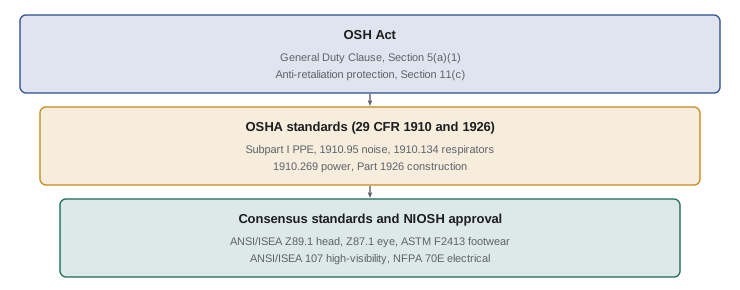
The OSH Act and the General Duty Clause
Section 5(a)(1) of the OSH Act, the General Duty Clause, requires each employer to provide a workplace free from recognized hazards that are causing or likely to cause death or serious physical harm. Section 5(a)(2) requires employers to comply with OSHA standards, and Section 5(b) requires employees to comply with standards and rules that apply to their own conduct. OSHA cannot generally cite employees, so enforcement falls on employers, who are expected to train, supervise and enforce PPE use, including through discipline where necessary. Where no specific standard applies to a hazard, OSHA may use the General Duty Clause to require reasonable protection, including PPE.
OSHA's PPE standards
OSHA's general industry PPE standards are in Subpart I of 29 CFR 1910. Section 1910.132 contains the general requirements: employers must assess the workplace to determine whether hazards are present that require PPE, select and have each affected employee use suitable PPE, communicate selection decisions, select PPE that properly fits each employee, certify the hazard assessment in writing, train each employee who must use PPE, and retrain when necessary. The following sections cover specific equipment: 1910.133 eye and face protection, 1910.134 respiratory protection, 1910.135 head protection, 1910.136 foot protection, 1910.137 electrical protective equipment, 1910.138 hand protection and 1910.140 personal fall protection systems. Noise is covered separately in 1910.95, and construction has parallel rules in Part 1926, Subpart E. State plans may add requirements; California's Title 8, for example, has its own detailed PPE provisions.
OSHA's training requirement is specific. Under 1910.132(f), employees must be trained to know at least when PPE is necessary, what PPE is necessary, how to properly don, doff, adjust and wear it, its limitations, and its proper care, maintenance, useful life and disposal. Each employee must demonstrate an understanding of the training and the ability to use PPE properly before being allowed to perform work requiring it, and employers must retrain when workplace changes make the training obsolete or when an employee shows a lack of understanding. Employers must also verify, through a written certification, that the required training has been completed.
Standards for PPE
The table below lists the main standards that PPE in each country is expected to meet. Regulations may refer to specific editions, and standards are revised every few years, so always check the edition required in your jurisdiction and the markings on the equipment.
| PPE type | Main US standard |
|---|---|
| Head protection | ANSI/ISEA Z89.1, Industrial head protection |
| Eye and face protection | ANSI/ISEA Z87.1, Occupational and educational eye and face protection |
| Hearing protection | EPA labeling rule (40 CFR Part 211) for noise reduction ratings; ANSI/ASA S12 test methods |
| Respiratory protection | NIOSH approval under 42 CFR Part 84; 29 CFR 1910.134 |
| Foot protection | ASTM F2413, Performance requirements for protective footwear |
| High-visibility apparel | ANSI/ISEA 107, High-visibility safety apparel |
| Fall protection | ANSI/ASSP Z359 series; 29 CFR 1910.140 and 1926 Subpart M |
| Electrical safety | NFPA 70E, Electrical safety in the workplace; ASTM F1506 and others |
OSHA standards reference specific editions of consensus standards, and OSHA permits equipment meeting a later edition if it provides equal or greater protection. Because OSHA rulemaking is slow, the edition named in the regulation may be years older than the current consensus standard. Employers commonly buy equipment certified to the current edition, which normally satisfies OSHA as well.
Who pays for PPE
Since 2008, OSHA has required employers to pay for most PPE used to comply with OSHA standards. Under 1910.132(h), employers must pay for required PPE, with limited exceptions: non-specialty safety-toe protective footwear and non-specialty prescription safety eyewear, provided the employer permits them to be worn off the job site; everyday clothing and ordinary weather gear; and items such as logging boots required under the logging standard. Employers must pay for replacement PPE, except when an employee has lost or intentionally damaged it. If an employee chooses to use PPE they own, the employer need not reimburse them, but must still ensure it is adequate and properly maintained.
Worked problem
Who pays for this PPE?
A warehouse requires workers to wear safety-toe boots, cut-resistant gloves and, in the battery charging room, a face shield and chemical gloves. Who is likely to pay for each item?
Show solution
- Under OSHA, non-specialty safety-toe footwear that workers may wear off the job site is an exception, so the employer may require workers to buy it.
- Cut-resistant gloves are task-specific PPE, normally provided by the employer.
- A face shield and chemical gloves for battery acid are specialized PPE, provided by the employer.
- Whoever pays, the employer must ensure each item meets the required standard, fits and is in good condition.
Answer: The employer pays for the gloves, face shield and chemical gloves; non-specialty safety-toe boots worn off site are an exception the worker may be required to buy.
Workers' rights
US workers have the right to a safe workplace, to receive training in a language and vocabulary they understand, to receive required PPE, to file a confidential complaint with OSHA, and to be protected from retaliation under Section 11(c) of the OSH Act. If required PPE is missing, damaged or does not fit, a worker should report it to their supervisor. Workers may refuse to perform a task in limited circumstances, where they reasonably believe there is an imminent danger of death or serious injury, they have asked the employer to correct it, there is no time to get OSHA to inspect, and they had no reasonable alternative. Retaliation complaints under Section 11(c) generally must be filed within 30 days.
Enforcement and consequences
OSHA inspectors issue citations with penalties that are adjusted for inflation each year, with higher penalties for willful and repeat violations. PPE and respiratory protection violations are consistently among OSHA's most frequently cited standards each year. A documented hazard assessment certification, written training certifications, a respiratory protection program where required, and evidence of enforcement are the core of a defensible PPE program.
Beyond the minimum
Legal requirements set a minimum. Good employers go further: they involve workers in choosing PPE, trial several models before buying, provide sizes and styles for everyone, replace PPE before it wears out, and use injury and near-miss data to identify where PPE is failing. They also look for opportunities to move up the hierarchy of controls so that less PPE is needed over time. Contractors and clients increasingly expect this level of performance and may audit PPE programs as part of prequalification.
How regulations refer to standards
Regulations rarely describe in detail how a hard hat or a respirator must perform. Instead, they refer to consensus standards written by standards organizations through committees of manufacturers, users, regulators, unions and technical experts. A regulation may name a specific edition of a standard, in which case that edition is the legal requirement even if a newer one has been published, or it may refer to the standard generally or to "the current edition", in which case the newest edition applies after a transition period. Some regulations also accept equipment that meets an equivalent standard, such as a European or international one, if the employer can show it provides equal or better protection. Because editions change and regulations are amended on their own schedules, it is good practice to check which edition the applicable regulation actually names before buying PPE or writing a specification.
Standards generally do two jobs. Performance standards set the tests that PPE must pass, such as impact energy, penetration resistance, optical quality, filter efficiency or arc rating, and the markings that show a product has passed them. Selection, care and use standards, often published as companion guidelines, explain how to choose the right product for a hazard, how to fit and maintain it, and when to replace it. Both are useful: the performance standard tells you what a product can do, and the selection guideline helps you decide whether that is enough for your workplace.
Certification marks and counterfeit PPE
A product that claims to meet a standard is not necessarily certified to it. Certification means an accredited third-party body has tested samples, inspected the factory and authorized the manufacturer to apply its mark, and continues to audit production. Look for the mark of a recognized certification body on the product itself and, for respirators, check the approval number against the official list of approved respirators maintained by NIOSH. Self-declared claims printed on packaging, such as "meets the standard", offer far less assurance.
Counterfeit and substandard PPE is a real problem, especially for respirators, safety glasses and fall protection sold online. Warning signs include prices far below normal, missing or misspelled markings, no approval number or one that does not match the product, missing user instructions, poor stitching or molding, and sellers who cannot provide certificates. Buying from reputable suppliers, keeping a list of approved models, and inspecting new stock before it is issued all help keep unsafe equipment out of the workplace.
Visitors, contractors and shared worksites
PPE rules apply to everyone who enters an area where PPE is required, not only to employees. Visitors, delivery drivers, inspectors and contractors must be told what PPE is needed and must have it before they enter. On construction projects and other shared worksites, several employers may be present at once, and each has duties toward its own workers, while the site owner, constructor or controlling employer often has duties to coordinate safety across the whole site. Contracts should state who provides which PPE, whose standards apply, and how disagreements are resolved. A common approach is for the host to set minimum site rules, such as hard hats, safety glasses, high-visibility apparel and safety footwear everywhere, while each contractor provides task-specific PPE for its own work.
Documenting decisions
Good documentation turns legal duties into everyday practice. A short written record of each PPE hazard assessment, the PPE selected and the standard it meets, the training given, and any fit tests or inspections makes it easier to show that duties have been met, to train new workers and supervisors, and to spot gaps when tasks change. It also helps when workers raise concerns, because everyone can see the reasoning behind the requirement and suggest improvements. Records do not have to be elaborate; a clear table for each job or area, reviewed at least once a year, is often enough for a small workplace.
When the law and the standard disagree
Occasionally a regulation names an older edition of a standard while manufacturers have moved on to a newer one. In most cases, equipment certified to the newer edition meets or exceeds the older requirements, and regulators generally accept it, but employers should confirm this with the regulator or the applicable guidance rather than assume. Where a regulation and a standard set different requirements, the regulation is the legal minimum, and the more protective requirement is usually the better choice.
Common mistakes
MistakeAssuming the latest standard edition is always the one required.
InsteadCheck the edition named in your regulation.
MistakeBelieving workers alone are responsible for wearing PPE.
InsteadEmployers must provide, train, supervise and enforce.
MistakeIgnoring who pays for replacement PPE.
InsteadKnow the payment rules in your jurisdiction and agreements.
MistakeAccepting PPE that does not fit.
InsteadReport poor fit; fit is a legal and practical requirement.
MistakeKeeping no records.
InsteadDocument assessments, training and maintenance.
Summary and key terms
- US PPE law comes from the OSH Act, OSHA standards and state plans.
- OSHA 1910.132 requires assessment, selection, fit, training and written certifications.
- PPE must meet referenced consensus standards; respirators must be NIOSH-approved.
- Employers pay for most required PPE, with limited exceptions.
- Workers must use PPE provided and report defects and poor fit.
- Workers have rights to training, PPE, complaints and protection from retaliation.
- Good programs go beyond the legal minimum.
- General duty
- Broad obligation to protect workers from hazards.
- Incorporation by reference
- A regulation requiring compliance with a named standard.
- Edition
- A specific dated version of a standard.
- CSA Group
- Canadian standards development and certification organization.
- ANSI
- American National Standards Institute, which accredits US standards.
- NIOSH
- US agency that tests and approves respirators.
- Hazard assessment certification
- Written record that a PPE assessment was done.
- Right to refuse
- Right to decline work believed to be dangerous.
- Reprisal
- Punishment for raising safety concerns.
- Due diligence
- Taking every reasonable precaution to prevent harm.
Practice problems
Work each problem on paper first, then reveal the answer to check.
Name the three levels of PPE law.
Show answer
General duty, specific regulations, technical standards.
Why check the edition of a standard?
Show answer
Regulations may name a specific edition.
Which standard covers hard hats in the US?
Show answer
ANSI/ISEA Z89.1.
Which standard covers protective footwear in the US?
Show answer
ASTM F2413.
Who approves respirators used in both countries?
Show answer
NIOSH.
Must US employers pay for non-specialty safety-toe boots worn off site?
Show answer
No, it is an exception to the payment rule.
What must a worker do if PPE is damaged?
Show answer
Report it to the supervisor and not use it.
Which section of the OSH Act protects against retaliation?
Show answer
Section 11(c).
What records support a PPE program?
Show answer
Assessments, training records, inspections and maintenance.
Name one way to go beyond the minimum.
Show answer
Involve workers, trial models, offer sizes, use injury data.
Lesson quiz · 5 questions
Score 60% or more to complete this lesson.
Create a free account to save your progress, take quizzes and earn a certificate.