
HSE-104 · Lesson 12 of 12 · 26 min
PPE programs and capstone
The previous lessons looked at each type of PPE in turn: head, eye and face, hearing, respiratory, hand and skin, foot and leg, high-visibility and protective clothing, and fall protection. In practice, PPE does not work as a collection of separate items. It works as a program: a planned, managed system that decides who needs what, provides it, makes sure it fits and is used, keeps it in good condition, and checks that it is actually protecting people. Workplaces with strong PPE programs see fewer injuries and fewer arguments about PPE, because workers understand why it is needed, have equipment that fits and works, and see supervisors and managers wearing it too. This lesson pulls the course together by describing the elements of a PPE program, compatibility between items, inclusion and sizing, training, maintenance and records, audits and continuous improvement, and a capstone case that applies everything you have learned.
Elements of a PPE program
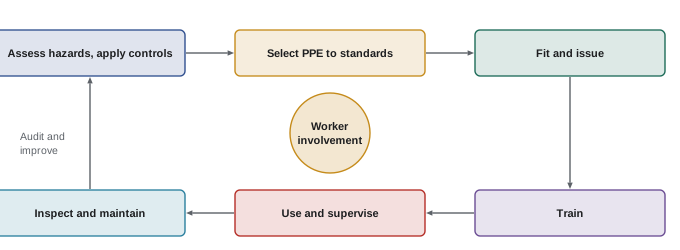
A PPE program usually includes:
- Leadership and responsibilities: a written policy, a program coordinator, and clear roles for managers, supervisors, workers, the joint health and safety committee or representative, and purchasing.
- Hazard assessment: identifying hazards by task and location, applying the hierarchy of controls, and documenting where PPE is still needed.
- Selection: choosing PPE that meets recognized standards, matches the hazards and the work, and is compatible with other PPE.
- Fit and sizing: providing a range of sizes and styles, and fit testing where required.
- Training: teaching workers why PPE is needed, how to use it, its limits and how to care for it.
- Use and enforcement: clear rules on where and when PPE is required, signs, supervision and consistent enforcement.
- Inspection, maintenance and replacement: routine checks, cleaning, storage, repair and replacement schedules.
- Records and evaluation: documentation of assessments, issue, training, fit tests and inspections, and regular audits.
Selecting PPE as a system
PPE items must work together. Combining equipment that was chosen separately often creates new problems: safety glasses that break the seal of earmuffs, earmuffs that do not fit under a welding helmet, a hard hat that cannot accept a face shield, a respirator that pushes goggles out of position, or a full-body harness worn under a high-visibility vest so that the tape bands are hidden. Choosing compatible systems, such as hard hats with slots for earmuffs and face shields, respirators designed to work with specific goggles, and high-visibility harnesses, avoids these conflicts. When selecting PPE, consider the whole ensemble the worker will wear, and try it on together during a trial.
Selection should also consider the work environment and human factors: heat and cold, which affect comfort and wear time; physical effort; communication needs; vision and hearing; the need to move in tight spaces; and the duration of wear. PPE that is uncomfortable, too hot or interferes with the job will be removed, sometimes at the very moment it is needed most. Involving workers in trials of candidate PPE produces better choices and greater acceptance.
| Combination | Common conflict | Solution |
|---|---|---|
| Glasses and earmuffs | Glasses arms break the earmuff seal | Thin-temple glasses or earplugs |
| Hard hat and face shield or earmuffs | No mounting points | Hard hat with accessory slots and matched accessories |
| Respirator and goggles | Goggles push the mask out of position | Full-facepiece respirator or matched goggles |
| Harness and hi-vis vest | Vest hides tape or harness hides vest | High-visibility harness or vest designed for harness use |
| Gloves and dexterity tasks | Thick gloves cause fumbling | Thinner rated gloves or coated knits |
| FR clothing and hi-vis | Non-FR vest can burn | FR-rated high-visibility garments |
Inclusion, sizing and individual needs
PPE has historically been designed around the average male body, and many workers, including women, smaller and larger people, and people from different ethnic backgrounds, have been issued PPE that does not fit. Poorly fitting PPE is not just uncomfortable; it can be dangerous. Oversized gloves catch in machinery, loose coveralls snag, harnesses that are too large allow the wearer to slip out, respirators that do not seal give little protection, and safety footwear in the wrong width causes falls and foot problems. A good program stocks or sources a wide range of sizes and styles, including PPE designed for women's body shapes, and gives workers a way to request PPE that fits.
Individual needs also include religious and cultural practices, such as head coverings and beards; medical conditions, such as latex allergy, skin conditions, hearing loss or limited lung function; prescription eyewear; and pregnancy, which may require changes in protective clothing, harnesses and exposure to certain hazards. The goal is to find PPE and work arrangements that protect the person, using alternatives such as loose-fitting PAPRs, adapted head protection or different tasks where needed, rather than excluding people from work.
Training and competence
Workers must be trained before they use PPE, and the training must be repeated when the PPE, the hazards or the work change, or when a worker shows that they do not understand. Good PPE training covers when PPE is needed; what PPE is needed; how to put it on, adjust, wear and take it off; its limitations; how to inspect, care for, store and dispose of it; and what to do if it is damaged or does not fit. Training should be practical, with hands-on practice and demonstration, and should be in a language and format that workers understand. Supervisors need additional training to recognize hazards, check that PPE is worn correctly and coach workers.
Supervision and enforcement
Rules on PPE only work if they are applied consistently. Supervisors and managers set the tone by wearing required PPE themselves, checking that workers have and use the right equipment, and correcting problems promptly and respectfully. When workers do not wear PPE, it is worth asking why: the equipment may be uncomfortable, hard to get, incompatible with other PPE or with the task, or the worker may not understand the hazard. Solving the underlying problem is more effective than discipline alone, although clear consequences for repeated or deliberate non-compliance are part of a fair program. Visitors and contractors must also be covered by the PPE rules for the areas they enter.
Maintenance, storage and replacement
PPE wears out and becomes damaged. A program sets out how each type of PPE is inspected before use and periodically; how it is cleaned and disinfected; where it is stored; who repairs it, using only approved parts; and when it is replaced, based on manufacturer instructions, service life and condition. Supplies of consumables such as earplugs, disposable gloves, filters and cartridges must be kept stocked so that workers never have to choose between working without protection and stopping work. Storage areas should be clean and convenient, with lockers or bags for individual PPE.
Records
Records show that the program is working and help meet legal requirements. Typical records include hazard assessments and PPE requirements by task; PPE issued to each worker; training records; fit-test records for respirators and, where used, hearing protectors; medical evaluations, kept confidential; inspection records for equipment such as harnesses, SCBA and electrical gloves; and audit findings and corrective actions. Records should be kept for the periods the applicable regulations require and be accessible to those who need them.
In the United States, OSHA requires a written certification of the PPE hazard assessment under 1910.132(d)(2), training certification under 1910.132(f)(4), and fit-test records under 1910.134(m), along with medical records kept under 1910.1020.
Audits and continuous improvement
A PPE program should be reviewed at least once a year and whenever there is an incident, a change in work or new information. Audits combine walk-throughs to observe PPE use and condition, conversations with workers and supervisors, checks of records and supplies, review of injury and near-miss data, and checks that new tasks, materials and equipment have been assessed. The results should lead to actions with owners and deadlines, and the program should look for opportunities to move up the hierarchy of controls, reducing reliance on PPE over time.
Worked problem
Measuring PPE compliance
During a monthly audit, a supervisor observes 40 workers in a fabrication area where safety glasses, hearing protection and safety footwear are required. 38 are wearing safety glasses, 31 are wearing hearing protection correctly, and all 40 wear safety footwear. What are the compliance rates, and what should be done?
Show solution
- Safety glasses: \(38/40 = 95\) %.
- Hearing protection: \(31/40 = 77.5\) %.
- Safety footwear: \(40/40 = 100\) %.
- Hearing protection is the clear gap; talk with the nine workers to find out why, check whether the protectors fit, are comfortable, conflict with glasses, or are hard to get, and whether workers understand the noise hazard.
- Look also at noise control at the source, which reduces reliance on protectors.
Answer: Compliance is 95 % for glasses, 77.5 % for hearing protection and 100 % for footwear; focus improvement efforts on hearing protection and noise reduction.
Capstone case: a maintenance shutdown
A food processing plant schedules a weekend maintenance shutdown. The tasks include: grinding and welding repairs on steel conveyor frames; cleaning a mixing tank with a caustic cleaning solution; replacing a motor in an electrical room where the panel has an arc flash label of 7 cal/cm²; replacing lights on a mezzanine with an unguarded edge 4.5 meters above the floor; and working near forklifts moving parts in the loading area. Planning the PPE for this shutdown draws on every lesson in the course.
- Begin with the hierarchy: lock out and de-energize equipment, including the electrical panel where possible; install temporary guardrails on the mezzanine; ventilate the tank; schedule forklift movements separately from foot traffic; and use local exhaust for welding fume.
- Grinding and welding: safety glasses with side protection under a welding helmet with the correct shade, face shield for grinding, FR clothing with natural-fiber underlayers, leather gloves and sleeves, hearing protection based on noise levels, and respiratory protection based on fume monitoring.
- Tank cleaning: chemical splash goggles and face shield, chemical-resistant gloves and apron or suit selected from permeation data for the caustic solution, chemical-resistant boots, and confined space procedures if the tank is a confined space, including atmospheric testing.
- Electrical room: an electrically safe work condition is the primary control; if work near energized parts is unavoidable, arc-rated clothing and face protection rated at least 7 cal/cm², rubber insulating gloves with leather protectors, Class E hard hat and EH or shock-resistant footwear, with qualified electrical workers only.
- Mezzanine: guardrails are preferred; if they cannot be installed, travel restraint or fall arrest with a calculated clearance, a properly fitted harness, inspected equipment and a rescue plan.
- Loading area: high-visibility apparel of the right class, safety footwear with toe protection, and traffic management.
Each worker should be trained for the specific PPE they will use, fit tested where needed, and checked by supervisors before and during work. After the shutdown, a debrief identifies what worked and what to improve next time.
Course wrap-up
Across this course, you have seen that PPE is the last line of defense: essential when hazards cannot be eliminated or controlled in other ways, but limited by fit, use, maintenance and the worker's ability to wear it. Good PPE decisions come from a hazard assessment, recognized standards, careful selection, proper fit, training and an active program. The same principles apply whether the PPE is a pair of safety glasses or a self-contained breathing apparatus. Remember too that this is an awareness-level course; specific tasks, such as respirator fit testing, arc flash work, confined space entry and fall protection, require additional training and competent supervision.
Purchasing and supply
The purchasing department plays an important role in a PPE program. Purchasing specifications should name the required standard, certification mark and performance ratings, not just a brand or a price, and should list approved models and sizes. Substituting a cheaper or different product without review can quietly break a program, for example by supplying a respirator model on which workers were never fit tested or gloves with a much shorter breakthrough time. A simple rule that any PPE substitution must be approved by the program coordinator prevents many problems.
Involving workers
Workers are often the first to know when PPE is not working: when gloves tear too quickly, glasses fog, earplugs hurt or a harness chafes. Programs that invite this feedback, through safety committees, toolbox talks, trial periods and simple reporting, find and fix problems faster and build trust that PPE decisions are made for the workers' benefit.
Common mistakes
MistakeBuying PPE item by item without checking compatibility.
InsteadSelect the whole ensemble and trial it together.
MistakeStocking only standard male sizes.
InsteadProvide a range of sizes and styles that fit all workers.
MistakeDisciplining non-use without asking why.
InsteadFind and fix the underlying problem, then enforce fairly.
MistakeLetting consumables run out.
InsteadKeep earplugs, gloves and cartridges stocked.
MistakeTreating the PPE program as finished.
InsteadAudit, improve and move up the hierarchy.
Summary and key terms
- PPE works best as a managed program, not separate items.
- Programs include assessment, selection, fit, training, use, maintenance and records.
- PPE items must be compatible as an ensemble.
- Inclusive sizing and individual needs are essential for protection.
- Supervisors set the example and solve the reasons for non-use.
- Audits and records show whether the program works.
- Planning PPE for real work combines every lesson in the course.
- PPE program
- Managed system for providing and maintaining PPE.
- Program coordinator
- Person responsible for running the PPE program.
- Compatibility
- Ability of PPE items to work together.
- Ensemble
- All the PPE a worker wears for a task.
- Inclusive sizing
- Providing PPE that fits a diverse workforce.
- Consumables
- Single-use PPE such as earplugs and disposable gloves.
- Compliance rate
- Share of workers correctly wearing required PPE.
- Audit
- Systematic review of a program.
- Corrective action
- Step taken to fix a problem found.
- Continuous improvement
- Ongoing effort to make the program better.
Practice problems
Work each problem on paper first, then reveal the answer to check.
Name five elements of a PPE program.
Show answer
Assessment, selection, fit, training, use, maintenance, records, evaluation.
Give an example of a PPE compatibility problem.
Show answer
Glasses arms breaking the earmuff seal.
Why does poorly fitting PPE matter?
Show answer
It reduces protection and can create new hazards.
What should happen when workers do not wear PPE?
Show answer
Find out why and fix the cause, then enforce fairly.
Name three PPE records.
Show answer
Hazard assessments, training, fit tests, issue, inspections.
Compliance if 27 of 30 workers wear glasses?
Show answer
90 %.
What is the primary control for electrical work?
Show answer
An electrically safe work condition.
What arc rating is needed at 7 cal/cm²?
Show answer
At least 7 cal/cm².
What is preferred at an unguarded mezzanine edge?
Show answer
Guardrails.
How often should a PPE program be reviewed?
Show answer
At least annually and after incidents or changes.
Lesson quiz · 5 questions
Score 60% or more to complete this lesson.
Create a free account to save your progress, take quizzes and earn a certificate.