
HSE-104 · Lesson 8 of 12 · 26 min
Hand and skin protection
Hands do most of the work in most jobs, and so they are injured more often than almost any other part of the body. Hand injuries include cuts and lacerations, punctures, crushing and amputations, burns from heat and chemicals, vibration injuries, and skin diseases such as dermatitis. Many of these injuries cause lasting disability, because the hand is a complex structure of bones, tendons, nerves and blood vessels packed into a small space. Gloves are the most widely used type of PPE, but they are also among the most misunderstood: no single glove protects against every hazard, a glove that is excellent against one chemical may dissolve in another, and in some situations, such as near rotating machinery, wearing gloves can make an injury more likely. This lesson covers hand hazards, glove materials and constructions, chemical permeation and breakthrough, cut and puncture ratings, selection, skin protection and care, and when gloves should not be worn.
Hand hazards and controls
Hand hazards fall into several groups: mechanical hazards, such as sharp edges, blades, glass, sheet metal, splinters, abrasive surfaces, pinch points, and moving or rotating parts; chemical hazards, such as solvents, acids, bases, oils, cutting fluids, pesticides and wet cement; thermal hazards, such as hot surfaces, molten metal, flames, cold surfaces and cryogenic liquids; electrical hazards; biological hazards, such as blood, body fluids and contaminated materials; vibration from power tools; and radiation. As with all PPE, gloves come after other controls. Machine guards keep hands out of danger zones, tool design such as self-retracting blades reduces cuts, substituting less hazardous chemicals reduces skin exposure, and push sticks, tongs and fixtures keep hands away from blades and hot material.
Glove materials and constructions
Gloves are made from many materials, each with strengths and weaknesses:
- Leather: good for abrasion, sparks, moderate heat and rough handling, as in welding and material handling, but poor against chemicals and cuts from sharp blades.
- Cotton and fabric: light protection against dirt and minor abrasion, and comfortable liners, but little protection against cuts, heat or chemicals.
- Coated knit gloves: a knit shell coated on the palm with nitrile, polyurethane, latex or PVC, giving grip and dexterity for assembly and handling.
- Cut-resistant fibers: high-performance polyethylene, aramid, steel, glass fiber and blended yarns, knitted into gloves or sleeves for handling sheet metal, glass and blades.
- Chemical-resistant materials: nitrile, neoprene, butyl rubber, natural rubber latex, PVC, polyvinyl alcohol (PVA), fluoroelastomer (Viton) and laminated films, each resisting different chemicals.
- Specialty gloves: insulated gloves for heat and cold, aluminized gloves for radiant heat, rubber insulating gloves for electrical work, anti-vibration gloves, and puncture-resistant gloves for needles.
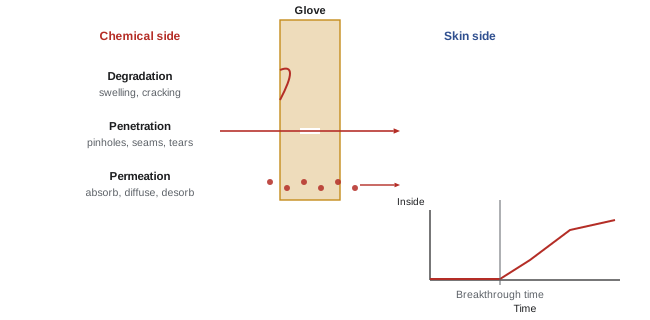
How chemicals get through gloves
Chemicals can pass through glove materials in three ways:
- Degradation: a physical change in the glove caused by the chemical, such as swelling, softening, hardening, cracking or dissolving. A degraded glove may still look whole but no longer protects.
- Penetration: flow of chemical through pinholes, seams, tears, porous material or other imperfections. Leather and fabric gloves allow liquids to penetrate readily.
- Permeation: movement of chemical through an intact glove at the molecular level. The chemical is absorbed into the outer surface, diffuses through the material and desorbs on the inside, often without any visible sign.
Glove manufacturers test their gloves against specific chemicals and publish chemical resistance guides that report three measures: breakthrough time, the time from first contact to detection of the chemical on the inside of the glove; permeation rate, the amount of chemical passing through per unit area per unit time once breakthrough has occurred; and degradation rating, often given as excellent, good, fair or poor. Testing follows standards such as ASTM F739 and EN 16523-1. A glove with a breakthrough time of 480 minutes or more is often considered suitable for a full shift of continuous contact, while one with a breakthrough time of only a few minutes may be suitable only for incidental splash protection and must be removed and replaced immediately after contact.
| Chemical group | Generally better glove materials | Generally poor glove materials |
|---|---|---|
| Ketones (acetone, MEK) | Butyl rubber, laminated film | Nitrile, natural rubber, PVC |
| Aromatic solvents (toluene, xylene) | Fluoroelastomer, PVA, laminated film | Natural rubber, neoprene, butyl |
| Chlorinated solvents | Fluoroelastomer, PVA, laminated film | Nitrile, natural rubber |
| Oils, greases, fuels | Nitrile, neoprene | Natural rubber latex |
| Dilute acids and bases | Nitrile, neoprene, natural rubber, PVC | Leather, fabric |
| Concentrated acids | Butyl, neoprene, fluoroelastomer | Natural rubber, thin nitrile |
| Water-based solutions | Most rubbers; avoid PVA | PVA dissolves in water |
These are broad tendencies and there are many exceptions. Thickness matters: breakthrough time increases roughly with the square of thickness, so a thin disposable nitrile glove may protect for minutes against a chemical that a thicker nitrile gauntlet resists for hours. Mixtures can behave very differently from their components, temperature speeds up permeation, and gloves of the same nominal material from different manufacturers can perform very differently, because of differences in formulation. For these reasons, glove selection for chemicals should always be based on the manufacturer's data for the specific glove model and chemical, and on the safety data sheet.
Worked problem
Choosing a glove using breakthrough times
A technician cleans parts by hand in a tank of a solvent for about 2 hours per day, with continuous hand contact. The manufacturer's guide lists breakthrough times for this solvent as: disposable nitrile (0.1 mm), 4 minutes; nitrile gauntlet (0.38 mm), 75 minutes; neoprene (0.45 mm), 30 minutes; fluoroelastomer (0.3 mm), more than 480 minutes. Which glove should be selected, and what else should be considered?
Show solution
- The task involves continuous contact for 2 hours, or 120 minutes, so the glove must have a breakthrough time well over 120 minutes.
- Disposable nitrile (4 minutes) is suitable only for incidental splash, not immersion.
- Nitrile gauntlet (75 minutes) and neoprene (30 minutes) would break through partway through the task.
- Fluoroelastomer (more than 480 minutes) provides an adequate margin; check also dexterity, grip on wet parts, cuff length to keep solvent out, and cost.
- Consider controls first: a parts washer with brushes, a less hazardous cleaner, or tongs could reduce or eliminate skin contact.
Answer: Select the fluoroelastomer glove with a long cuff, and look at substitution or a parts washer to reduce contact.
Cut, abrasion and puncture ratings
Mechanical performance of gloves is rated using standardized tests:
In the United States, the main voluntary standard is ANSI/ISEA 105, which classifies cut resistance into nine levels from A1 to A9 based on the force in grams needed to cut through the material with a blade in the ASTM F2992 test (A1 at 200 g or more up to A9 at 6,000 g or more), along with ratings for abrasion, puncture, needlestick, heat, cold and vibration. OSHA's 1910.138 requires employers to select hand protection based on the performance characteristics relative to the tasks and hazards identified, but does not mandate a particular standard. Many gloves also carry European EN 388 markings, which give numbers and letters for abrasion, blade cut, tear and puncture, and an ISO cut level from A to F.
Typical guidance is A1 to A3 for light cut hazards such as small parts handling and packaging, A4 to A6 for moderate hazards such as sheet metal, glass handling and metal stamping, and A7 to A9 for severe hazards such as handling sharp metal edges in large quantities or meat processing. Cut-resistant gloves resist slicing by sharp edges, but they are not puncture-proof and do not protect against powered blades such as saws and grinders. Puncture from needles needs a separate needlestick rating, because needles slip between the fibers of cut-resistant yarns.
Selecting gloves
A glove selection process should consider:
- The hazards, identified through the hazard assessment and safety data sheets, including chemicals, cuts, punctures, heat, cold, vibration and biological agents.
- The type and duration of contact: incidental splash, intermittent contact or continuous immersion.
- The parts of the hand and arm at risk: fingertips, palm, back of the hand, wrist or forearm, which determines cuff length and whether sleeves are needed.
- Dexterity, grip and tactile sensitivity needed for the task, because gloves that are too thick or clumsy may be removed or may cause dropped tools and parts.
- Size and fit, because gloves that are too large reduce grip and catch on objects, and gloves that are too tight tire the hands and tear.
- Comfort, heat and sweating, which can cause skin problems and reduce wear compliance.
- Allergies, especially to natural rubber latex proteins and to chemical accelerators used in rubber gloves.
Workers should be involved in trials of candidate gloves, because the best glove on paper is useless if workers will not wear it.
Gloves and rotating machinery
Gloves can be dangerous around machinery with rotating or moving parts, such as drill presses, lathes, milling machines, bench grinders, rollers and conveyors. A glove can be caught by a spinning chuck, a rotating workpiece or an in-running nip point and pull the hand and arm into the machine in a fraction of a second, causing severe injuries or amputation. A bare hand might slip free where a glove wraps and holds. For this reason, many workplaces prohibit gloves when operating such machines, or permit only close-fitting, tear-away gloves for specific tasks after a risk assessment. Long sleeves, jewelry and long hair create the same entanglement risk.
Skin protection and occupational dermatitis
Skin is the body's largest organ and an important barrier, but many substances damage it or are absorbed through it. Occupational contact dermatitis, an inflammation of the skin, is one of the most common occupational diseases. Irritant contact dermatitis is caused by repeated contact with irritants such as water, soaps, solvents, cutting fluids and wet cement, which strip the skin's protective oils. Allergic contact dermatitis is an immune response to substances such as chromates in cement, epoxy resins, nickel, some rubber chemicals and some preservatives, and once a worker is sensitized, even tiny exposures can trigger a reaction. Wet cement is particularly harmful because it is highly alkaline and can cause serious chemical burns, especially when it gets inside boots or gloves.
Some chemicals, such as phenol, some pesticides, methanol and certain solvents, are absorbed through the skin into the bloodstream and can cause systemic poisoning; safety data sheets and exposure limit tables mark these with a skin notation. For these substances, preventing skin contact is as important as controlling inhalation.
Skin protection includes gloves and protective clothing, but also good hygiene and skin care: washing hands with mild cleansers rather than solvents, drying them thoroughly, using moisturizers after work, and checking skin regularly for early signs of dermatitis such as redness, dryness, itching and cracking. Barrier creams have a limited role; they do not replace gloves and can give a false sense of security. Wearing gloves for long periods can itself cause problems, because sweat softens the skin and the occlusion can lead to irritation, so cotton liners and regular glove changes help.
Removing, caring for and replacing gloves
Contaminated gloves must be removed carefully to avoid transferring the contaminant to the skin. For disposable gloves, pinch the outside of one glove at the wrist and peel it off inside out, hold it in the gloved hand, slide a finger of the bare hand under the cuff of the remaining glove and peel it off over the first, then dispose of them and wash the hands. Reusable chemical gloves should be rinsed or decontaminated before removal, then inspected for discoloration, swelling, stiffness, cracks and pinholes, which can be found by inflating the glove with air and checking for leaks. Gloves should be stored away from heat, sunlight and chemicals and replaced on a schedule based on use, or immediately when damaged or contaminated beyond their rated limits. Rubber insulating gloves for electrical work have their own strict inspection and testing requirements, covered in electrical safety courses.
Vibration and cold
Anti-vibration gloves with gel or air-filled padding are sometimes used with power tools, but their effect on the vibration reaching the hand is often small, especially at the lower frequencies that cause most hand-arm vibration injuries, and thick gloves can make workers grip harder. Reducing vibration at the source, limiting exposure time and keeping hands warm and dry, which helps preserve circulation, are more important than gloves alone.
Common mistakes
MistakeAssuming any rubber glove resists any chemical.
InsteadCheck breakthrough data for the exact chemical and glove.
MistakeUsing disposable nitrile for immersion.
InsteadUse thin gloves for splash only; choose thicker rated gloves for immersion.
MistakeWearing gloves at a drill press or lathe.
InsteadKeep hands clear and follow the machine's glove rule.
MistakeRelying on barrier cream instead of gloves.
InsteadUse gloves and skin care together.
MistakePeeling contaminated gloves by grabbing the inside.
InsteadRemove inside out without touching the outer surface.
Summary and key terms
- Hand injuries are common and often cause lasting disability.
- No single glove protects against every hazard.
- Chemicals pass through gloves by degradation, penetration and permeation.
- Select chemical gloves using the manufacturer's breakthrough data.
- ANSI/ISEA 105 rates cut resistance from A1 to A9.
- Gloves can cause entanglement near rotating machinery.
- Skin care and hygiene help prevent occupational dermatitis.
- Degradation
- Physical change in a glove caused by a chemical.
- Penetration
- Flow of chemical through holes or seams.
- Permeation
- Molecular movement of chemical through intact material.
- Breakthrough time
- Time until a chemical is detected inside a glove.
- Permeation rate
- Amount of chemical passing through after breakthrough.
- Cut level
- Rating of resistance to blade cuts.
- Coated knit glove
- Knit shell with a palm coating for grip.
- Contact dermatitis
- Skin inflammation from contact with a substance.
- Skin notation
- Mark showing a chemical can be absorbed through skin.
- Sensitization
- Development of an allergy after exposure.
Practice problems
Work each problem on paper first, then reveal the answer to check.
Name three ways chemicals pass through gloves.
Show answer
Degradation, penetration, permeation.
What is breakthrough time?
Show answer
Time until the chemical is detected inside the glove.
Which glove often suits ketones such as acetone?
Show answer
Butyl rubber.
Why is PVA unsuitable for water-based solutions?
Show answer
It dissolves in water.
How does thickness affect breakthrough?
Show answer
Breakthrough time rises roughly with the square of thickness.
What cut-level range suits sheet metal?
Show answer
About A4 to A6.
Do cut-resistant gloves stop needles?
Show answer
Not necessarily; a needlestick rating is needed.
Why avoid gloves near rotating machinery?
Show answer
They can be caught and pull the hand in.
Why is wet cement harmful to skin?
Show answer
It is highly alkaline and can cause chemical burns and dermatitis.
How do you remove disposable gloves safely?
Show answer
Peel inside out without touching the outer surface, then wash.
Lesson quiz · 5 questions
Score 60% or more to complete this lesson.
Create a free account to save your progress, take quizzes and earn a certificate.