
HSE-104 · Lesson 11 of 12 · 26 min
Fall protection equipment overview and inspection
Falls from height are among the leading causes of workplace deaths in both Canada and the United States, especially in construction, roofing, utilities, telecommunications and maintenance work. Fall protection equipment is personal protective equipment, but it differs from most of the PPE in this course in one important way: it does not just reduce the severity of a hazard, it must catch a falling person and bring them to a stop without causing serious injury, and then allow them to be rescued. That requires a complete system of components that work together, correctly chosen, inspected and used by trained workers. This lesson gives an overview of fall protection equipment, the main rules and standards, the ABCs of a personal fall arrest system, clearance calculations, inspection and care, and rescue planning. It is an introduction only: workers who use fall protection need a dedicated working at heights or fall protection course, with hands-on training by a competent person, which this course does not replace.
The fall protection hierarchy
As with all PPE, personal fall protection equipment is not the first choice. The fall protection hierarchy is:
- Eliminate the hazard: do work at ground level, for example by assembling structures on the ground and lifting them into place, or using extendable tools.
- Use passive protection: guardrails, covers over openings, and safety nets protect everyone without any action by the worker.
- Use travel restraint: equipment that prevents a worker from reaching an unprotected edge, so a fall cannot occur.
- Use fall arrest: equipment that stops a fall after it has begun.
- Use administrative controls: warning lines, safety monitors and controlled access zones, where permitted and only where other methods are not practicable.
Travel restraint is preferred to fall arrest, because it prevents the fall entirely, while fall arrest accepts that the worker will fall and relies on the system to stop them safely.
Rules and standards
In the United States, OSHA requires fall protection in general industry at 4 feet or more under 29 CFR 1910.28, in construction at 6 feet or more under 1926.501, in shipyards at 5 feet, and in longshoring at 8 feet, and at any height over dangerous equipment. Personal fall protection system requirements are in 1910.140 for general industry and 1926.502 for construction (Subpart M). OSHA limits the maximum arresting force on a worker to 1,800 pounds with a body harness, the free fall to 6 feet, and the deceleration distance to 3.5 feet, and requires anchorages for fall arrest to support 5,000 pounds per worker or be designed by a qualified person with a safety factor of at least two. The voluntary ANSI/ASSP Z359 Fall Protection Code sets more detailed requirements, including Z359.11 for full-body harnesses, Z359.13 for energy-absorbing lanyards and Z359.14 for self-retracting devices.
The ABCs of a personal fall arrest system
A personal fall arrest system has three main parts, often remembered as the ABCs:
- A for anchorage: a secure point of attachment, such as a structural member, an engineered anchor or an anchorage connector such as a beam clamp, strap or roof anchor. Anchorages must be strong enough for the forces of a fall, generally 22 kN (about 5,000 lb) for a single worker unless engineered, and positioned to limit free fall and swing.
- B for body support: a full-body harness, which distributes fall forces across the thighs, pelvis, chest and shoulders and keeps the worker upright after a fall. Body belts must not be used for fall arrest because they concentrate forces on the abdomen and can cause serious internal injuries or allow the worker to slip out.
- C for connectors: the components that join the harness to the anchorage, such as energy-absorbing lanyards, self-retracting devices (also called self-retracting lifelines or SRLs), rope grabs on vertical lifelines, and snap hooks and carabiners, which must be self-closing and self-locking.
Some trainers add D for descent and rescue, because a fall arrest system is incomplete without a plan to reach and rescue a fallen worker quickly.
Harnesses, lanyards and self-retracting devices
Full-body harnesses have a back D-ring between the shoulder blades for fall arrest, and may have front D-rings for ladder climbing systems and rescue, side D-rings for work positioning, and shoulder D-rings for confined space retrieval. Harnesses must be sized and adjusted correctly: the back D-ring between the shoulder blades, the chest strap across the middle of the chest, and the leg straps snug enough to allow only a flat hand between the strap and the leg. A loose harness can let the worker slip out or cause injury during arrest.
Energy-absorbing lanyards contain a tear-away pack or a stretch webbing that deploys during a fall to limit the arresting force. They come in fixed lengths, commonly up to 1.8 meters (6 feet), and their deceleration distance must be included in clearance calculations. Self-retracting devices contain a drum of cable or webbing that pays out and retracts as the worker moves and locks quickly when a fall begins, much like a car seatbelt. They limit free fall to a short distance and so need less clearance than lanyards, but they must be used as the manufacturer specifies; some are rated only for overhead anchorage, while leading-edge models are designed for use at foot level where the line may contact a sharp edge.
Clearance and swing fall
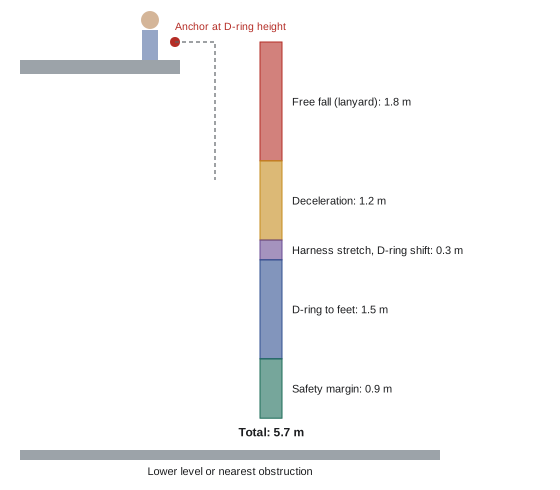
Fall clearance is the vertical distance needed below a worker to arrest a fall without the worker striking the ground, a lower level or an obstruction. It must be calculated before work begins. For an energy-absorbing lanyard anchored at the height of the back D-ring, the calculation adds the free fall distance, the deceleration distance, harness stretch and D-ring shift, the height of the D-ring above the worker's feet, and a safety margin.
Worked problem
Calculating fall clearance with a lanyard
A worker uses a 1.8 m energy-absorbing lanyard attached to an anchor at the height of the back D-ring. The energy absorber's maximum deceleration distance is 1.2 m, allowance for harness stretch and D-ring shift is 0.3 m, the D-ring is 1.5 m above the worker's feet, and a safety margin of 0.9 m is used. The working platform is 5 m above the floor. Is there enough clearance?
Show solution
- Free fall: the lanyard length, 1.8 m, because the anchor is at D-ring height.
- Total clearance: \(1.8 + 1.2 + 0.3 + 1.5 + 0.9 = 5.7\) m.
- Available clearance: 5.0 m.
- Required clearance exceeds available clearance by 0.7 m, so the worker could strike the floor.
- Solutions: raise the anchorage overhead to reduce free fall, use a self-retracting device rated for the application, use a shorter lanyard, or use travel restraint so the worker cannot reach the edge.
Answer: No: 5.7 m is required but only 5.0 m is available, so a different system or anchor position is needed. Detailed clearance calculations belong in a fall protection course.
Swing fall occurs when a worker falls from a position that is not directly below the anchor. The worker swings like a pendulum and can strike structures, columns or the ground, and the swing also increases the vertical distance fallen. Swing falls are minimized by keeping the anchor as close as possible to directly overhead and limiting how far the worker moves sideways from the anchor.
Suspension trauma and rescue
After a fall is arrested, the worker hangs in the harness. Suspension in a harness can restrict blood flow from the legs, causing blood to pool, and within minutes some workers develop dizziness, nausea and loss of consciousness, a condition called suspension intolerance or orthostatic intolerance. For this reason, every workplace that uses fall arrest must have a written rescue plan that can reach a fallen worker quickly, typically within minutes, using equipment and trained people on site rather than relying only on emergency services, which may lack the equipment or arrive too late. Suspension relief straps attached to the harness allow a conscious worker to stand in a loop of webbing and relieve pressure on the legs while waiting for rescue. Fall arrest equipment that has arrested a fall must be removed from service immediately.
Inspection and care
Fall protection equipment must be inspected by the user before each use and by a competent person at regular intervals, often at least annually or more often in harsh conditions, as the manufacturer and the applicable standard require. Inspections should be recorded.
| Component | Look for | Remove from service if |
|---|---|---|
| Webbing (harness and lanyard) | Cuts, frays, burns, chemical damage, discoloration, stiffness | Any cut, burn, broken stitches or significant wear |
| Stitching | Pulled, broken or cut threads; contrasting indicator stitching | Any broken or pulled stitches |
| D-rings and buckles | Cracks, bends, corrosion, sharp edges, smooth operation | Any distortion, cracks or failure to function |
| Snap hooks and carabiners | Gate closing and locking fully, wear, distortion | Gate does not close and lock |
| Energy absorber pack | Tears, partial deployment, damaged cover | Any sign of deployment |
| Self-retracting device | Retraction, locking, line condition, housing damage, fall indicator | Fall indicator showing or locking fails |
| Labels | Present and readable | Missing or unreadable labels |
Equipment should be cleaned with mild soap and water, dried away from direct heat and sunlight, and stored hanging in a cool, dry place away from chemicals, sharp edges and ultraviolet light. Harnesses and lanyards should not be used for any other purpose, such as towing or hoisting, and must not be modified. Many manufacturers specify a maximum service life, and equipment should be retired when it reaches that life or fails inspection.
Ladders, aerial lifts and other situations
Some common situations have specific fall protection requirements. Fixed ladders above certain heights require ladder safety systems or other protection, and older cage-only designs are being phased out in many jurisdictions. Workers in boom-type aerial work platforms generally must wear a harness attached to the manufacturer's anchor in the basket, usually with a short lanyard or travel restraint so they cannot be thrown out, while requirements for scissor lifts vary and often rely on the guardrails. Workers on roofs, scaffolds, towers and steel erection have their own rules and need specialist training.
Work positioning and rope access
Not all fall protection equipment is used for fall arrest. Work positioning systems, such as a pole strap used by a utility worker climbing a wooden pole, or a positioning lanyard attached to the side D-rings of a harness, hold a worker in place so both hands are free for work. Positioning systems are not designed to arrest a fall on their own and are normally used together with a backup fall arrest system. Rope access is a specialized technique in which workers use two independent ropes, a working line and a safety line, to reach and work at heights on buildings, bridges and industrial structures. It requires extensive training and certification under recognized rope access schemes and is well beyond the scope of this course.
Choosing anchorages
Anchorages must be selected and, where needed, designed by competent or qualified people. Typical anchorages include structural steel beams, engineered roof anchors, concrete anchors and permanent horizontal lifelines. Pipes, conduits, ventilation ducts, guardrails, ladder rungs and light fixtures are not suitable anchors unless they have been specifically evaluated, because they may not withstand the forces of a fall. Anchorages should be above the worker where possible, to reduce free fall and swing, and the connecting device should be compatible with the anchor, so that a snap hook cannot roll out of a ring or be loaded across its gate. Horizontal lifelines need engineering design, because the tension in a lifeline during a fall can be many times the force on the worker, and the sag of the line adds to the clearance needed.
Fall protection plans
Many jurisdictions require a written fall protection plan where workers may fall from height, describing the hazards at the site, the fall protection systems to be used, how equipment will be assembled, inspected and dismantled, and the procedures for rescue. The plan should be available at the work location and explained to workers before work begins. Reviewing the plan when conditions change, such as when a building rises a floor or a new contractor arrives, keeps it accurate.
Training for fall protection
Workers who use fall protection must be trained by a competent person in the hazards, the selection and use of equipment, inspection, anchorage selection, clearance, rescue procedures and the limits of each system, and must practice putting on and adjusting harnesses. Refresher training keeps skills current.
Common mistakes
MistakeUsing a body belt for fall arrest.
InsteadUse a properly fitted full-body harness.
MistakeIgnoring clearance below the work.
InsteadCalculate clearance before choosing the system.
MistakeAnchoring far to the side of the work.
InsteadKeep the anchor overhead to limit swing.
MistakeRelying on emergency services for rescue.
InsteadHave a written on-site rescue plan.
MistakeReusing a lanyard after a fall.
InsteadRemove arrested equipment from service.
Summary and key terms
- Falls are a leading cause of workplace deaths.
- Eliminate, guard and restrain before relying on fall arrest.
- OSHA requires fall protection at 4 ft in general industry and 6 ft in construction.
- A personal fall arrest system needs anchorage, body support and connectors.
- Clearance must account for free fall, deceleration, stretch, body height and margin.
- A rescue plan is needed because of suspension intolerance.
- Inspect equipment before each use and remove it after a fall.
- Travel restraint
- System preventing a worker from reaching an edge.
- Fall arrest
- System that stops a fall in progress.
- Anchorage
- Secure point of attachment for fall protection.
- Full-body harness
- Harness distributing fall forces over the body.
- Energy-absorbing lanyard
- Lanyard that limits arresting force.
- Self-retracting device
- Device that pays out line and locks during a fall.
- Free fall
- Distance fallen before the system begins to arrest.
- Fall clearance
- Vertical distance needed below the worker.
- Swing fall
- Pendulum fall from an offset anchor.
- Suspension intolerance
- Effects of hanging motionless in a harness.
Practice problems
Work each problem on paper first, then reveal the answer to check.
Why is travel restraint preferred to fall arrest?
Show answer
It prevents the fall entirely.
At what height does OSHA require fall protection in construction?
Show answer
6 feet.
What are the ABCs?
Show answer
Anchorage, body support, connectors.
Why not use a body belt for fall arrest?
Show answer
It concentrates forces and can cause internal injuries.
Where should the back D-ring sit?
Show answer
Between the shoulder blades.
Clearance for 1.8 + 1.0 + 0.3 + 1.5 + 0.9 m?
Show answer
5.5 m.
How can free fall be reduced?
Show answer
Anchor overhead or use a self-retracting device.
What is swing fall?
Show answer
A pendulum fall from an anchor not directly overhead.
Why is prompt rescue needed?
Show answer
Suspension intolerance can cause unconsciousness.
What happens to a lanyard after it arrests a fall?
Show answer
It is removed from service.
Lesson quiz · 5 questions
Score 60% or more to complete this lesson.
Create a free account to save your progress, take quizzes and earn a certificate.