
GEOM-360 · Lesson 3 of 12 · 21 min
Sound in water
Light travels only meters in harbor water, but sound travels kilometers. That is why every instrument in hydrography, from a fishing boat's sounder to a deep-ocean multibeam, measures depth with sound. It is also why the hydrographer must understand how sound behaves in water: its speed sets the scale of every depth, its bending sets the position of every outer-beam sounding, and its loss sets how deep and how far an instrument can see. On the first morning of the berth survey, before a single line is run, Theo lowers a sound velocity profiler over the side and watches the numbers change with depth.
Sound waves
Sound is a pressure wave: the water is alternately compressed and expanded as the wave passes. Its frequency \(f\) is the number of cycles per second, its wavelength \(\lambda\) the distance between successive compressions, and the two are linked by the sound speed \(c\):
At about 1,500 m/s, a 200 kHz pulse from a shallow-water echo sounder has a wavelength of 7.5 mm, a 12 kHz deep-ocean pulse about 12.5 cm. The frequency matters because it controls three things a surveyor cares about: how fast the signal weakens with distance, how narrow a beam a transducer of a given size can form, and how fine a detail the system can resolve. High frequencies give narrow beams and fine detail but do not reach far; low frequencies reach far but need large transducers for narrow beams and resolve less.
What controls the speed of sound
The speed of sound in water depends on temperature, salinity and pressure (depth). Temperature has the largest effect: in sea water, warming by 1 °C raises the speed by roughly 3 to 4 m/s near 10 °C. Raising salinity by one unit adds about 1.3 m/s, and each 100 m of depth adds about 1.6 m/s through pressure. Typical speeds range from about 1,420 m/s in cold fresh water to over 1,540 m/s in warm, salty tropical water. Several empirical equations give the speed from temperature, salinity and depth; one widely used, compact form is Mackenzie's nine-term equation of 1981:
with \(T\) in °C, \(S\) the salinity and \(D\) the depth in meters. More elaborate equations, such as Chen and Millero's and the UNESCO and TEOS-10 formulations, are used where the highest accuracy is needed; for fresh water, polynomial fits in temperature alone are adequate. In practice, surveyors rarely compute sound speed from temperature and salinity; they measure it directly with a sound velocity profiler, which times a pulse over a short fixed path, or compute it from a CTD instrument that measures conductivity, temperature and depth.
The sound speed profile
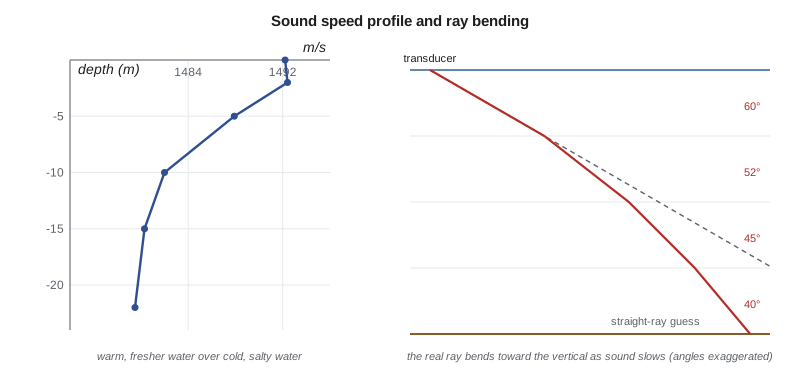
In a harbor, the water column is rarely uniform. In summer, the sun warms the surface layer and river water spreads over the denser sea water as a fresher layer; below lie colder, saltier waters. In Commencement Bay, the Puyallup River discharges at the head of the bay, and its fresher, sediment-laden water spreads over the salt water of Puget Sound, especially during snowmelt and after rain. The result is a sound speed profile that can change by 10 to 20 m/s from the surface to the bottom, and that changes again with the tide, the weather and the time of day as fresher water moves in and out.
Refraction
When sound crosses from water of one speed into water of another, it bends, following Snell's law:
where the angles are measured from the vertical and \(p\) is the ray parameter, constant along the ray. If the speed falls with depth, as in the summer harbor profile, the ray bends toward the vertical; if it rises, the ray bends away. A single-beam sounder looking straight down is unaffected by bending, although it still needs the mean speed to convert time to depth. A multibeam's outer beams, which leave the transducer at 60° or more from the vertical, are strongly affected: to place each sounding correctly, the processing software must trace each ray through the measured profile, layer by layer, accumulating horizontal distance, depth and travel time until the two-way time is used up.
Ray tracing needs two things to be right: the profile through the water column, and the sound speed at the transducer face, which determines the angle at which each beam is formed and launched. Modern multibeams carry a sound speed sensor at the transducer for that second purpose, and the acquisition software uses it in real time for beam steering. Profiles through the column are taken with a profiler lowered from the vessel, or with a moving-vessel profiler that casts a probe on a winch while the launch keeps surveying, as often as the water demands.
import math
def mackenzie(T, S, D):
    """Sound speed in sea water (m/s), Mackenzie (1981): T deg C, S salinity, D depth m."""
    return (1448.96 + 4.591 * T - 5.304e-2 * T ** 2 + 2.374e-4 * T ** 3 + 1.340 * (S - 35)
            + 1.630e-2 * D + 1.675e-7 * D ** 2 - 1.025e-2 * T * (S - 35) - 7.139e-13 * T * D ** 3)
def fresh(T):
    """Sound speed in pure water near the surface (m/s), a polynomial fit in temperature."""
    return (1402.385 + 5.038813 * T - 5.799136e-2 * T ** 2 + 3.287156e-4 * T ** 3
            - 1.398845e-6 * T ** 4 + 2.787860e-9 * T ** 5)

# A harbour cast in summer: fresher, warmer water over cold salty water (illustrative)
cast = [(0, 13.5, 27.0), (2, 13.0, 28.5), (5, 11.0, 30.5), (10, 9.0, 31.5), (15, 8.4, 31.9), (22, 8.1, 32.1)]
prof = [(d, mackenzie(T, S, d)) for d, T, S in cast]
for d, c in prof: print(f"depth {d:4.1f} m   sound speed {c:7.1f} m/s")
print(f"reservoir water at 18 C: {fresh(18):.1f} m/s; at 4 C: {fresh(4):.1f} m/s")

# Ray tracing a 60 degree beam through constant-speed layers (Snell: sin(theta)/c is constant)
def trace(beam_deg, twtt, prof):
    p = math.sin(math.radians(beam_deg)) / prof[0][1]   # ray parameter from the surface speed
    t_left = twtt / 2; x = z = 0.0
    for (d0, c0), (d1, _) in zip(prof, prof[1:] + [(1e9, None)]):
        th = math.asin(min(0.9999, p * c0)); dz = d1 - d0
        dt = dz / (c0 * math.cos(th))
        if dt >= t_left:
            s = c0 * t_left; return x + s * math.sin(th), z + s * math.cos(th)
        x += dz * math.tan(th); z += dz; t_left -= dt
twtt = 0.0560
x, z = trace(60.0, twtt, prof)
cbar = sum(c for _, c in prof) / len(prof)
xs = cbar * twtt / 2 * math.sin(math.radians(60)); zs = cbar * twtt / 2 * math.cos(math.radians(60))
print(f"traced: across-track {x:.2f} m, depth {z:.2f} m")
print(f"straight ray at a single mean speed: across {xs:.2f} m, depth {zs:.2f} m (depth error {zs - z:+.2f} m)")
# A wrong surface sound speed changes the beam's launch angle
for err in (-5.0, +5.0):
    p2 = [(prof[0][0], prof[0][1] + err)] + prof[1:]
    x2, z2 = trace(60.0, twtt, p2)
print(f"surface speed off by {err:+.0f} m/s: depth {z2:.2f} m ({z2 - z:+.2f} m)")depth 0.0 m sound speed 1492.2 m/s depth 2.0 m sound speed 1492.4 m/s depth 5.0 m sound speed 1487.9 m/s depth 10.0 m sound speed 1482.0 m/s depth 15.0 m sound speed 1480.3 m/s depth 22.0 m sound speed 1479.5 m/s reservoir water at 18 C: 1476.1 m/s; at 4 C: 1421.6 m/s traced: across-track 35.85 m, depth 21.08 m straight ray at a single mean speed: across 36.03 m, depth 20.80 m (depth error -0.28 m) surface speed off by -5 m/s: depth 20.88 m (-0.19 m) surface speed off by +5 m/s: depth 21.27 m (+0.19 m)
The summer cast gives speeds from 1,492 m/s at the surface to 1,480 m/s at the bottom. Tracing a 60° beam with a two-way time of 56.0 ms through this profile puts the seabed at 21.08 m depth, 35.85 m across track. A straight ray at the average speed gives 20.80 m, 0.28 m too shallow, more than the vertical allowance of a high-order survey at this depth. An error of 5 m/s in the surface speed alone moves the outer-beam depth by about 0.19 m. The reservoir water, being fresh, carries sound at 1,476 m/s at 18 °C but only 1,422 m/s at 4 °C, so a sounder set up for summer water would read about 4 percent too deep in the cold deep pool.
Recognizing sound speed errors
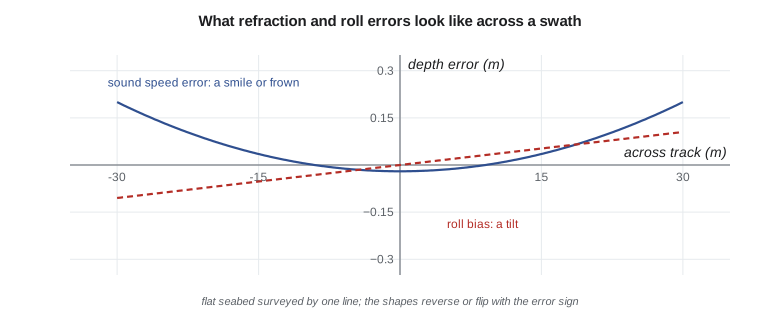
A sound speed error leaves a characteristic signature. Over a flat seabed, a swath processed with the wrong profile curls up or down at its outer edges, forming a smile or a frown in a cross-section. Where adjacent lines overlap, their outer beams disagree, and a gridded surface shows ridges or furrows along each line. Errors that change with time, as the profile changes through the day, produce artifacts that come and go between lines. A roll bias, by contrast, tilts the swath (Lesson 7), and a timing error makes it wobble with the vessel's motion. Learning to read these patterns is one of the first skills a multibeam processor develops, because the cure is different for each.
The cure for sound speed artifacts is more and better profiles. Leah sets a rule for the berth survey: cast at least every two hours, and immediately whenever the surface sound speed sensor departs by more than 2 m/s from the value in the last profile, or when line-to-line comparisons show the outer beams curling. Casts are also taken at both ends of long lines and wherever a river plume or an outfall changes the water. If the data show artifacts after the fact, the processor can sometimes repair them by applying the nearest cast in time or in space, or by refraction correction tools that solve for a profile that makes overlapping swaths agree, but the repair is always weaker than a good profile taken at the time.
Absorption, spreading and noise
Sound weakens as it travels. It spreads over a growing area, losing about 6 dB each time the distance doubles, and it is absorbed by the water, at a rate that grows steeply with frequency: a fraction of a decibel per kilometer at 12 kHz but tens of decibels per kilometer at 200 kHz and well over 100 dB per kilometer at 400 kHz in sea water. The sonar equation balances the transmitted level, the losses on the way out and back, the strength of the echo from the bottom or a target, and the background noise against the level needed for detection. Shallow-water multibeams use 200 to 400 kHz and reach a few hundred meters at most; deep-water systems use 12 to 30 kHz and reach the ocean floor.
The water also scatters sound back toward the transducer. Bubbles from breaking waves and propeller wash, suspended sediment, plankton and fish all return echoes, and a thermocline or a sharp salinity boundary can reflect some energy. Most of this is noise to a bathymetric survey, but some of it carries information: water column imaging is now used to find gas seeps and to check whether a mid-water target is a fish school or the top of an obstruction. Engine noise, flow noise around the hull at high speed, and other sonars on the same vessel add their own interference, which is why transducers are mounted away from propellers and why survey speeds are limited.
Fresh water
The project's reservoir and the Sun River are fresh water, so salinity drops out and temperature dominates. A reservoir in autumn may be nearly uniform after the surface has cooled and the water column has turned over; in summer, a warm surface layer sits on cold deep water, and the speed can drop by 40 m/s or more across the thermocline. In a shallow river the water is usually well mixed, but a tributary or an irrigation return flow can bring water of a different temperature. For the reservoir survey, Grant casts a profiler at the deep pool every morning and afternoon and wherever the surface temperature changes by more than a degree.
Worked problem
Depth from travel time with the right sound speed
A single-beam sounder in fresh water at 6 °C records a two-way travel time of 12.80 ms. The sounder was set for 1,480 m/s. Using 1,427 m/s for the actual speed at 6 °C, find the depth below the transducer and the error the wrong setting causes.
Show solution
- \[d_{\text{true}} = \frac{c\,t}{2} = \frac{1427 \times 0.01280}{2} = 9.13\ \text{m}\]
- \[d_{\text{set}} = \frac{1480 \times 0.01280}{2} = 9.47\ \text{m}\]
- \[\Delta d = 9.47 - 9.13 = 0.34\ \text{m}\]
Answer: The depth is 9.13 m; the wrong setting reads 0.34 m (3.7 percent) too deep.
Common mistakes
MistakeUsing one sound speed profile for a whole day in a harbor with river inflow.
InsteadCast often, and whenever the surface speed changes.
MistakeIgnoring the sound speed at the transducer face.
InsteadIt sets the beam launch angles; a wrong value bends every outer beam.
MistakeTreating a smile in the swath as real seabed shape.
InsteadCheck the profile first; flat seabeds do not curl at every line edge.
MistakeAssuming fresh water has the same speed as sea water.
InsteadFresh water is slower, and temperature controls it strongly.
Summary and key terms
- Sound speed depends mainly on temperature, then salinity and depth; harbor profiles vary by 10 to 20 m/s.
- Speeds are measured directly with profilers or CTDs; equations such as Mackenzie's convert temperature, salinity and depth.
- Snell's law bends rays; multibeam processing traces each beam through the profile.
- Wrong profiles make swaths smile or frown; wrong surface speeds misdirect outer beams.
- Absorption grows with frequency: high frequency for shallow detail, low for depth.
- Fresh water is slower and temperature-controlled; reservoirs stratify in summer.
- Sound speed profile
- Sound speed as a function of depth through the water column.
- Refraction
- The bending of sound rays where the speed changes.
- Ray tracing
- Computing the path of each beam through layers of different sound speed.
- Sound velocity profiler
- An instrument that measures sound speed directly over a short path.
- CTD
- An instrument measuring conductivity, temperature and depth.
- Absorption
- Loss of sound energy to the water, rising steeply with frequency.
- Thermocline
- A layer where temperature, and so sound speed, changes rapidly with depth.
Practice problems
Work each problem on paper first, then reveal the answer to check.
What is the wavelength of a 400 kHz pulse at 1,480 m/s?
Show answer
3.7 mm.
A ray leaves at 50° where c = 1,490 m/s. What is its angle where c = 1,470 m/s?
Show answer
About 49.1°.
Why does a single-beam sounder looking straight down not need ray tracing?
Show answer
A vertical ray does not bend; only the mean speed matters.
What swath shape suggests a sound speed error over a flat seabed?
Show answer
A smile or frown, curling at the outer beams.
Why do deep-water multibeams use low frequencies?
Show answer
Absorption is much smaller at low frequencies.
Lesson quiz · 5 questions
Score 60% or more to complete this lesson.
Create a free account to save your progress, take quizzes and earn a certificate.