
GCP-193 · Lesson 9 of 12 · 17 min
Practice strategy and timing
▶ Video coming soon A video version of this lesson is on the way.
Knowing the material and reading carefully are not enough if the clock runs out with ten questions unread. This lesson is about two connected skills: pacing through the exam, and practicing in a way that builds both knowledge and speed. Owen has never sat a timed certification exam; his last timed test was at college, many years ago. Sofia treats timing as something to rehearse, not something to hope for.
How much time each question gets
The exam allows 2 hours for 50 to 60 questions. Owen does not know in advance which number he will get, so he plans for the harder case: 60 questions in 120 minutes is 2 minutes a question. That sounds generous until one remembers that some questions are long scenarios, some are multiple select, and some need careful elimination. A plan that uses the full 2 minutes for every question leaves no time to review the questions he marks as uncertain.
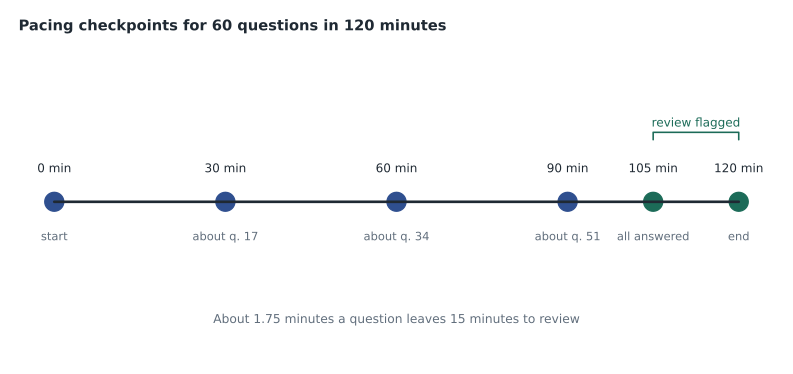
Sofia's plan is to aim for about 1.75 minutes a question on the first pass. At that pace, 60 questions take 105 minutes, leaving 15 minutes to return to marked questions. With 50 questions, the same pace takes about 88 minutes and leaves more than half an hour. Checkpoints turn the pace into something he can check against the timer without doing arithmetic under pressure.
# Pacing checkpoints: aim for a steady pace on the first pass and keep time to review.
exam_minutes = 120
review_minutes = 15
for questions in (50, 60):
    pace = (exam_minutes - review_minutes) / questions      # minutes per question on the first pass
    print(f"{questions} questions: about {pace:.2f} minutes each, first pass ends at minute {exam_minutes - review_minutes}")
    for minute in (30, 60, 90):
        target = int(minute / pace)                          # questions finished by this minute
print(f" by minute {minute:3d}: about question {target}")50 questions: about 2.10 minutes each, first pass ends at minute 105 by minute 30: about question 14 by minute 60: about question 28 by minute 90: about question 42 60 questions: about 1.75 minutes each, first pass ends at minute 105 by minute 30: about question 17 by minute 60: about question 34 by minute 90: about question 51
What this code does
The program takes the 120-minute exam and sets aside 15 minutes at the end for review. For an exam of 50 questions and one of 60, it works out how many minutes each question can have on the first pass, then shows which question number the candidate should have reached at 30, 60 and 90 minutes. Those numbers are the checkpoints to glance at during the exam.
For 60 questions, the checkpoints are about question 17 at 30 minutes, 34 at 60 minutes and 51 at 90 minutes. For 50 questions, with the same 15 minutes kept back, the pace is 2.1 minutes and the checkpoints are about 14, 28 and 42. Owen will see the number of questions on the first screen, so he writes both sets on his plan and will use whichever applies. If he is more than three or four questions behind a checkpoint, he speeds up by marking hard questions for later rather than wrestling with them.
The two-pass method
The method Sofia recommends is two passes. On the first pass, Owen answers every question. If he knows the answer, he chooses it and moves on. If he can narrow it to two options but is not sure, he chooses the more likely one, marks the question for review, and moves on. If he has no idea, he still chooses his best guess and marks it. On the second pass, in the time left, he returns only to marked questions.
| First-pass situation | Action | Why |
|---|---|---|
| Confident | Answer and move on; do not mark | Marking confident answers wastes review time |
| Down to two options | Choose the likelier, mark for review | A later question may jog the memory; the guess still counts if time runs out |
| No idea after a minute | Choose a best guess, mark for review | A blank answer cannot be right; time is better spent on questions you can answer |
| Very long scenario | Read it once carefully; if still stuck after two minutes, guess and mark | Long questions are not worth more than short ones |
Two points matter. First, never leave a question unanswered. Google describes results as pass or fail without describing any penalty for wrong answers, and an unanswered question can only be wrong. Second, every question is worth the same as far as a candidate can tell, so spending five minutes on one long question to save it costs two or three short questions later. Sofia puts it bluntly: "The exam doesn't give extra credit for difficult questions you finally cracked."
Changing answers on review
Should Owen change an answer when he reviews it? Sofia's rule is: change it only for a reason. If on review he notices a qualifier he missed, or another question reminded him of a fact, he changes it. If he simply feels less sure than before, he leaves it. First choices made on the basis of a careful reading are usually better than second guesses made under time pressure, and Owen's practice records will show whether this is true for him.
How to practice
Practice questions serve two purposes: finding gaps and building exam habits. Sofia's practice plan uses three kinds of practice at different stages.
| Kind of practice | When | Purpose |
|---|---|---|
| Untimed sets of 10, with notes allowed | November to February, in each session | Learn the material and the reading method; look up anything unsure |
| Timed sets of 20, without notes | From February, every week | Build pace and recall; 20 questions in 35 minutes |
| Full timed sets of 60, without notes, in one sitting | Saturday, March 20 and Saturday, May 8, as planned | Rehearse the whole exam: pacing, stamina and the two-pass method |
| Google's sample questions | April, as planned | A check of style against Google's own examples |
The full sets are rehearsals of the real thing, so Sofia plans them like the real thing: a Saturday morning at 9:00, the same time as the booked exam; a quiet room at the office; no phone, no notes; a timer set to 120 minutes; and the two-pass method. Afterwards, the most important work begins: reviewing every question, including the ones answered correctly.
Reviewing a practice set
A practice set is only as useful as its review. For each question, Owen records four things: whether he was right, how confident he was (sure, unsure, guess), which section of the guide it belongs to, and, if wrong, why. The why has four possible answers, from lesson 3 and lesson 8: did not know the material, misread the question, chose a look-alike, or ran out of time.
| Result | Confidence | What it means | Action |
|---|---|---|---|
| Right | Sure | Solid knowledge | Nothing; move on |
| Right | Unsure or guess | Lucky; the knowledge is not secure | Review the topic as if it were wrong |
| Wrong | Unsure or guess | A known gap | Study the topic; add to the error log |
| Wrong | Sure | A misconception: something believed that is false | Highest priority: find and correct the false belief |
The last row is the most dangerous. A question answered wrongly with confidence reveals a belief that is false, and false beliefs survive revision because the learner does not know to question them. In November, Owen was sure that Vault kept all deleted mail for 30 days by default. It does not: Vault keeps nothing until rules or holds exist. That one belief, corrected, will save him every question that touches it.
Spacing and mixing
Two study habits make practice work better. Spacing means returning to a topic several times over weeks rather than studying it once in a long session; memories tested again after a gap last longer. Mixing, sometimes called interleaving, means practicing questions from different sections in the same set rather than doing all Gmail questions together; the exam mixes sections, so practice should too, and it forces the reader to work out which topic a question is about before answering it.
Sofia builds both into the weekly sets. Each set of 20 mixes all six sections roughly by weight, and every topic Owen marked as unsure returns in at least three sets over six weeks.
If something goes wrong during the exam
Problems during an exam are rare, but knowing what to do keeps a small problem small. At a testing center, a frozen screen or a noisy neighbor is reported to the staff straight away by raising a hand; they can pause, move or restart the session according to their procedures. In an online exam, the proctor can be reached through the chat in the proctoring software. In either case, Owen should note the time and what happened, because Google's program policies describe how technical problems are handled, and a clear record helps if he needs to ask afterwards. What he must not do is leave the room or the camera's view, use his phone, or try to fix the computer himself.
A different kind of problem is a question that seems wrong: two options look identical, or none seems correct. The right response is to choose the best available answer, mark it, and move on. Arguing with a question in one's head wastes minutes that other questions need. If a question truly seems flawed, candidates can usually leave a comment through the exam interface or contact support afterwards, but the time to do that is not during the first pass.
Stamina
Two hours of concentration is tiring, especially for someone used to working with interruptions. The full practice sets also build stamina. Owen notices on his first timed set of 20 in February that his accuracy drops in the last few questions. Sofia suggests small habits: a deep breath and a moment looking away from the screen at each checkpoint, a steady rhythm rather than bursts, and eating properly before the exam. She also suggests he practice sitting still for two hours, which sounds silly until he realizes how often he gets up at work.
Worked problem
Recovering from a slow start
In his March practice set, Owen reaches the 60-minute checkpoint at question 27 instead of about 34. He has 60 minutes left and 33 questions to go. What should he do?
Show solution
- He is about 7 questions behind the checkpoint.
- With 60 minutes left, 33 questions would take about 1.82 minutes each with no review time.
- Speed up by answering confidently where he can and marking any question that is still unclear after about a minute and a half.
- Drop the plan of keeping 15 minutes for review; aim to finish all questions by about minute 115, keeping 5 minutes.
- In the review afterwards, find which questions took longest and why.
Answer: Speed up, mark more readily, aim to finish by about minute 115, and study afterwards what slowed him down.
Common mistakes
MistakeSpending as long as it takes on each hard question.
InsteadGuess, mark and move on after a set time; every question is worth the same.
MistakeLeaving questions blank to come back to.
InsteadAlways choose an answer before moving on, then mark it if unsure.
MistakeChanging answers on review because of a vague feeling.
InsteadChange an answer only for a reason, such as a missed qualifier.
MistakeReviewing only the questions answered wrongly.
InsteadReview every question, and treat lucky guesses as gaps.
MistakePracticing one section at a time right up to the exam.
InsteadMix sections in practice sets, as the exam does, and space topics over weeks.
Summary and key terms
- Plan for 60 questions in 120 minutes.
- A first-pass pace of about 1.75 minutes a question leaves 15 minutes to review; checkpoints are about question 17, 34 and 51 at 30, 60 and 90 minutes.
- For 50 questions the pace is 2.1 minutes with checkpoints at about 14, 28 and 42.
- Use two passes: answer everything, mark the uncertain ones, then review only those.
- Never leave a question unanswered.
- Change answers only for a reason.
- Practice untimed early, then timed, then full sets in exam conditions.
- Review every question by result and confidence; confident wrong answers reveal misconceptions.
- Space and mix practice, and build stamina.
- Checkpoint
- A question number to have reached by a set minute in the exam.
- First pass
- Going through every question once, answering all and marking uncertain ones.
- Mark for review
- An exam interface feature for flagging a question to return to.
- Misconception
- A false belief, often revealed by a wrong answer given with confidence.
- Spacing
- Returning to a topic several times with gaps, which strengthens memory.
- Mixing (interleaving)
- Practicing questions from different topics together.
- Full timed set
- A practice exam taken in one sitting under exam conditions.
- Error log
- A record of missed and lucky questions with section and reason.
Practice problems
Work each problem on paper first, then reveal the answer to check.
What are the checkpoints for 60 questions at 1.75 minutes each?
Show answer
About question 17 at 30 minutes, 34 at 60 and 51 at 90; all answered by 105.
Why should a question never be left blank?
Show answer
An unanswered question can only be wrong, and Google describes no penalty for wrong answers.
Which practice result has the highest priority, and why?
Show answer
Wrong but sure, because it reveals a false belief.
Lesson quiz · 5 questions
Score 60% or more to complete this lesson.
Create a free account to save your progress, take quizzes and earn a certificate.