
GCP-193 · Lesson 10 of 12 · 17 min
Finding and closing knowledge gaps
▶ Video coming soon A video version of this lesson is on the way.
Owen's marked-up exam guide and his November practice set together give him a rough map of what he knows. This lesson turns that map into a plan: a way to measure gaps by section, to decide where study hours go, and to close each gap so that it stays closed. Sofia's view is that most candidates who fail do not lack ability or effort. They spend their effort on the wrong things, usually the topics they already enjoy.
Three sources of evidence
A gap is something Owen would get wrong on the exam. He has three ways to find gaps, and each catches things the others miss.
| Source | What it shows | Limits |
|---|---|---|
| The marked exam guide | Every consideration marked confident, unsure or never seen | Self-assessment; people overrate what feels familiar |
| Practice question results | Actual right and wrong answers, with confidence and reason | Only covers what the questions happened to ask |
| Explaining a topic aloud | Whether he can explain a setting, when to use it and what it does to users | Takes time; best for topics already marked confident |
The third source is Sofia's favorite. Once a week she picks a consideration Owen marked as confident, such as "Drive trust rules", and asks him to explain it to her as if she were a new administrator: what it does, where it lives, who it applies to, how it differs from its look-alike, and what goes wrong when it is misconfigured. If he hesitates on any of those, the topic moves from confident to unsure. In the first three weeks, five of the twelve topics she picks move.
The error log
Every practice question that Owen gets wrong, or gets right by guessing, goes into an error log: a simple spreadsheet in his own drive. Each row records the date, the source of the question, the guide section and objective, whether he was right, his confidence, the reason if wrong, the correct idea in one sentence, and the date he last retested the idea. The one-sentence correct idea is the most valuable column, because writing it forces him to understand the answer rather than recognize it.
Date        Source      Obj.  Result  Confidence  Reason       Correct idea (one sentence)                                     Retested
2026-11-10  Sofia set 1  3.1  wrong   sure        knowledge    Vault keeps nothing until a retention rule or hold exists.       2026-11-24
2026-11-10  Sofia set 1  2.1  wrong   unsure      look-alike   A filtering relay in front of Gmail is an inbound gateway,       2026-11-24
                                                               not an IP allowlist.
2026-11-10  Sofia set 1  1.4  right   guess       (lucky)      Different people with their own accounts = secondary domain.     -
2026-11-10  Sofia set 1  5.2  wrong   guess       knowledge    Enrolling a browser makes policies follow the computer.          -
After each practice set, Owen sorts the log by section and by reason. The sort by reason shows whether his problem is knowledge, reading, look-alikes or time. The sort by section shows where the knowledge gaps are. In November, his gaps by section looked like this, measured as the share of questions in each section he answered wrongly or only by guessing.
| Section | Weight (about) | Questions in the diagnostic | Wrong or guessed | Gap (share missed) |
|---|---|---|---|---|
| 1. Users, domains and directory | 20 | 8 | 3 | 0.38 |
| 2. Core services | 23 | 5 | 2 | 0.40 |
| 3. Data governance and compliance | 15 | 4 | 2 | 0.50 |
| 4. Security and access | 20 | 6 | 2 | 0.33 |
| 5. Browsers and endpoints | 10 | 3 | 2 | 0.67 |
| 6. Troubleshooting | 13 | 4 | 1 | 0.25 |
Sofia warns that a 30-question diagnostic is a small sample. Three questions about browsers and endpoints cannot measure that section precisely; two misses out of three may be bad luck or may be a large gap. For planning, she suggests smoothing the numbers with judgment and with what the marked guide shows. Section 1 is a good example: the diagnostic says 0.38, but Owen marked almost every section 1 consideration as confident and explained three of them well to Sofia, so he smooths it down. His smoothed estimates, which he will update after each practice set, are: section 1, 0.25; section 2, 0.40; section 3, 0.45; section 4, 0.35; section 5, 0.60; section 6, 0.30.
Deciding where hours go
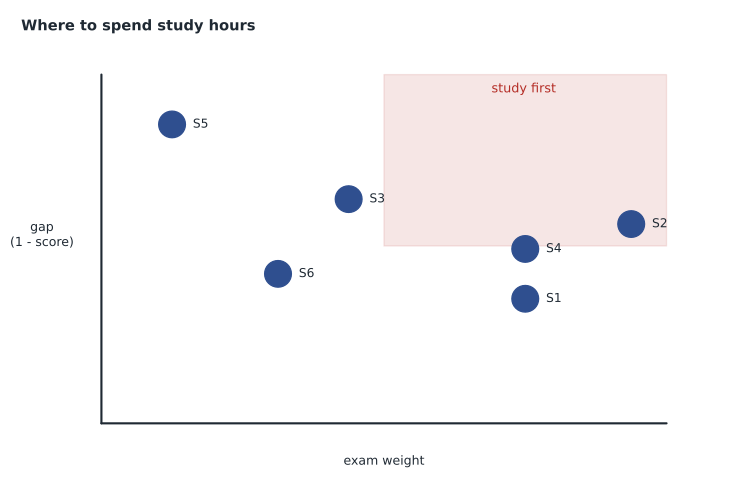
A section deserves study time in proportion to two things: how much of the exam it is, and how much of it Owen is likely to miss. Multiplying weight by gap gives a simple priority score, the expected number of marks at risk per 100 questions. Sharing his available hours in proportion to that score gives a first allocation. Owen expects to have about 60 study hours between now and the exam, outside the hours he spends doing the work itself.
# Share study hours by priority = weight x gap (gap = estimated share missed).
weights = {"S1": 20, "S2": 23, "S3": 15, "S4": 20, "S5": 10, "S6": 13}
gaps    = {"S1": 0.25, "S2": 0.40, "S3": 0.45, "S4": 0.35, "S5": 0.60, "S6": 0.30}
hours_available = 60

priority = {s: weights[s] * gaps[s] for s in weights}
total = sum(priority.values())
for s in weights:
    hours = hours_available * priority[s] / total
    print(f"{s}: weight {weights[s]:2d}, gap {gaps[s]:.2f}, priority {priority[s]:5.2f}, about {hours:4.1f} hours")
print(f"Marks at risk per 100 questions: {total:.1f}")S1: weight 20, gap 0.25, priority 5.00, about 7.9 hours S2: weight 23, gap 0.40, priority 9.20, about 14.6 hours S3: weight 15, gap 0.45, priority 6.75, about 10.7 hours S4: weight 20, gap 0.35, priority 7.00, about 11.1 hours S5: weight 10, gap 0.60, priority 6.00, about 9.5 hours S6: weight 13, gap 0.30, priority 3.90, about 6.2 hours Marks at risk per 100 questions: 37.9
What this code does
The program multiplies each section's exam weight by Owen's estimated gap in that section, which gives a priority: roughly how many marks per 100 questions he is at risk of losing there. It then shares his 60 study hours in proportion to those priorities and prints the hours for each section. The final line adds the priorities to estimate how many marks per 100 he would lose if nothing changed.
The result puts the most hours on section 2, about 14.6, then section 4 (about 11.1), section 3 (about 10.7), section 5 (about 9.5), section 1 (about 7.9) and section 6 (about 6.2). The total at risk is about 37.9 marks per 100, which tells Owen something sobering: if the exam were tomorrow, he would expect to answer only about 62 in every 100 correctly. Google does not publish a passing score, but nobody would want to sit an exam with that estimate.
The allocation is a starting point, not a rule. Section 5 has the biggest gap but a small weight; because its main gap, Chrome browser management, is a narrow topic that has never been studied at all, Sofia expects hours there to close the gap quickly, so the 9.5 hours may be more than needed. Section 2 is broad, so its 14.6 hours will spread thin across seven objectives. After each practice set, Owen updates the gaps and reruns the calculation.
Ways to close a gap
Different gaps need different methods. Sofia matches the method to the reason in the error log.
| Kind of gap | Best method | Example |
|---|---|---|
| Never seen the topic | Read the documentation, then do it in a test environment | Enroll a test Chrome browser and set extension policies for a test OU |
| Seen but fuzzy | Explain it aloud, then write the one-sentence idea | Explain trust rules to Sofia; write how they differ from DLP |
| Look-alike confusion | Write the pair on the card with a clue for each side | Inbound gateway versus IP allowlist |
| Facts and numbers | Short flashcards, spaced over weeks | Admin restore window; log retention; Vault export availability |
| Edition availability | A table of features by edition, built from Google's comparison pages | Which editions include the security center and context-aware access |
| Misreading | Practice the reading method in lesson 3 on more questions | Write the constraint and ask in five words before answering |
Hands-on practice is the strongest method for most Workspace topics, because doing a setting once fixes where it lives and what it changes. Birchline's tenant has a test OU with test accounts that GCP-212 created for the tabletop exercise. Owen may change settings there freely, as long as each change is recorded in the change log and nothing is applied above that OU. For features Birchline's editions do not include, such as some Business Plus or Enterprise Plus capabilities, he uses Google's documentation and its product demonstrations; Google has offered trial tenants for some editions, but Owen checks the current terms before signing up for one, and never uses one for real company data.
A weekly review
Owen ends every week of study with a fifteen-minute review on Friday afternoon. He looks at the hours he spent against the allocation, the error log rows added and closed, and the topics due for retest the following week. Sofia asks him to write one sentence about what worked and one about what did not. In the first weeks, the sentences are about time: work emergencies during the migration push study out of the week. The fix is not more willpower but smaller, fixed slots: forty minutes before work on Tuesdays and Thursdays, booked in his calendar as meetings with himself, which colleagues can see and avoid.
Closing a gap so it stays closed
A gap is closed when Owen answers questions on it correctly, with confidence, after a delay. Getting it right the same day he studied it proves little. So each error log row has a retest date, about two weeks after the correction, and the idea comes back in a practice set then. If he gets it right with confidence, the row is closed. If not, the idea gets a different method and another retest date.
Worked problem
Closing the Chrome browser gap
Owen has never managed Chrome browsers. The guide lists browser policies such as updates and offline access, enrollment, and allowing, blocking or force-installing extensions by OU or group. He has about 9 hours for section 5. How should he use them?
Show solution
- Read the documentation on enrolling browsers with an enrollment token and on user-level management through sign-in, and write the difference in one sentence: about 2 hours.
- In the test OU, enroll one test computer's browser, confirm it appears in the Admin console, and apply an update policy and a block-all-extensions policy with an approved list: about 3 hours.
- Write look-alike lines for managed browser versus managed profile, and for allow, block and force-install: about 1 hour.
- Review mobile device management from GCP-212 with three practice questions: about 1.5 hours.
- Two weeks later, answer 10 mixed section 5 questions and update the gap estimate: about 1.5 hours.
Answer: Read, do it in the test OU, write the look-alikes, review mobile management, then retest after two weeks.
Common mistakes
MistakeStudying the topics that feel interesting.
InsteadAllocate hours by weight times gap, then adjust with judgment.
MistakeTreating a 30-question diagnostic as a precise measurement.
InsteadSmooth small samples with the marked guide and update after each practice set.
MistakeWriting the correct option letter in the error log.
InsteadWrite the correct idea in one sentence, in your own words.
MistakeCounting a topic as fixed after getting it right the same day.
InsteadRetest after about two weeks; close it only when right and confident.
MistakePracticing in the live tenant's top-level OU.
InsteadUse a test OU and record every change in the change log.
Summary and key terms
- Find gaps from the marked guide, practice results and explaining topics aloud.
- Keep an error log with section, result, confidence, reason, a one-sentence correct idea and a retest date.
- Measure the gap in each section as the share missed, smoothing small samples with judgment.
- Priority equals weight times gap; share study hours in proportion to it, then adjust.
- Owen's first allocation puts most hours on section 2, then sections 4, 3, 5, 1 and 6, with about 38 marks per 100 at risk.
- Match the method to the gap: documentation and hands-on practice for new topics, explanation for fuzzy ones, look-alike lines, flashcards for facts, edition tables and reading practice.
- Close a gap only after a delayed, confident retest.
- Gap
- The share of questions in a section a candidate is likely to miss.
- Error log
- A record of missed and lucky questions with the reason and the correct idea.
- Priority score
- Weight multiplied by gap; the marks per 100 questions at risk in a section.
- Smoothing
- Adjusting rough measurements from small samples with judgment and other evidence.
- Retest date
- The date to check a corrected idea again after a delay.
- Test OU
- An organizational unit with test accounts where settings can be tried safely.
- Edition table
- A table of which features each Workspace edition includes.
- Enrollment token
- A value used to enroll Chrome browsers into an organization's Admin console.
Practice problems
Work each problem on paper first, then reveal the answer to check.
What two numbers decide a section's priority?
Show answer
Its weight and the candidate's gap in it.
Why does Sofia distrust a 30-question diagnostic for section 5?
Show answer
Only three questions came from it, too few to measure the gap precisely.
When is an error log row closed?
Show answer
When the idea is answered correctly, with confidence, at a retest about two weeks later.
Lesson quiz · 5 questions
Score 60% or more to complete this lesson.
Create a free account to save your progress, take quizzes and earn a certificate.