
GCP-193 · Lesson 12 of 12 · 18 min
After the exam: results, renewal and next steps
▶ Video coming soon A video version of this lesson is on the way.
The last lesson covers what happens after Owen submits the exam: how results are reported, what to do with a pass, what to do if an attempt fails, how the certification is kept current, and where to go next. It is the shortest part of the journey in time, but decisions made here, such as how to use a failed attempt's report or when to start renewal, have consequences for years. As with the earlier lessons, the details come from Google's certification help pages as we read them in November 2026; check them again when the time comes.
The provisional result
When the exam is submitted, a provisional result appears on the screen: pass or fail. Google's certification help pages explain that the result is provisional because Google then reviews the exam record, including whether the candidate followed the exam terms, before confirming it. They ask candidates to allow 7 to 10 days for official confirmation. In practice, a provisional pass is almost always confirmed, but Owen does not announce a certification until the official confirmation arrives.
Google reports results as pass or fail only. Its help pages say numerical scores are not shared because they are not meaningful to candidates. This surprises people used to exams with a score out of 100, but it fits the purpose of a certification: it says that a person met the standard, not by how much.
| Result | What Google provides | What Owen does |
|---|---|---|
| Provisional pass | Pass on screen; official confirmation after review, allowing 7 to 10 days | Wait for confirmation; write a topic note anyway |
| Official pass | Confirmation, certificate and digital credential through the certification account | Share it as planned; record the expiry date and set reminders |
| Provisional fail | Fail on screen | Write a topic note on the way home; do not rebook in a rush |
| Official fail | Access to a score report by section in the candidate portal's exam history | Use the report and the topic note to rebuild the gap plan |
If the result is a pass
A pass is confirmed in the certification account, which provides a certificate and a digital credential that can be shared, for example on a professional networking profile or in an email signature. The certification is valid for three years from the date it was earned. Owen will add it to his record with Birchline's people and culture team, which tracks certifications for the IT team's development plans.
Sofia suggests three things for the first week after a pass. First, write down the expiry date and set a reminder well before it, because renewal has a window, as below. Second, write a short note for the next Birchline colleague who prepares: which resources helped, which did not, and how long it took, without any exam questions. Third, keep the habits that made the pass possible. The Workspace Updates blog and the release calendar will keep changing the product, and the skills are only valuable if they stay current.
If an attempt fails
A failed attempt is not the end, and it is not unusual. Owen's plan, written now, is to treat a fail as information. The score report by section, which Google's help pages say is available in the exam history for a failed attempt (except for beta and renewal exams), shows how he did in each section relative to the approximate weights. Together with his topic note from the day, it tells him where the gaps were.
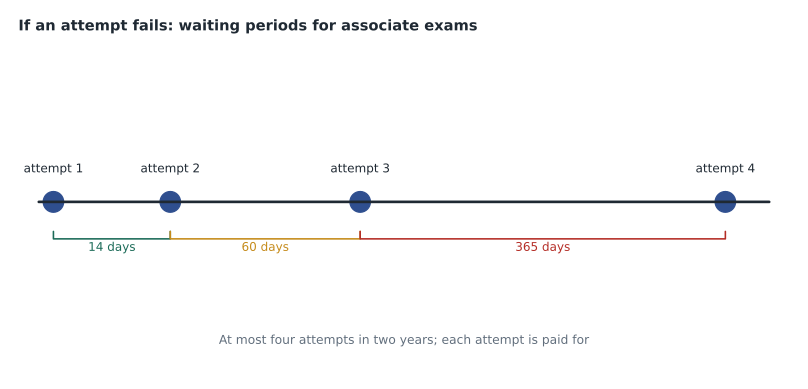
Google's retake policy for associate and professional exams sets waiting periods after each failed attempt and a limit on attempts.
| After | Wait before the next attempt |
|---|---|
| A first failed attempt | 14 days |
| A second failed attempt | 60 days |
| A third failed attempt | 365 days |
| Overall limit | Up to four attempts in two years |
The policy also says that every attempt counts toward the limit whatever the language or delivery method, that each attempt is paid for, and that getting around the rules, for example by registering under another name, can lead to a certification being denied or revoked. The waiting periods are minimums, not targets. Sofia's advice is that if the score report shows several weak sections, Owen should take the time he needs, perhaps six or eight weeks, rather than rebooking for day 15 and risking the longer 60-day wait after a second fail.
Worked problem
Planning a retake
Suppose Owen's first attempt on Tuesday, May 25, 2027 fails. The score report shows section 2 and section 5 well below the others. What is the earliest date he could retake, and how should he plan?
Show solution
- The first waiting period is 14 days: May 25 plus 14 days is Tuesday, June 8, 2027, the earliest possible date.
- Rebuild the gap estimates from the score report and the topic note, and rerun the hour allocation from lesson 10 with the new gaps.
- Estimate the hours needed to close section 2 and section 5; if that is more than two weeks of evenings, choose a later date.
- Book a date that allows at least one full timed practice set after the new study, such as early July.
- Keep the final-week plan from lesson 11 for the new date.
Answer: The earliest retake is June 8, 2027, but a date that allows real study and a full practice set, such as early July, is wiser.
There is one more reason not to rush. A second failed attempt brings a 60-day wait, and a third a full year. The cost of a hasty second attempt is not only the fee; it is time. Owen writes his plan for a possible fail now, while he is calm, so that he does not have to make the decision on the day.
Keeping the certification current
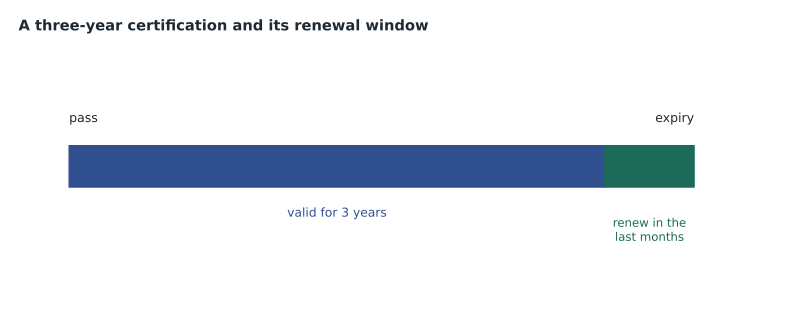
The certification is valid for three years. Google's general certification help pages say candidates are notified before expiry and that associate certifications can be renewed starting 180 days before they expire. For this certification, Google's page in November 2026 described renewal through a learning path on Google's training platform, Google Skills: completing designated courses or skill badges within the final year before the certification expires, after linking the training account to the certification account with the same email address. Google has changed renewal methods for its certifications before, so Owen's note says: read the renewal page again about a year before expiry.
If Owen passes in May 2027, his certification will expire in May 2030. His reminders, written now, are:
| Date (planned) | Reminder |
|---|---|
| May 2029 | One year before expiry: read the current renewal requirements for the certification |
| November 2029 | About 180 days before expiry: confirm the renewal path and start it |
| March 2030 | Two months before expiry: confirm renewal is complete and the new expiry date is recorded |
| May 2030 | Original expiry date |
Renewal is easier for someone who has kept up with the product. Three years is a long time in Workspace: features will have been added, renamed and retired. Sofia's suggestion is a small routine rather than a large effort every three years: skim the Workspace Updates blog each week, read the release notes for anything in his areas, and try new settings in the test OU before they reach Birchline's users.
Next steps
The certification is the end of this program, but not of Owen's learning. Several directions make sense, and the right one depends on where his work goes.
| Direction | Why it fits | Where to start |
|---|---|---|
| Deeper Workspace security | Birchline's security baseline, DLP and incident response will keep growing | Google's security documentation; the security center and investigation tool features in higher editions |
| Google Cloud administration | Owen also works on Birchline's Google Cloud migration and earned Cloud Digital Leader earlier | An associate-level Google Cloud certification such as Associate Cloud Engineer |
| Identity and access | Directory Sync, single sign-on and access policies sit at the center of both Workspace and Cloud | Cloud Identity and identity provider documentation |
| Automation | Repeated tasks such as onboarding can be scripted or built as no-code apps | Apps Script, AppSheet and the Admin SDK Directory API |
| Teaching others | The next Birchline administrator will need what Owen learned | Write runbooks and mentor a colleague, as Sofia did for him |
Sofia does not push him in any direction. She makes one observation: the most valuable thing he built over these four courses is not the certification but the way he works. He now writes a baseline before changing settings, tests on a small group, records changes, measures before deciding, and reads documentation instead of guessing. Those habits transfer to any platform.
Using the credential well
A certification is most useful when the people who need to know about it can see it and trust it. Owen will add it to his professional networking profile with the digital credential link, so anyone can confirm it is genuine and current, and to his CV with the date earned and the expiry date. At Birchline, Sofia suggests he also offer something back: a lunchtime session for the help desk on the troubleshooting order from lesson 7, and a short guide for the next person preparing for the exam. Teaching what he learned is also the best way to keep it.
He should be precise about what the certification says. It shows that he met Google's standard for an associate administrator at the time he passed. It does not say he knows every edition's features today, or that his organization's tenant is well configured. In conversations with managers, auditors or customers, he will describe it accurately and let the work speak for the rest.
Looking back on the program
Over four courses, Owen has gone from an IT generalist who looked after servers and backups to the administrator of a Workspace tenant for 1,100 people. GCP-210 built the directory and licensing. GCP-211 configured the services and the migration path from Exchange. GCP-212 secured the tenant, protected its data and rehearsed an incident. GCP-193 turned that work into an exam plan: the guide and its weights, registration and delivery, reading questions, reviews of all six sections, look-alike pairs, pacing, gap analysis, the final week, and what comes after.
His plan for the next six months fits on one page: migrate the head office in February and the stores in April, follow the study plan, sit two full practice sets in March and May, and take the exam on May 25. Whatever the result, the plan for what follows is already written. Sofia closes the last session with a sentence Owen writes at the top of the page: "The exam measures what you can do on a normal working day. Prepare for that, and the exam takes care of itself."
Common mistakes
MistakeAnnouncing the certification as soon as the provisional pass appears.
InsteadWait for official confirmation, which Google asks candidates to allow 7 to 10 days for.
MistakeRebooking for the earliest date after a fail without new study.
InsteadUse the score report and topic note, close the gaps, and pick a date that allows a full practice set.
MistakeForgetting the expiry date until a reminder arrives.
InsteadRecord it and set reminders a year and about 180 days before.
MistakeAssuming the renewal method will be the same in three years.
InsteadRead the current renewal requirements about a year before expiry.
MistakeTreating the certification as the end of learning.
InsteadKeep up with the Updates blog and release notes, and keep the working habits.
Summary and key terms
- A provisional pass or fail appears when the exam is submitted; Google reviews the record and asks candidates to allow 7 to 10 days for official confirmation.
- Results are pass or fail only.
- After a failed attempt, a score report by section is available in the exam history.
- Retakes for associate exams require waits of 14, 60 and 365 days after the first, second and third failures, with up to four attempts in two years, each paid for.
- The certification lasts three years; renewal can start in a window before expiry, and Google's page in November 2026 described renewal through a Google Skills learning path.
- Next steps include deeper security, Google Cloud administration, identity, automation and teaching others.
- Provisional result
- The pass or fail shown on screen before Google's review confirms it.
- Official confirmation
- Google's confirmation of the result after reviewing the exam record.
- Score report
- A report by section available in the exam history after a failed attempt.
- Retake policy
- Google's rules on waiting periods and attempt limits after failed attempts.
- Waiting period
- The minimum time before the next attempt after a fail: 14, 60 or 365 days.
- Renewal
- Keeping a certification valid beyond its expiry by meeting Google's current requirements.
- Google Skills
- Google's training platform, which hosts renewal learning paths.
- Digital credential
- A shareable online record of a certification.
Practice problems
Work each problem on paper first, then reveal the answer to check.
How long does Google ask candidates to allow for official confirmation?
Show answer
7 to 10 days.
What are the waiting periods after a first, second and third failed attempt?
Show answer
14 days, 60 days and 365 days.
When can an associate certification's renewal start, according to Google's general help pages?
Show answer
Up to 180 days before it expires.
Lesson quiz · 5 questions
Score 60% or more to complete this lesson.
Create a free account to save your progress, take quizzes and earn a certificate.