
GAS-340 · Lesson 5 of 12 · 22 min
Venting and draft problems
▶ Video coming soon A video version of this lesson is on the way.
In March 2026 Rosa took a call from a landlord whose tenants in a basement apartment on Livingston Avenue kept resetting their furnace. It ran in the evening, stopped overnight and showed a flashing code in the morning. The landlord's handyman had already replaced the pressure switch, "because that is what the code said". The new switch made no difference, because the switch had never been the problem. It was reporting faithfully that the furnace could not get rid of its flue gas, and the reason was outside, under three feet of snow that had drifted against the wall where the vent and intake pipes ended.
Venting faults are among the most dangerous on any service call, because the failure that matters is flue gas, and its carbon monoxide, going somewhere it should not. GAS-230 explained how venting works, how to size it and how to test for spillage and depressurization. This lesson is about the faults: how they show up on natural draft, fan-assisted and condensing appliances, how the safety controls respond, and how to find the cause rather than silence the control that is reporting it.
The controls are messengers
Every modern gas appliance has at least one control that watches its venting: a pressure switch on induced-draft and condensing appliances, a spill switch or blocked vent switch at the draft hood of many natural draft appliances, a flame rollout switch at the burner box, and on some boilers a flue gas temperature sensor. Each opens when it detects a sign that flue gas is not leaving properly, and the control board stops the burner. A fault code that names one of these controls tells the technician which messenger has spoken. It does not mean the messenger is broken.
The rule follows from lesson 2: prove a safety control faulty before replacing it, and never bypass one to see whether the appliance runs without it. A pressure switch that is jumpered "for a test" lets the burner fire with no proof of draft, which is how Rosa's January customer in lesson 1 ended up with carbon monoxide in the house. If a switch is tested by jumpering it momentarily under the maker's procedure, the technician stays with the appliance, watches the flame and the flue, and removes the jumper before doing anything else.
Pressure switch faults on induced-draft appliances
A pressure switch closes when the inducer creates enough suction, measured in the switch's tubing, and opens if the suction falls below its set point. When a board reports that the switch did not close, or opened during the run, the technician has to find out whether the switch is wrong or the suction is. The test is a manometer teed into the switch tubing, or connected to the tap the switch reads from, while the inducer runs, compared with the set point printed on the switch.
| Reading at the switch compared with its set point | Likely cause |
|---|---|
| Well above the set point, switch still open | Faulty switch, or wrong switch fitted; check the switch contacts and wiring |
| Below the set point at the switch, good at the tap | Tubing problem: cracked, kinked, water-logged or too long |
| Below the set point at the tap too | Restriction or weak inducer: blocked vent or intake, blocked heat exchanger, inducer wheel or motor failing |
| Good when cold, falls as the run continues | Condensate backing up, ice forming at the termination, or a vent that sags and fills |
| Falls only in wind | Termination exposed to wind; check the maker's termination options |
Worked problem
Is it the switch, the tubing or the vent?
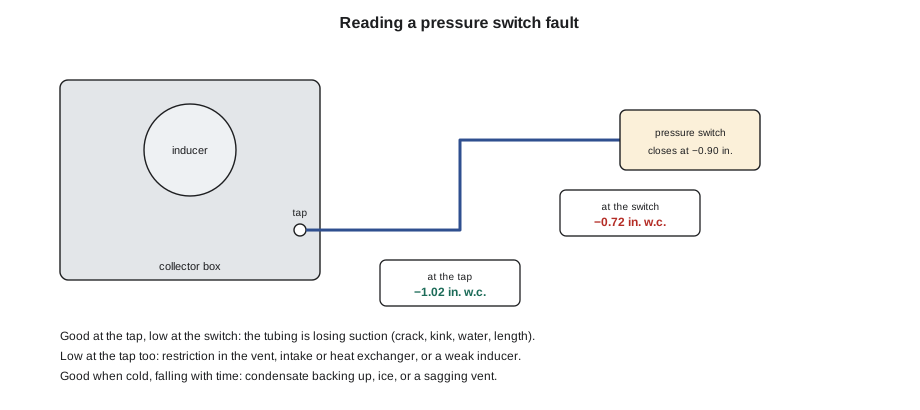
A condensing furnace's pressure switch is marked to close at −0.90 in. w.c. With the inducer running, the manometer reads −0.72 in. w.c. teed in at the switch and −1.02 in. w.c. at the tap on the collector box. Which part is at fault?
Show solution
- At the tap, the suction is strong enough:
- \[1.02 \text{ in.} > 0.90 \text{ in.}\]
- At the switch, it is not:
- \[0.72 \text{ in.} < 0.90 \text{ in.}\]
- The tubing is losing:
- \[1.02 - 0.72 = 0.30 \text{ in. w.c.}\]
Answer: The inducer and the venting are making enough suction, but the tubing between the tap and the switch is losing it. Look for a crack, a kink, a sag full of water or a blocked tap. A new switch would not have helped.
Blocked and restricted terminations
On condensing and direct-vent appliances, the termination outside is the part most likely to block, and winter is when it happens. Snow drifts, ice forming from the appliance's own condensing plume, frost on intake screens, leaves and insect nests in autumn, and pipes crushed by snow sliding off a roof all restrict the vent or intake. The pressure switch opens, the board locks out, and the appliance stops before carbon monoxide becomes a problem, which is the switch doing its job.
The technician checks the terminations from outside before taking anything apart inside. They also check the clearances to grade and to the expected snow line that the maker's instructions and the code require, because a termination that keeps blocking may simply be too low. Raising it, or moving it to a wall with less drifting, is the real repair; clearing the snow only buys time.
The basement apartment
At the apartment on Livingston Avenue, Rosa's door check was clear and the furnace was locked out with a code for the pressure switch. Before touching the furnace she walked around the building. The two-pipe vent and intake ended side by side about 12 in. above grade on a north wall, behind the building, and both were buried in a snowdrift. She dug them out and checked the pipes for ice; the exhaust had a ring of ice inside the elbow. The furnace started at once.
Clearing the snow was the call, but not the repair. The termination was below the height the maker's instructions required above the expected snow level, and drifting on that wall was predictable every winter. Rosa explained to the landlord that the furnace would keep shutting down whenever it snowed, that the shutdown was a safety feature, and that the fix was to raise the termination to the maker's required height with a snorkel kit approved for that furnace, or to move it. She also showed the tenants how to check the pipes from outside after a snowfall, and gave them the office number. The landlord approved the snorkel kit, and Bayline fitted it the following week.
| After a vent or draft fault | Check |
|---|---|
| Terminations clear inside and out, at the maker's heights above grade and snow line | |
| Suction at the switch and at the tap, compared with the set point | |
| Vent slope back toward the appliance, supports and joints | |
| Condensate trap and drain clear (lesson 7) | |
| Spillage test on any natural draft appliance sharing the space (GAS-230) | |
| Combustion analysis: CO air-free within the maker's limit |
Natural draft appliances: spillage and backdrafting
Natural draft appliances, mostly older water heaters, boilers and furnaces with draft hoods, depend on a warm chimney and a house that is not depressurized. Their venting faults show up differently. A spill switch at the draft hood may trip, shutting off the burner, but many older appliances have none, and the first sign is soot around the draft hood, melted plastic on the water heater's top, condensation on windows, a CO alarm, or the occupants' symptoms. GAS-230 set out the spillage and worst-case depressurization tests; on a service call they are done whenever a natural draft appliance is in the area of a fault, and always after a new exhaust appliance, a new air-tight window job or a furnace replacement that leaves a water heater alone in the chimney.
Common causes, in roughly the order they turn up: an exterior or oversized chimney that stays cold because a furnace no longer shares it, a blocked or collapsed chimney or liner, a disconnected or sagging connector, a range hood or other exhaust that depressurizes the house, a furnace's return-air leak that pulls on the appliance's room, and a downdraft at a chimney top in wind. The cure follows the cause: relining, reconnecting, make-up air, sealing a return or replacing the appliance with a direct-vent model. None of them is a new spill switch.
Rollout switches
A flame rollout switch trips when flame comes out of the burner box, where it should never be, and most rollout switches have to be reset by hand. A tripped rollout switch is never just reset and forgotten. Flame rolls out when the flue gas cannot get through the heat exchanger: a blocked secondary heat exchanger on a condensing furnace, a blocked flue passage, soot from a long-running underfired burner, or a cracked heat exchanger that lets the blower push air into the flame. Underfiring from low pressure or overfiring from the wrong orifices can also cause it. The technician finds the cause, and if it cannot be found and fixed the appliance is not left in service; GAS-220's Wentworth case, with a rollout switch jumpered by a handyman and a flue collector half blocked with rust, showed what happens when it is ignored.
Inducers and blocked heat exchangers
When the suction is low at the tap as well as at the switch and the terminations are clear, the fault is somewhere between the burner and the termination: in the heat exchanger, the inducer or the vent pipe itself. The technician checks each in turn. The inducer motor's current is measured with a clamp ammeter and compared with its nameplate. A motor drawing much more than its rating is struggling, perhaps with worn bearings; one drawing much less may have a slipping or broken wheel. The wheel is inspected for rust, a crack or a build-up of debris, and the housing for water, which on a condensing furnace means the condensate is not draining.
A blocked secondary heat exchanger on a condensing furnace is a common cause of low suction on older units. Rust and scale from a corroding primary heat exchanger, debris from a construction site, or biological growth from a dry summer collect in its fins and passages. The result is low suction, a pressure switch that will not close or opens during the run, and on some units flame rollout. GAS-130's Sanford Avenue case was one. Some makers allow the secondary to be flushed; others call for replacement. Either way, the cause of the debris is found, because a primary that is rusting badly enough to block the secondary may itself be failing.
Plastic vent pipe can also block from inside: a sag that fills with water, a joint where pipe has pushed too far into a fitting and narrowed the bore, or a piece of insulation or a nest that found its way in before a cap was fitted. Running a camera through the vent from the termination end, or disconnecting it at the furnace and measuring the suction with the vent off and on, shows whether the vent is the restriction.
| Suction low at tap; terminations clear | Check |
|---|---|
| Inducer current far above nameplate | Bearings, wheel rubbing, restriction downstream |
| Inducer current below nameplate | Slipping or broken wheel |
| Water in the inducer housing | Condensate drain or trap (lesson 7) |
| Suction rises with the vent disconnected | Restriction in the vent pipe |
| Suction still low with the vent disconnected | Heat exchanger passages or inducer |
Wind and downdrafts
Some venting faults come and go with the weather. A pressure switch that opens only on windy days, a natural draft water heater that spills only when the wind blows from one direction, or a pilot that goes out in a gale all point to the terminations. Wind blowing across or into a termination can raise or lower the pressure at it enough to upset the appliance. The maker's instructions usually show approved terminations for exposed walls and roofs, and where an installation keeps failing in wind, changing to one of those, or moving the termination to a sheltered wall within the maker's rules, is the cure. On a chimney, a cap designed to reduce downdrafts may help, and a chimney that is lower than nearby roofs or trees may need to be extended. The technician records the wind direction and strength when the fault happens, because it is the clue that connects the calls.
Common mistakes
MistakeReplacing a pressure switch because the code names it.
InsteadMeasure the suction at the switch and the tap first.
MistakeJumpering a pressure switch to see whether the furnace runs.
InsteadNever leave a safety bypassed; only test under the maker's procedure while watching.
MistakeTaking the furnace apart before looking at the terminations outside.
InsteadCheck the vent and intake outside first, especially after snow.
MistakeClearing snow from a low termination and calling it fixed.
InsteadRaise or move the termination to the maker's heights.
MistakeResetting a rollout switch without finding why it tripped.
InsteadFind the cause; a rollout means flue gas is not getting out.
MistakeIgnoring a natural draft water heater next to a faulty furnace.
InsteadSpillage-test natural draft appliances in the same space.
Summary and key terms
- Venting controls, pressure switches, spill switches, rollout switches and flue sensors, report that flue gas is not leaving properly; they are messengers, not usually the fault.
- A pressure switch fault is diagnosed by measuring suction at the switch and at the tap and comparing with the set point: a big difference means tubing, a low tap reading means a restriction or weak inducer, and a reading that falls with time points to condensate or ice.
- Terminations are checked outside first, and terminations that block in snow are raised or moved.
- Natural draft appliances fail by spillage and backdrafting from cold or blocked chimneys, disconnected connectors and depressurization, and are tested as GAS-230 described.
- A tripped rollout switch means flue gas is not getting through the heat exchanger and its cause must be found.
- Pressure switch
- A switch that proves the inducer is creating enough suction before and during firing.
- Set point
- The pressure at which a switch is made to close or open, printed on it.
- Spill switch
- A temperature switch at a draft hood that shuts off the burner if flue gas spills.
- Flame rollout switch
- A manual-reset temperature switch at the burner box that trips if flame comes out of it.
- Snorkel kit
- A maker-approved kit that raises a vent and intake termination above the snow line.
- Backdrafting
- Flue gas flowing back into a building instead of up the vent.
Practice problems
Work each problem on paper first, then reveal the answer to check.
Why should a pressure switch not be replaced just because its fault code appears?
Show answer
The switch is usually reporting low suction caused by the vent, intake, tubing, condensate or inducer.
Suction at the tap is above the set point, but at the switch it is below. What is at fault?
Show answer
The tubing between the tap and the switch.
What caused the basement apartment's lockouts?
Show answer
Snow drifted over vent and intake terminations that were too low.
What was the real repair there?
Show answer
Raising the termination to the maker's height with an approved snorkel kit.
What does a tripped rollout switch mean?
Show answer
Flame has come out of the burner box because flue gas is not getting through the heat exchanger.
Lesson quiz · 5 questions
Score 60% or more to complete this lesson.
Create a free account to save your progress, take quizzes and earn a certificate.