
GAS-340 · Lesson 1 of 12 · 23 min
The service call: communication and safety
▶ Video coming soon A video version of this lesson is on the way.
On a Tuesday afternoon in late September, with the first cool nights coming and the service board filling up, Rosa Delgado sat Jonah down in the shop with a stack of old work orders. They were her service calls from the previous winter, January to March 2026, each one stapled to her notes, readings and photographs. "Most of what you will do from now until spring is service," she said. "Somebody calls because something is wrong, and you have to find out what, fix it, prove it is fixed and leave the people safer than you found them. The fixing is the easy part. This pile is what the hard parts look like." The first work order on the pile was a no-heat call from a cold Saturday in January, at a two-story house on Karl Road. Its complaint line said only "furnace not working, house cold". The real problem turned out to be carbon monoxide.
This course is about service: finding and fixing faults in gas appliances, from a house furnace to a plant boiler. It draws on everything in the earlier courses: combustion and safety in GAS-110, the codes in GAS-120, electrical work in GAS-130, appliances in GAS-210 and GAS-320, controls in GAS-220, venting and combustion analysis in GAS-230, propane in GAS-240, burner controls in GAS-310 and pressure regulation in GAS-330. It does not teach those again. It teaches how to use them on a call, in order, under pressure, with a customer watching. This first lesson covers the call itself: taking it, arriving, talking with the customer, and keeping yourself and the occupants safe from the moment you reach the door.
Taking the call
A service call starts before the truck leaves. Whoever answers the phone, at Bayline usually Priya Nair at dispatch, asks a short list of questions, and the answers decide how urgent the call is and what the technician should bring. The most important question comes first: is anyone feeling unwell, is a carbon monoxide alarm sounding, or can anyone smell gas? A yes to any of those is not a service call. The caller is told to leave the building, call 911 and Columbia Gas's emergency line from outside, and not to operate switches, phones or appliances inside if they smell gas. The utility and the fire service respond to gas odors and alarms; a contractor's technician may follow, but the caller is never told to wait inside for one.
For an ordinary no-heat or no-hot-water call, the questions are practical:
- What is happening? No heat at all, not enough heat, noise, a smell, water on the floor, a code flashing.
- When did it start, and has it happened before? An intermittent fault that comes back every cold morning points in a different direction from one that started after a power cut.
- What equipment is it? Make, model and age if the caller can read the label, or a photograph by text message.
- Has anyone worked on it recently? A renovation, a new thermostat, a new range hood, a roofer on the roof.
- Who will be there, and is there anything the technician should know? Access, parking, dogs, a sleeping baby, a tenant who needs the landlord's permission.
Good intake saves a wasted trip. A caller who mentions a new kitchen exhaust fan and a water heater that "smells funny" has already told the technician to bring a manometer and to test for spillage before anything else, as GAS-230 explained.
Arriving: safety before diagnosis
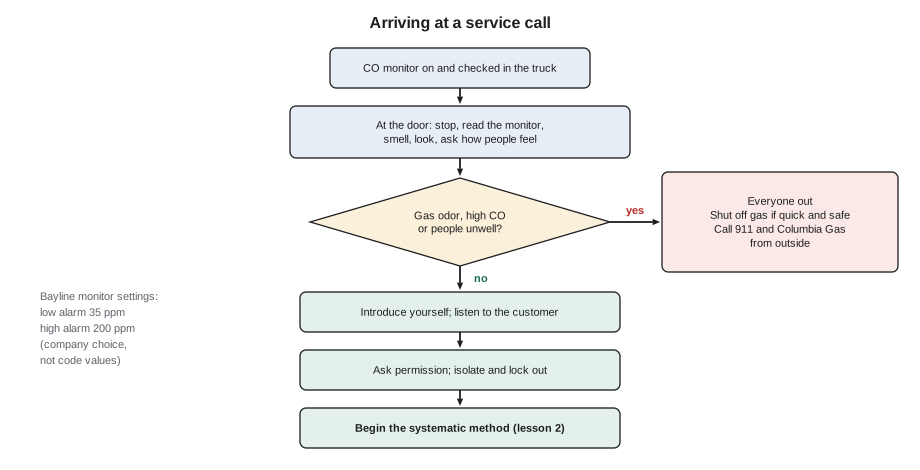
The first minute at the door sets up everything that follows. The technician's personal carbon monoxide monitor is switched on and checked before leaving the truck, clipped to the collar or chest so that it samples the air the technician breathes, not the air at the belt. It goes through the door first. Rosa's habit, which she taught Jonah on his first day, was to stop just inside the door, look at the monitor and wait for it to settle before setting down the tool bag.
Most monitors have two alarm levels. Bayline sets its monitors to give a low alarm at 35 ppm, the NIOSH recommended exposure limit, and a high alarm at 200 ppm. Those settings are a company choice; the monitor's maker and the employer decide them. What the alarms mean on a call is simple. A low alarm in an occupied house means something is producing carbon monoxide and the technician's first job is to find it, with the occupants told and windows opened. A high alarm means everyone leaves, the gas is shut off at the appliance or the meter if that can be done quickly and safely, and 911 and Columbia Gas are called.
| CO reading at the door | What it means | What the technician does |
|---|---|---|
| 0 to a few ppm | Normal background | Carry on, keep the monitor on |
| About 10 to 35 ppm | A source is likely nearby | Tell the occupants, ventilate, look for the source before anything else |
| Above the low alarm | A significant source | Ask about symptoms; occupants outside if unwell; find and stop the source |
| Above the high alarm | Dangerous | Everyone out; shut off gas if quick and safe; call 911 and Columbia Gas |
The monitor is not the only safety check at the door. The technician notices smells: the sharp odorant of gas, the acrid smell of flue gas, the scorched smell of an overheating motor. They notice condensation streaming down windows, which in a heated house in winter can mean a large source of water vapor such as an appliance spilling its flue gas. And they ask the occupants how they feel. Headache, dizziness, nausea and tiredness that ease when people leave the house are the classic signs of carbon monoxide exposure described in GAS-110, and occupants often put them down to a cold or the flu.
Rosa's January call
At the house on Karl Road, Rosa's monitor read 38 ppm at the front door and was still climbing when she reached the kitchen. The house was cold, about 59 °F, and the father, who had called, said the furnace had been "running all night but blowing cold". Two children were watching television on the couch; one had a headache. Rosa asked the family to put on coats and wait on the front porch with the door open, opened two windows, and went to the basement with the monitor held ahead of her. It read 120 ppm beside the furnace, above her high alarm. She turned the furnace's switch off, closed the appliance gas valve, and went back upstairs and outside.
Outside, she called 911 and Columbia Gas and Bayline's dispatch. The fire service arrived, checked the family with their own meters and recommended that the child with the headache be seen by a doctor. Once the house had aired out and the fire crew had cleared it, Rosa went back in to find the cause. The furnace was a 1998 mid-efficiency unit. Its inducer motor had seized, but someone, probably years earlier, had jumpered the pressure switch so that the burners would light with the inducer not running. With no draft, the flue gas had rolled out of the burner box into the basement all night. The furnace had run on its high limit, cycling the burners on and off, which is why the house was cold even though the furnace was "running".
That call is the reason this course starts with safety rather than diagnosis. Nothing about the complaint line said carbon monoxide. Rosa found it because she switched her monitor on before she opened the door, believed it when it alarmed, and put the people first and the furnace second. The jumpered switch and the furnace's condition made it an immediate hazard, which lesson 9 deals with; the furnace was shut off and tagged, and the family had a new one two days later.
Talking with the customer
Once the door check is clear, the technician introduces themselves by name and company, explains what they are there to do, and listens. The customer has information the technician needs: what they noticed, when, what they have already tried. Asking open questions and letting the customer finish is faster than cutting them off with a theory. A good technician also notices what the customer is worried about, which is often not the furnace itself: the cost, the cold, a sick parent, a landlord who will not pay.
Three habits keep the conversation honest. The technician asks permission before going into a room or moving belongings. They explain what they are going to do before doing it, especially anything that will shut off heat or hot water. And they never guess out loud: "I don't know yet; I'll tell you when I do" is better than a confident guess that turns out to be wrong. When the cause is found, the technician explains it in plain words, shows the customer the part or the reading if that helps, and gives the options and the cost before doing work beyond what was agreed. On a tenant's call, the owner or landlord usually has to approve repairs, and the technician records who approved what.
Difficult conversations come with the job. A customer may refuse to have a hazardous appliance shut off, insist on a cheaper repair that will not be safe, or be angry about a previous technician's work. The technician stays calm, explains the hazard plainly, and does not leave a dangerous appliance running to keep the peace. The legal duties described in lesson 9 are not negotiable, and writing down what was said, and what the customer was told, protects everyone.
Protecting yourself on the call
Service work is mostly done alone, in unfamiliar buildings, often at night and in bad weather. The hazards are the ones GAS-110 described, met in an unpredictable order:
- Carbon monoxide and flue gas, handled with the monitor as above and with care when opening a vent or heat exchanger.
- Gas leaks. A leak found on a call is stopped by shutting the nearest valve; a large or unlocated leak is an emergency.
- Electricity. Live testing on a furnace or boiler follows the rules from GAS-130: the right meter and leads, live-dead-live testing, and power isolated before hands go into the cabinet.
- Lockout. Before working on a fan, a pump, a burner or any part that could start, the technician switches off the power at the appliance's disconnect, locks or tags it so that nobody switches it back on, and closes the gas valve. In a house the occupant is told; in a plant or apartment building the owner's lockout procedure is followed.
- Hot surfaces and stored pressure: flue pipes, heat exchangers, boiler water, steam lines and capacitors.
- Access: ladders to roofs, attics and crawlspaces, icy roofs in winter, cramped mechanical rooms. A crawlspace or a boiler pit may be a confined space under the rules in GAS-110.
- People and animals. A technician who feels unsafe because of a person or a dog leaves and calls the office. No call is worth an assault.
Bayline also keeps track of where its technicians are. Priya logs each arrival and departure, and a technician on a night call texts dispatch when they arrive and when they leave. A technician who has not checked in on time gets a phone call.
Worked problem
How much carbon monoxide did Rosa breathe that day?
Rosa's monitor logs readings and calculates her exposure. On the January Saturday it recorded about 20 minutes at an average of 60 ppm while she found the furnace and shut it off, 15 minutes at an average of 30 ppm on later visits into the airing house, and the rest of her 8-hour shift, 445 minutes, at about 2 ppm. What was her 8-hour time-weighted average, and how does it compare with the OSHA limit of 50 ppm and the NIOSH limit of 35 ppm?
Show solution
- The time-weighted average is the sum of each reading times its minutes, divided by the 480 minutes of the shift:
- \[\text{TWA} = \frac{60 \times 20 + 30 \times 15 + 2 \times 445}{480}\]
- \[= \frac{1200 + 450 + 890}{480} = \frac{2540}{480} \approx 5.3 \text{ ppm}\]
- 5.3 ppm is well under both 50 ppm and 35 ppm.
Answer: About 5 ppm averaged over the shift. The limit was not the danger: the danger was the 120 ppm by the furnace, which is why Rosa's high alarm sent her out of the basement at once. Averages protect workers over a career; alarms protect them in the moment.
Before you start: the plan
With the occupants safe, the customer heard and the hazards controlled, the technician makes a plan. It is short: what the complaint is, what equipment is involved, what tests will be done first, and whether the customer will lose heat or hot water while the work is done. In winter, Bayline carries portable electric heaters to lend to customers whose heat will be off for long, and the technician offers one before shutting a furnace down for a repair that will take hours. The method for the diagnosis itself is the subject of lesson 2.
| Before diagnosis | Done? |
|---|---|
| Monitor on, checked, worn near the face | |
| Door check: CO, smell, condensation, how people feel | |
| Introduced; complaint heard in the customer's words | |
| Permission to enter rooms and work on the equipment | |
| Power and gas isolated before hands-on work; lockout where required | |
| Customer told about heat or hot water being off; heater offered |
Common mistakes
MistakeClipping the CO monitor to a belt or leaving it in the bag until the furnace room.
InsteadWear it near the face and switch it on before you reach the door.
MistakeTreating a no-heat call as an ordinary repair when the monitor alarms.
InsteadPeople first: tell them, ventilate, and find the source before anything else.
MistakeTelling a caller who smells gas to wait for the technician.
InsteadTell them to leave and call emergency services and the utility from outside.
MistakeGuessing the cause aloud before testing.
InsteadSay you will explain once you know, then test.
MistakeStarting work on a fan or burner with the power on.
InsteadIsolate power and gas and lock out before hands go into the cabinet.
MistakeLeaving a hazardous appliance running because the customer is upset.
InsteadExplain the hazard plainly and follow the shut-off duties; write down what was said.
Summary and key terms
- A service call starts with intake: dispatch asks about CO alarms, symptoms and gas odors first, and sends anyone with those to emergency services and the utility from outside.
- The technician's personal CO monitor is switched on and checked before the door and worn near the face, and the door check covers the monitor, smells, condensation and how the occupants feel.
- Low and high alarm settings are the employer's choice; a high reading means everyone out.
- The customer is heard in their own words, asked for permission, told before heat is shut off and given plain explanations and costs.
- Technicians protect themselves from flue gas, leaks, electricity, moving parts, hot surfaces, access hazards and unsafe people, isolate and lock out before hands-on work, and check in with dispatch.
- Only then does diagnosis begin.
- Personal CO monitor
- A small instrument worn by the technician that reads and logs carbon monoxide in the air they breathe and alarms at set levels.
- Door check
- The safety checks made on entering a building, before any diagnosis: CO reading, smells, condensation and how the occupants feel.
- Time-weighted average
- An exposure averaged over a work shift, usually 8 hours, used to compare with workplace limits.
- Intake
- The questions asked when a service call is booked, which set its urgency and what the technician brings.
- Lockout
- Isolating and securing an energy source, such as power or gas, so that equipment cannot start while someone works on it.
- Jumpered safety switch
- A safety control bypassed with a wire so the appliance runs without it; always a serious hazard.
Practice problems
Work each problem on paper first, then reveal the answer to check.
A caller says the CO alarm is beeping. What should dispatch tell them?
Show answer
Leave the building and call 911 and Columbia Gas from outside; do not wait inside for a technician.
Where should a personal CO monitor be worn, and when switched on?
Show answer
Near the face, on the collar or chest; switched on and checked before reaching the door.
Name three things the door check includes besides the monitor reading.
Show answer
Smells, condensation on windows and asking how the occupants feel.
What made Rosa's January furnace produce carbon monoxide?
Show answer
Its inducer had seized and the pressure switch had been jumpered, so the burners ran with no draft.
What must be done before working on a fan or burner?
Show answer
Isolate the power and gas and lock out or tag them so nothing can start.
Lesson quiz · 5 questions
Score 60% or more to complete this lesson.
Create a free account to save your progress, take quizzes and earn a certificate.