
GAS-340 · Lesson 12 of 12 · 27 min
Case study: a winter service day
▶ Video coming soon A video version of this lesson is on the way.
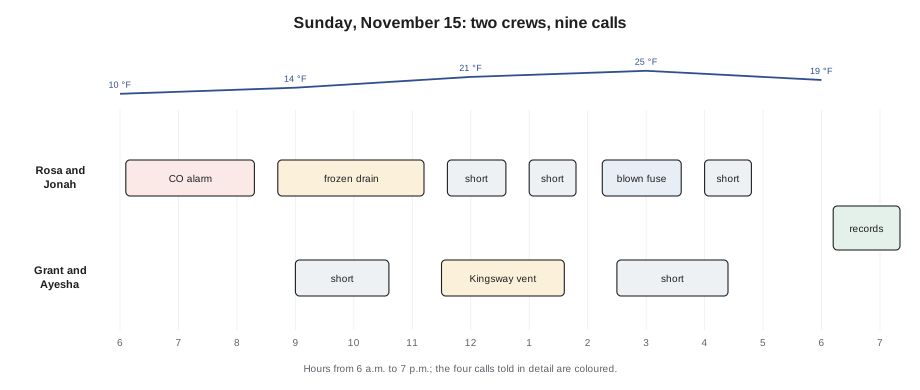
This lesson follows Bayline's on-call crews through one day, Sunday, November 15, 2026, the first hard cold snap of the season. The overnight low was about 10 °F, the first night that cold since March, and by six in the morning Priya Nair, on dispatch from home, had five calls waiting. Rosa Delgado and Jonah Clarke had the residential calls; Grant Whitlock and Ayesha Rahman had the commercial ones. By the end of the day the two crews had answered nine calls between them. Four of them are told here in detail, because between them they use nearly every lesson in this course: the door check and a carbon monoxide call, a frozen condensate line, a regulator problem on a commercial boiler plant, a blown fuse with a cause behind it, unsafe-condition notices, and the records that tie the day together.
6:05 a.m.: the carbon monoxide alarm
The first call came from a family in a 1950s two-story house on Kenwick Road whose CO alarm had gone off at 5:50. Priya asked whether anyone felt unwell; nobody did, but the alarm was still sounding. She told them to get everyone out of the house, call 911 and Columbia Gas from outside, and wait for the fire service. Then she sent Rosa and Jonah.
When Rosa and Jonah arrived at 6:50, the fire crew had ventilated the house and measured 32 ppm in the upstairs hallway before they opened the windows. A Columbia Gas technician had arrived with them, traced the CO to the basement and shut off the boiler and water heater at their valves, leaving a hazard tag on each. The family were in a neighbor's kitchen; the fire crew had checked them and nobody had symptoms. With the fire captain's agreement, Rosa and Jonah went in with their monitors on. Rosa's read 18 ppm at the front door and 26 ppm at the bottom of the basement stairs.
The basement held a 1960s cast-iron atmospheric boiler, 150,000 Btu/h, and a natural draft water heater, both venting into the original masonry chimney. With the fire captain present, Rosa fired the boiler briefly to see what it was doing. Spillage at the draft hood was immediate, a mirror held at the relief opening fogged at once, and her analyzer, held at the opening, read 410 ppm in the spilling gas. The draft at the breeching, with the boiler firing, was only about −0.004 in. w.c., where she would have expected a few times that on a cold morning. She shut the boiler off again.
The chimney had a clean-out door at its base. Jonah opened it and passed the inspection camera up the flue. About 7 ft below the top, the camera met a mass of leaves, twigs and what looked like a squirrel's nest, almost filling the flue. It had probably been built over the summer, when the boiler was off and the water heater's small flue flow barely kept the chimney warm. The first long run of the boiler in the cold snap had met a chimney that could not carry the gas away, and the flue gas had come back into the basement.
Rosa classified both appliances as immediate hazards: they shared the blocked chimney. The Columbia Gas technician's shutoffs and tags stayed in place. Rosa added Bayline's own red tags and wrote the owners a notice that neither appliance was to be used until the chimney was cleared and the venting tested, and she recorded the Columbia Gas tag numbers on the work order. The owners had no heat and no hot water. Jonah brought in two of the truck's portable electric heaters, Rosa explained the next steps, and the owners booked a CSIA-certified chimney sweep for Monday morning. Bayline was booked to come back Monday afternoon to inspect the chimney after cleaning, recommend a cap with a screen, relight both appliances and test them for spillage, all of it a plan at the end of this day.
| Reading at the CO call | Value |
|---|---|
| Fire crew, upstairs hallway, before ventilating | 32 ppm |
| Rosa's monitor at the front door, after ventilating | 18 ppm |
| Rosa's monitor, bottom of the basement stairs | 26 ppm |
| Analyzer at the boiler draft hood relief opening, firing | 410 ppm |
| Draft at the breeching, firing | About −0.004 in. w.c. |
8:40 a.m.: no heat in the townhouse
The second call was a townhouse on Refugee Road with a 2018 two-stage condensing furnace, 60,000 Btu/h, that had stopped some time in the night. Jonah did the door check: 0 ppm. The board was flashing its pressure switch code. Following lesson 5, Rosa sent him outside first. The two-pipe terminations on the back wall were clear of snow and ice. Back inside, Jonah teed his manometer into the switch tubing and then read the tap on the collector box with the inducer running.
Worked problem
What does the pressure switch reading show?
The pressure switch is marked to close at −0.65 in. w.c. Jonah read −0.30 in. w.c. at the switch and −0.30 in. w.c. at the tap on the collector box. Is the fault in the switch, the tubing or upstream of the tap?
Show solution
- At the tap:
- \[0.30 \text{ in.} < 0.65 \text{ in.}\]
- At the switch it is the same, so the tubing loses nothing:
- \[0.30 - 0.30 = 0 \text{ in. w.c.}\]
Answer: The suction is already low at the tap, so the switch and tubing are fine and the restriction is upstream: in the venting, the inducer or the heat exchanger. With clear terminations outside, the next suspect on a condensing furnace on a very cold morning is water.
The condensate trap was full to the top and water was standing in the collector box. The drain line ran from the trap through the wall into the attached garage, along the garage wall and down to a floor drain on the far side. In the garage, where the overnight temperature had fallen to about 16 °F, the line had frozen solid where it sagged between two clips.
Rosa explained to the owner that thawing the line would restore heat, but the next cold night would freeze it again. The proper repair was to keep the condensate in the heated space. The owner agreed, and Jonah, with Rosa checking, fitted a condensate pump beside the furnace, discharging to the laundry standpipe a few meters away, with the pump's overflow switch wired into the furnace's safety circuit as its instructions showed. The garage line was removed and the wall opening sealed. The trap was cleaned and refilled.
| Reading | As found | As left |
|---|---|---|
| Suction at the tap | −0.30 in. w.c. | −1.05 in. w.c. |
| Pressure switch set point | −0.65 in. w.c. | −0.65 in. w.c. |
| Flame signal, high fire | Not reached | 3.2 µA |
| Air-free CO, high fire | Not reached | 16 ppm |
| Overflow switch test | No pump | Furnace stopped when the float was lifted |
11:30 a.m.: the boiler plant
Grant and Ayesha's first commercial call was the Kingsway Senior Apartments, a six-story building with two boilers in a ground-floor mechanical room, fed at 2 psig through a line regulator set to 10 in. w.c.. Boiler 2 had locked out three times since the early morning on its low gas pressure switch, set at 6 in. w.c., and the building's superintendent had reset it each time. Boiler 1 was running.
Ayesha read the regulator outlet with both boilers firing. The pressure would not settle: it swung between about 5.2 and 11.6 in. w.c. every few seconds, and each time boiler 2 drove to high fire the low points dropped below the low gas pressure switch's setting. A hunting regulator pointed to the vent, as lesson 3 explained. The regulator's vent line ran outdoors through the wall and ended, with a screened cap, directly under a balcony. Water dripping from the balcony had frozen over the cap's screen in a solid plug of ice.
Worked problem
Does the cleared regulator now protect the boiler?
With the vent cap cleared of ice, Ayesha read the regulator outlet at 9.6 in. w.c. with both boilers at high fire and 10.8 in. w.c. at lockup. The boiler's low gas pressure switch is set at 6 in. w.c. and its train is rated for a maximum inlet of 14 in. w.c. Check the margins.
Show solution
- Margin above the low gas switch at full load:
- \[9.6 - 6 = 3.6 \text{ in. w.c.}\]
- Margin below the train's maximum at lockup:
- \[14 - 10.8 = 3.2 \text{ in. w.c.}\]
- Droop from the set point at full load:
- \[\frac{10 - 9.6}{10} = 0.04\]
Answer: With the vent clear, the regulator holds steady with a droop of only 4 in 100 and good margins at both ends. The regulator was never faulty; its vent had been frozen shut.
Grant and Ayesha cleared the ice, ran boiler 2 through three cycles at high fire, tested its low gas pressure switch as its maker's procedure described, and recorded the readings. The repair the building needed was a vent termination that dripping water could not reach. Grant recommended in writing that the vent line be extended and turned down clear of the balcony, with a cap of the kind the regulator's maker approved, and the property manager booked it for Tuesday. Until then, the superintendent was shown how to check the cap and asked to call Bayline, not to reset the boiler, if it locked out again. It was not an unsafe condition under the rules in lesson 9, because the low gas pressure switch had done exactly what it was there for, but Grant wrote it up as a fault with a deadline.
2:15 p.m.: the blown fuse
The fourth call was a 2010 furnace in a split-level on Olentangy Boulevard with a dark control board. Rosa let Jonah lead while she watched. He started at the supply, as lesson 6 taught: 120 V at the furnace switch, line voltage on the transformer primary, nothing on the secondary at the board. The board's 3 A fuse was blown. Before fitting a new one, he asked the question the lesson demanded: what drew too much current?
The homeowner had added a bypass humidifier to the furnace's supply duct in October, wired by a handyman to the board's humidifier terminals. Jonah disconnected the humidifier's solenoid valve and measured its coil: 0.9 ohms, where a 24 V coil of its size would normally read tens of ohms. The cable to it had been run against the sharp edge of the duct opening and had chafed through, shorting the coil's leads together. With the humidifier disconnected, he fitted a new fuse, and the furnace started and ran normally.
Worked problem
Is the transformer within its rating without the humidifier?
With the humidifier disconnected and the furnace calling for heat, Jonah measured 0.95 A on the transformer's 24 V side at 24.6 V. The transformer is rated 40 VA. What is its load?
Show solution
- Load in volt-amperes:
- \[0.95 \times 24.6 \approx 23.4 \text{ VA}\]
- Fraction of the rating:
- \[23.4 \div 40 \approx 0.58\]
Answer: The transformer is at about 58 in 100 of its rating, comfortable. A sound humidifier valve, drawing a few tenths of an ampere, would still leave room, so the fault was the chafed cable, not an overloaded transformer.
Rosa had Jonah leave the humidifier disconnected, explain the chafed cable to the homeowner with a photograph, and write a recommendation for the cable to be rerun with a bushing at the duct opening. Before they left, Jonah ran the furnace through three cycles and recorded the flame signal, the temperature rise and the combustion readings, because a no-heat call still ends with proof that the appliance is safe.
The other calls
The day's other five calls were shorter. Two were the basics from lesson 2: a thermostat in a new house set to cool by a child, and a tripped breaker on a furnace circuit shared with a space heater. One was a gas fireplace whose pilot would not light because the owner had turned its gas valve off in the spring. On the commercial side, Grant and Ayesha replaced a seized inducer motor on a unit heater in a car dealership's service bay and found a restaurant's rooftop unit running on a filter so loaded that its limit was tripping; they changed the filters and wrote up a recommendation for the restaurant's maintenance program. None of the five called for an unsafe-condition notice.
6:30 p.m.: closing the day
The day ended at the kitchen tables of the four technicians, closing their work orders on their tablets. Each record carried the readings as found and as left, the photographs, the analyzer files and the customers' signatures. Priya checked them from home and logged the follow-ups. Columbia Gas's tags on the Kenwick Road boiler and water heater would be cleared only after the chimney was cleaned and the appliances retested, and Priya put the call to Columbia Gas on Monday's office list, with Rosa's report. Monday's board already had three return visits: the chimney inspection and relight, the Kingsway vent extension on Tuesday, and a check on the townhouse pump after its first full cold night.
| Call | Lessons used | Outcome at day end |
|---|---|---|
| CO alarm, Kenwick Road | 1, 2, 5, 9, 10 | Boiler and water heater shut off and tagged; sweep and relight planned for Monday |
| Townhouse no heat | 2, 5, 7, 10 | Condensate pump fitted; six cycles verified |
| Kingsway boilers | 2, 3, 10, 11 | Vent ice cleared; vent extension planned for Tuesday |
| Split-level blown fuse | 2, 6, 10 | Humidifier disconnected; recommendation written |
| Five shorter calls | 2, 11 | Basics fixed; one maintenance recommendation |
What the day shows
Read back over the four calls and the same pattern appears in each. The technicians made the call safe before they diagnosed it. They checked the basics and the outside of the building before taking the appliance apart. They took readings and let the readings, not a guess, name the fault. They looked for the cause behind the failed part: a nest behind a blocked chimney, a garage behind a frozen drain, a balcony behind an iced vent, a sharp duct edge behind a blown fuse. They fixed what could be fixed, shut off and tagged what could not, explained it to the people who had to live with it, and wrote it all down. That pattern, more than any single fact in this course, is what a good gas service technician does.
Common mistakes
MistakeResetting a boiler that keeps locking out on its low gas pressure switch.
InsteadFind out why the pressure is falling; the switch is doing its job.
MistakeThawing a frozen condensate line and leaving it in the cold garage.
InsteadKeep the condensate path in the heated space.
MistakeReplacing a blown fuse without finding the short.
InsteadFind what drew the current, as Jonah did.
MistakeRelighting appliances on a chimney that has not been cleared and tested.
InsteadWait for the sweep, inspect, then relight and test for spillage.
MistakeLeaving the records until Monday.
InsteadClose each work order the same day, with readings, photographs and notices.
Summary and key terms
- On one cold Sunday, Bayline's two crews answered nine calls.
- A CO alarm call was made safe with the fire service before diagnosis, and a nest in the chimney was found by spillage testing, a draft reading and a camera; the boiler and water heater were shut off and tagged as immediate hazards with the required notices, and a sweep and relight were planned.
- A condensing furnace's pressure switch fault was traced by tap and switch readings to a frozen condensate line in a garage, fixed by keeping the condensate in the heated space with a pump.
- A boiler's low gas pressure lockouts were traced to a regulator hunting because its vent cap had frozen over, and a vent extension was planned.
- A blown board fuse was traced to a humidifier valve shorted by a chafed cable.
- Each call used the method of this course: safety first, basics, readings, cause, repair or shutoff, explanation and records.
- Cold snap
- A sudden spell of very cold weather, which brings faults in venting, condensate and gas supply to light.
- Clean-out door
- An access door at the base of a chimney for inspection and cleaning.
- Low gas pressure switch
- A switch on a gas train that shuts the burner down if the gas pressure falls below its setting.
- Hunting
- A regulator outlet pressure that swings up and down instead of holding steady.
- Overflow switch
- A float switch on a condensate pump that stops the appliance if the pump's reservoir overflows.
- Return visit
- A planned follow-up visit to complete or verify work.
Practice problems
Work each problem on paper first, then reveal the answer to check.
Why did Rosa classify both the boiler and the water heater as immediate hazards?
Show answer
They shared the blocked chimney, so both would spill flue gas into the house.
What readings proved the townhouse fault was upstream of the pressure switch tubing?
Show answer
The suction was equally low at the tap and the switch, below the set point.
What made the Kingsway regulator hunt?
Show answer
Its vent cap had frozen over with ice from water dripping off a balcony.
What caused the split-level's blown fuse?
Show answer
A humidifier valve whose cable had chafed through on a duct edge, shorting the coil.
What had to happen before the Columbia Gas tags could be cleared?
Show answer
The chimney had to be cleaned and the appliances retested.
Lesson quiz · 5 questions
Score 60% or more to complete this lesson.
Create a free account to save your progress, take quizzes and earn a certificate.