
GAS-340 · Lesson 10 of 12 · 23 min
Documenting service and reporting
▶ Video coming soon A video version of this lesson is on the way.
Hank Morrow keeps a framed work order on the wall above Priya's desk. It is from 2009, written by a technician who no longer works for Bayline, and it reads, in full: "Furnace serviced. OK." Four months later the same furnace was involved in a carbon monoxide call, and the family's insurer asked Bayline what had been checked at that service, what the readings were and whether the water heater beside it had been looked at. Nobody could say. "That piece of paper cost us more than any part we ever sold," Hank told Jonah. "Every work order you write could end up in front of a lawyer, an inspector or the next technician. Write it for them."
This lesson covers the records a gas technician keeps on every service call: the work order, readings as found and as left, photographs, notices of unsafe conditions, combustion printouts and start-up sheets, and what must be reported to whom. Good records protect the customer, who can see what was done; the next technician, who can see what was found; the company, which can prove what it did; and the technician, who is accountable for their own license. They are also how a company learns from its callbacks.
What a service record must show
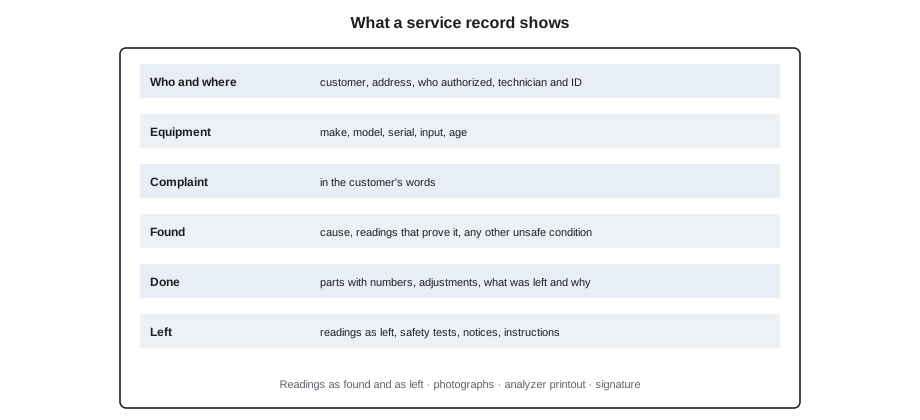
A complete service record answers six questions, in writing, so that someone who was not there can follow it:
- Who and where: customer, address, contact, who was present, who authorized the work, the technician's name and license or ID number.
- What equipment: make, model and serial number of each appliance worked on, its type, input and age.
- What the complaint was, in the customer's words.
- What was found: the cause, with the readings that proved it, and any other unsafe conditions found anywhere on the premises, whether or not they were part of the call.
- What was done: parts replaced, with part numbers; adjustments; what was left for later and why.
- What it was left like: the readings as left, the safety controls tested, the customer's instructions, and any notices given.
Readings are recorded as as found and as left, because the pair shows what the technician changed. A manifold pressure of 3.5 in. w.c. as left means little without the 2.5 in. w.c. as found. Times, dates and the condition each reading was taken under, such as high fire or every appliance on, go with them.
| Reading | As found | As left | Spec |
|---|---|---|---|
| Inlet static / running | 7.0 / 6.5 in. w.c. | 7.0 / 6.6 in. w.c. | 4.5 to 14 in. w.c. |
| Manifold, high fire | 2.5 in. w.c. | 3.5 in. w.c. | 3.5 in. w.c. |
| Clocked input | 67,500 Btu/h | 88,000 Btu/h | 88,000 Btu/h |
| Temperature rise | 40 °F | 56 °F | 45 to 75 °F |
| Flame signal | 3.1 µA | 3.6 µA | Maker minimum 0.8 µA |
| Flue CO air-free / O₂ | 95 ppm / 10.8 | 22 ppm / 7.4 | Maker limit; O₂ as maker states |
Photographs and printouts
A phone camera has made documentation far easier. Bayline technicians photograph the rating plate, the appliance as found, any unsafe condition, the failed part next to its replacement, and the finished work. A photograph of a cracked heat exchanger, a disconnected vent or a rubber hose on a gas line is worth more than a paragraph. Combustion analyzers print or export their readings with the date and time, and the printout or file goes with the record. The rule is that the photograph or printout supports what is written on the work order; it does not replace it.
Privacy matters too. Photographs of a customer's home are taken only of what the work needs, kept in the company's records system rather than a technician's personal phone gallery, and not posted anywhere. Customers' names, addresses and contact details are handled under the company's privacy policy and any state privacy law that applies.
Writing it clearly
Good service notes are short, factual and specific. They say what was measured, not what was felt. Compare two notes written after the same call:
| Weak note | Strong note |
|---|---|
| Furnace not heating. Fixed igniter. Working now. | No heat; board code 1, three failed trials. HSI 115 V at warm-up, open circuit cold. Replaced with maker's igniter, part no. on invoice. 5 cycles OK; flame 3.4 µA; rise 31 °C / 56 °F. |
| Water heater venting bad, told customer. | WH spilling at draft hood, 280 ppm at hood, 14 ppm in basement. Connector separated at thimble. Gas shut off and tagged; written notice given to tenant 10:40; landlord phoned 10:45. Repaired with new connector, 3 screws per joint; spillage test passed. |
| Checked everything, all good. | Annual service: items on checklist completed, readings attached. Second-floor CO alarm past replacement date (made 2014); advised owner in writing. |
Words to avoid are the vague ones: "OK", "good", "checked", "adjusted". Each one hides a number. And notes are written at the time, on site or in the truck before the next call, not at the end of the week from memory. A late entry is marked as late, with the time it was written, and a mistake in a record is corrected by adding a dated correction, never by erasing.
Worked problem
Do the as-found readings explain the complaint?
The record above is from a no-heat-enough call. Before adjustment the furnace clocked 67,500 Btu/h against a plate input of 88,000 Btu/h. What fraction of its rated input was it burning as found, and what did the technician's manifold adjustment do?
Show solution
- Fraction as found:
- \[67{,}500 \div 88{,}000 \approx 0.77\]
- As left:
- \[88{,}000 \div 88{,}000 = 1.00\]
Answer: The furnace was burning only about three quarters of its input because its manifold was set low, which also explains the low temperature rise and the high air-free CO. The as-left readings show the adjustment brought it to its rated input, with the rise back in range and CO well down. The pair of readings tells the whole story.
Reporting
Some findings go beyond the customer and the company, and must be reported:
- Unsafe conditions go to the customer in writing, and to Columbia Gas when Bayline's procedure requires it, as lesson 9 described.
- Incidents: a CO poisoning, explosion or fire involving gas brings in 911 and Columbia Gas, and the company keeps every record for the investigation.
- Permitted work: replacements and new installations need a City of Columbus mechanical permit and inspection, and the work order shows the permit number.
- Workplace injuries and near misses go to the employer, and through the employer to OSHA and the state workers' compensation system where the law requires.
- Manufacturer problems, a defective new part or a failure pattern on a model, go to the maker and, through the company, to the safety authority if a product appears unsafe.
Callbacks and learning from records
A callback, a return visit for a fault the company has already been paid to fix, is expensive and embarrassing, and it is also information. Bayline's office reviews every callback with the technician involved, using the records from the first visit. Most callbacks fall into a few patterns: the cause was not found and a part was swapped; the repair was right but not verified through enough cycles; a second problem was missed; or the customer was not told something they needed to know. Good records make the review quick and fair. Poor records make it a matter of memory and blame.
Records also show patterns across many calls: a model whose igniters fail early, a neighborhood with debris in new gas services, a building whose condensate drains freeze every January. Priya flags those for Hank, and they shape the maintenance programs in lesson 11.
Digital records
Bayline moved to a tablet-based service system in 2023. Technicians fill in the work order, take photographs, attach analyzer files and collect the customer's signature on the tablet, and the record is in the office's system before the truck leaves the driveway. The system will not close a work order without the required readings, and it prompts for an unsafe-condition notice if the technician marks one. Paper still has a place: the written notice of an unsafe condition is printed or written and handed to the customer, and the tag on the appliance is a physical tag. Whatever the format, records are kept for as long as the law, the insurer and the company's policy require, which is longer than most technicians expect.
Start-up sheets and commissioning records
Service records are one kind of record. When a technician installs or replaces an appliance, or puts a commercial appliance back into service after a major repair, a start-up sheet or commissioning record is filled in as well. Most makers supply their own, and warranty claims often depend on it being complete. It records the installation details, the gas pressures, the clocked input, the temperature rise or water temperatures, the combustion readings, the safety control tests and the venting checks, and on commercial burners the flame safeguard tests and the settings of the gas train's switches. A copy is left with the appliance, a copy goes in the company's records, and the maker's copy is sent or uploaded as the maker asks.
On the next service call, that start-up sheet is gold. It shows what the appliance did when it was new and set up correctly, so a technician can compare today's readings with the original ones. A furnace whose temperature rise has climbed 15 °F since start-up has lost airflow; a boiler whose stack temperature has climbed has fouled; a burner whose CO has crept up has drifted. Good technicians look for the start-up sheet before they start testing.
Time on the work order
Service work is usually billed by time, and the work order records it: arrival, departure and travel, to the quarter hour or as the company's policy says. Accurate times protect the customer from overcharging and the technician from questions later. Time spent on a return visit for a callback is recorded too, so that the office can see what callbacks cost. And time spent waiting, for the utility, the fire service or an owner's approval, is recorded with the reason.
Worked problem
How long was the call?
A technician arrived at 9:47 and left at 11:52, and the company bills in quarter hours, rounding each call up to the next quarter hour. How long was the call, and how much time is billed?
Show solution
- Time on site:
- \[11{:}52 - 9{:}47 = 2 \text{ h } 5 \text{ min}\]
- Rounded up to the next quarter hour:
- \[2 \text{ h } 15 \text{ min} = 2.25 \text{ h}\]
Answer: Two hours and five minutes on site, billed as 2.25 hours under the company's rounding rule. The actual times go on the work order, so anyone can see how the billed time was worked out.
Records that protect the technician
Records protect the person who writes them. A technician's license is personal, and an inspector, an insurer or a court that looks into an incident will ask what that technician found and did. A clear, dated record made at the time, with readings, photographs and the notices given, is the best evidence a technician can have that they did the job properly and told the customer what they needed to know. Hank's framed work order makes the point from the other side: a record that says nothing proves nothing.
Records for commercial customers
Commercial customers usually need more than a work order. A building's owner or property manager may want a monthly or seasonal report summarizing every visit, every finding and every recommendation across all their equipment, and their insurer may ask for it. Boiler logs, combustion test records, flame safeguard test results and the dates of safety control tests are kept for each appliance, and the technician's entries are signed and dated. A clear trail of records is often what persuades an owner to approve a repair: a report showing that a boiler's stack temperature has climbed every month since October, or that a rooftop unit's limit has tripped twelve times in a season, is evidence a property manager can take to their budget meeting.
The habit is simple to state and hard to keep on a busy day: write the record before you start the truck. A record written in the driveway, with the readings still on the instruments and the customer's words still fresh, is accurate. One written that evening from memory is not.
Common mistakes
MistakeWriting "serviced, OK".
InsteadWrite what was measured, found and done, with numbers.
MistakeRecording only as-left readings.
InsteadRecord as found and as left, with the conditions.
MistakeWriting up the call at the end of the week.
InsteadWrite it on site or in the truck, and mark late entries.
MistakeErasing a mistake in a record.
InsteadAdd a dated correction.
MistakeLeaving out an unsafe condition because it was not part of the call.
InsteadRecord every unsafe condition found and the notice given.
MistakeKeeping customer photographs in a personal phone gallery.
InsteadStore them in the company system, and photograph only what the work needs.
Summary and key terms
- A service record shows who and where, what equipment, the complaint, what was found with the readings that prove it, what was done and how it was left, with readings as found and as left and the conditions they were taken under.
- Photographs and analyzer printouts support the written record.
- Notes are short, factual and specific, written at the time, and corrected by dated additions.
- Unsafe conditions, gas occurrences or incidents, permitted work, workplace injuries and product problems are reported to the people the law and procedures name.
- Callbacks are reviewed from the records, and patterns across records shape maintenance programs.
- Records are kept as long as the law, insurers and company policy require, and customers' privacy is protected.
- Work order
- The record of a service call: customer, equipment, complaint, findings, work done and readings.
- As found / as left
- Readings taken before and after the technician's work, which together show what was changed.
- Callback
- A return visit to fix a fault the company was already paid to fix.
- Occurrence report
- A report of a gas-related CO poisoning, asphyxiation, explosion or fire to the safety authority.
- Dated correction
- An added, dated note that corrects a record without erasing the original.
- Combustion printout
- The dated record of an analyzer's readings, kept with the work order.
Practice problems
Work each problem on paper first, then reveal the answer to check.
What six questions should a service record answer?
Show answer
Who and where, what equipment, the complaint, what was found, what was done and how it was left.
Why record readings as found as well as as left?
Show answer
The pair shows what the technician changed and why.
What is wrong with the note "Checked everything, all good"?
Show answer
It hides every reading and finding behind vague words.
Who is called after a CO poisoning involving gas?
Show answer
911 and Columbia Gas, with every record kept for the investigation.
How is a mistake in a record corrected?
Show answer
By adding a dated correction, never by erasing.
Lesson quiz · 5 questions
Score 60% or more to complete this lesson.
Create a free account to save your progress, take quizzes and earn a certificate.