
FIN-201 · Lesson 8 of 12 · 28 min
Estimating project cash flows and taxes
A capital budgeting decision is only as good as the cash flow forecast behind it. The decision rules of lesson 7 tell us to discount a project's cash flows, but which cash flows? This lesson sets out the principles for identifying the cash flows that belong in the analysis, shows how to build a project's free cash flows year by year, and explains how taxes, especially the tax deductions for capital spending, change the result. The tax rules differ sharply between Canada and the United States, so this lesson uses each country's system on its own site. Nothing here is tax advice; rules change often, and real projects need current rules and professional advice.
Incremental cash flows
The cash flows that matter are incremental: the difference between the firm's cash flows if it takes the project and its cash flows if it does not. Every item in the analysis should pass that test. Several common traps follow from it. Sunk costs, money already spent and unrecoverable whatever the decision, are irrelevant: a market study paid for last year should not count against the project. Opportunity costs are relevant: if the project uses land the firm already owns, the cash the firm could get by selling or renting that land is a cost of the project, even though no check is written. Side effects matter: a new product that takes sales from an existing one (cannibalization) should be charged with the lost profit, while one that boosts sales of other products should be credited with the gain. Allocated overhead counts only to the extent that the project actually increases it.
Financing costs are excluded from project cash flows. Interest, debt repayments and dividends are payments to investors, and the required return of those investors is captured in the discount rate, the weighted average cost of capital developed in lesson 11. Subtracting interest from the cash flows and also discounting at a rate that includes the cost of debt would count it twice. Finally, be consistent about inflation, as lesson 3 explained: if revenues and costs are forecast in nominal dollars that include expected price increases, discount at a nominal rate.
| Item | Include? | Why |
|---|---|---|
| Market research already paid for | No | Sunk: it does not change with the decision |
| Rent forgone on a building the firm owns | Yes | Opportunity cost |
| Lost profit on an existing product | Yes | Cannibalization is a side effect |
| Share of head office costs | Only if they rise | Allocated costs that do not change are not incremental |
| Interest on a loan to buy the equipment | No | Financing costs are in the discount rate |
| Extra inventory and receivables | Yes | Investment in working capital uses cash |
| Tax savings from depreciation or CCA | Yes | Taxes are real cash flows |
The parts of a project's cash flows
A project's free cash flow in each year has three parts, matching the free cash flow definition of lesson 2. The first is after-tax operating cash flow: incremental revenue minus incremental cash operating costs, minus the taxes on that difference. The second is the tax saving from deducting the cost of the capital assets over time, called the depreciation tax shield, or in Canada the capital cost allowance tax shield. The third is investment: the capital spending at the start (and any later), the investment in net working capital, and their recovery at the end through the after-tax salvage value of the assets and the release of the working capital.
Here \( D_t \) is the tax deduction for the capital asset in year \( t \) and \( T \) the marginal tax rate. The term \( T \cdot D_t \) shows that depreciation itself is not a cash flow, but its effect on taxes is: each dollar deducted saves \( T \) dollars of tax. Working capital is usually invested at the start or as sales grow and recovered at the end of the project, when inventory is sold off and receivables are collected; ignoring it overstates the NPV of almost any project, because it moves cash from early years to late years.
Tax deductions for capital spending
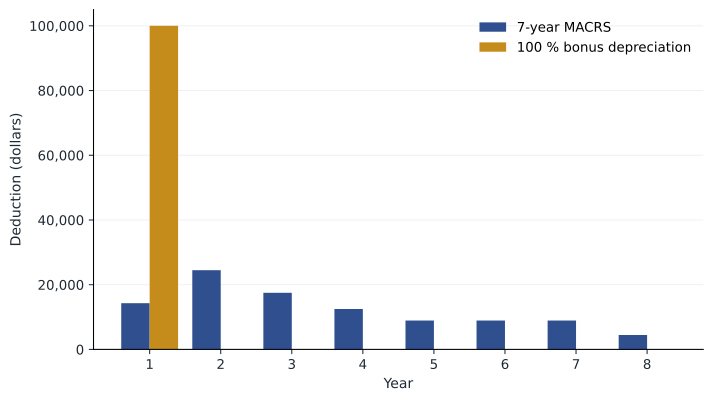
In the United States, the tax deduction for most tangible business property follows the Modified Accelerated Cost Recovery System (MACRS). Assets are assigned to recovery periods (3, 5, 7, 10, 15, 20, 27.5 or 39 years) with prescribed percentages; for example, machinery is commonly 7-year property and computers and vehicles 5-year property, depreciated with the 200 % declining balance method and a half-year convention. On top of MACRS, bonus depreciation lets firms deduct a percentage of the cost immediately. The 2017 Tax Cuts and Jobs Act allowed 100 % bonus depreciation, phasing down from 2023 (80 %) to 2024 (60 %) and early 2025 (40 %); the One Big Beautiful Bill Act of July 2025 made 100 % bonus depreciation permanent for qualifying property acquired after January 19, 2025. Section 179 also allows small and mid-sized firms to expense qualifying property up to an annual limit ($2.56 million in 2026, phasing out above about $4.09 million of purchases). Many states do not conform to federal bonus depreciation, so state taxable income can differ.
When an asset is sold, any amount above its remaining tax basis (cost minus depreciation claimed) is taxed: gains up to the depreciation claimed are recaptured as ordinary income, and in the simple case where the asset is sold for less than its original cost, the whole gain is taxed at the ordinary corporate rate. With 100 % bonus depreciation the remaining basis is zero, so the whole salvage value is taxable. A sale below the remaining basis creates a deductible loss.
Worked problem
Comparing depreciation treatments
A firm buys equipment costing $100,000. The tax rate is 25 % and the discount rate 10 %. Find the present value of the tax shield using 7-year MACRS and using 100 % bonus depreciation in the first year.
Show solution
- MACRS percentages: 14.29, 24.49, 17.49, 12.49, 8.93, 8.92, 8.93, 4.46 %.
- PV of deductions = 100,000 × (0.1429/1.1 + 0.2449/1.1² + … + 0.0446/1.1⁸) = 72,145.
- MACRS tax shield = 0.25 × 72,145 = 18,036.
- Bonus depreciation: 0.25 × 100,000 ÷ 1.10 = 22,727.
Answer: Full expensing is worth about $4,700 more per $100,000 of equipment than 7-year MACRS, because the tax is saved immediately.
A complete project analysis
Bringing the pieces together, consider a project that requires equipment costing $800,000, has a five-year life, and will be sold for $150,000 at the end. It needs $60,000 of extra working capital at the start, recovered at the end. It is expected to increase revenue by $500,000 a year and cash operating costs by $230,000 a year. The discount rate is 10 %. The tax treatment of the equipment follows each country's rules.
Worked problem
Project NPV with depreciation
Using a 25 % tax rate, find the NPV of the project described above with 7-year MACRS and with 100 % bonus depreciation. Treat any gain on the sale of the equipment as taxable at 25 %.
Show solution
- After-tax operating cash flow = 270,000 × 0.75 = 202,500 a year; PV over 5 years = 767,634.
- MACRS: deductions in years 1 to 5 are 14.29 %, 24.49 %, 17.49 %, 12.49 % and 8.93 % of 800,000; PV of the tax savings = 120,893.
- Remaining basis after 5 years = 800,000 × (1 − 0.7769) = 178,480; the sale for 150,000 creates a deductible loss of 28,480, so after-tax salvage = 150,000 + 7,120 = 157,120.
- NPV with MACRS = −800,000 − 60,000 + 767,634 + 120,893 + (157,120 + 60,000) ÷ 1.10⁵ = 163,342.
- With bonus depreciation the tax saving is 200,000 at year 1 (PV 181,818) but the whole salvage is taxable: after-tax salvage 112,500.
- NPV with bonus = −860,000 + 767,634 + 181,818 + (112,500 + 60,000) ÷ 1.10⁵ = 196,561.
Answer: Immediate expensing raises the NPV by about $33,200 compared with MACRS, even after the higher tax on the salvage value.
# Project NPV with MACRS and with 100 % bonus depreciation
cost, salvage, nwc, years = 800_000, 150_000, 60_000, 5
revenue, op_costs, tax, r = 500_000, 230_000, 0.25, 0.10
macrs7 = [0.1429, 0.2449, 0.1749, 0.1249, 0.0893, 0.0892, 0.0893, 0.0446]
def npv(dep_rates):
    total = -cost - nwc
    basis = cost
    for t in range(1, years + 1):
        dep = cost * dep_rates[t - 1] if t - 1 < len(dep_rates) else 0
        basis -= dep
        cf = (revenue - op_costs) * (1 - tax) + dep * tax
        if t == years:
            gain = salvage - basis           # taxed as ordinary income (recapture)
            cf += salvage - gain * tax + nwc
        total += cf / (1 + r) ** t
    return total, basis
for label, rates in [("7-year MACRS", macrs7), ("100 % bonus depreciation", [1.0])]:
    value, basis = npv(rates)
print(f"{label:26s} NPV {value:10,.0f} tax basis left at year 5 {basis:10,.0f}")7-year MACRS NPV 163,342 tax basis left at year 5 178,480 100 % bonus depreciation NPV 196,561 tax basis left at year 5 0
Replacement decisions
Many capital budgeting decisions are about replacing an existing asset with a new one. The incremental cash flows are then the differences: the cost of the new machine minus the after-tax proceeds from selling the old one, the change in operating costs, the change in tax deductions, and the difference in salvage values at the end. The old machine's original cost is sunk; what matters is what it could be sold for now and what keeping it would cost in the future.
Worked problem
Replacing a machine
An old machine could be sold today for $40,000; if kept, it will last 4 more years with no salvage value. A new machine costs $150,000, lasts 4 years, would be worth $30,000 at the end, and cuts operating costs by $45,000 a year. Ignoring taxes for simplicity, and using 9 %, should the firm replace?
Show solution
- Net investment = 150,000 − 40,000 = 110,000.
- PV of savings = 45,000 × (1 − 1.09^−4) ÷ 0.09 = 145,787.
- PV of salvage = 30,000 ÷ 1.09⁴ = 21,253.
- NPV of replacing = −110,000 + 145,787 + 21,253 = 57,040.
Answer: Replacing adds about $57,000 before taxes. With taxes, the savings would be reduced by the tax rate and the change in tax deductions added.
Practical forecasting
Forecasts of revenue and costs are where most capital budgeting errors begin. Managers proposing a project tend to be optimistic, and they often have an incentive to be. Good practice includes checking forecasts against the experience of past projects, asking why the firm has an advantage that will let it earn more than its cost of capital, building forecasts from specific assumptions (market size, share, price, unit costs) rather than from a target NPV, and reviewing projects after they are completed. Lesson 9 shows how sensitivity, scenario and simulation analysis expose the assumptions that matter most. And whatever the tax rules, the project should make economic sense before the tax shield: an investment that is worthwhile only because of a tax incentive is vulnerable if the rules change.
Common mistakes
MistakeInclude money already spent on a feasibility study.
InsteadIt is sunk; only future cash flows that change with the decision count.
MistakeA building the firm already owns is free to use.
InsteadIts rental or sale value is an opportunity cost.
MistakeSubtract interest payments from project cash flows.
InsteadFinancing costs are captured in the discount rate.
MistakeDepreciation is a cash flow.
InsteadOnly its tax effect, T × D, is a cash flow.
MistakeWorking capital can be ignored because it is recovered.
InsteadInvesting it early and recovering it later has a real present value cost.
Summary and key terms
- Use incremental cash flows: ignore sunk costs, include opportunity costs and side effects, exclude financing costs.
- Project FCF = after-tax operating cash flow + tax shield on capital deductions − capital spending − investment in working capital.
- MACRS sets recovery periods and percentages; 100 % bonus depreciation became permanent for property acquired after January 19, 2025, and Section 179 allows expensing up to a limit.
- Salvage above the remaining tax basis is taxable; with full expensing the whole salvage is taxed.
- Working capital investment and recovery must be included.
- Replacement decisions use the differences between keeping and replacing; the old asset's cost is sunk.
- Forecast discipline matters more than precise formulas.
- Incremental cash flow
- The change in the firm's cash flow that results from a decision.
- Sunk cost
- A cost already incurred that cannot be recovered.
- Opportunity cost
- The value of the best alternative use of a resource.
- Cannibalization
- Sales a new product takes from the firm's existing products.
- Tax shield
- The tax saved by a deductible expense, equal to the expense times the tax rate.
- Capital cost allowance
- The Canadian tax deduction for depreciable property.
- Undepreciated capital cost
- The remaining balance of a CCA class on which future deductions are calculated.
- MACRS
- The US Modified Accelerated Cost Recovery System for tax depreciation.
- Bonus depreciation
- A US provision allowing an immediate deduction of a percentage of an asset's cost.
- Salvage value
- The amount for which an asset can be sold at the end of a project.
Practice problems
Work each problem on paper first, then reveal the answer to check.
A firm spent $25,000 on a survey last year. Include it in the NPV?
Show answer
No, it is sunk.
A project uses a warehouse the firm could rent for $40,000 a year. Treatment?
Show answer
Include $40,000 a year (after tax) as an opportunity cost.
Revenue 300,000, cash costs 120,000, tax 25 %, deduction 50,000. Operating cash flow including the shield?
Show answer
135,000 + 12,500 = 147,500.
First-year bonus deduction on $50,000, T = 25 %, r = 8 %: PV of the tax saving?
Show answer
50,000 × 0.25 ÷ 1.08 = 11,574.
NWC of $20,000 is invested now and recovered in 4 years; r = 10 %. PV cost?
Show answer
20,000 − 13,660 = 6,340.
Why is cannibalization a cost?
Show answer
It reduces cash flows the firm would otherwise earn.
Equipment with a zero tax basis is sold for $30,000; T = 25 %. After-tax salvage?
Show answer
30,000 × 0.75 = 22,500.
Old machine sells for $15,000; new costs $70,000 and saves $20,000 a year for 5 years; r = 10 %, no taxes or salvage. NPV?
Show answer
−55,000 + 75,816 = 20,816.
Why should financing costs be excluded from project cash flows?
Show answer
The discount rate already reflects the cost of debt and equity.
Portfolio task: list the incremental cash flows, with sources, for a real investment your organization or a public company has announced.
Show answer
Answers vary; identify sunk costs and opportunity costs explicitly.
Lesson quiz · 5 questions
Score 60% or more to complete this lesson.
Create a free account to save your progress, take quizzes and earn a certificate.