
FIN-201 · Lesson 5 of 12 · 32 min
Bond valuation and interest rates
Bonds are the main way governments and large companies borrow for long periods. For the issuing firm, bonds are a source of capital whose cost feeds into the cost of capital in lesson 11; for investors, they are the benchmark against which riskier assets are judged. BUS-110 lesson 10 showed how to price a simple bond and find its yield. This lesson goes further: it describes the features that make bonds differ, explains quoted and invoice prices, measures how bond prices respond to interest rate changes, and shows how credit risk and maturity shape the yields firms pay. Detailed fixed-income portfolio management, including immunization and interest rate derivatives, is left to FIN-301.
Bond features
A bond is a promise to pay interest, called coupons, at a stated rate on the face value (also called par or principal), and to repay the face value at maturity. The terms are set out in a legal contract, the trust indenture, which also contains covenants: promises such as limits on additional borrowing, minimum interest coverage, or restrictions on selling assets and paying dividends. Covenants protect lenders against the agency problems described in lesson 1. Many corporate bonds include extra features. A callable bond can be redeemed early by the issuer, usually at a premium, which the issuer will do if rates fall; investors demand a higher yield for bearing that risk. A convertible bond can be exchanged for a fixed number of shares, so it pays a lower coupon. Secured bonds are backed by specific assets; debentures are unsecured; subordinated debt ranks behind other debt in bankruptcy.
US Treasury notes and bonds, and most US corporate bonds, pay coupons semi-annually. The Treasury also issues bills (up to one year), Treasury Inflation-Protected Securities (TIPS), whose principal is indexed to the consumer price index, and savings bonds sold directly to individuals. Municipal bonds issued by states and cities usually pay interest that is exempt from federal income tax. Corporate bonds are rated by agencies such as S&P Global Ratings, Moody's and Fitch.
Pricing a bond
A bond's price is the present value of its coupons and face value, discounted at the market yield for bonds of similar risk and maturity. For a bond paying a coupon \( C \) per period for \( n \) periods with face value \( F \) and yield \( y \) per period, the price is an annuity plus a single payment. Because coupons are semi-annual, \( C \) is half the annual coupon and \( y \) half the quoted annual yield; bond yields are conventionally quoted as twice the semi-annual rate, a bond-equivalent yield, rather than as an effective annual rate.
Three relationships follow from the formula. When the coupon rate equals the market yield, the bond sells at par. When the coupon rate is below the yield, the bond sells at a discount; when above, at a premium. And when market yields rise, bond prices fall, and vice versa. As a bond approaches maturity its price converges to face value, whatever happens to yields, so a premium bond drifts down and a discount bond drifts up toward par.
Worked problem
Pricing a corporate bond
A 10-year bond has a face value of $1,000 and a 5 % coupon paid semi-annually. Bonds of similar risk yield 6.2 % (quoted annually, compounded semi-annually). Find the price.
Show solution
- Coupon per period C = 25; n = 20; y = 0.031.
- Annuity factor = (1 − 1.031^−20) ÷ 0.031 = 14.7409.
- PV of coupons = 25 × 14.7409 = 368.52.
- PV of face value = 1,000 ÷ 1.031²⁰ = 543.03.
- Price = 368.52 + 543.03 = 911.55.
Answer: The bond sells at a discount, about 91.16 % of face value, because its coupon is below the market yield.
Finding the yield to maturity
The yield to maturity (YTM) is the single discount rate that makes the present value of a bond's promised payments equal its price. It is the bond's internal rate of return if the investor holds it to maturity, all payments are made, and coupons are reinvested at the same rate. Like the loan cost in lesson 4, it must be found numerically. Bisection is simple and reliable: start with a low and a high rate that bracket the answer and repeatedly halve the interval.
# Price and yield to maturity of a semi-annual bond
def price(face, coupon_rate, years, ytm):
    c, n, y = face * coupon_rate / 2, int(years * 2), ytm / 2
    return c * (1 - (1 + y) ** -n) / y + face / (1 + y) ** n

def ytm(market_price, face, coupon_rate, years):
    lo, hi = 1e-6, 1.0
    for _ in range(200):
        mid = (lo + hi) / 2
        if price(face, coupon_rate, years, mid) > market_price:
            lo = mid
        else:
            hi = mid
    return mid

print(f"price at 6.2 %: {price(1000, 0.05, 10, 0.062):.2f}")
print(f"YTM of a 7-year 4 % bond priced at 945: {ytm(945, 1000, 0.04, 7) * 100:.3f} %")
for y in (0.04, 0.05, 0.06, 0.07):
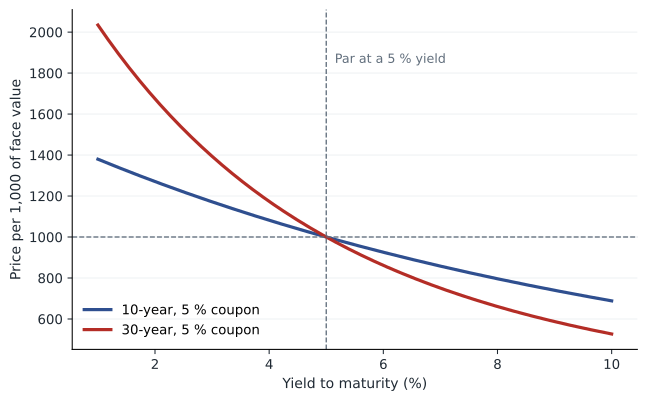
print(f"yield {y:.0%}: 10-year 5 % bond {price(1000, 0.05, 10, y):8.2f} 30-year 5 % bond {price(1000, 0.05, 30, y):8.2f}")price at 6.2 %: 911.55 YTM of a 7-year 4 % bond priced at 945: 4.939 % yield 4%: 10-year 5 % bond 1081.76 30-year 5 % bond 1173.80 yield 5%: 10-year 5 % bond 1000.00 30-year 5 % bond 1000.00 yield 6%: 10-year 5 % bond 925.61 30-year 5 % bond 861.62 yield 7%: 10-year 5 % bond 857.88 30-year 5 % bond 750.55
The current yield, the annual coupon divided by the price, is often quoted but ignores the gain or loss as the price moves to par, so it overstates the return on premium bonds and understates it on discount bonds. For a callable bond trading above its call price, investors also calculate the yield to call, assuming the bond is redeemed at the first call date, and focus on the lower of the two yields.
Quoted prices and accrued interest
Bonds are rarely bought on a coupon date. Between coupons, the seller has earned part of the next coupon, so the buyer pays the seller that accrued interest in addition to the quoted price. The quoted price, which excludes accrued interest, is the clean price; the price actually paid is the dirty or invoice price. Quoting clean prices stops the price from jumping every time a coupon is paid. Accrued interest is the coupon times the fraction of the coupon period that has elapsed, with day-count conventions that differ by market.
US Treasury notes and bonds use an actual/actual day count (actual days elapsed over actual days in the coupon period); most corporate and municipal bonds use 30/360, which treats every month as 30 days.
Worked problem
Clean and dirty prices
A Treasury note with a 4.5 % coupon pays coupons on 15 May and 15 November. A buyer settles on 1 August with a quoted (clean) price of 97.50 per 100 of face value. Using actual/actual, find the accrued interest and the invoice price for $100,000 of face value.
Show solution
- Days since last coupon (15 May to 1 August) = 78; days in the period (15 May to 15 November) = 184.
- Accrued interest per 100 = 2.25 × 78 ÷ 184 = 0.9538.
- Dirty price = 97.50 + 0.9538 = 98.4538 per 100.
- For $100,000 face: invoice = $98,453.80, of which $953.80 is accrued interest.
Answer: The buyer pays the clean price plus accrued interest, then receives the full coupon on the next payment date.
Interest rate risk and duration
Bond prices move inversely with yields, but not all bonds are equally sensitive. Longer maturities and lower coupons mean more of the bond's value lies in distant cash flows, which are most affected by discounting. The code above shows this: when yields rise from 5 % to 7 %, the 10-year 5 % bond loses about 14 % of its value, the 30-year bond about 25 %. Duration measures this sensitivity. Macaulay duration is the weighted average time to receive the bond's cash flows, using each payment's share of the price as its weight. Modified duration, Macaulay duration divided by \( (1 + y) \) per period, gives the approximate percentage price change for a small change in yield.
Worked problem
Using duration
A bond has a price of $911.55 and a modified duration of 7.6 years. Estimate the price change if yields rise by 0.50 percentage points.
Show solution
- ΔP ÷ P ≈ −7.6 × 0.005 = −0.038, or −3.8 %.
- ΔP ≈ −0.038 × 911.55 = −34.64.
- Estimated new price ≈ 876.91.
Answer: Duration gives a quick estimate. Because the price-yield curve is convex, the actual drop is slightly smaller for a rise in yields and the actual gain slightly larger for a fall.
Credit risk and ratings
A government that borrows in its own currency is very unlikely to default on its nominal debt, so its yields are treated as the benchmark riskless rate. Corporate bonds carry default risk, and their yields include a credit spread to compensate. Rating agencies classify issuers by credit quality: bonds rated BBB (or Baa at Moody's) and above are investment grade; lower-rated bonds are high-yield or speculative grade. Many institutional investors are limited to investment-grade bonds, so a downgrade below that line can raise a firm's borrowing cost sharply. Spreads widen in recessions and financial stress and narrow in good times.
Note that the promised yield on a risky bond is not its expected return. If a bond yields 9 % when government bonds yield 4 %, part of the 5-point spread compensates for the expected loss from default and part is a risk premium. Lesson 11 uses the yield on a firm's bonds as an estimate of its cost of debt, which is reasonable for investment-grade firms but overstates the expected cost for firms close to default.
| Rating (S&P / Moody's) | Category | Comment |
|---|---|---|
| AAA / Aaa to AA / Aa | High grade | Very strong capacity to pay; few companies hold AAA |
| A / A | Upper medium grade | Strong, but more affected by economic conditions |
| BBB / Baa | Lowest investment grade | Adequate capacity; the largest group of corporate issuers |
| BB / Ba and B / B | Speculative (high yield) | Significant uncertainty about payment |
| CCC / Caa and below | Highly speculative or in default | Default is a real possibility or has occurred |
Yields across maturities
The yield curve plots government bond yields against maturity. Three ideas explain its shape. The expectations theory says long rates reflect expected future short rates, so an upward slope signals expected rate increases and an inverted curve expected cuts. The liquidity premium theory adds that investors demand extra yield to hold long bonds because their prices are more volatile, which is why the curve usually slopes upward. Market segmentation and preferred habitat theories note that pension funds, insurers, banks and central banks have preferences for particular maturities, so supply and demand in each segment matter.
For valuation, the cleanest approach discounts each cash flow at the spot rate for its own maturity, the yield on a zero-coupon bond paying only at that date, rather than using one yield for all. A bond priced with spot rates cannot be arbitraged against a portfolio of zero-coupon bonds, by the law of one price from lesson 3. In practice, firms and analysts often use a single yield for simplicity, especially for bonds with similar maturities.
Worked problem
Pricing with spot rates
Annual spot rates are 4.0 % for one year, 4.5 % for two years and 5.0 % for three years. Price a three-year bond with a 6 % annual coupon and $1,000 face value, and find its yield to maturity.
Show solution
- PV = 60 ÷ 1.04 + 60 ÷ 1.045² + 1,060 ÷ 1.05³.
- = 57.69 + 54.94 + 915.67 = 1,028.30.
- The yield to maturity is the single rate that gives 1,028.30: about 4.96 %.
Answer: The bond's yield is a blend of the spot rates, weighted toward the three-year rate because most of the value comes at maturity.
Bonds and the firm
For the corporate financial manager, bond pricing matters in four ways. It determines how much a firm raises when it issues debt and what coupon it must offer. It sets the market cost of debt used in the weighted average cost of capital. It shows how much the market value of existing debt changes when rates or the firm's credit quality change. And it frames decisions such as whether to call and refinance a bond when rates fall, or to include covenants that lower the cost of borrowing in exchange for less flexibility. The large rise in yields in both countries from 2022 onward, with 10-year yields in late October 2026 around 3.8 to 3.9 % in Canada and about 5 % in the United States, raised the cost of new debt and lowered the market value of existing fixed-rate bonds, the same mechanics that caused losses at some US banks in 2023.
Common mistakes
MistakeIf market yields rise, the price of an existing bond rises because it now pays more.
InsteadIts coupons are fixed, so higher yields lower its price.
MistakeThe current yield is the bond's return.
InsteadIt ignores the gain or loss as the price converges to par; use the yield to maturity.
MistakeThe quoted price is what the buyer pays.
InsteadThe buyer pays the clean price plus accrued interest.
MistakeA high-yield bond's promised yield is its expected return.
InsteadPromised yields assume no default; expected returns are lower.
MistakeA 6 % yield on a semi-annual bond is a 6 % effective annual rate.
InsteadBond yields are quoted as twice the semi-annual rate; the EAR is 1.03² − 1 = 6.09 %.
Summary and key terms
- A bond pays coupons and face value; its terms and covenants are set out in an indenture.
- Price = PV of coupons + PV of face value at the market yield; prices and yields move inversely.
- The yield to maturity is the discount rate equating price with promised payments, found numerically.
- Invoice (dirty) price = clean price + accrued interest; day-count conventions vary.
- Longer maturities and lower coupons mean higher interest rate risk; modified duration estimates the percentage price change.
- Credit spreads compensate for default risk and a risk premium; ratings divide investment grade from high yield.
- Spot rates price each cash flow by its own maturity; the yield curve reflects expectations, liquidity premiums and segment demand.
- Coupon
- The periodic interest payment on a bond.
- Face value
- The amount repaid at maturity, also called par or principal.
- Indenture
- The legal contract setting out a bond's terms and covenants.
- Callable bond
- A bond the issuer can redeem early at a stated price.
- Yield to maturity
- The discount rate that equates a bond's price with its promised payments.
- Clean price
- A bond's quoted price, excluding accrued interest.
- Accrued interest
- The part of the next coupon earned by the seller since the last coupon date.
- Duration
- A measure of the weighted average timing of a bond's cash flows and its price sensitivity to yields.
- Investment grade
- Bonds rated BBB or Baa and above.
- Spot rate
- The yield on a zero-coupon bond maturing at a given date.
Practice problems
Work each problem on paper first, then reveal the answer to check.
Price a 5-year, 4 % semi-annual bond (face $1,000) at a yield of 5 %.
Show answer
956.24.
A bond's coupon rate is 7 % and the market yield is 6 %. Premium or discount?
Show answer
Premium.
A 20-year zero-coupon bond with face $1,000 yields 5 % (semi-annual). Price?
Show answer
1,000 ÷ 1.025⁴⁰ = 372.43.
A bond with annual coupon $55 trades at $1,040. Current yield?
Show answer
5.29 %.
Accrued interest on a 4 % semi-annual bond, 60 days into a 182-day period, per $100?
Show answer
2 × 60 ÷ 182 = 0.659.
Modified duration 12; yields fall 0.25 points. Approximate price change?
Show answer
+3.0 %.
Why do investors demand a higher yield on callable bonds?
Show answer
The issuer calls when rates fall, cutting off the investor's gain.
Spot rates: 1 year 3 %, 2 years 4 %. Price a 2-year 5 % annual-coupon bond (face 1,000).
Show answer
48.54 + 970.78 = 1,019.32.
What separates investment grade from high yield?
Show answer
A rating of BBB/Baa or higher.
Portfolio task: find today's yields on 2-, 5- and 10-year Treasuries from the US Treasury and describe the shape of the curve.
Show answer
Answers vary; note the date and whether the curve slopes up, down or is flat.
Lesson quiz · 5 questions
Score 60% or more to complete this lesson.
Create a free account to save your progress, take quizzes and earn a certificate.