
FIN-201 · Lesson 3 of 12 · 29 min
Time value of money I: the valuation principle and interest rates
A dollar today is worth more than a dollar next year, because today's dollar can be invested to earn a return. That simple idea, the time value of money, is the foundation of every valuation in finance. BUS-110 lessons 7 and 8 covered the mechanics of compound interest and annuities. This lesson revisits them briefly and then goes further: it explains why market prices make present value the right way to compare cash flows, how to handle the many ways interest rates are quoted, including the semi-annual convention used for Canadian mortgages and the monthly convention used for US ones, and how to separate real from nominal returns. Lesson 4 applies the same tools to streams of cash flows, loans and leases.
The valuation principle
Suppose a bank will lend or borrow at 5 % a year with no risk. An investment that pays $1,050 for certain in one year is then worth exactly $1,000 today, because $1,000 deposited at the bank would produce the same $1,050. If someone offered to sell the investment for $990, you could buy it, borrow $990 against its payoff at 5 % (owing $1,039.50), and pocket $10.50 next year with no risk. If they asked $1,010, nobody would buy. In a competitive market, such riskless profit opportunities, called arbitrage, are quickly eliminated, so equivalent cash flows must sell at the same price. This is the law of one price, and it is why discounting at the market rate gives the value of a cash flow: the present value is what it would cost to replicate the cash flow in the market.
The rate used for discounting is the opportunity cost of capital: the return investors could earn on alternative investments of similar risk. For a riskless cash flow, it is the riskless rate, such as the yield on a government treasury bill or bond of the same maturity. For a risky cash flow, it is higher, and much of this course is about estimating it. The valuation principle, stated generally, is that the value of an asset to the firm or its investors is the present value of its expected future cash flows, discounted at the opportunity cost of capital for cash flows of that risk.
Worked problem
Using the law of one price
A government bond pays $10,000 in exactly three years. Riskless three-year investments earn 3.8 % a year compounded annually. What should the bond sell for? If it is offered at $8,700, what would an arbitrageur do?
Show solution
- PV = 10,000 ÷ 1.038³ = 10,000 ÷ 1.11840 = 8,941.45.
- At $8,700 the bond is cheap: buy it and borrow (or short-sell an equivalent bond) $8,941 at 3.8 %, repayable by the bond's $10,000.
- The arbitrageur keeps 8,941 − 8,700 = $241 today, with the future flows offsetting exactly.
Answer: The fair price is about $8,941. Buying pressure from arbitrageurs would push the price up toward that level.
Quoted rates, periodic rates and effective rates
Interest rates are quoted in different ways, and comparing them requires converting to a common basis. A quoted annual rate with compounding \( m \) times a year, often called the annual percentage rate (APR) or nominal rate, means a periodic rate of \( APR/m \) is applied each period. The effective annual rate (EAR) is the rate that, compounded once a year, gives the same result. It is the right figure for comparing loans or investments with different compounding frequencies.
As compounding becomes more frequent, the EAR rises toward a limit given by continuous compounding. The differences look small for moderate rates, but they add up on large balances and long horizons, and they become dramatic at high rates. To find the periodic rate that matches a given EAR for a different payment frequency, reverse the formula: the rate per period for \( n \) periods a year is \( (1 + EAR)^{1/n} - 1 \). BUS-110 called this an equivalent rate.
# Effective annual rates for a 6 % quoted rate with different compounding
import math
apr = 0.06
for label, m in [("annual", 1), ("semi-annual", 2), ("quarterly", 4), ("monthly", 12), ("daily", 365)]:
    ear = (1 + apr / m) ** m - 1
    print(f"{label:12s} EAR {ear * 100:.4f} %")
print(f"{'continuous':12s} EAR {(math.exp(apr) - 1) * 100:.4f} %")annual EAR 6.0000 % semi-annual EAR 6.0900 % quarterly EAR 6.1364 % monthly EAR 6.1678 % daily EAR 6.1831 % continuous EAR 6.1837 %
Mortgage conventions
US mortgage rates are quoted as an annual rate compounded monthly, matching monthly payments: a 7 % rate means a monthly rate of 7 % ÷ 12 ≈ 0.5833 %, an effective annual rate of about 7.23 %. The Truth in Lending Act and Regulation Z require lenders to disclose an APR that adds most finance charges, such as points and origination fees, to the interest, expressed as the periodic rate times the number of periods; it is not the effective annual rate. In late October 2026, rates on 30-year fixed mortgages were around 7 %, with the 10-year Treasury yield near 5 %. Rates change daily, so treat these as illustrative.
Worked problem
A US mortgage rate
A 30-year fixed mortgage is quoted at 7.00 % compounded monthly. Find the monthly rate and the effective annual rate.
Show solution
- Monthly rate = 7.00 % ÷ 12 = 0.5833 %.
- EAR = 1.005833¹² − 1 = 7.229 %.
- Twelve times the monthly rate is the 7.00 % quoted.
Answer: The borrower actually pays the equivalent of about 7.23 % a year; the quoted rate understates it slightly.
Very high rates
The gap between quoted and effective rates matters most for short-term, high-cost credit. Interest caps on consumer loans are set mainly by state usury and small-loan laws, which vary widely; some states effectively ban payday loans and others allow fees that work out to triple-digit APRs. The federal Military Lending Act caps the APR on most credit to active-duty service members at 36 %. Because a payday loan is short, a fee per $100 translates into an enormous effective annual rate.
Worked problem
The true cost of a short loan
A borrower pays a $15 fee on a $100 loan repaid after 14 days. What is the APR (simple annualization) and the effective annual rate if the loan were rolled over continuously for a year?
Show solution
- Periodic rate = 15 ÷ 100 = 15 % per 14 days.
- Periods per year = 365 ÷ 14 = 26.07.
- APR = 15 % × 26.07 = 391 %.
- EAR = 1.15^26.07 − 1 ≈ 3,724 %, so each dollar would grow to about $38.24 in a year.
Answer: A fee that looks modest per $100 implies an extraordinary annual cost. This is why lending laws focus on annualized rates.
Real and nominal rates
Quoted interest rates are nominal: they measure growth in dollars. What investors care about is growth in purchasing power, the real rate. If prices rise by 3 % and an investment earns 5 %, the investor's purchasing power grows by less than 5 %. The exact relation, the Fisher equation, is \( 1 + r_{nominal} = (1 + r_{real})(1 + \pi) \), where \( \pi \) is the inflation rate; for low rates the approximation \( r_{real} \approx r_{nominal} - \pi \) is close enough. ECON-102 lesson 6 explains how expected inflation and central bank policy determine nominal rates.
The rule for practical work is consistency. Discount nominal cash flows (those that include expected inflation) at nominal rates, and real cash flows (in today's dollars) at real rates. Mixing them, such as forecasting sales in constant dollars and discounting at a nominal cost of capital, systematically undervalues projects. Most corporate forecasts and discount rates are nominal, and this course uses nominal figures unless stated otherwise.
Worked problem
Real versus nominal discounting
A project produces a cash flow of $10,000 in real terms (today's dollars) in three years. Inflation is expected to be 2.5 % a year and the nominal discount rate is 8 %. Value it both ways.
Show solution
- Nominal cash flow = 10,000 × 1.025³ = 10,768.91.
- PV at the nominal rate = 10,768.91 ÷ 1.08³ = 8,548.71.
- Real rate = 1.08 ÷ 1.025 − 1 = 5.3659 %.
- PV at the real rate = 10,000 ÷ 1.053659³ = 8,548.71.
Answer: Both methods give $8,548.71, as they must. Discounting the real cash flow at 8 % would give $7,938, understating value by about 7 %.
Interest rates differ by maturity and risk
There is not one interest rate but many. Rates differ by maturity: the relation between yield and time to maturity for government bonds is the term structure of interest rates, plotted as the yield curve. Normally longer maturities pay higher yields, but in 2022 to 2024 short rates in both countries were above long rates, an inverted curve that often, though not always, precedes a slowdown. Rates also differ by credit risk: corporate bonds yield more than government bonds of the same maturity, and the extra yield, the credit spread, widens when investors fear defaults. A careful valuation uses a discount rate that matches both the timing and the risk of each cash flow. In late October 2026, the 10-year Government of Canada bond yielded about 3.8 to 3.9 % and the 10-year US Treasury about 5 %, a gap reflecting different inflation, policy rates and fiscal outlooks; lesson 5 looks at bond yields in detail.
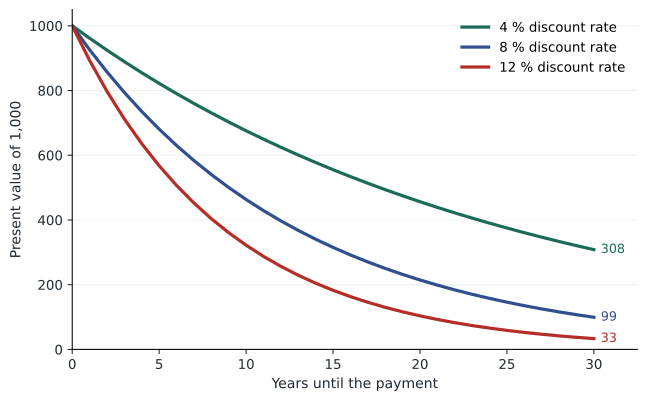
The chart shows two lessons that run through corporate finance. First, distant cash flows are worth little today at high discount rates: $1,000 in 30 years is worth about $308 at 4 % but only $33 at 12 %. Second, the value of long-lived assets is very sensitive to the discount rate, which is why getting the cost of capital roughly right matters so much for capital budgeting.
Common mistakes
MistakeA 6 % rate compounded monthly and a 6 % rate compounded annually cost the same.
InsteadMonthly compounding gives an EAR of 6.17 %; compare loans using effective rates.
MistakeA US mortgage APR is the effective annual rate.
InsteadThe disclosed APR is a periodic rate times periods and includes fees; it is not the EAR.
MistakeNominal cash flows can be discounted at a real rate if inflation is low.
InsteadMatch nominal cash flows with nominal rates and real cash flows with real rates.
MistakeThe real rate is exactly the nominal rate minus inflation.
InsteadThat is an approximation; the exact real rate is (1 + nominal) ÷ (1 + inflation) − 1.
MistakeOne discount rate fits every cash flow.
InsteadRates vary with maturity and risk; use the opportunity cost of capital for cash flows of similar timing and risk.
Summary and key terms
- A dollar today is worth more than a dollar later because it can earn a return.
- The law of one price makes present value the market cost of replicating a cash flow; arbitrage eliminates deviations.
- The discount rate is the opportunity cost of capital for cash flows of the same risk and timing.
- EAR = (1 + APR/m)^m − 1; use effective rates to compare.
- US mortgage rates are compounded monthly; the disclosed APR includes fees but is not an effective rate.
- Real rate = (1 + nominal) ÷ (1 + inflation) − 1; discount consistently.
- Rates vary with maturity (the yield curve) and credit risk (spreads).
- Time value of money
- The principle that money available now is worth more than the same amount later.
- Law of one price
- Equivalent assets must sell for the same price in a competitive market.
- Arbitrage
- A riskless profit from simultaneously buying and selling equivalent assets at different prices.
- Opportunity cost of capital
- The expected return available on alternative investments of similar risk.
- Annual percentage rate (APR)
- A quoted annual rate equal to the periodic rate times the number of periods per year.
- Effective annual rate (EAR)
- The annual rate with once-a-year compounding that gives the same growth as the quoted rate.
- Continuous compounding
- The limit of compounding infinitely often; EAR = e^APR − 1.
- Real interest rate
- The rate of growth of purchasing power, adjusted for inflation.
- Term structure
- The relation between interest rates and maturity.
- Credit spread
- The extra yield on a risky bond over a government bond of the same maturity.
Practice problems
Work each problem on paper first, then reveal the answer to check.
What is the PV of $5,000 in 4 years at 6 % compounded annually?
Show answer
5,000 ÷ 1.06⁴ = 3,960.47.
Find the EAR of 9 % compounded quarterly.
Show answer
1.0225⁴ − 1 = 9.31 %.
Find the EAR of 9 % compounded continuously.
Show answer
e^0.09 − 1 = 9.42 %.
A Canadian mortgage is quoted at 6 % compounded semi-annually. Find the monthly rate.
Show answer
1.03^(1/6) − 1 = 0.4939 %.
A loan charges 1.5 % a month. APR and EAR?
Show answer
APR 18 %; EAR 1.015¹² − 1 = 19.56 %.
A bond pays $1,000 in 2 years; riskless 2-year rate 4 %. Fair price?
Show answer
924.56.
Nominal rate 7 %, inflation 3 %. Exact real rate?
Show answer
1.07 ÷ 1.03 − 1 = 3.88 %.
Why must real cash flows be discounted at a real rate?
Show answer
Otherwise inflation is removed from the cash flows but not from the rate, undervaluing the asset.
What is the yield curve and what does an inverted curve mean?
Show answer
Yields plotted against maturity; short rates above long rates, often associated with expected rate cuts or slowdowns.
Portfolio task: find today's average 30-year fixed mortgage rate and convert it to a monthly rate and an EAR.
Show answer
Answers vary; show the conversion.
Lesson quiz · 5 questions
Score 60% or more to complete this lesson.
Create a free account to save your progress, take quizzes and earn a certificate.