
FAT-310 · Lesson 9 of 12 · 20 min
Mass notification systems: in-building, wide-area and distributed recipient
Willowbank School's board has asked Bramwell to quote on a mass notification system. The school already has a fire alarm system, an intercom and a bell system, but none of them can do what the principal wants: tell every classroom, the gym, the portables and the yard, at once and in plain words, to go into lockdown, to shelter from a tornado warning, or to hold children inside because of a chemical spill on the highway. 'A fire alarm tells people to leave,' Donna Achebe tells Sasha as they read the board's request. 'Half of these events need the opposite. That's what mass notification is for.' This lesson covers what mass notification systems are, the different kinds, how they are designed from a risk analysis, and what fire alarm technicians install and maintain.
What mass notification is
A mass notification system, or MNS, delivers information and instructions to people during an emergency of any kind, not only fire. The events it covers include violent intruders, severe weather, hazardous materials releases, utility failures, bomb threats, medical emergencies and building system failures. The right instruction varies: for some events people should leave, for others they should stay inside, move to an interior room, lock doors or avoid an area. A fire alarm system is designed to make people leave; an MNS is designed to tell them what to do.
Mass notification grew out of security planning for military bases and government buildings in the early 2000s, and spread to campuses, schools, hospitals, airports and large workplaces after events in which people needed to be warned quickly about threats other than fire. In the United States, NFPA 72's Chapter 24 covers mass notification as part of emergency communications systems, and UL 2572 covers the listing of mass notification control and communication equipment. The building codes rarely require mass notification outside some government and military buildings, so most systems are installed because owners choose them.
The layers of mass notification
Mass notification is often described in layers, by how the message reaches people. The layers work together, and a well-designed system uses several of them, because no single method reaches everyone.
- In-building mass notification uses speakers, visible appliances and text displays inside buildings, often sharing equipment with the fire alarm voice system. It reaches people where they are, in rooms and corridors, with voice and text.
- Wide-area mass notification uses high-power outdoor speaker arrays and sirens to reach people outdoors across a campus or a site: the school yard, the parking lots, the sports fields.
- Distributed recipient mass notification, often abbreviated DRMNS, sends messages to individuals through text messages, phone calls, emails, computer pop-ups and apps. It reaches people wherever they are, including people who are away from the site but need to know, such as parents.
- Public alerting, the fourth layer, is run by governments: in Canada the Alert Ready system on radio, television and wireless devices; in the United States the federal integrated public alert system and wireless emergency alerts. Building systems don't control it, but the emergency plan takes it into account.
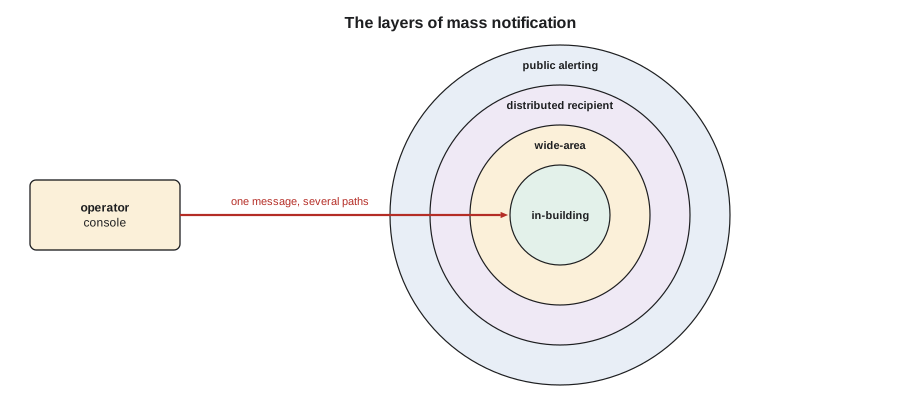
At Willowbank, the board's request covers the first three layers: speakers and text displays in the school, an outdoor speaker on the gym roof covering the yard and portables, and a link to the school board's existing text and email alert service. The fire alarm technician's work is mainly in the first two layers; the third is software, run by the board's communications staff, but it has to be triggered by the same events and say the same things.
Designing from a risk analysis
Because mass notification covers so many events, and because it can do harm if it gives the wrong instruction, it is designed from a risk analysis. The analysis looks at the hazards the site faces, how likely they are, who would be affected, how quickly they need to be warned, and what they should do. The result sets the system's scope: which areas need which layers, what messages are needed, who may send them, how fast they must arrive, and how reliable each part must be. NFPA 72 requires a risk analysis for mass notification systems, and it uses the analysis to set requirements such as pathway survivability and message priority.
# Willowbank risk analysis summary: events, actions and how fast people must be told
events = [
    # (event, likelihood 1-5, consequence 1-5, action, minutes to warn)
    ("Fire", 2, 5, "leave the building", 1),
    ("Violent intruder", 1, 5, "lockdown", 1),
    ("Tornado warning", 3, 5, "shelter in interior rooms", 5),
    ("Chemical release on highway", 2, 4, "shelter in place, close vents", 5),
    ("Severe storm, power loss", 3, 2, "hold in classrooms", 15),
    ("Medical emergency", 4, 2, "keep corridors clear", 5),
]
print(f"{'Event':30s}{'Risk':>5s}  {'Action':30s}{'Warn within':>12s}")
for name, lik, con, action, minutes in sorted(events, key=lambda e: -e[1] * e[2]):
    risk = lik * con
    print(f"{name:30s}{risk:5d}  {action:30s}{minutes:>9d} min")
need_voice = [e[0] for e in events if e[4] <= 1]
print("Events needing immediate voice and text inside:", ", ".join(need_voice))Event Risk Action Warn within Tornado warning 15 shelter in interior rooms 5 min Fire 10 leave the building 1 min Chemical release on highway 8 shelter in place, close vents 5 min Medical emergency 8 keep corridors clear 5 min Severe storm, power loss 6 hold in classrooms 15 min Violent intruder 5 lockdown 1 min Events needing immediate voice and text inside: Fire, Violent intruder
The summary shows why the board's request makes sense. A violent intruder is unlikely, but the consequences are severe and people must be told within a minute; the action, lockdown, is the opposite of a fire evacuation, so the fire alarm system can't do the job. Tornado warnings are a real risk in the Charlotte area, which is why Ravi rates them more likely than the other weather events, and they call for a shelter message. Each event becomes a pre-recorded message, a text display message and, for some, an alert sent to parents.
Voice, text and visible signals
In-building mass notification usually combines voice messages, text displays and visible appliances. Voice gives the instruction to people who can hear; text displays, such as LED message signs and computer screen alerts, give it to people who are deaf or hard of hearing and to everyone in noisy areas; and visible appliances draw attention to the message. To keep mass notification signals distinct from fire signals, many systems use visible appliances of a different color for mass notification, commonly amber, and appliances marked 'ALERT' rather than 'FIRE'. The design must make it clear to occupants which signal means what, and the training and signage must explain it.
Mass notification messages follow the same rules as fire messages: short, plain, direct and repeated, saying what is happening and what to do. 'Lockdown. Lockdown. Go to the nearest room, lock the door and stay out of sight. This is not a drill.' Some messages are recorded in advance for the events in the risk analysis; others are live announcements by authorized staff, who need training and a script so that they don't say something confusing under stress.
Who can send a message
A fire alarm system sends messages automatically when it detects a fire. A mass notification system usually needs a person to decide to send a message, because most of the events it covers can't be detected automatically. That means the system needs local operating consoles, the places from which authorized people send messages, and controls that let them choose the message and the areas quickly. At Willowbank, the consoles will be in the main office and the custodian's office, with a third at the board's central office that can send messages to any school. Each console is protected against unauthorized use, usually by a key or a code, and the system records every message sent, by whom and when.
Some events can trigger messages automatically. A severe weather alert service, a gas detection system or a door access system can be connected to the MNS so that a message plays without waiting for a person. These connections must be designed carefully, because an automatic message that is wrong can cause as much harm as a missing one.
Sharing equipment with the fire alarm system
Many in-building mass notification systems share the fire alarm voice system's speakers, amplifiers and circuits, with an MNS control unit or a mass notification function added to the fire alarm control unit. This saves money and gives the MNS the fire alarm system's supervision and backup power. But it means the two systems must agree on which message plays when both want to: a lockdown and a fire alarm at the same time, for example. Lesson 10 covers how priority is decided and programmed. Where the MNS shares equipment, the combination must be listed for the purpose and accepted by the authority, and any change to one system must be checked against the other.
Willowbank has no voice fire alarm system, so the MNS will have its own speakers and amplifiers, with an interface to the fire alarm control unit so that the two systems coordinate. Ravi's design includes a relay from the fire alarm control unit that silences the MNS when the fire alarm sounds, unless an authorized operator overrides it, and a supervised connection the other way so that the fire alarm system reports MNS troubles.
Worked problem
Choosing layers for the Willowbank yard
The school has six portable classrooms and a large yard used at recess and lunch. Children in the portables and the yard can't hear the indoor speakers. Which layers and devices would reach them for a lockdown and for a tornado warning?
Show solution
- In-building layer in the portables: a speaker and an amber visible appliance in each portable, connected to the MNS.
- Wide-area layer for the yard: an outdoor speaker array on the gym roof aimed across the yard, loud and clear enough at the far fence.
- Distributed recipient layer: text alerts to staff phones, so that teachers on yard duty get the message even if the speaker is hard to hear.
- Different messages for different events: lockdown tells the yard to go to the nearest building; tornado warning tells everyone to go to the interior shelter areas.
- A risk analysis check: the yard needs a warning within a minute for a lockdown, which the outdoor speaker and staff phones can deliver.
Answer: The yard and portables need all three site layers working together: outdoor speakers, appliances in each portable, and text alerts to staff.
Reliability and testing of mass notification
A mass notification system is only useful if it works when it is needed, and many of the events it covers happen rarely. Regular testing is therefore essential: the speakers and appliances, the consoles, the outdoor speakers, the links to the distributed recipient service and the interfaces with other systems. Testing in an occupied school needs planning, because a lockdown message heard by children who weren't told about the test can frighten them. Willowbank's plan includes a short test of the outdoor speaker each month at a set time, announced to staff, and a full test of all layers during the school's lockdown drills, coordinated with the police and the board.
Records of mass notification tests are kept with the fire alarm records, and the results are reviewed with the owner. Failures in the distributed recipient layer, such as text messages that took several minutes to arrive, are as important as failures in the speakers, because the risk analysis set how quickly each message must be delivered.
# Distributed recipient delivery check: how long until everyone has the message?
recipients = {"staff phones": 85, "parent contacts": 1310, "board office": 12}
rate_per_min = {"staff phones": 600, "parent contacts": 900, "board office": 600}
target_min = {"staff phones": 1, "parent contacts": 10, "board office": 2}
for group, n in recipients.items():
    minutes = n / rate_per_min[group]
    ok = minutes <= target_min[group]
print(f"{group:16s} {n:5d} recipients, about {minutes:4.1f} min target {target_min[group]} min {'met' if ok else 'not met'}")staff phones 85 recipients, about 0.1 min target 1 min met parent contacts 1310 recipients, about 1.5 min target 10 min met board office 12 recipients, about 0.0 min target 2 min met
The check uses the delivery rates stated by the board's alert service, which are assumptions until they are measured during a drill. Sending to staff first, before parents, is part of the plan: staff need the instruction to act, and parents need it to know what is happening.
Common mistakes
MistakeTreating mass notification as a second fire alarm.
InsteadDesign it for all hazards, from a risk analysis, with the right action for each.
MistakeRelying on one layer to reach everyone.
InsteadCombine in-building, wide-area and distributed recipient layers.
MistakeUsing the same visible signals for fire and mass notification.
InsteadMake mass notification signals distinct, commonly amber and marked 'ALERT'.
MistakeLeaving consoles unprotected.
InsteadProtect them with keys or codes and log every message.
MistakeChanging a shared system without checking the other.
InsteadCheck fire alarm and MNS functions together after any change.
Summary and key terms
- Mass notification delivers instructions for any emergency, not only fire.
- Its layers are in-building, wide-area, distributed recipient and public alerting.
- It is designed from a risk analysis of the site's hazards.
- Voice, text and distinct visible signals reach different people.
- Authorized people usually send messages from protected consoles.
- Shared fire alarm and MNS equipment must coordinate and be listed for the purpose.
- Mass notification system (MNS)
- A system that gives information and instructions to people in an emergency of any kind.
- Wide-area MNS
- Outdoor speakers and sirens covering a site or campus.
- Distributed recipient MNS
- Messages sent to individuals by text, phone, email or app.
- Risk analysis
- An assessment of hazards that sets a system's scope and requirements.
- Local operating console
- A place from which authorized people send mass notification messages.
Practice problems
Work each problem on paper first, then reveal the answer to check.
Name three events a mass notification system covers that a fire alarm doesn't.
Show answer
Violent intruder, severe weather and a hazardous release.
What are the four layers of mass notification?
Show answer
In-building, wide-area, distributed recipient and public alerting.
Why is a mass notification system designed from a risk analysis?
Show answer
Its scope and requirements depend on the site's hazards and the actions needed.
Why are mass notification visible appliances often amber?
Show answer
To distinguish them from fire alarm signals.
Who usually sends a mass notification message?
Show answer
An authorized person at a protected console.
Lesson quiz · 5 questions
Score 60% or more to complete this lesson.
Create a free account to save your progress, take quizzes and earn a certificate.