
FAT-310 · Lesson 2 of 12 · 20 min
Voice evacuation system architecture: amplifiers, zones and paging
Ravi's drawings for Riverlight show the new voice system as a set of boxes connected by lines: a control unit and a command panel in the fire command center on the ground floor, a message generator, three amplifier cabinets on different floors, and speaker circuits fanning out from each cabinet. 'Before you pull a single cable,' Gerry tells Sasha, 'understand how the audio gets from that microphone to a speaker on the 17th floor, and what happens when something along the way fails.' This lesson covers how voice systems are put together: where the audio comes from, how it is distributed, how amplifiers are sized and backed up, how speaker zones are laid out, and how the operator controls the system.
Where the audio comes from
Every voice system has at least two audio sources. The first is the message generator, a digital unit that stores the pre-recorded messages and plays them when the control unit tells it to. Modern generators store many messages, each assigned to an event: an alert message, an evacuation message, a relocation message, an all-clear, and often test messages. The second is the live microphone at the control location, which lets a trained operator, often a firefighter, make announcements. Some systems add other sources, such as a mass notification input or a telephone paging interface, which are covered in lessons 9 and 10.
The microphone has priority over recorded messages in the zones the operator selects: when the operator keys the microphone, the recorded message in those zones is interrupted, and it resumes when the operator releases it, or stays off if the operator chose that. This lets the operator give specific instructions, such as which stair to use, without the recorded message talking over them. The microphone itself is supervised so that a fault is reported.
How the audio is distributed
There are two common ways to move audio around a building. In a centralized system, all the amplifiers are in one room, often the fire alarm control room, and every speaker circuit runs from there. This keeps the equipment together, which is convenient for service, but it means long speaker circuits and a large bundle of cables leaving one room, and a single fire or failure in that room can disable the whole system.
In a distributed system, the audio leaves the control location as a low-level signal, analog or digital, on a riser or network, and amplifiers in cabinets on several floors convert it to speaker power close to the speakers. Speaker circuits are shorter, the riser carries a few audio channels rather than dozens of speaker circuits, and a failure in one cabinet affects only the floors it serves. Most large modern systems are distributed, and many now carry audio digitally over the same network that links the fire alarm nodes.
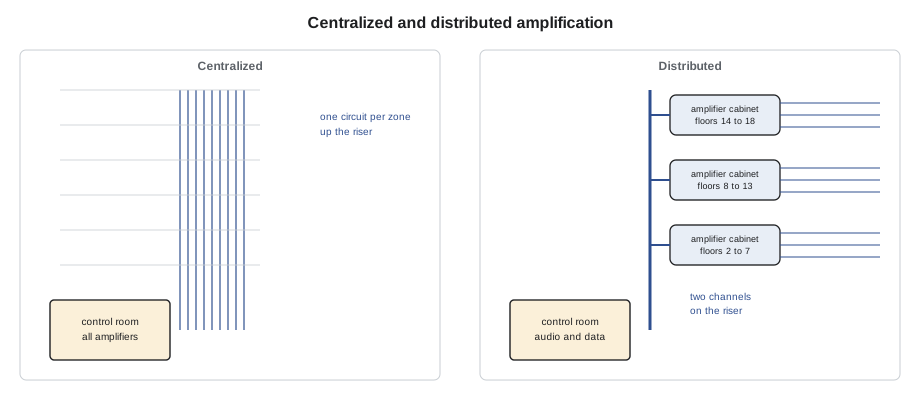
Riverlight's new system is distributed. The control unit and message generator are on the ground floor, and amplifier cabinets on floors 2, 8 and 14 each serve six floors. Each cabinet is fed by the audio riser and the fire alarm network, and each has its own power supply and batteries. Ravi chose two audio channels, so that the system can play two different messages at the same time, an evacuation message to the fire floor and the floors next to it, and an alert message to the rest of the building.
Channels and why they matter
A channel is a separate audio path. A single-channel system can play only one message at a time: every zone that is active hears the same thing. That works for buildings that evacuate all at once, but not for phased evacuation, where different floors need different instructions at the same time. A two-channel system can play one message on some zones and another message on others, and a system with more channels can do more at once. When the operator uses the microphone, it typically takes one channel, so a two-channel system can carry a live announcement on one channel while a recorded message continues on the other.
The number of channels also limits how the system can grow. If the building later adds a mass notification function, with its own messages that may need to play at the same time as fire messages, it may need another channel. Ravi's design leaves room in the message generator and the amplifier cabinets for a third channel.
Sizing amplifiers
An amplifier is rated in watts at its output voltage, usually 25 V or 70 V. The load on an amplifier is the sum of the tap settings of all the speakers it drives. If the speakers on a circuit are tapped at a total of 60 W, the amplifier driving that circuit must be able to deliver at least 60 W. But designers don't load amplifiers to their full rating. They leave spare capacity for three reasons: so that speakers can be added later without a new amplifier, so that taps can be turned up during commissioning if a space turns out to need it, and so that the amplifier runs well within its rating, which keeps distortion low. A spare capacity of 20 to 25 percent is common in specifications; the code itself generally leaves the margin to the designer, the specification and the manufacturer's instructions.
Amplifiers also need power, and like every part of a fire alarm system they need secondary power. An amplifier draws a small current when idle and a much larger current when it is delivering audio, and the battery calculation must include both. The standards set how long the system must run on batteries, as FAT-130 covered: a period of supervisory standby followed by a period of alarm, and for voice systems the alarm period is often longer than for tone systems. Because amplifiers are power-hungry, they are usually the largest load in a voice system's battery calculation, and their cabinets often contain the largest batteries in the building.
# Amplifier sizing for one Riverlight amplifier cabinet (floors 2 to 7)
SPARE = 0.25          # design spare capacity, 25 percent
per_floor_taps = [
    ("corridor speakers", 6, 1.0),
    ("suite living speakers", 8, 0.5),
    ("suite bedroom speakers", 10, 0.25),
    ("elevator lobby speaker", 1, 0.5),
]
floors = 7 - 2 + 1
floor_w = sum(n * w for _, n, w in per_floor_taps)
stair_w = 2 * 1.0 * floors / 3          # stair speakers every third floor in each of 2 stairs
load = floor_w * floors + stair_w
need = load * (1 + SPARE)
print(f"Tapped load per floor: {floor_w:.1f} W, floors served: {floors}")
print(f"Stair speakers: {stair_w:.1f} W")
print(f"Total load: {load:.1f} W, with {SPARE:.0%} spare: {need:.1f} W")
for size in (60, 120, 250, 500):
    if size >= need:
        print(f"Smallest standard amplifier that fits: {size} W per channel")
        break
# each channel carries the same zones, so both channels are sized for the full load
print(f"Two channels: 2 x {size} W in this cabinet")Tapped load per floor: 13.0 W, floors served: 6 Stair speakers: 4.0 W Total load: 82.0 W, with 25% spare: 102.5 W Smallest standard amplifier that fits: 120 W per channel Two channels: 2 x 120 W in this cabinet
The result shows that each channel in the floor 2 cabinet needs a 120 W amplifier. Ravi's design uses the same size in all three cabinets, and a spare amplifier module in the floor 8 cabinet that the system switches in automatically if one fails, a feature many systems offer and many authorities expect in tall buildings.
Backup amplifiers and survivability
Because a failed amplifier silences every speaker it drives, voice systems often include a backup amplifier that is switched in automatically when a primary amplifier fails. The control unit supervises each amplifier and reports a trouble if one fails, and in systems with backup it reports that the backup is in use. The risers that carry audio and data between the control location and the amplifier cabinets are among the pathways the codes protect against fire, so that a fire on one floor can't cut off the speakers on the floors above it.
In the United States, NFPA 72 requires pathway survivability for voice systems that use partial evacuation, relocation or selective evacuation. In buildings of fire-resistance-rated construction of two hours or more, which includes most high-rise buildings, the pathways to the notification zones must generally meet survivability Level 2 or Level 3, unless the building meets the specific conditions in Chapter 24. Riverlight's audio and data riser runs in a two-hour rated shaft, and the speaker circuits leave it within each floor's own notification zone.
Speaker zones
A speaker zone, or notification zone, is an area that can receive its own message. In most buildings the zones follow the fire alarm zones and the evacuation plan: at least one zone per floor, separate zones for stairs and elevator lobbies, and in large floors separate zones for each fire compartment or smoke compartment. Zones must not be so large that people in one area hear instructions meant for another, and they must line up with how the building will actually be evacuated.
At Riverlight, each floor is one zone for corridors and suites, the two stairs are separate zones, the elevator lobbies on each floor are part of their floor's zone, and the ground floor lobby and amenity room are separate zones. In total the building has 22 speaker zones. Ravi checks that each speaker circuit stays within one zone; a circuit that served two floors would make it impossible to send different messages to them.
Paging and operator control
The operator controls the system from a command panel next to the control unit. It has a microphone, zone selector switches or a touchscreen, indicators showing which zones are active and on which channel, and controls for the firefighter telephones. Most panels also have an 'all call' control that sends the microphone to every zone at once. The panel is designed for a firefighter who may never have seen this building's system before, so it should be clearly labeled with zone names that match the building: '9th floor' rather than 'zone 11'.
Automatic operation comes first. When a detector or pull station activates, the system plays the programmed messages to the programmed zones without anyone touching the panel. The operator's controls are for changing that: adding zones, sending live instructions, or stopping a message once the situation is understood. FAT-210 covered how the control unit's cause-and-effect programming works; in a voice system the outputs of that programming include messages and zones as well as appliances.
Worked problem
Checking amplifier loading after a design change
During construction, the owner decides to add a speaker in each suite's second bedroom on floors 8 to 13, tapped at 0.25 W. All eight suites on each of those floors get one. The floor 8 cabinet's channels are 120 W amplifiers carrying 82 W of load each. Does the cabinet still have the design spare capacity?
Show solution
- Count the added speakers: 8 suites x 6 floors = 48 speakers.
- Find the added load: 48 x 0.25 W = 12 W per channel.
- Find the new load: 82 + 12 = 94 W.
- Find the load with 25 percent spare: 94 x 1.25 = 117.5 W.
- Compare with the amplifier rating: 117.5 W is just under 120 W.
Answer: The cabinet still has its 25 percent spare, but only just. Ravi records that the floor 8 amplifiers have no further room, so any later additions on those floors will need a larger amplifier.
Amplifier cabinets on site
Amplifier cabinets are heavy, and they produce heat when they are delivering audio, so their locations are chosen with care. Each cabinet needs a wall that can carry its weight and its batteries, clearance in front for service, and a room that stays within the equipment's listed temperature range even when the amplifiers run for the full alarm period. At Riverlight, the floor 8 cabinet was first shown in a small closet with no ventilation; Ravi moved it into the electrical room on that floor after the maker's data showed the closet would overheat during a long alarm. Like the control unit, each cabinet has a smoke detector nearby where the standard requires it, so that a fire in the room is detected before it can disable the amplifiers.
Each cabinet is labeled with the floors it serves, the circuits it drives and the branch circuit that feeds it, so that a technician who opens it years later can tell what it does. The battery date and the calculation for that cabinet are kept inside the door.
Common mistakes
MistakeLoading an amplifier to its full rating.
InsteadLeave spare capacity, commonly 20 to 25 percent.
MistakeLeaving amplifiers out of the battery calculation.
InsteadAmplifiers are usually the largest load; include idle and alarm current.
MistakeRunning one speaker circuit across two floors.
InsteadKeep each circuit within one notification zone.
MistakeLabeling command panel zones with numbers only.
InsteadUse names that match the building.
MistakeForgetting that a single-channel system plays one message at a time.
InsteadUse enough channels for the evacuation plan.
Summary and key terms
- Voice systems have recorded and live audio sources; the live microphone takes priority in the zones it selects.
- Audio is distributed centrally or by amplifiers spread through the building.
- Channels limit how many messages can play at once.
- Amplifiers are sized from tapped load plus spare capacity, and need secondary power.
- Risers and amplifier cabinets are protected so that a fire on one floor doesn't silence others.
- Zones follow the evacuation plan, and each speaker circuit stays in one zone.
- Message generator
- A unit that stores and plays recorded voice messages.
- Channel
- A separate audio path that can carry its own message.
- Distributed amplification
- Amplifiers located near the speakers they drive, fed by a low-level audio signal.
- Spare capacity
- Amplifier power left unused for later additions and adjustment.
- Notification zone
- An area that can receive its own message.
- All call
- A control that sends an announcement to every zone at once.
Practice problems
Work each problem on paper first, then reveal the answer to check.
Why does phased evacuation need more than one channel?
Show answer
Different floors need different messages at the same time.
What spare capacity is commonly specified for voice amplifiers?
Show answer
20 to 25 percent.
Why are amplifiers usually the largest battery load?
Show answer
They draw large currents when delivering audio.
What is the advantage of a distributed system?
Show answer
Shorter speaker circuits and less effect from a failure in one location.
A speaker circuit serves floors 4 and 5. What is the problem?
Show answer
The two floors can't receive different messages.
Lesson quiz · 5 questions
Score 60% or more to complete this lesson.
Create a free account to save your progress, take quizzes and earn a certificate.