
FAT-310 · Lesson 5 of 12 · 20 min
Phased and selective evacuation in high buildings and hospitals
Riverlight's two exit stairs are each about 44 in wide. If all 400 or so residents tried to use them at once, the stairs would fill, people from the upper floors would queue at the stair doors, and firefighters climbing up to the fire floor would be fighting a flow of people coming down. 'That's why tall buildings don't empty all at once,' Captain Strand tells Sasha. 'We get the people near the fire out first, and we keep everyone else informed and ready.' Phased and selective evacuation is the main reason high buildings need voice systems, and it is the reason hospitals use relocation instead of evacuation. This lesson covers how these strategies work, how the voice system carries them out, and what the technician must program and test.
Why tall buildings evacuate in phases
Exit stairs in tall buildings are sized for the occupants of a few floors at a time, not for everyone at once. The structure of a high building, with fire-resistant floors, fire separations around each suite or tenancy, sprinklers and smoke control, is designed to contain a fire to the floor where it starts long enough for the people on that floor and the floors next to it to leave. People on floors well away from the fire are protected by that construction, and they are safer staying where they are, informed and ready, than crowding into stairs where smoke from the fire floor may enter.
The usual strategy evacuates the fire floor, the floor above and the floor below first, because they are at greatest risk: the fire floor directly, the floor above from smoke and fire spread up the outside of the building, and the floor below from falling debris and the need for firefighting access. The rest of the building receives an alert message. If the fire grows or smoke spreads, the fire department or the system can extend the evacuation to more floors, often two floors at a time upward from the fire.
In the United States, the IBC requires the high-rise EVACS to automatically sound an alert tone followed by voice instructions on at least the alarm floor, the floor above and the floor below. NFPA 72 calls strategies like this partial evacuation or selective evacuation, and it requires the voice system's pathways to meet survivability requirements when they are used, as lesson 2 explained. The rest of the building receives an alert or stand-by message, as the emergency plan decides, and the fire department controls any further evacuation from the fire command center.
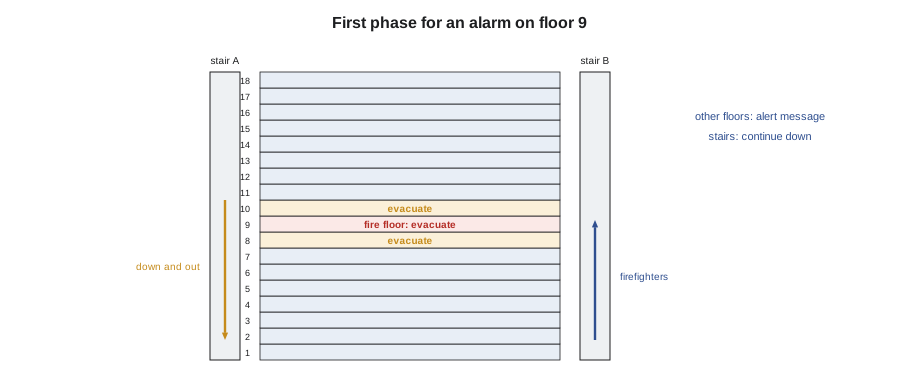
Programming the phases
The control unit's programming carries out the first phase automatically. When a detector or pull station activates on a floor, the programming sends the evacuation message to that floor's zone and the zones of the floors above and below, sends the alert message to every other floor, and sends a stairwell message to the stair zones. If a second device activates on another floor, the programming adds that floor and its neighbors to the evacuation. Special cases need their own rules: an alarm on the top floor has no floor above; an alarm in the basement or parking levels may evacuate the ground floor too; an alarm in a stair or an elevator shaft may need its own response.
# Phased evacuation schedule for an 18-story building
FLOORS = list(range(1, 19))
def first_phase(alarm_floors):
    evac = set()
    for f in alarm_floors:
        for g in (f - 1, f, f + 1):
            if g in FLOORS:
                evac.add(g)
    alert = [f for f in FLOORS if f not in evac]
    return sorted(evac), alert
def extend(evac, steps):
    # the fire department extends the evacuation two floors at a time upward
    top = max(evac)
    added = [f for f in range(top + 1, top + 1 + 2 * steps) if f in FLOORS]
    return sorted(set(evac) | set(added))
for alarms in ([9], [18], [1], [9, 12]):
    evac, alert = first_phase(alarms)
    print(f"Alarm on floor(s) {alarms}: evacuate {evac}, alert {len(alert)} floors")
evac, _ = first_phase([9])
print("After two extensions:", extend(evac, 2))Alarm on floor(s) [9]: evacuate [8, 9, 10], alert 15 floors Alarm on floor(s) [18]: evacuate [17, 18], alert 16 floors Alarm on floor(s) [1]: evacuate [1, 2], alert 16 floors Alarm on floor(s) [9, 12]: evacuate [8, 9, 10, 11, 12, 13], alert 12 floors After two extensions: [8, 9, 10, 11, 12, 13, 14]
Running the schedule for the cases that matter shows how the rules behave at the edges: an alarm on the 18th floor evacuates only floors 17 and 18, and an alarm on the 1st floor evacuates floors 1 and 2. Ravi's design adds a rule the simple schedule doesn't show: an alarm on the 1st floor also evacuates the ground-floor amenity area and the lobby, which are separate zones, because people from the whole building pass through them to leave.
Testing the phases means testing the logic, not just the speakers. For each kind of case in the matrix, the technician activates a device and confirms that every zone receives the message it should, on the channel it should, and nothing else. A program that evacuates floors 8, 9 and 10 correctly for an alarm on floor 9 can still be wrong for an alarm on floor 18 if the 'floor above' rule tries to address a zone that doesn't exist.
Stairs, elevator lobbies and the ground floor
Stairs are separate zones because people in them are in a different situation from people on the floors. Once people are in a stair, they need to be told to continue down and out, not to return to their floor; a message telling the 15th floor to stay in place must not play in the stair that the 9th floor is using. Elevator lobbies get the same message as their floor in most systems, but in buildings with occupant evacuation elevators, which some tall buildings now use, the lobbies get their own messages telling people whether the elevators are available.
The ground floor is where everyone ends up. Its messages need to tell people where to go once they are out of the stair, so that they don't gather at the door and block it, and so that they move to the meeting place set out in the emergency plan.
Hospitals: relocation instead of evacuation
Hospitals can't evacuate like other buildings. Many patients can't walk, some are connected to equipment, and moving them outside, especially in winter, can harm them. Hospital fire safety relies instead on defending patients in place and moving them horizontally, through a fire door or smoke door into the next smoke compartment on the same floor, if the fire threatens them. Staff are trained to do this, and the fire alarm system supports them by telling them, quietly and precisely, where the fire is.
At Eastview General Hospital, the main tower uses private mode signaling in the patient care areas: chimes and coded voice messages that staff hear but that are not loud enough to wake or alarm patients, with public mode signals in public areas such as lobbies and cafeterias. The messages are written for staff, using the hospital's emergency code words. The relocation strategy is supported by the smoke compartments the IBC requires, and the north wing, below the high-rise threshold, uses a simpler system without voice, as FAT-220 described.
The voice system in a hospital must be designed with the hospital's emergency plan, and changes to either must be coordinated with the other. A new wing, a changed compartment layout, or a new unit with different patients all change who needs to hear what. The fire alarm technician who services the system needs to know the plan well enough to test it properly, and to recognize when the programming no longer matches it.
Who controls the later phases
Automatic programming handles the first phase. Later phases are usually controlled by people: the fire department's incident commander, or in some buildings the building's own emergency staff, who use the command panel to extend the evacuation, send live instructions, or send an all-clear. The command panel must make this easy, with zone controls that match the floors and a clear display of what each zone is receiving. During commissioning, Captain Strand will want to operate the panel herself, and if she can't work out how to extend the evacuation in a minute or two, the panel's labeling needs to change.
Worked problem
Testing an edge case in the phase programming
During pre-testing, Sasha activates a smoke detector in the 18th-floor corridor. Floors 17 and 18 receive the evacuation message, and the rest of the building receives the alert. But the panel also shows a trouble: 'zone 19 output fault'. What has happened, and what should she do?
Show solution
- Note the symptom: the first phase is correct for floors 17 and 18, but the panel reports a fault on a zone that doesn't exist.
- Look at the programming: the 'floor above' rule is trying to activate zone 19, which is the mechanical penthouse and has no speaker circuit.
- Decide whether the penthouse needs a message: it has rooftop equipment and maintenance staff may be there.
- Report it to Ravi, who confirms that the penthouse has two speakers on the 18th floor's circuit and that the rule should stop at 18.
- After the programming is corrected, repeat the test and record the result.
Answer: The fault was in the programming, not the wiring. The corrected rule stops at the top floor, and the test is repeated for the other edge cases: floors 1 and 2, and an alarm in each stair.
Occupant evacuation elevators
Some very tall buildings now allow occupants to use specially protected elevators to evacuate during a fire, because walking down 40 or 60 floors takes too long and is too hard for many people. These occupant evacuation elevators have protected lobbies, protected power and controls, and their own operating sequence. The voice system plays a large part: messages in the elevator lobbies tell people whether the elevators are available and how long they may have to wait, and messages on the floors tell people whether to use the elevators or the stairs. Riverlight's elevators are not occupant evacuation elevators, and its messages tell residents not to use them. But fire alarm technicians who work on newer towers will meet these systems, and the same rules apply: the messages are part of the design, they must match the operating sequence, and every case is tested.
Coordinating with the emergency plan
Phased evacuation only works if the people in the building know what the messages mean and what to do. The building's fire safety plan describes the strategy, the roles of the building's staff, the help available for people who can't use the stairs, and how residents are told about the plan. At Riverlight, the property manager distributes a summary to every suite and holds an annual fire safety meeting, and the new messages are played during the first meeting after commissioning so that residents recognize them. The fire alarm technician's role is to make sure the system matches the plan. If the plan changes, for example if the building decides to evacuate four floors in the first phase instead of three, the programming and the messages must change with it, and the change must be tested.
Hospitals carry this further. Their staff are trained regularly in the emergency codes and the relocation procedures, and fire drills test the system and the staff together. When Bramwell tests the Eastview voice system, the hospital's emergency preparedness staff take part, so that the test checks the messages and the response as well as the equipment.
Common mistakes
MistakeEvacuating every floor of a high building at once.
InsteadEvacuate the fire floor and the floors next to it first, and alert the rest.
MistakeTesting phases only for a mid-height floor.
InsteadTest the edge cases: top floor, bottom floor, stairs and multiple alarms.
MistakePlaying a stay-in-place message in the stairs.
InsteadGive stairs their own message to continue down and out.
MistakeWriting hospital messages for patients.
InsteadWrite them for staff, using the hospital's codes.
MistakeChanging a hospital's programming without its emergency plan.
InsteadCoordinate any change with the plan.
Summary and key terms
- High buildings evacuate the fire floor, the floor above and the floor below first, and alert the rest.
- The voice system carries out the first phase automatically; people control the later phases.
- Stairs, elevator lobbies and the ground floor need their own messages.
- Hospitals defend in place and relocate patients horizontally, with messages written for staff.
- Testing covers the programming logic, including edge cases, not just the speakers.
- Phased evacuation
- Evacuating the areas at greatest risk first and others later as needed.
- Selective evacuation
- Evacuating only selected areas of a building.
- Relocation
- Moving occupants to a safe area within the building.
- Defend in place
- Protecting occupants where they are rather than evacuating them.
- Smoke compartment
- A part of a floor separated by smoke barriers, used for horizontal relocation.
Practice problems
Work each problem on paper first, then reveal the answer to check.
Which floors are evacuated first in a typical high-building strategy?
Show answer
The fire floor, the floor above and the floor below.
Why are stairs separate speaker zones?
Show answer
People in the stairs need to be told to continue down and out.
How do hospitals usually protect patients from a fire?
Show answer
By defending in place and relocating them horizontally.
Who usually controls later phases of evacuation?
Show answer
The fire department or the building's emergency staff.
Name two edge cases to test.
Show answer
An alarm on the top floor and an alarm on the bottom floor.
Lesson quiz · 5 questions
Score 60% or more to complete this lesson.
Create a free account to save your progress, take quizzes and earn a certificate.