
FAT-310 · Lesson 4 of 12 · 20 min
Messages: alert, evacuate, relocate and shelter
The old Riverlight messages were recorded by a voice actor more than twenty years ago, and nobody at the building remembers who approved the words. One message told residents to use the elevators. Another said 'a fire has been reported in the building' in a voice so slow and calm that, as the property manager put it, 'it sounds like it's announcing the weather'. For the new system, Ravi has drafted a full set of messages, and before they are recorded they go through review by the owner and by Captain Strand's office. 'The words are part of the design,' Ravi tells Sasha. 'A perfect system playing the wrong message is a failed system.' This lesson covers the kinds of messages voice systems use, how they are written, how they are sequenced with tones, and how they are loaded and verified.
The kinds of messages
Every voice system needs a small set of messages that match the building's emergency plan. The common types are:
- Alert messages, which tell people that there is an emergency in the building and that they should stand by for instructions. In two-stage and phased systems, these go to the areas not yet being evacuated.
- Evacuation messages, which tell people to leave the building or the area now, and how.
- Relocation messages, used in hospitals and some other buildings, which tell people to move to another part of the building, such as the next smoke compartment, rather than outside.
- Shelter-in-place messages, which tell people to stay where they are. In a fire, these may go to floors well away from the fire in a tall building; in mass notification they cover events such as severe weather or a hazardous release outside.
- All-clear messages, which tell people that the emergency is over and normal activity can resume, usually issued only by the fire department or the building's emergency staff.
- Test messages, used during inspections so that occupants know the sounds they hear are a test.
Mass notification systems add messages for other events, such as lockdown or a threat in the building; lessons 9 and 10 cover these. The building's emergency plan decides which messages are needed, and the authority must accept them.
How messages are written
Good emergency messages share a few features. They are short, so that they can be repeated several times within a minute. They use plain words and short sentences, so that people under stress, people who speak the language as a second language, and people listening through poor acoustics can still understand them. They say what is happening, what to do, and how: 'An emergency has been reported in the building. Please leave the building now by the nearest exit stair. Do not use the elevators.' They avoid technical terms such as 'zone' or 'alarm condition', and they avoid words that might cause panic. Where it helps, they name the place: messages that identify the floor are possible in systems that select messages by zone.
Messages are recorded by a clear, natural voice at a moderate pace, usually by a professional speaker in a studio, so that they sound calm but serious. Male and female voices are both used; what matters most is that the voice is clear in the frequency range that the speakers reproduce well. Some buildings record messages in more than one language, which doubles their length. Many US buildings add Spanish messages where a large share of occupants speak Spanish, and Riverlight's owner chose English and Spanish messages. A bilingual message cycle takes much longer, so the sequence has to be checked to make sure the repeats still fit.
NFPA 72 requires the content of voice messages to follow the building's emergency response plan, and the IBC requires the system to deliver an alert tone followed by voice instructions. Messages are part of the submittal the authority reviews, and NFPA 72's annex gives guidance on writing them clearly.
Tones and messages together
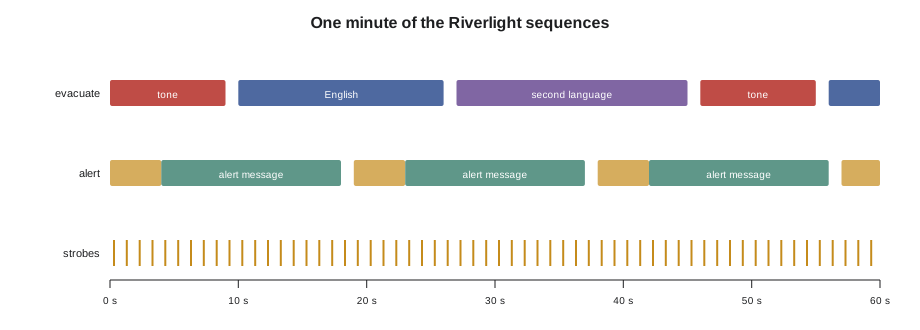
Voice systems don't use voice alone. Each message is normally preceded by an alert or evacuation tone that gets people's attention, and in many systems the tone and the message alternate. In an evacuation, the system might sound the temporal-three evacuation signal for a few cycles, then play the evacuation message, then repeat, so that the tone keeps signaling 'leave' and the message keeps explaining how. The pattern and lengths are set by the standard, the authority and the message design. The visible signals keep flashing throughout, including while the message plays, because people who can't hear the message still need the signal.
In the United States, the IBC requires an alert tone followed by voice instructions, and NFPA 72 sets the evacuation tone pattern and requires the voice message to follow it. A common sequence is a few cycles of the temporal-three evacuation tone followed by the message, repeated, with the message itself repeated several times in each cycle; the exact pattern is set by the design and the authority. Visible signals keep flashing throughout, including while the message plays.
# Message sequence check: how many complete cycles fit in the first minute?
tone = 9.0             # seconds of evacuation tone per cycle (three temporal-three cycles)
msg_en = 16.0            # English evacuation message, seconds
msg_2 = 17.0             # second-language message, seconds
gap = 1.0                # silence between parts
cycle = tone + gap + msg_en + gap + msg_2 + gap
print(f"One cycle: {cycle:.1f} s")
t = 0.0
n = 0
log = []
while t + cycle <= 60:
    log.append(f"{t:5.1f} s  tone, then English and Spanish messages")
    t += cycle
    n += 1
print("\n".join(log))
print(f"Complete cycles in the first minute: {n}")
print("Message heard at least twice in the first minute:", "yes" if n >= 2 else "no, shorten the messages")One cycle: 45.0 s 0.0 s tone, then English and Spanish messages Complete cycles in the first minute: 1 Message heard at least twice in the first minute: no, shorten the messages
The check shows that, with two languages, only one full cycle fits in the first minute. Ravi's first draft of the English message was 22 s long; trimming it to 16 s and the second-language message to a similar length gives the result above. He decides to shorten both messages further, to bring the second cycle inside the first minute, because he wants every resident to hear the instructions at least twice before they start moving.
Messages for phased and selective evacuation
In a phased system, different floors get different messages at the same time, as lesson 5 explains. The messages have to make sense side by side. Residents on the 9th floor hear 'leave the building now by the nearest exit stair', while residents on the 15th hear 'an emergency has been reported in the building; stay where you are and wait for further instructions'. If a resident on the 15th floor opens the stair door and hears the evacuation message playing in the stair, the two messages must not contradict each other in a way that causes confusion. Stairwell messages are often written for everyone in the stair: 'continue down the stairs to the ground floor and leave the building'.
The 'stay where you are' instruction is the hardest one to write well. People's instinct is to leave, and a message that tells them not to must give a reason and a promise: there is no danger to them now, they are protected where they are, and they will be told if they need to move. In residential towers built with fire separations between suites, staying in place can be safer than entering a stair that may fill with smoke and with people from the fire floor.
Loading and verifying messages
Messages are loaded into the message generator from files supplied by the designer or the recording studio, and each is assigned to its event and its channel in the programming. Verifying them is a technician's job, not just a programmer's. For each message, the technician confirms that the correct file is assigned to the correct event, that it plays from start to finish without being cut off, that it plays in the right zones and on the right channel, that its level is correct relative to the tones, and that the words are the approved words. A message that starts half a second late can lose its first word, and a message assigned to the wrong event can tell people to stay when they should leave.
Every message is checked by listening to it in the building, through the speakers, in several representative spaces. A message that sounds perfect on the generator's headphone jack can sound quite different through a speaker in a stairwell. The approved script is kept in the documentation, and the message files are kept with the site-specific software so that they can be reloaded after a failure.
Worked problem
Reviewing a draft evacuation message
Ravi's first draft reads: 'Attention please. An alarm condition has been detected in zone 9. All occupants of the affected zone are requested to proceed to the nearest available means of egress and evacuate the premises in an orderly fashion. Elevators are not to be used. Thank you.' What would Sasha and Captain Strand change?
Show solution
- Remove technical terms: 'alarm condition', 'zone 9', 'affected zone' and 'means of egress' mean nothing to most residents.
- Use short, direct instructions: 'Leave the building now by the nearest exit stair.'
- Keep the important warning: 'Do not use the elevators.'
- Cut words that add length without meaning, such as 'in an orderly fashion' and 'thank you'.
- Read the new message aloud and time it, and check that the cycle still fits the sequence.
Answer: The revised message reads: 'May I have your attention please. A fire emergency has been reported in the building. Leave the building now by the nearest exit stair. Do not use the elevators.' It is shorter, clearer and easier to understand through a speaker.
Messages for people with different needs
Messages must work for everyone in the building, not only for people who hear well and speak the main language. For people who are deaf or hard of hearing, the visible signals carry the alarm, and in buildings with text displays the message text is shown as well. For people with cognitive disabilities and for children, short, simple sentences and a calm, steady voice matter most. For people who speak another language, a second-language message helps, but only if the cycle still repeats often enough. And for people who are blind or have low vision, the message itself should mention useful cues, such as the location of the nearest exit stair, rather than relying on signs they can't read.
Messages should also avoid giving instructions that some occupants can't follow. 'Use the stairs' is correct for most people, but residents who can't use stairs need to know what to do instead. Riverlight's evacuation message adds one sentence for them: 'If you need help to leave, go to the elevator lobby on your floor and use the call station.' Lesson 8 covers the call stations that make this instruction work.
Changing messages after commissioning
Messages change when the emergency plan changes. A building that moves from full evacuation to phased evacuation, a hospital that renames its emergency codes, or a school that adds a lockdown procedure all need new or revised messages. Changing a message is a change to the fire alarm system: the new script is approved, the new file is loaded and assigned, every event that uses it is tested, and the documentation is updated. Bramwell treats a message change like any other programming change, with a record of what was changed, why, by whom, and how it was tested. The old message files are kept until the new ones are accepted, so that the system can be restored if a problem is found.
Test messages need the same care. A test message that is mistaken for a real one causes alarm; a real message that is mistaken for a test can be ignored. Test messages start with the word 'test' and are used only during scheduled tests, with occupants told beforehand.
Common mistakes
MistakeWriting messages in technical language.
InsteadUse plain words and short sentences.
MistakeMaking messages so long that they can't be repeated.
InsteadKeep them short, and check the cycle timing.
MistakeAssuming the words are someone else's responsibility.
InsteadCheck every message against the approved script.
MistakeTesting messages only at the generator.
InsteadListen to every message through the speakers in the building.
MistakeLetting strobes stop while the message plays.
InsteadVisible signals keep operating throughout.
Summary and key terms
- Voice systems use alert, evacuation, relocation, shelter, all-clear and test messages.
- Messages are short, plain and direct, and say what is happening, what to do and how.
- Tones and messages alternate, with timing set by the code, standard and authority.
- Phased systems need messages that make sense side by side.
- Every message is verified for content, event, zone, channel, level and completeness.
- Alert message
- A message telling people there is an emergency and to stand by for instructions.
- Evacuation message
- A message telling people to leave the building or area now.
- Relocation message
- A message telling people to move to another part of the building.
- Shelter-in-place message
- A message telling people to stay where they are.
- Message cycle
- One repetition of the tone and message sequence.
Practice problems
Work each problem on paper first, then reveal the answer to check.
Why must messages be short?
Show answer
So they can be repeated several times in the first minute.
What three things should an evacuation message say?
Show answer
What is happening, what to do and how.
Why does a bilingual message need a timing check?
Show answer
The cycle is much longer, so fewer repeats fit.
Who usually issues an all-clear message?
Show answer
The fire department or the building's emergency staff.
Why is every message checked through the building's speakers?
Show answer
It can sound very different from the generator's output.
Lesson quiz · 5 questions
Score 60% or more to complete this lesson.
Create a free account to save your progress, take quizzes and earn a certificate.