
FAT-310 · Lesson 11 of 12 · 20 min
Testing voice systems: audibility and intelligibility measurements
Two weeks before the Riverlight commissioning, Gerry hands Sasha a hard case with a sound level meter, a small speaker on a stand and a calibrator. 'Tones you can test with your ears and a meter,' he says. 'Voice you test with your ears, a meter and this,' pointing to an intelligibility analyzer that runs the STIPA test. 'And with a plan, because there are more than four hundred speakers in this building and the measurements have to be taken in the right places, at the right times, with the right noise in the room.' This lesson covers how voice systems are tested: the functional tests of the equipment, the sound level measurements, the intelligibility measurements, the test plan that ties them together, and the records that prove the system works.
What has to be tested
Testing a voice system means proving everything the earlier lessons described. The equipment works: every amplifier, the backup amplifier switching, the message generator, the microphone, the command panel controls and the telephones. The supervision works: every speaker circuit reports an open, a short and a ground fault. The programming works: every input produces the right message in the right zones on the right channel, including the phased evacuation cases and the edge cases. The messages are right: each plays completely, with the approved words, at the right level relative to the tones. And people can hear and understand the messages throughout the building, which is proved by measurement.
For a new system, these tests are part of the acceptance testing required by NFPA 72, which FAT-330 covers in detail, and the results go into the record of completion and its emergency communications supplement. After that, NFPA 72's Chapter 14 sets the periodic inspection and testing of voice equipment, as FAT-230 described, including the tests of speakers, amplifiers, telephones and intelligibility after changes.
Functional testing
Functional tests come first, because there is no point measuring intelligibility in a zone whose amplifier has failed. Each amplifier is tested at its rated load, with the full alarm message playing on every circuit it drives, while its output is checked and its cabinet's batteries are checked under load. The backup amplifier is tested by failing a primary amplifier and confirming that the backup takes over and the trouble is reported. Each speaker circuit is tested for supervision by opening it at the last speaker, shorting it, and grounding it, and confirming the correct trouble at the panel each time.
Every speaker is then listened to. With a test message playing, the technician walks the building and listens at each speaker for level, clarity, rattles, distortion and silence. The 11th-floor speaker on the wrong tap, which Sasha found in lesson 3, is the kind of fault this walk finds. Speaker taps are checked against the schedule, and any that were changed during commissioning are recorded. The command panel, microphone and all-call are tested by making live announcements to each zone and to all zones, and the telephone system is tested station by station, as lesson 7 described.
Measuring sound level
Sound levels are measured with a sound level meter set to A-weighting and to the time weighting the standard calls for. The meter is checked with its calibrator before and after each session, so that the readings can be trusted. Measurements are taken at the height of a listener's ears, standing or seated as the space is used, and in the places the standard and the design require, including the farthest points from the speakers and, in sleeping areas, at the pillow with the bedroom door closed.
For voice systems, sound level is measured both for the tones and for the voice messages. The tones must meet the audibility rules for the occupancy, as FAT-120 described: a set margin above the ambient noise and, in sleeping rooms, a minimum level. The voice messages need enough level above the noise to be understood, but too much level can make them harder to understand, especially in reverberant spaces, so the target is set by the design. The ambient noise in each space is measured too, with the building in its normal condition, because the margins depend on it.
# Audibility check for tones: measured level against ambient (Riverlight sample)
MARGIN = 15         # dB above ambient required for public spaces in this design
MAX_DBA = 110
SLEEP_MIN = 75           # dBA at the pillow, bedroom door closed
readings = [
    # (location, ambient dBA, tone dBA, sleeping area?)
    ("Floor 9 corridor, far end", 48, 71, False),
    ("Suite 905 living area", 42, 68, False),
    ("Suite 905 bedroom, pillow", 35, 77, True),
    ("Suite 912 bedroom, pillow", 36, 73, True),
    ("Stair A, floor 9 landing", 52, 74, False),
    ("Ground floor lobby", 58, 75, False),
]
for loc, amb, tone, sleep in readings:
    need = max(amb + MARGIN, SLEEP_MIN) if sleep else amb + MARGIN
    ok = need <= tone <= MAX_DBA
print(f"{loc:28s} ambient {amb} dBA, tone {tone} dBA, need {need} {'pass' if ok else 'FAIL'}")Floor 9 corridor, far end ambient 48 dBA, tone 71 dBA, need 63 pass Suite 905 living area ambient 42 dBA, tone 68 dBA, need 57 pass Suite 905 bedroom, pillow ambient 35 dBA, tone 77 dBA, need 75 pass Suite 912 bedroom, pillow ambient 36 dBA, tone 73 dBA, need 75 FAIL Stair A, floor 9 landing ambient 52 dBA, tone 74 dBA, need 67 pass Ground floor lobby ambient 58 dBA, tone 75 dBA, need 73 pass
The sample shows one failure in each country's version: the bedroom in suite 912, where the level at the pillow falls short. Sasha finds that the bedroom speaker in that suite is mounted on the far side of a closet bulkhead; the design moves it, and the retest passes.
Measuring intelligibility
Intelligibility is measured with an instrument that plays a test signal through the voice system and measures how well its modulation survives at the listener's position. The most common method for public address and emergency systems is STIPA, a shortened form of the Speech Transmission Index that gives a reliable result in about 15 to 25 seconds per position. The test signal is played through the system at the same level as the voice messages, from the message generator or through the microphone input, and the meter at the listening position reports the STI. Because background noise lowers the STI, measurements are taken with the building's normal noise present, or the noise is measured separately and its effect calculated, as the method and the specification allow.
Measurement points are laid out on a grid in each acoustically distinguishable space, with more points in larger spaces, and are placed at listener height, away from walls, in the places people will actually be. Small spaces such as bedrooms may have one or two points; a long corridor or a lobby may have many. The designer or the specification sets how many points are needed in each type of space, and the commissioning plan lists them, so that the results can be compared with the criteria space by space.
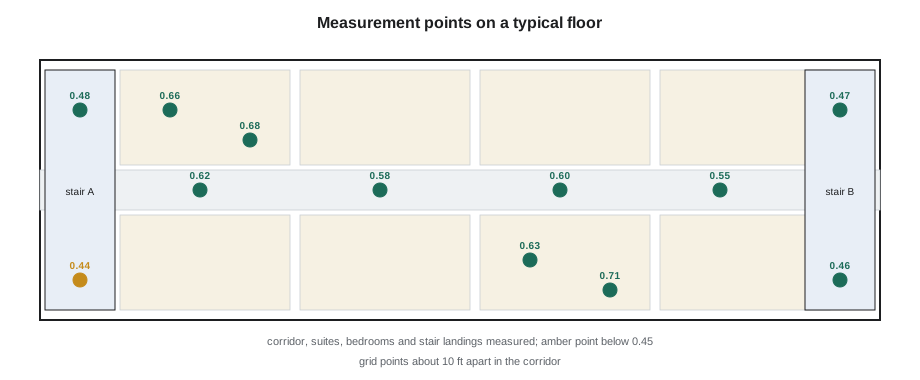
# Intelligibility results by acoustically distinguishable space (STIPA)
results = {
    "Corridor": [0.62, 0.58, 0.60, 0.55],
    "Suite living area": [0.66, 0.63],
    "Suite bedroom": [0.68, 0.71],
    "Elevator lobby": [0.54, 0.51],
    "Stair A landing": [0.48, 0.46, 0.44, 0.47],
    "Ground floor lobby": [0.52, 0.49, 0.47, 0.53, 0.50, 0.48],
}
TARGET_AVG = {"Stair A landing": 0.45}        # accepted lower average for stairs
for space, pts in results.items():
    avg = sum(pts) / len(pts)
    target = TARGET_AVG.get(space, 0.50)
    share = sum(1 for p in pts if p >= 0.45) / len(pts)
    ok = avg >= target and share >= 0.90
print(f"{space:20s} avg {avg:.3f} (target {target:.2f}), points >= 0.45: {share:.0%} {'pass' if ok else 'review'}")Corridor avg 0.588 (target 0.50), points >= 0.45: 100% pass Suite living area avg 0.645 (target 0.50), points >= 0.45: 100% pass Suite bedroom avg 0.695 (target 0.50), points >= 0.45: 100% pass Elevator lobby avg 0.525 (target 0.50), points >= 0.45: 100% pass Stair A landing avg 0.463 (target 0.45), points >= 0.45: 75% review Ground floor lobby avg 0.498 (target 0.50), points >= 0.45: 100% review
The results show two spaces to review. The stair passes on average but has one point below 0.45, so only 75 percent of its points meet the minimum. The ground floor lobby has every point above 0.45, but its average, 0.498, is just under the target. Ravi decides to add a speaker near the lobby's mailboxes, where the lowest readings were taken, and to accept the stair result with the authority's agreement, because the low point is at the bottom landing beside the exit door, where people are leaving the stair rather than listening.
Planning the tests
A voice system test is too large to improvise. The commissioning plan lists every test, the order in which they are done, who will do them and who will witness them, and the criteria for each. Functional tests come first, then supervision, then programming, then sound level and intelligibility, and finally the integrated tests with other systems and the fire department's witness test. The plan also deals with the people in the building: occupants must be told when tests are happening, especially in an occupied apartment building, and access to suites for bedroom measurements has to be arranged with the residents. Measurements in occupied buildings are often done at set times so that residents know when to expect noise.
Records
Every test produces a record: what was tested, when, by whom, the readings, the criteria and the result. Sound level readings are recorded with the meter's identity and calibration, the ambient noise and the measurement location. Intelligibility readings are recorded with the method, the measurement points and their positions on a plan, and the result for each space. Failed tests are recorded along with the correction and the retest. These records become part of the verification report or record of completion, and they are the baseline for later inspections: when an inspector finds a space that seems quieter or less clear in five years, the original measurements show what it was.
Worked problem
Sorting out a low STI in a suite living area
In suite 1508, the living area measures STI 0.41, well below the other suites. The tone level is fine, and the speaker sounds normal. What should Sasha check?
Show solution
- Check the conditions: the resident is home with a television on and a window open to the street, raising the background noise.
- Measure the background noise and compare it with the other suites: it is 12 dB higher.
- Repeat the measurement with the television off and the window closed, as the test plan requires for normal conditions.
- Check for anything unusual in the room: a large bare tile floor and glass wall make it more reverberant than other suites.
- Record both results and report the reverberant finish to Ravi, who decides whether the design needs a change.
Answer: With normal conditions restored, the living area measures 0.52 and passes. The record notes the conditions of both measurements, so that the result can be understood later.
Instruments and their care
The instruments used for voice testing need care. Sound level meters must meet the accuracy class the standard calls for and be calibrated by a laboratory at the interval the maker recommends, usually yearly, with the certificate kept on file; the field calibrator checks the meter each day but doesn't replace the laboratory calibration. Intelligibility meters must use the test method the specification names, and their software version is recorded with the results, because methods have been revised over the years. The test signal source, whether a file in the message generator or a portable player connected to the microphone input, must be set to the level that matches the voice messages, or the results won't represent the real system.
Measurement technique matters as much as the instrument. The meter is held at the listener's ear height, away from the technician's body, which can reflect sound, and away from walls. Readings are taken with doors in their normal positions. In occupied spaces, the technician waits for interruptions such as passing traffic or a resident's television to stop, or notes them on the record. Two technicians measuring the same point should get nearly the same result; when they don't, the technique is checked before the system is changed.
Common mistakes
MistakeMeasuring intelligibility before the functional tests.
InsteadTest the equipment, supervision and programming first.
MistakeUsing an uncalibrated sound level meter.
InsteadCheck calibration before and after each session.
MistakeTaking measurements only near the speakers.
InsteadMeasure at listener positions across each space, including the far points.
MistakeIgnoring the background noise.
InsteadMeasure it, and test under normal conditions.
MistakeRecording a failure without the correction and retest.
InsteadRecord the whole sequence.
Summary and key terms
- Voice testing covers equipment, supervision, programming, messages, audibility and intelligibility.
- Every speaker is listened to, and every tap checked against the schedule.
- Sound levels are measured with a calibrated meter at listener positions, with the ambient noise recorded.
- Intelligibility is measured with STIPA at grid points in each acoustically distinguishable space.
- A commissioning plan orders the tests and arranges access and notice.
- Records of every reading become the baseline for later inspections.
- Sound level meter
- An instrument that measures sound pressure level, usually in dBA.
- Calibrator
- A device that produces a known sound level to check a meter.
- STIPA
- A shortened Speech Transmission Index method used for emergency and public address systems.
- Ambient noise
- The normal background sound in a space.
- Measurement grid
- The set of positions at which readings are taken in a space.
Practice problems
Work each problem on paper first, then reveal the answer to check.
Why are functional tests done before intelligibility measurements?
Show answer
A failed amplifier or wrong programming would make the measurements meaningless.
Where is the sound level measured in a sleeping room?
Show answer
At the pillow, with the bedroom door closed.
How long does a STIPA measurement take at one point?
Show answer
About 15 to 25 seconds.
Why is ambient noise recorded with each measurement?
Show answer
The margins and the STI depend on it.
What makes the test records useful years later?
Show answer
They are the baseline for comparing later inspections.
Lesson quiz · 5 questions
Score 60% or more to complete this lesson.
Create a free account to save your progress, take quizzes and earn a certificate.