
FAT-310 · Lesson 1 of 12 · 21 min
Why voice beats tones: emergency voice communication
Riverlight Tower, the 18-story apartment building that Bramwell Fire Protection has looked after for years, is getting a new voice evacuation system. The old one went in when the building was new. Its amplifiers are past the age at which the maker supports them, two floors have speakers that crackle, and the recorded messages still tell residents to 'use the elevators to leave the building', an instruction that was wrong even when it was recorded. Ravi Menon has designed the replacement, and Gerry Tremaine and Sasha Vukovic will install, program and commission it over the next several months. On the first site visit, Captain Helen Strand from fire prevention walks the corridors with them. 'In a tower this size,' she says, 'the voice system is how we talk to four hundred people who can't see us. If they can't understand it, it isn't working, however loud it is.' This course follows that project, and it uses the other Bramwell buildings to cover the parts of voice and mass notification that a tower doesn't need.
What a tone can and can't tell people
A fire alarm tone carries one message: something is wrong, leave. That is enough in a small building where everyone can see the exits and nobody needs to make a choice. It is not enough in a building where people need instructions. A horn can't tell residents of the 14th floor to stay in their suites while the 6th floor evacuates. It can't tell hospital staff that the fire is in the east wing and patients in the west wing should be moved to the next smoke compartment rather than outside. It can't tell people that one stair is filling with smoke and they should use the other. And it can't tell anyone when the danger is over.
Research on how people respond to alarms points the same way. People do not react to a tone the way designers once hoped. Many first look for confirmation: they check with neighbors, look into the corridor, finish what they were doing, or assume the alarm is a test or a false alarm. The time spent deciding whether to act, often called the pre-movement time, can be longer than the time it takes to walk out. A clear spoken message that says what is happening and what to do shortens that delay, because it answers the questions people would otherwise stop to ask.
Voice also reaches people that tones fail. A tone means nothing to a visitor who doesn't know the building's signals, or to someone who has never heard that particular sound. A spoken message in plain words, repeated, can be understood by almost anyone who hears it. That is why codes require voice systems where buildings are tall, large, complex or full of people who don't know the building, and why many owners choose voice even where it isn't required.
Where codes require voice communication
In the United States, the International Building Code requires an emergency voice/alarm communication system, usually written EVACS, in several kinds of buildings: high-rise buildings, which in the IBC means buildings with an occupied floor more than 75 ft above the lowest level of fire department vehicle access; large assembly occupancies; certain covered and open malls; and other cases set out in Section 907. In a high-rise, the system must, when activated, sound an alert tone followed by voice instructions on at least the alarm floor, the floor above and the floor below, and it must allow live paging to selected areas: elevator groups, exit stairways, each floor and areas of refuge. NFPA 72, Chapter 24, sets the performance and installation requirements. North Carolina adopts the IBC with state amendments, so these are the rules Riverlight is built to.
Riverlight qualifies on height alone. So does the newest part of Eastview General Hospital's main tower, although Eastview's north wing, at six stories, is below the threshold and has a different system. Willowbank School has no voice system required by the building code, but the school board has asked for a mass notification system for lockdowns, which this course covers in lessons 9 and 10. Cartwright Distribution Center, the warehouse, has neither, but it has the loudest ambient noise of any Bramwell building, and it is the example for why voice in noisy spaces is hard.
The parts of an emergency voice system
A voice evacuation system is built on top of a fire alarm system and shares its control unit, its initiating devices and usually its power supplies. What it adds is a way to make and deliver speech. The main parts are:
- A message source: a digital message generator that stores pre-recorded messages, and a microphone at the control location for live announcements.
- Amplifiers, which raise the audio signal to the power needed to drive many speakers. In large systems they are spread around the building in cabinets on several floors.
- Speaker circuits, which are notification appliance circuits that carry audio at 25 V or 70 V instead of DC, and are supervised like any other notification circuit.
- Speakers and speaker-strobes, the notification appliances that turn the audio into sound, each set to a power tap.
- Zone control: switches or screen controls that let the operator choose which zones hear which message, and the programming that does this automatically.
- Two-way communication: the firefighter telephones or other two-way systems that let responders talk to the control location.
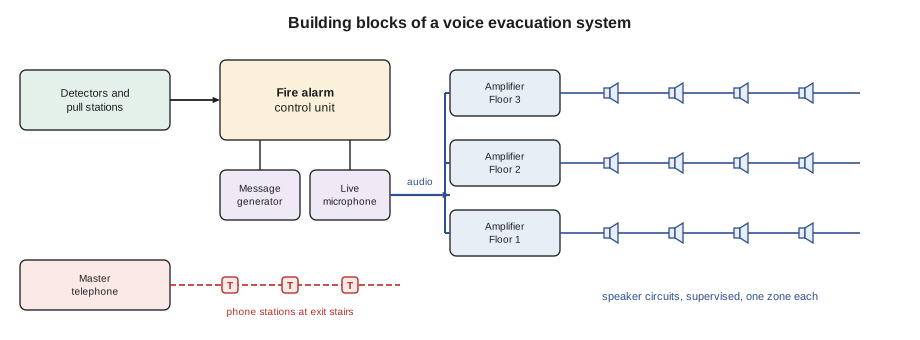
The rest of this course follows those parts in order: architecture and amplifiers in lesson 2, speaker circuits in lesson 3, messages in lesson 4, phased evacuation in lesson 5 and intelligibility in lesson 6. Lessons 7 and 8 cover two-way communication, lessons 9 and 10 mass notification, lesson 11 testing, and lesson 12 the Riverlight commissioning.
What makes voice harder than tones
A tone system works if it is loud enough. A voice system works only if it is loud enough and clear enough. Clarity depends on the room as much as on the equipment: speech that is perfectly clear in a carpeted corridor can become an unintelligible blur in a stairwell, a gymnasium or a parking structure, because the sound reflects from hard surfaces and the reflections smear the syllables together. Background noise masks speech, and turning the system up to beat the noise can make it distort. These problems are why voice systems are designed space by space, and why the standards require voice messages to be intelligible, not just audible. Lesson 6 covers how intelligibility is designed and lesson 11 how it is measured.
Voice systems also have more ways to fail quietly. A tone either sounds or it doesn't. A message can play but be cut off, play in the wrong zone, play over another message, or be recorded with the wrong words. A speaker can be wired out of phase with its neighbor so that the two partly cancel each other along a corridor. A tap can be set too high, so that one speaker is painfully loud and the next is too quiet. None of these shows up as a trouble signal at the panel. The technician's job is to find them during installation and testing, before a real emergency does.
The technician's role
On a voice project, the fire alarm technician installs and terminates speaker circuits and amplifiers, sets speaker taps to the design, loads and checks messages, programs the zone logic and the automatic sequences, tests every speaker and every zone, takes the sound level and intelligibility measurements, and records it all. The designer sets the number, location and tap setting of each speaker and the zoning and messages, and the authority approves them. When a field condition doesn't match the design, such as a room that is louder or more reverberant than expected, the technician reports it to the designer rather than simply turning the speaker up.
Some work on voice systems overlaps with the audio-visual trade. AV installers know a great deal about sound, and many of the same principles apply. But a life safety voice system is a fire alarm system: its equipment must be listed for fire alarm use, its circuits supervised, its power backed up, and its messages controlled by the fire alarm control unit. A background music system or a paging system can share speakers with a voice evacuation system only where the fire alarm system has priority and the combination is listed and approved; FAT-120 and the LVT-310 course on AV systems both touch on this boundary.
# Riverlight voice system: notification inventory from the design schedule
speakers = [
    # (location, quantity per floor, floors, tap watts)
    ("Corridor ceiling speaker", 6, 18, 1.0),
    ("Suite speaker (living area)", 8, 18, 0.5),
    ("Suite speaker (bedroom)", 10, 18, 0.25),
    ("Exit stair speaker", 2, 6, 1.0),
    ("Elevator lobby speaker", 1, 18, 0.5),
    ("Amenity and lobby, ground floor", 10, 1, 1.0),
]
total_spk = 0
total_w = 0.0
for name, per_floor, floors, tap in speakers:
    n = per_floor * floors
    total_spk += n
    total_w += n * tap
    print(f"{name:34s} {n:4d} speakers  {n * tap:7.1f} W")
print(f"Total speakers: {total_spk} Total tapped power: {total_w:.1f} W")Corridor ceiling speaker 108 speakers 108.0 W Suite speaker (living area) 144 speakers 72.0 W Suite speaker (bedroom) 180 speakers 45.0 W Exit stair speaker 12 speakers 12.0 W Elevator lobby speaker 18 speakers 9.0 W Amenity and lobby, ground floor 10 speakers 10.0 W Total speakers: 472 Total tapped power: 256.0 W
The inventory is the starting point for everything else in the design. It tells the installer how many speakers to order and the designer how much amplifier power the building needs. Lesson 2 uses the total tapped power to size the amplifiers.
Worked problem
Choosing between a tone and a voice message
During the walk-through, Captain Strand asks Sasha a question: 'A fire starts on the 9th floor. With the old system, the whole building got the same tone. What can the new system do that the old one couldn't, and why does it matter here?'
Show solution
- Identify who is at risk first: the people on the fire floor and the floors next to it.
- Identify what they need to know: that there is a fire, where it is, and what to do.
- Identify what everyone else needs to know: that there is an emergency elsewhere in the building and whether to stay or prepare to leave.
- Recognize that a single tone can't carry different instructions to different floors, but a voice system can.
- Note that clear instructions shorten the delay before people act, and reduce crowding in the stairs.
Answer: The new system can tell the 8th, 9th and 10th floors to leave by the stairs while telling the rest of the building what is happening and what to do, which gets the people at most risk out first and keeps the stairs clear for them and for firefighters.
Voice systems over the life of a building
A voice system is not finished when it is commissioned. Buildings change: suites are renovated, corridors are carpeted or stripped to concrete, new tenants arrive with different needs, and the emergency plan is revised. Each change can affect what the system should say and whether people can understand it. A renovation that replaces carpet with tile can make a corridor more reverberant; a new tenant that runs loud equipment can raise the background noise; a change from full evacuation to phased evacuation changes every message. The technicians who service the system are often the first to notice that it no longer fits the building, and part of their job is to report it.
Riverlight's old system is an example of what happens when nobody does. Its messages were never updated when the building's emergency plan changed, its speakers were never moved when the ground floor was renovated, and its amplifiers ran for years past the point where spare parts were available. By the time the property manager asked for a quote, almost nothing about the system matched the building. Bramwell's service agreement for the new system includes a yearly review of the messages and the emergency plan with the property manager, so that the new system doesn't drift the same way.
Common mistakes
MistakeThinking a voice system works if it is loud enough.
InsteadVoice must be intelligible as well as audible.
MistakeTurning a speaker tap up to fix a reverberant room.
InsteadReport it to the designer; louder sound in a reverberant room is often less clear.
MistakeTreating a voice system as an AV system.
InsteadIt is a fire alarm system: listed, supervised, backed up and controlled by the fire alarm control unit.
MistakeAssuming a tone tells everyone what to do.
InsteadA tone says 'something is wrong'; instructions need words.
MistakeLeaving out-of-date messages in service.
InsteadMessages are part of the design and must match the building's current evacuation plan.
Summary and key terms
- Voice messages shorten the delay before people act and can give different instructions to different areas.
- Codes require voice systems in high buildings and other large or complex occupancies.
- A voice system adds message sources, amplifiers, speaker circuits, zone control and two-way communication to a fire alarm system.
- Voice must be intelligible, and intelligibility depends on the space as much as the equipment.
- The technician installs, programs and verifies the system and reports field conditions that don't match the design.
- Voice evacuation system
- A fire alarm system that delivers spoken messages as well as tones.
- EVACS
- Emergency voice/alarm communication system, the US term for a fire alarm voice system.
- Pre-movement time
- The time people take to decide to act after an alarm starts.
- Intelligibility
- How well speech can be understood by the people listening.
- Speaker tap
- The power setting chosen on a speaker transformer.
Practice problems
Work each problem on paper first, then reveal the answer to check.
Why does a voice message often get people moving sooner than a tone?
Show answer
It answers the questions people would otherwise stop to ask about what is happening and what to do.
Name three things a voice system can do that a tone can't.
Show answer
Give different instructions to different floors, tell people which exit to use, and say when the emergency is over.
What does a voice system share with the fire alarm system?
Show answer
The control unit, the initiating devices and usually the power supplies.
Why is a stairwell hard for voice?
Show answer
Hard surfaces cause reflections that smear speech.
A room is too reverberant for the design to be understood. What should the technician do?
Show answer
Report it to the designer rather than turning the speaker up.
Lesson quiz · 5 questions
Score 60% or more to complete this lesson.
Create a free account to save your progress, take quizzes and earn a certificate.