
FAT-230 · Lesson 8 of 12 · 20 min
Manual stations, waterflow and supervisory devices
At Cartwright Distribution Center, the sprinkler system is the building's main fire detection. The warehouse roof is too high for smoke detectors to work well, so a fire is detected when a sprinkler opens and water flows past the waterflow switch on the riser. Luis, the sprinkler foreman, meets Sasha and Gerry at riser 2 with a bucket and a hose for the inspector's test connection. 'You test my switches, I test my valves,' he says. 'Between us, we prove the building will call the fire department.' This lesson covers manual stations, sprinkler waterflow switches and supervisory devices, and the coordination between fire alarm and sprinkler trades that their testing needs.
Manual stations
Manual stations, also called pull stations, let a person who sees a fire raise the alarm. Each one is inspected and tested every year.
- Inspection: the station is in its required location near the exit, visible, unobstructed, mounted at the right height, undamaged, and of the right type, such as a two-action station or one with a protective cover where the design calls for it.
- Testing: the station is operated as a person would operate it, using its key or reset tool where needed, and the correct alarm appears at the control unit with the right location. The station is then reset and checked to confirm it latched and restored properly.
Protective covers, the clear hinged covers that sound a local horn when lifted and are used to deter malicious alarms, are tested too: the cover must open freely and its local signal must sound, and the station beneath must still be operable. A cover whose hinge has seized or whose battery is dead keeps people from raising the alarm.
Stations in public areas suffer most. In a school or an apartment lobby, a station may be broken, missing its glass rod or reset tool, or have its cover glued shut. The inspection finds them, and the report lists them with their locations.
Waterflow switches
A waterflow switch, usually a vane type inserted into the sprinkler pipe or a pressure switch on a dry or deluge system, signals that water is flowing in the sprinkler system. It is the link between a sprinkler opening and the fire alarm. The test shows that flow equal to one sprinkler causes an alarm at the control unit within the required time.
Waterflow switches are tested by flowing water through the system's inspector's test connection, which is sized to flow about as much as one sprinkler. The time from opening the valve to the alarm at the control unit is measured; the switch's retard, a built-in delay that keeps pressure surges from causing false alarms, is part of that time. NFPA 72 requires the alarm signal within 90 seconds of waterflow equal to one sprinkler, and NFPA 72 and NFPA 25 both call for waterflow devices to be tested semiannually. The sprinkler side of the test is done to NFPA 25 by the sprinkler contractor or the owner's staff.
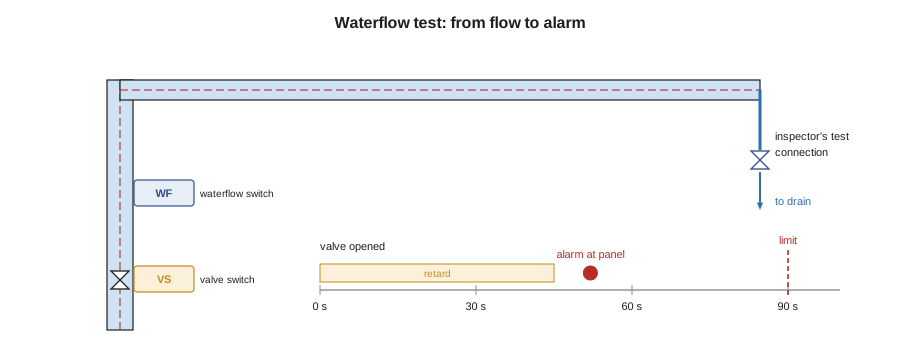
# Waterflow test times against the 90-second limit
limit_s = 90
tests = [("riser 1", 48), ("riser 2", 71), ("riser 3", 104), ("dock dry system", 58)]
for name, t in tests:
print(f"{name:16s} alarm after {t:3d} s {'OK' if t <= limit_s else 'TOO SLOW - check retard setting and switch'}")riser 1 alarm after 48 s OK riser 2 alarm after 71 s OK riser 3 alarm after 104 s TOO SLOW - check retard setting and switch dock dry system alarm after 58 s OK
Riser 3 is too slow. Gerry checks the switch's retard dial and finds it set to its maximum. The setting is reduced to the value the design and the maker call for, and the test is repeated; the alarm now arrives in 52 seconds. Dry systems are different: the flow is detected by a pressure switch that operates when the dry pipe valve trips, and the test is part of the trip test the sprinkler contractor schedules.
The test also checks the outputs. On most systems a waterflow alarm sounds the building alarm, transmits to the monitoring station, and may start the fire pump, which the sprinkler contractor and the building operator watch for. At Cartwright the waterflow alarm also sounds an outside bell by the fire department connection; Sasha checks that it rings.
Valve supervisory switches
Sprinkler control valves must stay open. A valve supervisory switch, often called a tamper switch, signals when a valve is moved from its fully open position. The signal is a supervisory signal, not an alarm or a trouble, because a closed valve isn't a fire and isn't a fault in the fire alarm, but it means the sprinkler system may not work.
Each valve supervisory switch is tested by closing the valve and confirming that the supervisory signal appears at the control unit within two revolutions of the handwheel or when the valve has moved one-fifth of the way from fully open, as NFPA 72 requires, and that the signal restores only when the valve is fully open. NFPA 72 and NFPA 25 call for valve supervisory switches to be tested semiannually. The valve is operated by the sprinkler contractor or the owner's staff, and the valve is confirmed fully open, and sealed or locked where required, before the crew moves on.
The restoring check matters as much as the operating one. A switch that restores before the valve is fully open can let a valve sit half-closed with no signal at the panel. Luis turns each valve back slowly while Gerry watches the panel, and confirms the signal clears only at the last turn.
Other supervisory devices
Other conditions are supervised in the same way, each giving a supervisory signal when it is abnormal:
- low air pressure on a dry pipe sprinkler system, and high air pressure where the switch is fitted;
- low temperature in a dry pipe valve room or a building that could freeze;
- low water level in a gravity tank, or low pressure in a pressure tank;
- fire pump conditions, such as pump running, loss of a phase, phase reversal or the pump controller not in automatic;
- duct smoke detectors, where the design uses them to give a supervisory signal rather than an alarm.
Each is tested by producing the condition or, where that isn't practical, by operating the switch in the way the maker allows, and confirming the correct signal at the control unit and the monitoring station. Fire pump signals are tested during the fire pump's own test, with the building operator and the pump contractor.
# Classify each sprinkler-related signal as it should appear at the panel
signals = {"waterflow riser 2": "alarm", "valve VS-4 moved": "supervisory", "dry system low air": "supervisory",
           "fire pump running": "supervisory", "valve room low temperature": "supervisory",
           "switch wiring open": "trouble"}
received = {"waterflow riser 2": "alarm", "valve VS-4 moved": "supervisory", "dry system low air": "trouble",
            "fire pump running": "supervisory", "valve room low temperature": "supervisory", "switch wiring open": "trouble"}
for name, want in signals.items():
    got = received[name]
print(f"{name:28s} expected {want:11s} got {got:11s} {'OK' if got == want else 'WRONG TYPE - reprogram and retest'}")waterflow riser 2 expected alarm got alarm OK valve VS-4 moved expected supervisory got supervisory OK dry system low air expected supervisory got trouble WRONG TYPE - reprogram and retest fire pump running expected supervisory got supervisory OK valve room low temperature expected supervisory got supervisory OK switch wiring open expected trouble got trouble OK
Coordinating with the sprinkler trade
Waterflow and supervisory testing involves two trades, two standards and the owner's staff, and it goes smoothly only if everyone agrees in advance who does what. The sprinkler contractor operates valves and test connections and inspects the sprinkler side; the fire alarm technician watches the control unit and confirms signals, times and outputs; the owner's staff or the building operator handles the fire pump and anything that affects the building's operation. The results go on both companies' reports.
Water damage is a real risk. The inspector's test connection must discharge to a drain that can take the flow; in winter, outdoor discharges can freeze. Gerry's crew never opens a sprinkler valve or test connection itself unless it is trained and authorized by the owner to do so; that is the sprinkler trade's work.
At the end of the test, every valve must be confirmed fully open, and the control unit must show no supervisory signals. A valve left closed after an inspection is one of the most dangerous mistakes in fire protection, because the building looks protected and isn't. Bramwell's checklist ends with a walk past every valve with the sprinkler foreman, and a photo of each one open.
Worked problem
Cartwright's riser room
At Cartwright, Luis and Gerry test four valve supervisory switches and three waterflow switches. Results: VS-1 signals at one and a half turns and restores at full open; VS-2 signals at four turns; VS-3 restores while the valve is still three turns from fully open; riser 3 waterflow took 104 seconds before adjustment. What is the outcome for each?
Show solution
- VS-1: pass.
- VS-2: fail; the switch must be adjusted or replaced so that it signals within the allowed movement, then retested.
- VS-3: fail; a valve could sit partly closed with no signal. The switch is adjusted or replaced and retested.
- Riser 3: fail on the first test; after adjusting the retard it passed at 52 seconds. Both results are recorded, with the adjustment.
- All valves are confirmed fully open and the panel shows no supervisory signals before the crew leaves.
Answer: Failures are fixed with the sprinkler trade on site where possible, and every valve is left open.
Manual stations in special settings
In some buildings manual stations are deliberately not where the public can reach them. In psychiatric units and some correctional settings, stations are placed where staff can operate them, sometimes key-operated, so that patients or detainees can't misuse them. In buildings where malicious alarms have been a problem, the authority may accept stations with protective covers. The inspection checks that the stations are where the design and the approval put them, and that staff know how to use them; a key-operated station whose key nobody on shift can find is effectively not there.
Sprinkler supervision and the monitoring station
Sprinkler signals are among the most important the monitoring station receives, because a waterflow alarm is often the first sign of a fire in a sprinklered building, and a valve supervisory signal is often the only sign that the sprinkler system has been shut off. During the tests, the technician confirms with the station that each waterflow alarm arrives as an alarm and each valve signal as a supervisory signal, and that the station's response for each is correct: dispatching the fire department for a waterflow, and calling the building contact for a supervisory signal. At Cartwright, Luis also asks the station to confirm the time it received each signal, so that the flow-to-station time can be recorded alongside the flow-to-panel time.
# Flow-to-panel and flow-to-station times for each riser
tests = [("riser 1", 48, 63), ("riser 2", 71, 84), ("riser 3 (after adjustment)", 52, 70), ("dock dry system", 58, 75)]
for name, panel_s, station_s in tests:
print(f"{name:28s} panel {panel_s:3d} s station {station_s:3d} s transmission {station_s - panel_s:3d} s")riser 1 panel 48 s station 63 s transmission 15 s riser 2 panel 71 s station 84 s transmission 13 s riser 3 (after adjustment) panel 52 s station 70 s transmission 18 s dock dry system panel 58 s station 75 s transmission 17 s
The station's response is tested as well as its receipt. Gerry asks the operator, after the waterflow test, what the station would have done if this had not been a test, and checks that the building contact list the station holds is current: an old number for a building manager who left two years ago means a supervisory signal at night reaches nobody.
Common mistakes
MistakeOperating sprinkler valves yourself without authority.
InsteadThe sprinkler contractor or authorized owner staff operate valves.
MistakeTiming waterflow from when the bell rings outside.
InsteadTime from the opening of the test valve to the alarm at the control unit.
MistakeChecking only that a tamper switch operates.
InsteadCheck that it restores only at fully open, too.
MistakeAccepting a supervisory condition coded as trouble.
InsteadEach signal type must arrive as the right type.
MistakeLeaving without confirming every valve is open.
InsteadWalk every valve with the sprinkler foreman at the end.
Summary and key terms
- Manual stations are inspected and operated like a person would operate them.
- Waterflow switches are tested by flowing water from the inspector's test connection.
- The alarm must arrive within 90 seconds; waterflow devices are tested semiannually.
- Valve supervisory switches must signal early and restore only when the valve is fully open.
- Other supervisory devices are tested by producing the condition.
- Sprinkler and fire alarm trades test these devices together, and every valve is left open.
- Manual station
- A device a person operates to raise the alarm.
- Waterflow switch
- A device that signals water flowing in a sprinkler system.
- Inspector's test connection
- A sprinkler test outlet sized to flow about as much as one sprinkler.
- Retard
- A delay in a waterflow switch that prevents false alarms from pressure surges.
- Valve supervisory switch
- A switch that signals when a sprinkler control valve moves from fully open.
- Supervisory signal
- A signal showing an abnormal condition in a monitored system.
Practice problems
Work each problem on paper first, then reveal the answer to check.
How is a waterflow switch tested?
Show answer
By flowing water through the inspector's test connection and timing the alarm at the control unit.
What signal does a valve supervisory switch give?
Show answer
A supervisory signal.
Why check when a tamper switch restores?
Show answer
A switch that restores early lets a valve sit partly closed without a signal.
Who operates the sprinkler valves during the test?
Show answer
The sprinkler contractor or authorized owner staff.
What must be confirmed before leaving?
Show answer
Every valve fully open and no supervisory signals at the panel.
Lesson quiz · 5 questions
Score 60% or more to complete this lesson.
Create a free account to save your progress, take quizzes and earn a certificate.