
FAT-230 · Lesson 10 of 12 · 20 min
Interconnected systems: elevator recall, fans and door releases
On the fourth day at Riverlight Tower, the elevator mechanic, the building operator and the security supervisor are all in the lobby at 9 a.m. Today the crew tests what the fire alarm makes other systems do: recall the elevators, start the stair pressurization fans, shut down the air handlers, release the magnetic door holders, unlock the stair doors and shut off the parking garage's gas-fired heaters. 'Detectors are the easy part,' Gerry tells Sasha. 'This is where systems from five different trades have to work together, and where last year's renovation usually broke something.' This lesson covers the testing of the fire alarm system's interfaces with other building systems.
What the fire alarm controls
Most fire alarm systems do more than sound signals. The sequence of operation describes every output, and each one must be tested. Typical outputs include:
- elevator recall: sending elevators to the designated or alternate landing when a lobby, hoistway or machine room detector operates, and flashing the firefighters' hat warning in the car when a hoistway or machine room detector operates;
- elevator power shutdown: shunt trip of the elevator power before sprinklers in the machine room or hoistway discharge, where required;
- air handling: shutting down supply and return fans, closing smoke dampers, or starting smoke control fans as the design requires;
- stair pressurization: starting fans that keep smoke out of stairwells;
- door releases: releasing magnetic door holders so fire doors close, and unlocking electrically locked doors in the exit path where the code requires;
- other building systems: shutting off fuel gas or heaters, recalling escalators, releasing suppression systems, or sending signals to the building automation and security systems.
Each output is tied to particular inputs. A smoke detector in the third-floor elevator lobby recalls the elevators to the main floor; one in the main-floor lobby recalls them to the alternate floor; a duct detector in AHU-2 shuts down AHU-2 only. Testing means confirming not only that each output works, but that the right input causes it, and only it.
Working from the sequence of operation
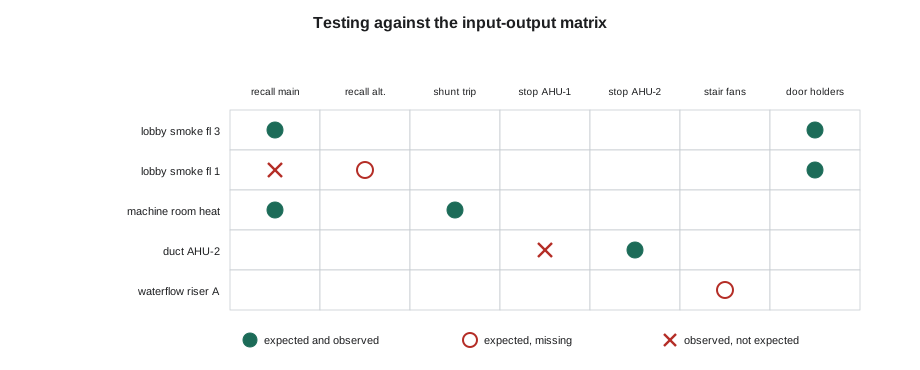
The sequence of operation, often in the form of an input-output matrix, is the test script. Before the interface tests, Gerry marks up the matrix with the rows he will test and the trades who need to watch each output. During the tests, Sasha records what actually happened in each column: did the elevator go to the right floor, did the fan stop, did the door close? Any difference between the matrix and the result is a deficiency, unless the matrix itself is out of date, in which case the matrix is a deficiency and the correct behavior has to be confirmed with the designer and the owner.
# Compare interface test results with the input-output matrix
matrix = {
    "lobby smoke, floor 3": {"recall main", "door holders 3"},
    "lobby smoke, floor 1": {"recall alternate", "door holders 1"},
    "machine room heat": {"shunt trip", "recall main"},
    "duct AHU-2": {"stop AHU-2"},
    "waterflow riser A": {"general alarm", "stair fans start"},
}
observed = {
    "lobby smoke, floor 3": {"recall main", "door holders 3"},
    "lobby smoke, floor 1": {"recall main", "door holders 1"},
    "machine room heat": {"shunt trip", "recall main"},
    "duct AHU-2": {"stop AHU-2", "stop AHU-1"},
    "waterflow riser A": {"general alarm"},
}
for inp, want in matrix.items():
    got = observed[inp]
    missing, extra = want - got, got - want
    status = "OK" if not missing and not extra else f"missing {sorted(missing)} extra {sorted(extra)}"
print(f"{inp:22s} {status}")lobby smoke, floor 3 OK lobby smoke, floor 1 missing ['recall alternate'] extra ['recall main'] machine room heat OK duct AHU-2 missing [] extra ['stop AHU-1'] waterflow riser A missing ['stair fans start'] extra []
Three rows fail. The first-floor lobby detector recalls the elevators to the main floor, which is the floor where the fire is; it must go to the alternate floor. The AHU-2 duct detector also stops AHU-1, which serves the other half of the building and shouldn't stop. And the waterflow alarm doesn't start the stair pressurization fans. Each is a programming or wiring fault to trace, correct and retest.
Elevator recall
Elevator recall testing is done with the elevator mechanic, who is responsible for the elevator's side of the test. The fire alarm technician operates each recall input, and the mechanic confirms that the car responds correctly: Phase I recall to the right landing, doors opening and staying open, the car taken out of normal service, and the firefighters' hat signal flashing for hoistway and machine room detectors. The cars are restored to normal service by the mechanic after each test.
The elevator code, ASME A17.1, and NFPA 72 share the requirements for recall and shunt trip. The tests are coordinated so that both the elevator's periodic tests and the fire alarm's annual inspection cover the interface, and the results go on both reports.
Shunt trip, which removes power from the elevator before machine room or hoistway sprinklers discharge, is tested without actually tripping the power where possible, by confirming the control relay operates and the shunt trip circuit is supervised, and the full trip is done only when the mechanic and the owner agree, because it strands any car in the hoistway.
Fans, dampers and smoke control
Air handling shutdown and smoke control are tested with the building operator, who watches the fans and dampers and the building automation system. Each duct detector and each zone that controls a fan is operated, and the operator confirms the fan stops, the damper closes or the smoke control fan starts as the matrix says. Where the building has a smoke control system, it usually has its own test program under the building code, and the fire alarm technician's part is to confirm the fire alarm inputs and the signals to the smoke control panel.
Many fan shutdowns happen through relays in the building automation system rather than directly from the fire alarm. The test confirms the whole path: a fire alarm relay that operates correctly but feeds a building automation input that was reprogrammed during an energy upgrade is still a failed shutdown.
Door holders and locks
Magnetic door holders keep fire doors open for convenience and release them in an alarm. Each door is checked: the holder releases, and the door closes and latches fully under its closer. A door that releases but doesn't latch, because a closer is weak or the frame is out of square, is a deficiency for the owner's door contractor.
Electrically locked doors in the path of egress, such as stair doors and doors with delayed egress locks, must unlock as NFPA 101 and the building code require when the alarm operates or power fails, and the test confirms each one. Stair doors locked from the stair side for security must unlock on alarm so that people in the stair can re-enter the floors.
# Door release test: every door must release and latch
doors = [("stair A floor 4", True, True), ("stair A floor 5", True, False), ("corridor 6 east", True, True),
         ("corridor 6 west", False, False), ("stair B floor 9", True, True)]
for name, released, latched in doors:
    if not released:
        r = "DID NOT RELEASE - check holder and relay"
    elif not latched:
        r = "released but did not latch - closer or frame"
    else:
        r = "OK"
print(f"{name:18s} {r}")stair A floor 4 OK stair A floor 5 released but did not latch - closer or frame corridor 6 east OK corridor 6 west DID NOT RELEASE - check holder and relay stair B floor 9 OK
Other interfaces
Other systems connected to the fire alarm are tested to the extent the fire alarm controls them: the shutdown of gas-fired heaters in the parking garage, the release of kitchen hood suppression signals, the recall of escalators, and signals sent to the security system and building automation. Where the fire alarm monitors another system, such as a kitchen hood suppression system or a clean agent system in a computer room, the fire alarm technician confirms that the alarm and trouble signals from that system arrive correctly; the other system itself is tested by its own trade.
Where fire protection and life safety systems from several trades depend on each other, NFPA 4 describes integrated testing of those systems together, and many codes and owners now require it at intervals. The annual fire alarm inspection doesn't replace that test, but its interface results feed into it.
Restoring everything
Interface tests change the building's condition: elevators recalled, fans stopped, doors closed, heaters off, sometimes alarms sent to tenants' security systems. At the end, each system is restored by the trade responsible for it, and the building operator confirms that the building is back to normal. Elevators returned to service, fans back on schedule, doors back on their holders where that is allowed. The control unit is checked for any remaining bypass or disabled point.
Worked problem
Riverlight's interfaces
Riverlight Tower's interface tests found: (1) the first-floor lobby detector recalled to the main floor; (2) the AHU-2 duct detector also stopped AHU-1; (3) waterflow didn't start the stair pressurization fans; (4) the stair A floor 5 door released but didn't latch; (5) the corridor 6 west holder didn't release. What happens next?
Show solution
- Items 1 to 3: trace each one. Gerry finds that the program was changed during a controller update last spring, and the recall and fan rows were mapped wrongly. With the owner's approval, the program is corrected from the matrix, and every affected input and output is retested, with the trades present.
- Item 4: a door hardware deficiency for the owner's door contractor.
- Item 5: the holder's relay contact is welded; the relay is replaced and the door retested.
- The program change, the retests and the outstanding door item go in the report.
Answer: A program change requires retesting every function it could affect, not just the one that failed.
When the matrix and the building disagree
Sometimes the interface test shows that the building does something the matrix doesn't describe, and the building is right. A fan added during a renovation may have been wired to shut down on alarm, correctly, but the matrix was never updated. In that case the deficiency is in the documents, not the system. The technician records what the system actually does, confirms with the designer and the owner that it is the intended behavior, and the matrix is revised and filed. A matrix that doesn't match the building is a problem for the next technician and for the fire department, who may rely on it during an incident.
The opposite case is more serious: the matrix describes a function the building no longer has. At an older building on Gerry's route, the matrix shows that the alarm closes a set of smoke dampers that were removed in a mechanical upgrade. The building now has no smoke dampers in that duct, and the question of whether it needs them goes to the owner's mechanical engineer and the authority. The fire alarm inspection reports the gap; it doesn't decide the answer.
Testing outputs with the building occupied
Interface tests disturb the building more than any other part of the inspection. Recalling elevators strands people waiting in lobbies, shutting fans changes the air in occupied floors, releasing door holders closes corridors. Tests are scheduled when the disturbance is least, announced in advance, and done one function at a time with the building operator ready to restore each one. In a hospital, elevator recall and door release tests are coordinated with the hospital's own staff so that patient transport isn't caught in a recalled elevator.
At the end of the interface tests, Gerry asks each trade to sign the test sheet for its own system: the elevator mechanic for recall, the building operator for fans and dampers, security for door locks. The signatures show the owner and the authority that each output was tested with the person responsible for it, and they make it clear who owns any problem that was found.
Common mistakes
MistakeTesting outputs without the trade that owns them.
InsteadBook the elevator mechanic, the building operator and other trades.
MistakeChecking only that an output operates.
InsteadCheck that the right input operates it, and nothing else.
MistakeStopping at the fire alarm relay.
InsteadFollow the path through to the fan, damper or door.
MistakeTripping elevator power without agreement.
InsteadCoordinate shunt trip tests with the mechanic and owner.
MistakeLeaving the building with elevators recalled or fans off.
InsteadRestore every system and confirm with the operator.
Summary and key terms
- The sequence of operation is the script for interface tests.
- Each output must be operated by the right inputs, and only those.
- Elevator recall and shunt trip are tested with the elevator mechanic.
- Fan, damper and smoke control tests follow the whole path to the equipment.
- Doors must release and latch; locked exit doors must unlock as required.
- Every system is restored and the building returned to normal.
- Sequence of operation
- The description of what the system does for each input.
- Input-output matrix
- A table showing which outputs each input operates.
- Elevator recall
- Sending elevators to a designated landing on a fire alarm signal.
- Shunt trip
- Removing power from elevators before sprinklers discharge on them.
- Door holder
- A magnet that holds a fire door open and releases it on alarm.
- Integrated testing
- Testing interconnected fire and life safety systems together.
Practice problems
Work each problem on paper first, then reveal the answer to check.
What document is the script for interface testing?
Show answer
The sequence of operation or input-output matrix.
Who confirms the elevator's response during recall tests?
Show answer
The elevator mechanic.
A fire alarm relay operates but the fan doesn't stop. What is it?
Show answer
A failed fan shutdown; the whole path must work.
A fire door releases but doesn't latch. Whose deficiency is it?
Show answer
The owner's, to correct with a door contractor.
After a program change, what must be retested?
Show answer
Every function the change could affect.
Lesson quiz · 5 questions
Score 60% or more to complete this lesson.
Create a free account to save your progress, take quizzes and earn a certificate.