
FAT-230 · Lesson 4 of 12 · 20 min
Before the test: occupants, monitoring and the fire department
At 7:40 on the first morning of the Tamarind House inspection, Gerry stands at the control unit with the phone on speaker. Before anyone touches a detector, he calls the monitoring station, gives the account number and his name, and puts the building into test for the next three hours. Then he calls the fire department's dispatch line. 'Most of the trouble on an inspection day happens before the first test,' he tells Sasha, 'when someone forgets to make a call.' This lesson is about the steps that come before testing: who must be told, what has to be bypassed or disabled, and how to put everything back.
Why notification matters
An annual test sends alarms on purpose. If the monitoring station isn't told, it treats every test alarm as real, dispatches the fire department and calls the keyholders. Trucks arrive for a test, which ties up crews that might be needed at a real fire and teaches everyone that alarms at this building are usually false. If occupants aren't told, they evacuate for every horn, or worse, they learn to ignore the horn during an inspection week, which is the most dangerous time to ignore it, because the system is partly out of service while it is tested.
The other direction matters too. While a zone is in test, a real fire in that zone may not reach the fire department automatically. Everyone involved has to know which parts of the system are in test, for how long, and what to do if a real fire happens during the inspection.
Who is notified
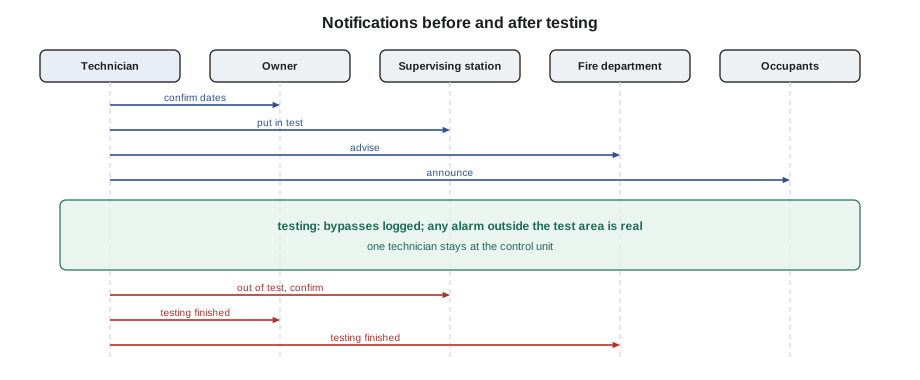
NFPA 72 requires that, before testing, the owner or designated representative, the supervising station, and the building occupants, plus the fire department or other facilities that receive alarm signals, are notified that testing will take place, and that they are notified again when testing is finished. The fire code requires the fire department or fire code official to be notified when a required system is taken out of service, and the building's emergency plan usually spells out the steps.
- The owner or building operator, who confirms the dates, arranges access and decides how occupants will be warned.
- The supervising station, which puts the account into test for a stated period and zones, and confirms the end of the test.
- The fire department's dispatch, where the local procedure requires it, so that any calls from the building are handled with the test in mind.
- Occupants and tenants, through notices, announcements or e-mail, with a clear statement that a continuous alarm or a voice instruction outside the announced pattern means a real emergency.
- Other trades and systems, such as the elevator company, the building automation operator and the security desk, whose systems the test will trigger.
Putting the monitoring station in test
A supervising station, whether a central station, a proprietary station or a remote station, receives the building's alarm, supervisory and trouble signals. When the technician calls, the operator verifies the caller with a passcode, records the start of the test, the expected duration and the scope, and treats signals from the building as test signals for that period. During the inspection, the technician confirms that the station actually receives each type of signal: alarm, supervisory and trouble, and for each transmission path where the communicator has two. A test that never reaches the station is a failed test of the monitoring connection, even if everything in the building worked.
Gerry asks the operator to read back the signals received at the end of each test session. At Tamarind House the read-back shows that the station received the alarm and trouble signals but logged the supervisory signal from a valve switch as a trouble signal. The communicator's programming had the wrong event code for the supervisory zone, so the station would have treated a closed sprinkler valve as a minor fault. The fix is a programming change at the communicator and a retest of each signal type.
# Compare what the building sent with what the monitoring station logged
sent = [("09:12", "alarm", "zone 3 manual station"), ("09:31", "supervisory", "valve VS-2 closed"),
        ("09:40", "trouble", "AC power off"), ("09:52", "alarm", "zone 5 smoke")]
logged = {"09:12": "alarm", "09:31": "trouble", "09:40": "trouble", "09:52": "alarm"}
for time, kind, what in sent:
    got = logged.get(time, "nothing")
    ok = "OK" if got == kind else "MISMATCH"
print(f"{time} sent {kind:11s} logged {got:11s} {ok:8s} {what}")09:12 sent alarm logged alarm OK zone 3 manual station 09:31 sent supervisory logged trouble MISMATCH valve VS-2 closed 09:40 sent trouble logged trouble OK AC power off 09:52 sent alarm logged alarm OK zone 5 smoke
What gets bypassed, and why
Testing every function would shut the building down if nothing were bypassed: every smoke test would recall the elevators, shut down the fans, release the magnetic door holders and unlock the stairwell doors. Most inspections test the inputs and outputs separately: the outputs are disabled at the control unit while devices are tested, and then each output is tested on its own, with the owner's staff and the other trades present (Lesson 10). Some functions are tested together at least once, so that the whole chain from detector to output is proven.
Every bypass is a risk, because a bypassed function won't work in a real fire during the test. The rules Gerry follows are simple: bypass only what must be bypassed, for as short a time as possible; record each bypass on a sheet at the control unit with the time it was applied; and restore and check each one before leaving, with a second person confirming the control unit shows no disabled points.
# Bypass log: everything disabled must be restored before the crew leaves
log = [("07:55", "elevator recall relay", "restored 11:40"), ("07:56", "fan shutdown AHU-1", "restored 11:42"),
       ("07:56", "fan shutdown AHU-2", "restored 11:42"), ("07:58", "door holder release floors 2-6", None),
       ("08:02", "stair door unlock", "restored 11:45")]
open_items = [what for when, what, done in log if done is None]
print("bypasses applied:", len(log))
if open_items:
    print("NOT RESTORED:", ", ".join(open_items))
else:
print("all restored; panel shows no disabled points")bypasses applied: 5 NOT RESTORED: door holder release floors 2-6
Telling occupants what to expect
The building's occupants are the people the system protects, and they are also the people most likely to be confused by testing. A good occupant notice says when the testing will happen, what they will hear and see, whether they need to leave, and what a real alarm will sound like. In an office building, short bursts of the alarm signal are announced in advance. In an apartment building, tenants are told which days the suites on their floor will be entered to test the suite devices, with notice periods that follow the lease and the provincial or state rules on entering a dwelling. In a hospital, the testing is coordinated with the hospital's safety officer and the charge nurses, and patients in areas where signals will sound are told in advance.
In voice buildings such as Riverlight Tower, the test session can start and end with a live announcement over the speakers. Gerry's script is short: 'This is a test of the fire alarm system. Alarm signals will sound for short periods today between 9 and 4. If you hear the evacuation message without this announcement first, follow it.'
If a real alarm happens during testing
A real fire can happen on an inspection day. The crew plans for it. Before testing starts, Gerry confirms which zones and outputs are disabled and how long it would take to restore them, and he keeps one technician near the control unit whenever devices are being tested elsewhere. If an alarm comes in from a device that isn't being tested, it is treated as real: the technician at the control unit restores the outputs, the building follows its fire safety plan, and the fire department is called. Only after the fire department confirms there is no fire does testing resume.
Monitoring stations and fire departments are told about this rule in the first call: 'Any alarm from outside the zone we're testing is real.' Gerry also tells the operator which floors he is on, so that a call from a tenant on another floor reporting smoke is handled as a real call.
Ending the test
At the end of each session the crew restores everything that was bypassed, silences and resets the system, and confirms that the control unit is normal with no alarms, supervisory signals, troubles or disabled points. Then the crew calls the monitoring station to take the building out of test and confirms by asking the operator to watch for a final test signal or by checking that the account is back in service. Finally, the owner and the fire department, if they were notified, are told that testing is finished. The end-of-test calls and times go in the report.
The commonest failure at the end of an inspection is a building left in test. The monitoring station's test period expires automatically at many stations, but not at all of them, and a station that still has the building in test will ignore a real alarm overnight. Bramwell's procedure is that the crew lead doesn't leave until the station confirms the account is in service.
Worked problem
Monday at Riverlight Tower
Riverlight Tower's annual inspection starts Monday. The building has voice evacuation, elevator recall, stair pressurization fans, door holders and suite smoke alarms in each apartment. List the steps before the first test.
Show solution
- Confirm with the owner that tenant notices went out with the suite entry dates, and that the building operator and elevator mechanic will be on site on the days of their tests.
- Call the supervising station, verify the passcode and put the account in test for today's hours and the floors to be tested.
- Call the fire department dispatch line as local procedure requires.
- Make a live announcement over the voice system describing today's testing.
- Disable the elevator recall, fan and door holder outputs at the control unit, and record each bypass on the log.
- Assign one technician to stay at the control unit whenever devices are being tested.
Answer: Testing starts only when every notification is made and every bypass is recorded.
Silent testing and partial tests
Not every test needs the signals to sound. Most control units allow devices to be tested in a silent walk-test mode, in which each device's alarm is recorded at the panel but the signals don't operate and outputs stay off. Silent testing lets the crew work through hundreds of detectors in an occupied building without disturbing anyone. The signals and outputs are then tested separately, in short announced windows, so that every part of the chain is still proven. The report records which method was used for each part of the system.
Silent testing has its own risks. While a zone is in walk-test mode, a real alarm from that zone may not sound the building signals. The technician at the panel watches for any alarm that doesn't match the device being tested, and the walk-test mode is turned off as soon as each section is done. Some control units return to normal automatically after a period without activity; Gerry never relies on that and always ends walk-test mode himself.
In apartment buildings, entering suites raises its own questions. Tenants are given the notice the lease and the law require, a building staff member accompanies the technician, and the technician touches only the fire alarm devices. A suite that can't be entered on the day is recorded, and the owner arranges another time.
Keeping the occupants' trust
Occupants who are told the truth about testing respond better to real alarms. Gerry's notices always end the testing at the announced time, and if testing runs late, a new announcement says so. A building where the alarm sounds unannounced on testing days soon has occupants who wait to see whether an alarm is real, which is exactly the habit that costs lives.
Common mistakes
MistakeStarting tests before calling the monitoring station.
InsteadMake every notification before the first test.
MistakeAssuming the station receives the right signal type.
InsteadAsk for a read-back and compare it with what was sent.
MistakeLeaving a bypass on because the next session is tomorrow.
InsteadRestore every bypass at the end of each session.
MistakeTreating every alarm on test day as a test.
InsteadAn alarm from outside the test area is real.
MistakeLeaving without confirming the account is back in service.
InsteadConfirm with the station before the crew leaves.
Summary and key terms
- Notify the owner, the monitoring station, the fire department and occupants before testing.
- Tell them again when testing ends.
- Confirm the station receives each signal type correctly.
- Bypass only what must be bypassed, log it and restore it.
- Plan for a real alarm during testing.
- The building is back in service only when the station confirms it.
- Supervising station
- A central, proprietary or remote station that monitors buildings for fire signals.
- Test mode
- A period when the monitoring station treats signals from a building as tests.
- Bypass
- Disabling an output or input at the control unit during testing.
- Read-back
- The station operator reading the signals it received.
- Occupant notice
- Advance notice to occupants of testing and what to expect.
- Emergency plan
- The building plan for fire emergencies, including system shutdowns.
Practice problems
Work each problem on paper first, then reveal the answer to check.
Who is notified before testing?
Show answer
The owner, the supervising station, the fire department where required, and occupants.
Why ask the station for a read-back?
Show answer
To confirm it received the right type of signal for each test.
What should happen to bypasses at the end of a session?
Show answer
Each is restored and checked, and the panel shows no disabled points.
An alarm comes from a floor not being tested. What is it?
Show answer
A real alarm, until the fire department says otherwise.
When is the building back in service?
Show answer
When the station confirms the account is out of test.
Lesson quiz · 5 questions
Score 60% or more to complete this lesson.
Create a free account to save your progress, take quizzes and earn a certificate.