
FAT-230 · Lesson 1 of 12 · 20 min
Why existing systems are inspected and tested
Sasha Vukovic's third year at Bramwell Fire Protection starts in the service department. For two years she has mostly installed new systems: device layouts at Willowbank School, a panel replacement at Tamarind House, the north wing at Eastview General Hospital. Donna Achebe, the service manager, puts her on Gerry Tremaine's inspection crew for the autumn. 'Installation is about a hundred buildings a year,' Donna tells her on the first morning. 'Inspection is about every building we have ever touched, every year, for as long as they stand. Most of this company's work is keeping systems working, not putting them in.'
This course is about that work: the periodic inspection, testing and maintenance of fire alarm systems that are already in service. FAT-330 covers the verification of new installations and the acceptance of major changes. Here the question is different. A system was verified when it was new; years later, is it still doing what it was designed to do?
A fire alarm system ages like any other building system
A fire alarm system spends almost all of its life waiting. It may go years without a real alarm, and during those years nothing in normal operation proves that it still works. A detector can fill with dust until it no longer senses smoke at the level it was listed for, or drift the other way until it alarms on steam from a shower. A battery can lose capacity quietly while the charger keeps it looking healthy on the panel display. A waterflow switch paddle can stick, a horn can fail open, a relay that releases the magnetic door holders can weld its contacts shut. Building changes add their own failures: a new wall cuts a room in two and leaves one half with no detector, a renovation paints over a smoke detector's openings, a tenant stacks boxes in front of a manual station.
Many of these failures are silent. The control unit supervises its wiring and reports opens, shorts and ground faults, and an addressable panel reports a device that stops answering. But supervision can't tell whether a detector will still see smoke, whether a horn is loud enough, or whether the fan shutdown relay still drops the fan. The only way to know is to inspect the system and make each part do its job.
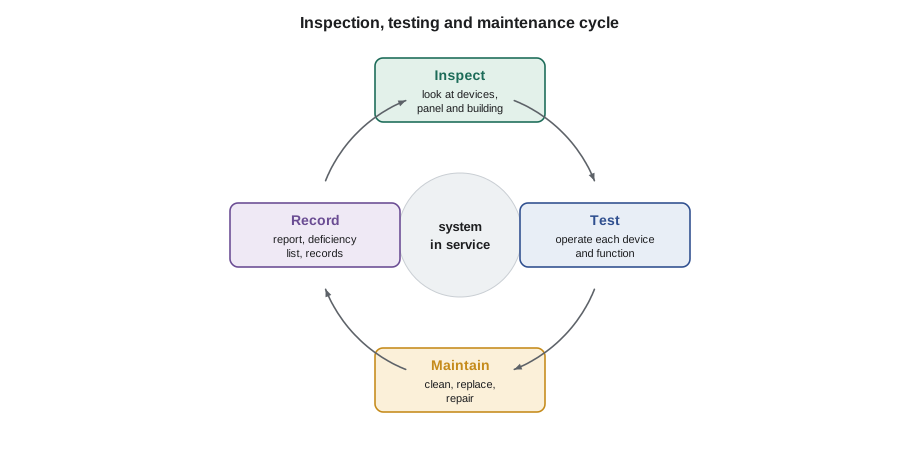
Inspection, testing and maintenance are different things
The three words are often run together, but each means something specific, and a technician has to know which one a task is.
- Inspection is looking. The technician checks visually that equipment is in place, undamaged, not obstructed, correctly labeled and in its normal condition, and that the building around it hasn't changed in ways that affect it.
- Testing is operating. The technician makes a device or function do what it is supposed to do, such as putting smoke into a detector, pulling a manual station, flowing water through a sprinkler test connection or running the system on its battery, and confirms the correct result at the control unit and at the outputs.
- Maintenance is keeping the system in working order: cleaning, adjusting, replacing worn or expired parts such as batteries, repairing faults and updating records and programming after changes.
A good annual visit does all three. Gerry's rule is that a test result means nothing without the inspection around it. 'A detector that alarms on the test gas but sits behind a new bulkhead is a pass on paper and a fail in the building,' he tells Sasha. 'You test the device and you look at where it is.'
Who is responsible
In the United States, the International Fire Code, as adopted in North Carolina in the state fire code, makes the building owner responsible for maintaining fire protection systems in operating condition, and requires fire alarm systems to be inspected, tested and maintained to NFPA 72. Chapter 14 of NFPA 72 sets out the methods and frequencies. The owner usually hires a qualified fire alarm service company, such as Bramwell, to do the work, but the responsibility stays with the owner. The authority having jurisdiction, in Charlotte the fire marshal's office of the Charlotte Fire Department, enforces the code, reviews reports and can order deficiencies corrected.
The service company is responsible for doing the work competently, following the standard, reporting honestly and telling the owner about every deficiency it finds. A technician who skips a device, or writes a pass for a device that wasn't tested, is not just doing poor work. The report is a document the owner, the insurer and the fire department rely on, and a false report can leave a building unprotected while everyone believes it is safe.
Qualifications matter too. NFPA 72 requires inspection, testing and maintenance personnel to be qualified and experienced, through means such as factory training and certification, NICET certification, or a state or local license, and North Carolina licenses fire alarm work through its limited license. Sasha's inspection reports are signed by Gerry, who holds NICET Level III, as the responsible technician, until she earns her own certification.
What the standard expects in an annual inspection
NFPA 72 Chapter 14 describes what is inspected and tested, how, and how often. Its tables list visual inspection frequencies and testing frequencies for each component, from the control unit and power supplies to each type of initiating device and notification appliance. Most components are tested annually; some, such as batteries, waterflow devices and valve supervisory switches, are tested more often, and smoke detector sensitivity is measured on its own schedule. NFPA 72 also defines the records to be kept, including an inspection and testing form that lists every device and the result of its test.
The standard also covers what happens when something fails. A failed device is a deficiency; a system or part of a system out of service is an impairment. Both must be reported to the owner, and some must be reported to the authority. Lesson 11 covers deficiencies and impairments in detail.
| Visit | Typical scope |
|---|---|
| Annual inspection and test | Every device and function tested; full report |
| Periodic tests between annual visits | Batteries, waterflow and valve supervisory devices, as the tables require |
| Service call | One fault found and repaired; report of the repair |
| After a change | Retest of everything the change affected |
Why a full test, every year
New technicians sometimes ask why every device has to be tested every year when most of them pass every time. The answer is that the system is only as good as its weakest device. A fire starts in one place. If the one detector in that room is the one that failed, the rest of the system's perfect record doesn't help the person asleep in that room. Annual testing of every device is how the industry finds the few that have failed.
Records over many years make the case. At Riverlight Tower, the 18-story apartment building Bramwell has serviced since it was built, the records show that each year roughly one or two percent of the field devices fail their annual test or are found damaged, painted or obstructed. Two percent sounds small until it is turned into numbers: in a building with over a thousand devices, it means a dozen or more rooms or corridors where the system would not have worked if a fire had started there that year.
# How many failed devices does an annual test find?
devices = 1180          # field devices at Riverlight Tower
rates = [0.005, 0.01, 0.015, 0.02]
for r in rates:
    found = round(devices * r)
    print(f"failure rate {r*100:4.1f} %  ->  about {found:3d} devices to repair this year")
# The chance that a given device has failed since the last test, if failures are random:
r = 0.015
for years in (1, 2, 3, 5):
    p = 1 - (1 - r) ** years
print(f"untested for {years} year(s): {p*100:4.1f} % chance a given device has failed")failure rate 0.5 % -> about 6 devices to repair this year failure rate 1.0 % -> about 12 devices to repair this year failure rate 1.5 % -> about 18 devices to repair this year failure rate 2.0 % -> about 24 devices to repair this year untested for 1 year(s): 1.5 % chance a given device has failed untested for 2 year(s): 3.0 % chance a given device has failed untested for 3 year(s): 4.4 % chance a given device has failed untested for 5 year(s): 7.3 % chance a given device has failed
The second half of the calculation shows why the interval matters. If devices fail at random at about one and a half percent a year, a device left untested for five years has roughly a seven percent chance of having failed. Testing every year keeps the fraction of hidden failures low. The standard's frequencies are a balance between that risk and the cost and disruption of testing.
The cost of skipping it
Fire investigations repeatedly find systems that were not maintained: detectors removed during renovations and never replaced, panels silenced in trouble for months, batteries years past their date, a monitoring connection disconnected because the phone line was canceled. In each case the system had once been verified and worked. What failed was the ongoing inspection and maintenance. The technician's annual visit is what catches these problems before a fire does.
It also protects people in less dramatic ways. A detector that has become oversensitive causes nuisance alarms, and nuisance alarms teach occupants to ignore the alarm. Testing smoke detector sensitivity and replacing detectors that are out of range is as much a part of life safety as finding the ones that no longer work.
How this course follows the work
The lessons follow the order of a real inspection. Lesson 2 looks at the standard and the code that require it. Lesson 3 covers frequencies and how Donna's office schedules hundreds of buildings. Lesson 4 covers the steps before testing begins: notifying occupants, the monitoring station and the fire department. Lessons 5 to 10 work through the system: the control unit, power and batteries, detectors, manual stations and sprinkler devices, notification appliances and voice, and the interfaces to other building systems. Lesson 11 covers deficiencies, impairments and fire watch. The capstone, Lesson 12, is the annual inspection of Riverlight Tower, from planning to the signed report.
Worked problem
Inspection, test or maintenance?
On Sasha's first day at Tamarind House, Gerry lists five tasks and asks her to classify each one: (1) checking that every manual station is visible and unobstructed, (2) operating the AHU-2 duct detector with test gas and confirming the fan shuts down, (3) replacing the panel batteries that are past their date, (4) confirming that the zone descriptions on the annunciator match the floors, (5) cleaning a detector that failed its sensitivity check and retesting it.
Show solution
- Task 1 is an inspection: it is a visual check of condition and access.
- Task 2 is a test: the device is operated and the output is confirmed.
- Task 3 is maintenance: a part is replaced to keep the system working.
- Task 4 is an inspection: the labels are checked against the building.
- Task 5 is maintenance followed by a test: the detector is cleaned, then tested again to show it is now in range.
Answer: All five belong in the report, each recorded as what it was.
What a good technician brings
Inspection work rewards habits more than heroics. The technicians Donna trusts most share a few: they read last year's report before arriving, they work from the device list rather than memory, they write down measured values instead of ticking boxes, they tell the owner about problems the same day, and they never let a test result stand in for looking at the device. Sasha's first assignment is to shadow Gerry for a month and write the reports herself, so that she learns what a complete record looks like before she is responsible for one.
Common mistakes
MistakeTreating a passed device test as a full check.
InsteadInspect where the device is and what has changed around it as well.
MistakeTesting only the devices that are easy to reach.
InsteadPlan access so that every device is tested, and record any that couldn't be.
MistakeThinking the service company carries the legal duty.
InsteadThe owner is responsible; the service company does the work and reports.
MistakeAssuming panel supervision proves the system works.
InsteadSupervision finds wiring faults, not failed sensors or weak signals.
MistakeWriting a pass for a device that wasn't tested.
InsteadRecord what was actually done, and list untested devices as such.
Summary and key terms
- A fire alarm system can fail silently while it waits for a fire.
- Inspection is looking, testing is operating, maintenance is keeping it working.
- The fire code requires inspection, testing and maintenance to NFPA 72; the owner is responsible.
- Every device and function is tested at the required frequency, most of them annually.
- Annual testing keeps the fraction of hidden failures low.
- The report is a document others rely on and must be honest and complete.
- Inspection
- A visual check of equipment, its condition and its surroundings.
- Testing
- Operating a device or function to confirm it works.
- Maintenance
- Work that keeps the system in working order, including repairs and replacements.
- Deficiency
- A condition that keeps a device or function from working as required.
- Impairment
- A condition where a system or part of it is out of service.
- Owner
- The person responsible in law for keeping the system working.
Practice problems
Work each problem on paper first, then reveal the answer to check.
Name the three parts of the work in this course.
Show answer
Inspection, testing and maintenance.
Who is responsible for keeping the system working?
Show answer
The building owner.
Why doesn't panel supervision replace testing?
Show answer
It detects wiring faults but not failed sensors, weak signals or failed outputs.
If 1.5 % of devices fail at random each year, roughly what fraction has failed after five years untested?
Show answer
About 7 %.
Which course covers the verification of new installations?
Show answer
FAT-330.
Lesson quiz · 5 questions
Score 60% or more to complete this lesson.
Create a free account to save your progress, take quizzes and earn a certificate.