
FAT-230 · Lesson 11 of 12 · 20 min
Deficiencies, impairments and fire watch
Late on a Friday afternoon at Willowbank School, a ground fault Sasha is tracing turns out to be a cable crushed by a new ceiling grid, and the fault takes out a whole conventional zone: twelve classrooms with no detection until the cable is replaced. The school opens on Monday. 'Now it's not just a deficiency,' Gerry says. 'Part of the system is out of service. That's an impairment, and the rules change.' This lesson covers what happens when an inspection finds something wrong: how deficiencies are classified and reported, what an impairment is, and how a building is protected while its system is impaired.
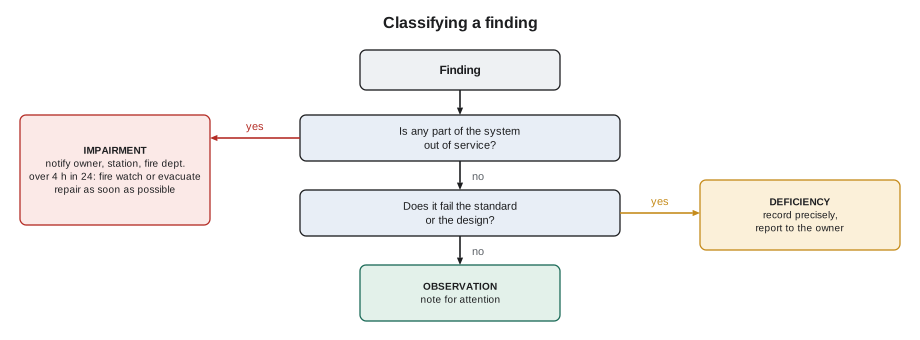
Deficiency, impairment, observation
Three words describe what an inspection can find.
- A deficiency is a condition that keeps a device, circuit or function from meeting the standard: a detector that fails its test, a strobe set below its design candela, a missing document, a door that doesn't latch. The system may still work overall, but something in it doesn't.
- An impairment is a condition where a system, or part of a system, is out of service and can't perform its function: a zone with no detection, a control unit that has failed, a disconnected monitoring connection, a system shut off for construction. Impairments can be planned, such as testing or a renovation, or unplanned, such as a fault or damage.
- An observation, a category in recent editions of NFPA 72, is something the technician noticed that isn't a deficiency or impairment but may improve the system, such as a battery that passed but is near its replacement date, or a detector drifting toward its limit. The owner isn't required to act on an observation unless it becomes a deficiency or impairment.
The distinction matters because the response is different. A deficiency is listed in the report for the owner to correct within a reasonable time, which the authority may set. An impairment needs immediate action to protect the building while the system is out of service.
Recording deficiencies
NFPA 72 requires deficiencies to be recorded and reported to the owner, and where a deficiency isn't corrected at the end of the inspection, the owner must be told in writing within a short time, commonly 24 hours. Recent editions describe a color-coded tagging scheme in an annex, with a yellow tag for a system with deficiencies and a red tag for a system that is impaired, which many authorities adopt. Many service companies also rank deficiencies by how serious they are, so the owner knows what to fix first.
A useful deficiency entry has five parts: where it is (address, floor, room), what it is (device type and model), what was found, the requirement it fails, and what should be done. 'L3-021 smoke detector, 12th floor corridor outside 1207, did not alarm with aerosol, dust cap found on head; cap removed, detector retested and passed' is a complete entry; 'smoke detector failed' isn't.
# Rank deficiencies so the owner knows what to fix first
findings = [
    ("zone 7 no detection, 12 classrooms", "impairment"),
    ("strobe 30 cd where design shows 75 cd, room 114", "major"),
    ("manual station cover hinge seized, gym", "major"),
    ("zone label out of date, panel", "minor"),
    ("battery passed but past replacement date, RPS-2", "major"),
    ("detector drifting toward limit, L1-033", "observation"),
]
order = {"impairment": 0, "major": 1, "minor": 2, "observation": 3}
for text, level in sorted(findings, key=lambda f: order[f[1]]):
print(f"{level.upper():12s} {text}")IMPAIRMENT zone 7 no detection, 12 classrooms MAJOR strobe 30 cd where design shows 75 cd, room 114 MAJOR manual station cover hinge seized, gym MAJOR battery passed but past replacement date, RPS-2 MINOR zone label out of date, panel OBSERVATION detector drifting toward limit, L1-033
What counts as an impairment
An impairment is any condition that takes a required function out of service. Common examples:
- a zone, loop or circuit with a fault that disables its devices;
- a failed or disconnected control unit, power supply or amplifier;
- loss of the monitoring connection to the signal receiving or supervising station;
- detectors covered or removed for construction or painting;
- planned testing, maintenance or renovation that disables part of the system;
- loss of a sprinkler system the fire alarm relies on for detection.
Planned impairments, including the inspection itself, are handled with the notification steps in Lesson 4: the owner, the monitoring station and the fire department know in advance, the impaired period is as short as possible, and the system is restored at the end. Unplanned impairments, like the crushed cable at Willowbank, are handled the same way, but at once.
Responding to an impairment
NFPA 72 requires the owner to be notified when the system is impaired, mitigating measures acceptable to the authority to be taken while it is impaired, and the owner and the authority to be told when the impairment ends; the owner keeps a record of impairments. The fire code, and NFPA 101 where it applies, require that when a required fire alarm system is out of service for more than 4 hours in a 24-hour period, the fire code official be notified and the building be evacuated or an approved fire watch provided for all affected areas until the system is restored. The owner is responsible for the measures; the service company tells the owner what is impaired and how quickly it can be repaired.
# Does an impairment trigger the fire watch rule?
from datetime import datetime
start = datetime(2026, 11, 13, 15, 40)
expected_repair = datetime(2026, 11, 16, 7, 30)
hours_out = (expected_repair - start).total_seconds() / 3600
print(f"zone out of service for about {hours_out:.0f} h")
if hours_out > 4:
    print("over 4 h in 24: notify the fire code official; evacuate or provide an approved fire watch until restored")
else:
print("short impairment: notify and repair; follow the fire safety plan")zone out of service for about 64 h over 4 h in 24: notify the fire code official; evacuate or provide an approved fire watch until restored
The four-hour rule comes from the fire code and NFPA 101; check which applies to the building and what the authority accepts as a fire watch.
Fire watch
A fire watch is a temporary measure, not a substitute for the system. The people doing it must know the area, be able to raise the alarm by phone, radio or a working part of the system, know how to call the fire department, and patrol every affected space at the interval the authority or the plan requires, commonly every hour or more often. Each patrol is logged with the time, the areas checked and anything found. In a school, fire watch may mean that the affected classrooms aren't used until the repair; in a hospital, the safety officer applies the hospital's own interim life safety measures.
At Willowbank, the owner decides that the twelve classrooms will stay closed on Monday morning, and the school's custodians will patrol the corridor hourly with a radio until the repair. Bramwell schedules a technician for 7:30 Monday. By 10:00 the cable is replaced, the zone is restored and retested, and the custodian's log, the notifications and the repair go in the report.
Correcting deficiencies
Some deficiencies are corrected during the inspection: a dust cap removed, a detector cleaned, a label replaced, a battery changed with the owner's approval. Each correction is recorded, with the device retested. Others need the owner's authorization, parts or another trade. The report lists them as open, and the service company quotes the repair or tells the owner who can do it. When an open deficiency is corrected, the affected part is tested and the report is updated or a supplementary report issued.
The owner can't make deficiencies go away by not reading the report. The authority reviews reports, and many authorities track open deficiencies until they are closed. Captain Strand's office sends follow-up letters when a report shows open deficiencies, and an owner who ignores them can be ordered to correct them by a date.
Records
NFPA 72 requires inspection, testing and maintenance records to be kept until the next test and for one year after, and impairment records to be kept by the owner. Many authorities and owners keep them much longer, and an online reporting service, where the authority uses one, keeps them centrally.
Worked problem
Classifying Willowbank's findings
At the end of the Willowbank inspection, Sasha has: (1) zone 7 with no detection; (2) a strobe in room 114 set to 30 candela where the drawing shows 75; (3) the gym manual station cover hinge seized; (4) the zone 9 label still naming a demolished portable; (5) a battery at RPS-2 that passed its load test but is two months past its replacement date; (6) a detector drifting toward its upper sensitivity limit. Classify each.
Show solution
- Item 1: impairment. Notify the owner, the monitoring station and the fire department; interim measures under the plan; repair as soon as possible.
- Item 2: deficiency; reset the strobe to 75 candela, confirm the circuit's voltage, and record.
- Item 3: deficiency; the cover keeps people from using the station. Repair or replace the cover.
- Item 4: deficiency; correct the label with the owner's approval.
- Item 5: deficiency under the company's and the standard's replacement rule; replace.
- Item 6: observation; clean or watch it, and compare next year.
Answer: Each finding is classified, recorded and given an action.
Deficiencies the inspection can't fix
Some deficiencies are outside the fire alarm technician's work. A fire door that doesn't latch needs a door contractor. A room built without a detector needs a designer, an installer and a verification. A sprinkler valve that won't open fully needs the sprinkler contractor. The report names the deficiency and, where Bramwell can't correct it, says who can. Gerry's practice is to be specific: 'door closer on stair A floor 5 does not latch the door, refer to door hardware contractor' tells the owner exactly what to do next.
Deficiencies also have a cost, and owners sometimes delay the expensive ones. The report helps the owner set priorities by ranking each item, and the authority helps by setting dates. A deficiency that leaves the building less safe, such as a missing detector in a sleeping area or a failed waterflow switch, is ranked high and may be treated by the authority as needing correction within days. A missing label is ranked low.
Telling the owner
Before leaving any site, the crew lead tells the owner or the building's representative what was found: what was corrected, what is still open, and whether anything is impaired. This conversation is recorded in the report, with the name of the person told and the time. Bad news delivered in person, the same day, gets fixed faster than bad news found in a report two weeks later. Where an open deficiency isn't corrected at the end of the visit, the written notice goes to the owner within the time the standard and the authority require.
# Days remaining to correct each open deficiency, by priority
from datetime import date
due_days = {"impairment": 1, "major": 30, "minor": 90}
found_on = date(2026, 11, 13)
items = [("zone 7 no detection", "impairment"), ("strobe 30 cd in room 114", "major"), ("zone 9 label", "minor")]
for what, level in items:
    target = date.fromordinal(found_on.toordinal() + due_days[level])
print(f"{level:10s} {what:26s} correct by {target}")impairment zone 7 no detection correct by 2026-11-14 major strobe 30 cd in room 114 correct by 2026-12-13 minor zone 9 label correct by 2027-02-11
The target dates in the code are Bramwell's internal targets for the example; the authority may set its own dates, which take precedence.
Impairments during construction
Renovations are one of the commonest causes of impairment. Detectors are covered to keep out dust, circuits are cut to move walls, and whole floors may be disconnected for weeks. The contractor, the owner and the fire alarm service company agree in advance which parts of the system will be out of service, for how long, and what the interim measures will be. Dust covers are removed at the end of each working day where the authority requires it, so that the floor is protected at night, and the removal is checked. When the work is finished, every affected device and circuit is tested before the floor is returned to use. At Riverlight, the dust cap Sasha finds on the sixteenth floor is the kind of thing this process exists to prevent: one cover missed at the end of a job left a corridor unprotected for weeks.
Common mistakes
MistakeCalling an out-of-service zone a minor deficiency.
InsteadAny part of the system out of service is an impairment.
MistakeWriting 'detector failed' without a location.
InsteadRecord where, what, the finding, the requirement and the action.
MistakeLeaving the owner to discover open deficiencies in the report later.
InsteadTell the owner before leaving, and in writing as required.
MistakeTreating a fire watch as a substitute for repair.
InsteadRepair as soon as possible; fire watch is temporary.
MistakeCorrecting a deficiency without retesting.
InsteadTest the affected part and update the report.
Summary and key terms
- A deficiency fails the standard; an impairment takes part of the system out of service.
- Observations note things that deserve attention but aren't deficiencies.
- Deficiencies are recorded precisely and ranked for the owner.
- Impairments need notification and interim measures at once.
- Over 4 hours in 24, the authority is notified and a fire watch or evacuation is required.
- Corrections are retested and the report updated.
- Deficiency
- A condition that keeps a device or function from meeting the standard.
- Impairment
- A condition that takes all or part of a system out of service.
- Observation
- A noted condition that may need attention but isn’t a deficiency.
- Fire watch
- Trained people patrolling an area to detect fire and raise the alarm while a system is impaired.
- Planned impairment
- An impairment scheduled in advance, such as testing or renovation.
- Interim measures
- Temporary steps that protect a building while its system is impaired.
Practice problems
Work each problem on paper first, then reveal the answer to check.
A zone has no detection because of a crushed cable. What is it?
Show answer
An impairment.
Name the five parts of a useful deficiency entry.
Show answer
Where, what device, what was found, the requirement it fails, and the action.
What is a fire watch?
Show answer
Trained people patrolling the impaired area, able to raise the alarm and call the fire department, with a log.
Who is responsible for the interim measures?
Show answer
The owner.
What happens after a deficiency is corrected?
Show answer
The affected part is tested and the report updated.
Lesson quiz · 5 questions
Score 60% or more to complete this lesson.
Create a free account to save your progress, take quizzes and earn a certificate.