
FAT-230 · Lesson 6 of 12 · 20 min
Power supply and battery testing
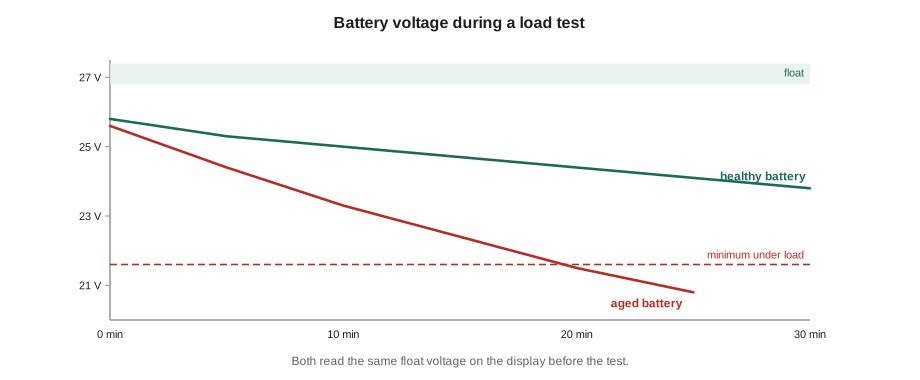
On the second morning at Tamarind House, Gerry pulls the main panel's batteries out onto a cart and reads the label: manufactured four and a half years ago. On the panel display they show 27.3 volts on float, which looks perfect. Ten minutes into a load test, the pair has dropped below the point where the panel would start reporting low battery. 'This is why we test,' he says. 'A battery on a charger always looks healthy. You only find out what it can do when you make it work.' This lesson covers the inspection and testing of primary power, chargers, batteries and remote power supplies.
Two sources of power
Every fire alarm system has a primary supply, normally a dedicated branch circuit from the building's electrical system, and a secondary supply, normally batteries and sometimes an emergency generator with batteries to carry the system until the generator picks up. FAT-130 covered how the secondary supply is sized: enough capacity to run the system in standby for the required time, then in alarm for the required time, with a margin for aging. The inspection's job is to confirm that the supplies installed years ago can still do that.
Remote power supplies, the boosters that feed notification circuits and other loads away from the main panel, are part of the system and are tested the same way. A building like Riverlight Tower has a dozen of them, each with its own batteries and charger, and each must report its troubles to the control unit.
Inspecting the primary supply
The primary supply is checked first. The technician confirms that the branch circuit is dedicated to the fire alarm system, that its breaker or disconnect is identified and protected against accidental operation, and that the supply voltage is within the control unit's rated range. The supply is then disconnected to test the transfer to battery: the control unit must give an AC power trouble, keep running on battery without losing any function, transmit the trouble to the monitoring station where required, and return to normal when power is restored.
Where an emergency generator also feeds the system, its transfer is tested with the building operator during the generator's own test, and the fire alarm's behavior during the transfer is observed: the system must ride through the short interruption on its batteries with no false alarms or resets.
Inspecting batteries
Batteries are inspected visually for:
- the date: every battery should be marked with its date of manufacture or installation, and the standard and the maker set how long it may stay in service;
- physical condition: no swelling, cracks, leaks, corrosion on the terminals or heat damage;
- connections: tight, clean terminals, correct polarity, the correct battery type and size for the charger and the battery calculation;
- matching: batteries in a series string should be the same type, size, maker and age; mixing a new battery with an old one shortens the life of both and hides the weak one.
NFPA 72 requires batteries to be marked with their date of manufacture, and recent editions also require a replacement date marked on the battery, with replacement by that date or sooner if the battery fails its test or the maker requires it. Many makers rate sealed lead-acid batteries for a service life of about four to five years in standby use. Bramwell's practice is to mark the replacement date on each battery at installation and replace by that date even if the battery passes its test.
Testing the charger
The charger keeps the batteries at a float voltage, recharges them after a discharge, and supervises the battery connection. The charger test checks that the float voltage is within the maker's range, typically around 2.25 to 2.30 volts per cell for a sealed lead-acid battery at room temperature, which is about 27 volts for a 24-volt system, and that the charger recharges a discharged battery within the time the standard requires. Disconnecting a battery must produce a battery trouble at the control unit.
Float voltage that is too high dries out a sealed battery and shortens its life; too low, and the battery is never fully charged. A battery that runs hot on float, or a charger whose voltage drifts, is a deficiency even if the battery passes its load test today.
Load testing the batteries
NFPA 72 Table 14.4.3.2 sets out the battery tests and their frequencies. For sealed lead-acid batteries, the semiannual tests include a charger test and a load voltage test, in which the battery is put under load and its terminal voltage measured against the maker's specification. A discharge test, running the system on battery under load for a period and measuring the voltage, is also used. Some technicians use a dedicated battery tester that applies a measured load or measures internal resistance; the result is compared with the maker's data and with last year's reading.
# Battery load test: does the terminal voltage stay above the minimum?
nominal = 24.0
minimum = 21.6            # volts under load, from the maker and the standard
readings = [(0, 25.6), (5, 24.9), (10, 24.4), (15, 23.9), (20, 23.4), (25, 22.9), (30, 22.4)]
for t, v in readings:
    flag = "" if v >= minimum else "  BELOW MINIMUM"
    print(f"{t:2d} min  {v:5.1f} V{flag}")
lowest = min(v for t, v in readings)
print("result:", "PASS" if lowest >= minimum else "FAIL - replace batteries and recalculate")0 min 25.6 V 5 min 24.9 V 10 min 24.4 V 15 min 23.9 V 20 min 23.4 V 25 min 22.9 V 30 min 22.4 V result: PASS
The minimum in the code is an example; the actual minimum comes from the maker's data and the standard's method for the battery and load being tested. A battery that passes but is much weaker than last year is flagged as an observation, because it is likely to fail before the next annual test.
Capacity: is the battery still big enough?
A battery passes or fails its load test, but the deeper question is whether it can still carry the system for the required standby and alarm time. Battery capacity falls with age, and the system's load may have grown since the battery was sized, as devices were added. The inspection compares the installed battery with the load on the system today.
# Is the installed battery still big enough for today's load?
standby_A = 0.38        # measured standby current
alarm_A = 3.6          # alarm current from the device list
standby_h = 24
alarm_h = 0.25
needed_Ah = (standby_A * standby_h + alarm_A * alarm_h) * 1.25
installed_Ah = 18
remaining = 0.80        # fraction of rated capacity estimated from the load test
available = installed_Ah * remaining
print(f"needed {needed_Ah:.1f} Ah, available about {available:.1f} Ah")
print("OK" if available >= needed_Ah else "UNDERSIZED - replace with larger batteries and redo the calculation")needed 12.5 Ah, available about 14.4 Ah OK
For Tamarind House, a 24-hour standby followed by 15 minutes of alarm needs about 12.5 Ah with the aging factor, and two 18 Ah batteries in good condition are enough. The old pair failed the load test, so Gerry replaces them with new 18 Ah batteries, marks the replacement date, and runs the load test again on the new pair.
Remote power supplies
Each remote power supply is inspected and tested like the main panel: primary circuit identified, AC loss trouble reported to the control unit, batteries dated and load-tested, charger voltage checked, and the supply's trouble contacts proven by creating each fault. Riverlight Tower's supplies are on the stair landings and in electrical rooms on several floors. On the last inspection, one supply's trouble relay was wired but not programmed at the main panel, so a dead battery in that supply would never have been reported. Testing each trouble output, not just looking at the wiring, is how that was found.
Remote supplies also carry the notification circuits that the voltage-drop calculations in FAT-130 were based on. If a supply's batteries are weak, the voltage at the last appliance during an alarm on battery may fall below what the appliances need. Lesson 9 covers measuring that voltage.
Safety with batteries
Even small fire alarm batteries can deliver very high currents if shorted. Technicians remove rings and watches, use insulated tools, disconnect the battery before removing it, and never lay a tool across the terminals. Lead-acid batteries can release hydrogen if overcharged, so a battery that is hot or swollen is handled carefully and the charger checked. Old batteries are recycled through the supplier or a battery recycler, not thrown away, because they contain lead and acid.
Worked problem
A weak battery at a remote supply
At Riverlight Tower, the remote power supply on the ninth floor passes its AC loss test, but its batteries, dated five years ago, drop from 25.4 volts to 22.0 volts in the first ten minutes of the load test. The minimum under load is 21.6 volts. What should Sasha do?
Show solution
- Stop the test before the battery is damaged further, and record the readings.
- Report the battery as near end of life: it passed, but it is five years old and falling fast.
- Recommend replacement now rather than at the next visit, because the battery is past the company's replacement date.
- After replacement, load-test the new batteries and mark their replacement date.
- Check whether the circuits on this supply still meet their end voltage on battery (Lesson 9).
Answer: A battery past its date that barely passes is replaced, not trusted for another year.
Trending battery results
A single load test tells whether a battery passes today. A series of tests over the years tells when it will stop passing. Bramwell records the voltage at the end of the load test, or the internal resistance where a tester measures it, for every battery at every visit. Plotted over time, the readings fall slowly for a few years and then drop quickly as the battery nears the end of its life. A battery whose reading has dropped sharply since last year is replaced even if it still passes, because it is unlikely to last another year.
# Trend of end-of-test voltage for one battery pair
history = [(2022, 24.6), (2023, 24.4), (2024, 24.2), (2025, 23.6), (2026, 22.5)]
for (y1, v1), (y2, v2) in zip(history, history[1:]):
    drop = v1 - v2
    flag = "  sharp drop" if drop > 0.5 else ""
    print(f"{y1}->{y2}: {v1:.1f} -> {v2:.1f} V (drop {drop:.1f}){flag}")
print("recommend replacement: readings are falling faster each year")2022->2023: 24.6 -> 24.4 V (drop 0.2) 2023->2024: 24.4 -> 24.2 V (drop 0.2) 2024->2025: 24.2 -> 23.6 V (drop 0.6) sharp drop 2025->2026: 23.6 -> 22.5 V (drop 1.1) sharp drop recommend replacement: readings are falling faster each year
Temperature matters too. Batteries in a hot electrical room age faster than those in a cool one; a common rule of thumb is that a sealed lead-acid battery's life is roughly halved for every 8 to 10 degrees Celsius above about 25 degrees. A battery cabinet beside a transformer, or in a room with no ventilation, is worth noting in the report, because its batteries will need replacing sooner than the date on the label suggests.
Generators and emergency power
Where the fire alarm's primary supply is backed by an emergency generator, the generator is the owner's and its contractor's to test, under the emergency power standard that applies. The fire alarm technician's interest is in what the fire alarm does during the transfer: it must keep running on its own batteries through the interruption, with no alarm, reset or loss of supervision. Gerry asks the building operator for the date of the last generator transfer test and whether the fire alarm was watched during it; if not, he arranges to be present at the next one.
Where the battery is close to its limit, Gerry records both the battery's capacity estimate and the calculated need in the report, so that the owner can see why a larger battery is recommended rather than a like-for-like replacement.
Common mistakes
MistakeTrusting the float voltage on the display.
InsteadLoad-test the batteries; float voltage hides lost capacity.
MistakeReplacing one battery in a series pair.
InsteadReplace both with matched batteries of the same type and date.
MistakeLeaving batteries past their replacement date because they passed.
InsteadReplace by the marked date.
MistakeForgetting remote power supplies.
InsteadInspect and test each one, including its trouble outputs.
MistakeShorting terminals with a tool.
InsteadUse insulated tools and disconnect before removing batteries.
Summary and key terms
- The system has a primary supply and a battery secondary supply.
- Disconnecting the primary supply must give a trouble and transfer to battery.
- Batteries are inspected for date, condition, connections and matching.
- The charger's float voltage and recharge are checked.
- A load test shows the battery's real condition.
- The installed capacity is compared with today's load.
- Primary supply
- The normal power source for the system, usually a dedicated branch circuit.
- Secondary supply
- The standby power source, usually batteries.
- Float voltage
- The voltage a charger holds a fully charged battery at.
- Load test
- A test of battery voltage while the battery delivers current.
- Replacement date
- The date marked on a battery by which it must be replaced.
- Remote power supply
- A power supply away from the main panel that feeds notification circuits or other loads.
Practice problems
Work each problem on paper first, then reveal the answer to check.
Why doesn't float voltage prove a battery is good?
Show answer
The charger holds it at float even when its capacity has fallen.
What must happen when the primary supply is disconnected?
Show answer
An AC power trouble, transfer to battery with no loss of function, and transmission of the trouble.
Why must batteries in a series string match?
Show answer
Mixed batteries shorten each other's life and hide a weak one.
What is the typical float voltage for a 24 V sealed lead-acid system?
Show answer
About 27 V.
What should happen to a battery past its replacement date that passes the test?
Show answer
It is replaced anyway.
Lesson quiz · 5 questions
Score 60% or more to complete this lesson.
Create a free account to save your progress, take quizzes and earn a certificate.