
ELE-370 · Lesson 5 of 12 · 33 min
DC machines
DC machines were the first practical electric motors and generators, and for a century they were the standard choice wherever speed had to be controlled precisely: rolling mills, paper machines, elevators, cranes and traction. Today, AC motors with variable-frequency drives have taken over most of these roles, but DC machines remain in service in many plants, and their simple, linear relationships between voltage, current, speed and torque make them the best place to learn how all electric machines convert energy. Brushless DC and permanent magnet motors, which dominate small drives, electric vehicles and drones, follow the same equations with electronic rather than mechanical commutation. This lesson covers construction, the EMF and torque equations, generators, motor types, speed control, starting, armature reaction and losses.
Construction and commutation
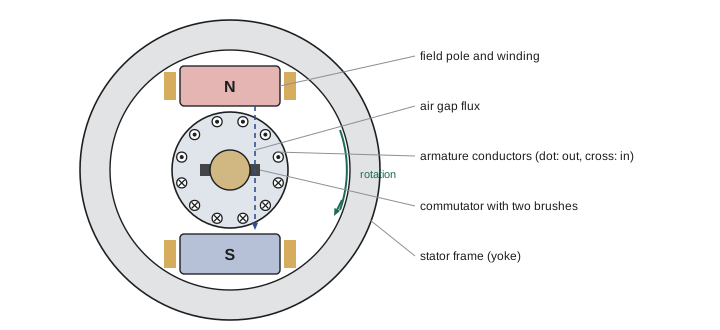
A DC machine has a stationary field system, the stator, and a rotating armature, the rotor:
- The field poles carry field windings (or permanent magnets) that produce a steady flux crossing the air gap.
- The armature carries coils in slots around its surface, connected to a commutator: a cylinder of insulated copper segments on the shaft.
- Carbon brushes ride on the commutator and connect the armature to the external circuit.
As each armature coil rotates past the poles, the voltage induced in it alternates. The commutator acts as a mechanical rectifier: it reverses each coil's connection just as the coil passes between poles, so the brushes always see a voltage of the same polarity. In a motor, the same switching keeps the torque on every coil in the same direction. Commutation is also the machine's weak point: brushes and commutators wear, sparking limits speed and current, and they need regular maintenance, which is a major reason AC drives replaced DC machines.
EMF and torque equations
Each armature conductor moving through the air-gap field has a voltage induced in it; summing over all conductors gives the armature EMF, and the force on each current-carrying conductor sums to the electromagnetic torque:
where \(\Phi\) is the flux per pole, \(\omega\) the angular speed (rad/s), \(I_a\) the armature current, \(Z\) the total number of armature conductors, \(p\) the number of poles and \(a\) the number of parallel paths through the armature. The same constant \(K\Phi\) appears in both equations, which expresses energy conservation: the electrical power converted, \(E_a I_a\), equals the mechanical power \(T\omega\). In SI units, \(K\Phi\) in V·s/rad equals \(K\Phi\) in N·m/A. Speed is often given in rpm, \(n\), with \(\omega = 2\pi n/60\).
The armature circuit adds the armature resistance \(R_a\) (including brushes):
Worked problem
EMF and torque
A 4-pole DC machine has 600 armature conductors in a lap winding (4 parallel paths) and a flux of 25 mWb per pole. Find the EMF at 1500 rpm, and the torque at an armature current of 80 A.
Show solution
- \(K = Zp/(2\pi a) = 600 \times 4/(2\pi \times 4) = 95.5\).
- \(K\Phi = 95.5 \times 0.025 = 2.39\) V·s/rad.
- \(\omega = 2\pi \times 1500/60 = 157.1\) rad/s; \(E_a = 2.39 \times 157.1 = 375\) V.
- \(T = 2.39 \times 80 = 191\) N·m.
Answer: The EMF is 375 V and the torque 191 N·m. Check: \(E_a I_a = 375 \times 80 = 30.0\) kW \(= T\omega = 191 \times 157.1\).
DC generators
DC generators are classified by how their field is supplied:
- Separately excited: the field comes from an independent source; terminal voltage falls slightly with load because of \(I_a R_a\) and armature reaction.
- Shunt: the field is connected across the armature. The generator builds up its own voltage from residual magnetism, provided the field resistance is below a critical value and the field connection reinforces the residual flux. Voltage falls more with load than for separate excitation, because lower terminal voltage weakens the field.
- Series: the field carries the full load current, so voltage rises with load; rarely used alone.
- Compound: shunt and series fields together; a cumulatively compounded generator can be set so that voltage stays nearly constant from no load to full load (flat compounding).
DC generators have been almost entirely replaced by AC generators with rectifiers, but the self-excitation principle and the magnetization curve remain important for understanding synchronous machine excitation (Lesson 9).
DC motors and their characteristics
DC motor types mirror the generators:
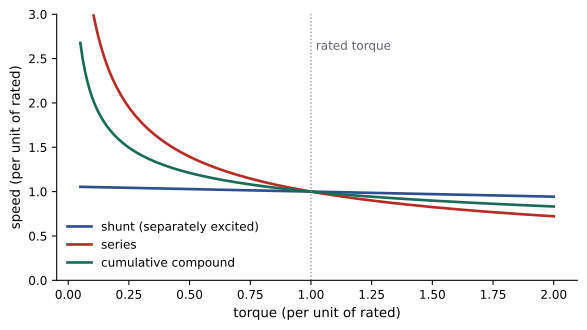
- Separately excited and shunt motors have nearly constant flux, so speed falls only slightly as load increases: \(\omega = (V - I_a R_a)/(K\Phi)\). Speed regulation is typically 5 to 10%.
- Series motors have flux proportional to armature current (below saturation), so torque is roughly proportional to current squared and speed falls steeply with load. They produce very high starting torque, which made them the standard for traction (trams, locomotives) and cranes, but they must never run unloaded, because speed rises dangerously as load and flux fall.
- Compound motors combine the two, giving high starting torque with limited speed rise at light load.
- Permanent magnet DC motors behave like separately excited motors with fixed flux, and are common in small drives, automotive accessories and tools.
import numpy as np

# separately excited / shunt DC motor with constant field flux
V, Ra = 230.0, 0.25            # supply (V), armature resistance (ohm)
I_rated, n_rated = 50.0, 1200  # rated armature current (A) and speed (rpm)
E_rated = V - I_rated * Ra
k = E_rated / (n_rated * 2 * np.pi / 60)       # back-emf and torque constant k*phi (V.s/rad = N.m/A)
print(f"k*phi = {k:.3f} N.m/A, rated torque = {k * I_rated:.1f} N.m")
n0 = V / k * 60 / (2 * np.pi)
print(f"no-load speed = {n0:.0f} rpm, speed regulation = {(n0 - n_rated) / n_rated * 100:.1f}%")

for T in (0, 50, 100, 150):
    Ia = T / k
    n = (V - Ia * Ra) / k * 60 / (2 * np.pi)
    print(f"torque {T:4d} N.m: armature current {Ia:6.1f} A, speed {n:6.0f} rpm")

print(f"starting current with no resistance: {V / Ra:.0f} A ({V / Ra / I_rated:.0f} x rated)")
# choose starting resistance steps so the current swings between 2.0 and 1.2 x rated
Imax, Imin = 2.0 * I_rated, 1.2 * I_rated
R_total = V / Imax
steps = []
R = R_total
while R > Ra + 1e-9:
    E_switch = V - Imin * R             # back-emf when current has fallen to Imin
    R_next = max((V - E_switch) / Imax, Ra)
    steps.append((R, E_switch / k * 60 / (2 * np.pi)))
    R = R_next
for i, (R, n_sw) in enumerate(steps, 1):
print(f"step {i}: total resistance {R:.3f} ohm (external {R - Ra:.3f}), switch at {n_sw:.0f} rpm")k*phi = 1.731 N.m/A, rated torque = 86.5 N.m no-load speed = 1269 rpm, speed regulation = 5.7% torque 0 N.m: armature current 0.0 A, speed 1269 rpm torque 50 N.m: armature current 28.9 A, speed 1229 rpm torque 100 N.m: armature current 57.8 A, speed 1189 rpm torque 150 N.m: armature current 86.7 A, speed 1149 rpm starting current with no resistance: 920 A (18 x rated) step 1: total resistance 2.300 ohm (external 2.050), switch at 508 rpm step 2: total resistance 1.380 ohm (external 1.130), switch at 812 rpm step 3: total resistance 0.828 ohm (external 0.578), switch at 995 rpm step 4: total resistance 0.497 ohm (external 0.247), switch at 1105 rpm step 5: total resistance 0.298 ohm (external 0.048), switch at 1170 rpm
The 230 V motor with 0.25 \(\Omega\) armature resistance has \(K\Phi = 1.731\) N·m/A. Its speed falls linearly from 1269 rpm at no load to 1149 rpm at 150 N·m, a speed regulation of 5.7% at rated load: nearly constant speed, as expected of a shunt motor.
Starting
At standstill the back EMF is zero, so the only thing limiting armature current is the small armature resistance. Connected directly to 230 V, the example motor would draw 920 A, 18 times rated current, damaging the commutator and windings and causing a large voltage dip. Starting therefore requires limiting the current until the back EMF builds up:
- A starting resistor in series with the armature, cut out in steps as the motor accelerates. The code chooses steps so the current swings between 2.0 and 1.2 times rated: the first step uses 2.3 \(\Omega\) in total, and each subsequent step is switched in as the speed reaches 508, 812, 995, 1105 and 1170 rpm, until the external resistance is removed.
- Reduced armature voltage from a controlled rectifier (thyristor drive) or chopper, which is how modern DC drives start smoothly without resistor losses.
Worked problem
Starting resistance
A 500 V DC motor has an armature resistance of 0.4 \(\Omega\) and a rated armature current of 60 A. What external resistance limits the starting current to 1.5 times rated? What is the back EMF when the current has fallen to rated current with that resistor still in circuit?
Show solution
- Total resistance: \(500/(1.5 \times 60) = 5.56\ \Omega\); external \(= 5.56 - 0.4 = 5.16\ \Omega\).
- At 60 A: \(E_a = 500 - 60 \times 5.56 = 167\) V.
Answer: About 5.2 \(\Omega\) of external resistance. When the back EMF reaches 167 V (one third of full speed, approximately), the current has fallen to rated value and the next section of resistance can be removed.
Speed control
Rearranging the motor equation shows three ways to control speed:
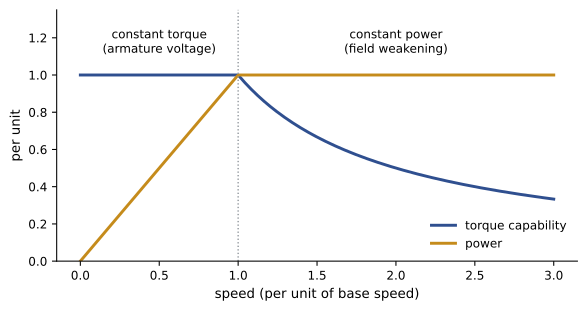
- Armature voltage control: varying \(V\) with constant field gives speeds from zero up to base speed at constant torque capability (since rated \(I_a\) and \(\Phi\) give rated torque). Modern DC drives use thyristor rectifiers or PWM converters for this.
- Field weakening: reducing \(\Phi\) raises speed above base speed. Since \(E_a\) cannot exceed the supply voltage, torque capability falls in proportion to \(1/\omega\), so this region delivers constant power. Field weakening is limited by commutation and mechanical stresses, typically to two to four times base speed.
- Armature resistance: adding resistance lowers speed but wastes power, so it is used only for starting or rough control.
This two-region scheme, constant torque below base speed and constant power above, carries over directly to AC drives (Lesson 7) and electric vehicle motors.
Worked problem
Field weakening
The example motor (230 V, \(R_a = 0.25\ \Omega\), \(K\Phi = 1.731\) at full field) drives a load requiring 40 A of armature current. To what fraction must the field be reduced to run at 1800 rpm?
Show solution
- \(E_a = 230 - 40 \times 0.25 = 220\) V.
- \(\omega = 2\pi \times 1800/60 = 188.5\) rad/s; required \(K\Phi = 220/188.5 = 1.167\).
- Fraction of full field \(= 1.167/1.731 = 0.674\).
Answer: The field must be reduced to about 67% of full value. The torque at 40 A is then \(1.167 \times 40 = 46.7\) N·m, a third less than the 69 N·m the same current gives at full field, which illustrates the reduced torque capability above base speed.
Armature reaction and commutation
Armature current produces its own mmf, which distorts and weakens the main field. This armature reaction shifts the magnetic neutral plane, where coils should be commutated, and causes sparking at the brushes, and in a saturated machine it reduces the net flux, lowering the EMF. Larger machines counter it with interpoles (commutating poles between the main poles, carrying armature current) and compensating windings embedded in the pole faces. During commutation, each coil's current must reverse in a fraction of a millisecond; the coil's inductance resists this, producing a reactance voltage that also causes sparking unless the interpoles cancel it.
Losses and efficiency
DC machine losses are:
- Copper losses: \(I_a^2 R_a\) in the armature and \(V_f I_f\) in the field.
- Brush contact loss: roughly 2 V total drop times armature current for carbon brushes.
- Core losses in the rotating armature (hysteresis and eddy currents, Lesson 1).
- Mechanical losses: friction and windage.
- Stray load losses: about 1% of output for larger machines.
Efficiencies range from about 75% for small machines to 95% for large ones. Because core and mechanical losses are roughly constant at a given speed while copper loss grows with current squared, efficiency peaks where variable losses equal constant losses, as for transformers.
Worked problem
Motor efficiency
A 230 V shunt motor draws 52 A from the line, of which 2 A is field current. \(R_a = 0.25\ \Omega\), brush drop 2 V, and rotational losses (core, friction and windage) are 600 W. Find the output power and efficiency.
Show solution
- Input: \(230 \times 52 = 11{,}960\) W. \(I_a = 50\) A.
- Field loss \(= 230 \times 2 = 460\) W; armature copper \(= 50^2 \times 0.25 = 625\) W; brush \(= 2 \times 50 = 100\) W.
- Output \(= 11{,}960 - 460 - 625 - 100 - 600 = 10{,}175\) W.
- Efficiency \(= 10{,}175/11{,}960 = 85.1\%\).
Answer: About 10.2 kW (13.6 hp) output at 85% efficiency.
Brushless and permanent magnet machines
A brushless DC (BLDC) motor turns the DC machine inside out: permanent magnets rotate on the rotor, the windings are on the stator, and an electronic inverter switches current between windings according to rotor position, measured by Hall sensors or estimated from the back EMF. Electronic commutation removes the brushes and commutator, eliminating wear, sparking and most maintenance, and allows higher speeds. BLDC motors with trapezoidal back EMF and permanent magnet synchronous motors (PMSM) with sinusoidal back EMF (Lessons 9 and 11) power computer fans, drones, appliances, robots, data center cooling fans and most electric vehicles. Their speed and torque obey the same relations as the DC machine, \(E = K\Phi\omega\) and \(T = K\Phi I\), with the inverter supplying the voltage control.
Lesson 6 turns to the AC windings and rotating magnetic field used by the induction and synchronous machines in the rest of the course.
Common mistakes
MistakeStarting a DC motor across the full line voltage.
InsteadLimit current with a starting resistor or reduced-voltage drive.
MistakeRunning a series motor without load.
InsteadIts speed rises dangerously; always couple series motors to their load.
MistakeOpening the field circuit of a running shunt motor.
InsteadFlux collapses and speed can run away or current soar; use field-loss protection.
MistakeExpecting rated torque above base speed.
InsteadField weakening gives constant power, so torque falls with speed.
MistakeMixing rpm and rad/s in EMF and torque equations.
InsteadUse ω = 2πn/60 with KΦ in SI units.
Summary and key terms
- DC machines have a field on the stator and an armature with a commutator that rectifies mechanically.
- Ea = KΦω and T = KΦIa, with the same constant; EaIa = Tω.
- Motor: V = Ea + IaRa; generator: V = Ea − IaRa.
- Shunt motors run at nearly constant speed; series motors give high starting torque and must stay loaded.
- Starting current must be limited because back EMF is zero at standstill.
- Armature voltage control gives constant torque below base speed; field weakening gives constant power above.
- Armature reaction distorts the field; interpoles and compensating windings correct it.
- Brushless DC and PM motors follow the same equations with electronic commutation.
- Commutator
- Segmented ring that reverses armature coil connections to produce unidirectional voltage and torque.
- Armature
- The winding in which EMF is induced and load current flows.
- Back EMF
- The EMF induced in a motor's armature, opposing the supply voltage.
- Shunt field
- A field winding connected in parallel with the armature.
- Series field
- A field winding carrying armature current.
- Base speed
- The speed at rated armature voltage and full field.
- Field weakening
- Reducing field flux to raise speed above base speed.
- Armature reaction
- Distortion of the main field by armature mmf.
- Interpole
- A small pole that aids commutation by canceling reactance voltage.
- Speed regulation
- The change in speed from no load to full load as a percentage of full-load speed.
- Brushless DC motor
- A permanent magnet motor commutated electronically.
Practice problems
Work each problem on paper first, then reveal the answer to check.
KΦ = 2.0 V·s/rad. EMF at 1200 rpm?
Show answer
2.0 × 125.7 = 251 V.
Same machine: torque at 30 A?
Show answer
60 N·m.
A 250 V motor with Ra = 0.5 Ω draws 20 A. Back EMF?
Show answer
240 V.
No-load speed 1500 rpm, full-load 1420 rpm. Speed regulation?
Show answer
80/1420 = 5.6%.
Why must series motors never run unloaded?
Show answer
Light load means low current and flux, so speed rises without limit.
A 120 V motor with Ra = 0.3 Ω: starting current without resistance?
Show answer
400 A.
External resistance to limit that start to 50 A?
Show answer
120/50 − 0.3 = 2.1 Ω.
If flux falls to 80% at constant Ea, how does speed change?
Show answer
Speed rises by 1/0.8 = 1.25 times.
What torque capability does field weakening give above base speed?
Show answer
Torque falls as 1/speed; power is constant.
How does a BLDC motor commutate?
Show answer
An inverter switches stator windings based on rotor position.
Lesson quiz · 5 questions
Score 60% or more to complete this lesson.
Create a free account to save your progress, take quizzes and earn a certificate.