
DCE-450 · Lesson 11 of 12 · 24 min
Incident response and analysis
No data center is immune to incidents. Equipment fails, procedures are misapplied, utilities suffer storms, and occasionally several things go wrong at once. What distinguishes a well-run facility is not the absence of incidents but how it responds to them and what it learns afterwards. A fast, disciplined response can turn a failure that might have dropped the IT load into a non-event; a thorough, blame-free analysis can make sure the same failure never happens again. This lesson covers the phases of incident response, how incident command organizes people under pressure, communication with customers, the investigation and root cause analysis that follow, corrective actions, and how incident data reveals patterns across many events.
What counts as an incident
An incident is any unplanned event that interrupts, degrades or threatens the facility's ability to support the IT load, or that harms people. Operators classify incidents by severity so that the response matches the consequence. A typical scheme distinguishes a loss of IT load (the most severe), a loss of redundancy with the load still supported, a degradation such as a cooling excursion within allowable limits, and a near miss in which something went wrong but no effect resulted. Near misses deserve as much attention as outages, because they reveal the same weaknesses at no cost.
Phases of response
Incident response follows a recognizable sequence:
- Detect: an alarm, a monitoring trend, a customer report or an operator's observation reveals that something is wrong. Fast, reliable detection depends on the alarm management of Lesson 10.
- Assess: the team establishes what has happened, what is affected and how much time is available. Is the load at risk? Is redundancy lost? Is anyone in danger?
- Stabilize: the team acts to protect people and the IT load, following the emergency operating procedures (Lesson 9): for example, transferring load to a healthy path, starting standby equipment, or isolating a fault.
- Communicate: notify management, customers and, where required, authorities, early and honestly, with regular updates.
- Restore: return the facility to its normal, fully redundant configuration, carefully, because restoration switching is itself risky.
- Learn: investigate, find causes and implement corrective actions.
The temptation in a crisis is to act quickly on a first guess. Experienced teams take a moment to assess and verify before acting, because a hasty action on a misread situation, such as opening the wrong breaker, can turn a loss of redundancy into a loss of load.
Incident command
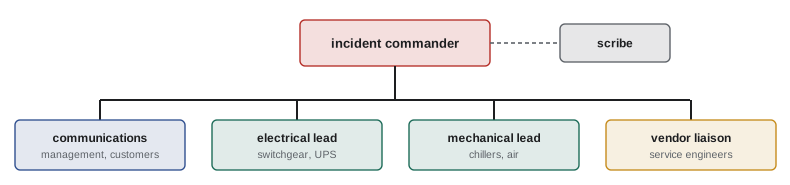
When an incident escalates, people converge: technicians, managers, vendors, customer representatives. Without structure, the result is confusion, contradictory instructions and no one in charge. Many data center operators adopt a simplified form of the incident command system used by emergency services. One person is the incident commander, responsible for decisions and directing the response, ideally not physically operating equipment. A communications lead handles updates to management and customers so that the commander is not interrupted. Technical leads direct work on specific systems. A scribe records the timeline as it happens, which is invaluable for the later investigation. Roles are handed over explicitly if the incident lasts for hours or a more senior person arrives.
Communicating with customers
Customers of colocation and cloud facilities need to know quickly whether their equipment is affected, what is being done, and when the next update will come. Good practice is to send an initial notification within minutes of a significant incident, even if the cause is unknown, followed by updates at regular intervals, and a final notice when service is fully restored. Statements should be factual: what is known, what is not yet known, and what the customer may need to do. Speculation about causes in the first hours often turns out to be wrong and damages trust. A written incident report follows, usually within days, summarizing the event, its impact, its causes and the corrective actions.
In the United States, OSHA requires employers to report a work-related fatality within 8 hours and an in-patient hospitalization, amputation or loss of an eye within 24 hours, and state plans may add requirements. Breaches affecting personal information fall under state breach notification laws and sector rules.
Investigation: building the timeline
Once the facility is stable, the investigation begins, and its foundation is an accurate timeline. The sequence of events from the EPMS, BMS, UPS and generator controllers (Lesson 5), the scribe's notes, access control records, camera footage and interviews with everyone involved are combined into a single, time-ordered account of what happened. Data must be preserved immediately: event logs can be overwritten, and memories fade within days. Interviews are conducted promptly, one person at a time, in a non-threatening way, asking what the person saw, knew and did, and why it made sense at the time.
Root cause analysis
Root cause analysis (RCA) seeks the underlying causes that, if corrected, would prevent recurrence. Several methods are widely used:
- Five whys: asking why repeatedly, starting from the failure, until reaching a cause that can be acted on. It is simple but can follow a single chain and stop too early.
- Cause-and-effect (fishbone or Ishikawa) diagrams: brainstorming possible causes under headings such as people, procedures, equipment, materials, environment and management.
- Causal factor charting and the Apollo method: mapping the chain of events and conditions, with evidence for each, and identifying all the causes that had to combine for the event to occur.
- Fault tree analysis of the specific event (Lesson 7).
Most significant incidents have several causes, rarely one. A single breaker failure becomes an outage only if, say, the redundant path was out for maintenance, the alarm was missed, and the procedure for the situation was wrong. Each of these is a contributing cause, and each is an opportunity to prevent recurrence. This is the insight behind the Swiss cheese model: defenses have holes, and an accident happens when the holes in several layers line up.
Worked problem
Five whys with a wider view
During planned maintenance, a technician opened the wrong breaker, dropping power to one side of a 2N hall. The other side was already de-energized for unrelated work, so 40 racks lost power. Apply the five whys and look for additional contributing causes.
Show solution
- Why did the racks lose power? Both power paths were de-energized at the same time.
- Why were both de-energized? The technician opened breaker B-12 instead of A-12, while the B side was already out for other work.
- Why did he open the wrong breaker? The MOP referred to "breaker 12" without specifying the switchboard, and the A and B switchboards are in mirror-image rooms.
- Why did the MOP not catch this? It was not peer reviewed, and challenge-and-response was not used because the task was considered routine.
- Why was work allowed on both sides at once? The change schedule did not show the B-side work, which had been approved by a different supervisor.
Answer: The five whys reveal not one but several causes: an ambiguous MOP, no peer review or challenge-and-response, look-alike rooms, and a change control process that allowed conflicting work. Blaming the technician would fix none of them. Corrective actions include unambiguous equipment naming and labeling, mandatory MOP review and challenge-and-response, color-coded A and B rooms, and a single schedule that blocks simultaneous work on both sides.
A just culture
If people are punished for honest mistakes, they stop reporting near misses and become guarded in investigations, and the organization loses the information it needs to improve. A just culture distinguishes honest errors, which are treated as symptoms of system weaknesses to be fixed, from reckless behavior, such as deliberately bypassing safety rules, which is addressed through management. Post-incident reviews are described as blameless: they focus on what happened and why the system allowed it, not on who is at fault. This does not mean no one is accountable; it means accountability is for improving the system.
Corrective actions
Corrective actions should address each significant contributing cause, and they are stronger when they change the system rather than ask people to try harder. A useful ranking, borrowed from safety engineering, is: eliminate the hazard (remove the possibility of the error), engineer it out (interlocks, physical separation, automation), change the environment (labeling, color coding, layout), improve procedures and training, and finally warnings and reminders, which are the weakest. Each action has an owner and a due date, is tracked to completion, and is verified as effective. Lessons are shared with other sites and, where possible, with the industry, through confidential reporting schemes and published analyses.
Learning from many incidents
One incident tells a story; many incidents reveal patterns. Tracking every incident and near miss with its cause category, detection time and restoration time lets operators see where risk concentrates.
from collections import Counter
from statistics import median

# Incidents over three years: (minutes to detect, minutes to restore service, primary cause)
incidents = [
    (2, 35, "maintenance procedure"), (1, 12, "UPS component"), (6, 95, "controls or software"),
    (3, 40, "maintenance procedure"), (1, 8, "utility and generator"), (14, 180, "cooling"),
    (2, 22, "maintenance procedure"), (4, 60, "controls or software"), (1, 15, "UPS component"),
    (9, 140, "cooling"), (2, 30, "change not reviewed"), (3, 45, "maintenance procedure"),
    (5, 75, "change not reviewed"), (1, 10, "utility and generator"),
]
detect = [d for d, _, _ in incidents]
restore = [r for _, r, _ in incidents]
print(f"{len(incidents)} incidents; median time to detect {median(detect)} min, median time to restore {median(restore)} min")

causes = Counter(c for _, _, c in incidents)
running = 0
print("Pareto of primary causes:")
for cause, n in causes.most_common():
    running += n
    print(f"  {cause:<24} {n:2d}  cumulative {running / len(incidents):5.0%}")

human = sum(n for c, n in causes.items() if c in ("maintenance procedure", "change not reviewed"))
print(f"Share with procedure or change causes: {human / len(incidents):.0%}")
slow = [i for i in incidents if i[0] >= 5]
print(f"Incidents detected after 5 min or more: {len(slow)}, mean restore {sum(r for _, r, _ in slow) / len(slow):.0f} min")14 incidents; median time to detect 2.5 min, median time to restore 37.5 min Pareto of primary causes: maintenance procedure 4 cumulative 29% UPS component 2 cumulative 43% controls or software 2 cumulative 57% utility and generator 2 cumulative 71% cooling 2 cumulative 86% change not reviewed 2 cumulative 100% Share with procedure or change causes: 43% Incidents detected after 5 min or more: 4, mean restore 122 min
Across these fourteen incidents, maintenance procedures are the largest single cause category, and procedure and change control together account for 43 %, consistent with industry surveys that find human and process factors behind most significant outages. The incidents detected after five minutes or more took on average about two hours to restore, compared with a median of under 40 minutes overall, showing that detection speed matters. Improvement effort is best directed at procedures and change control, and at monitoring and alarms that detect cooling and controls problems earlier, rather than at the components that already fail rarely.
Common mistakes
MistakeActing on a first guess during an incident.
InsteadAssess and verify the situation before switching.
MistakeHaving the most senior person operate equipment while directing the response.
InsteadAssign an incident commander who directs, and technicians who operate.
MistakeSpeculating about causes in early customer updates.
InsteadCommunicate facts, unknowns and the time of the next update.
MistakeStopping the analysis at human error.
InsteadFind the system weaknesses that made the error possible and likely.
MistakeRelying on reminders as corrective actions.
InsteadPrefer elimination, engineering and environmental changes.
Summary and key terms
- Incidents are classified by severity; near misses deserve full attention.
- Response phases: detect, assess, stabilize, communicate, restore, learn.
- Incident command assigns a commander, communications lead, technical leads and a scribe.
- Customer communication is early, factual and regular.
- Investigations rest on a preserved, merged timeline and prompt interviews.
- Root cause analysis finds multiple contributing causes; a just culture keeps information flowing.
- Strong corrective actions change the system; incident data reveals patterns.
- Incident
- An unplanned event that interrupts, degrades or threatens service or harms people.
- Near miss
- An event that could have caused harm but did not.
- Incident commander
- The person directing the response.
- Scribe
- The person recording the incident timeline as it happens.
- Root cause analysis
- Investigation to find causes that, if corrected, prevent recurrence.
- Five whys
- Asking why repeatedly to trace causes.
- Fishbone diagram
- A cause-and-effect diagram grouping possible causes by category.
- Contributing cause
- One of several conditions that combined to cause an incident.
- Just culture
- A culture that treats honest errors as system problems and reckless acts as management issues.
- Pareto analysis
- Ranking causes by frequency to focus improvement effort.
Practice problems
Work each problem on paper first, then reveal the answer to check.
List the six phases of incident response.
Show answer
Detect, assess, stabilize, communicate, restore, learn.
Why do near misses deserve attention?
Show answer
They reveal the same weaknesses as outages at no cost.
Why should the incident commander not operate equipment?
Show answer
To keep an overview and direct the response without distraction.
What should an initial customer notification contain?
Show answer
What is known, what is not yet known, any customer action, and when the next update will come.
Why must event data be preserved immediately?
Show answer
Logs can be overwritten and memories fade.
What is the weakness of the five whys?
Show answer
It may follow a single chain and stop too early, missing other causes.
In the example, name three contributing causes.
Show answer
Ambiguous MOP, no peer review or challenge-and-response, look-alike rooms, conflicting work allowed by change control.
Rank these corrective actions from strongest to weakest: reminder sign, interlock, procedure update.
Show answer
Interlock, procedure update, reminder sign.
From the output, what is the largest cause category?
Show answer
Maintenance procedures, 4 of 14 incidents.
From the output, how do slowly detected incidents compare?
Show answer
They took about 122 minutes on average to restore, against a median of 37.5 minutes overall.
Lesson quiz · 5 questions
Score 60% or more to complete this lesson.
Create a free account to save your progress, take quizzes and earn a certificate.