
DCE-450 · Lesson 1 of 12 · 26 min
Commissioning: purpose, process and people
A data center is designed to keep running through utility failures, equipment breakdowns and maintenance, but on the day construction ends, nobody actually knows whether it will. Breakers may be set wrongly, a sensor may be wired backwards, a control sequence may never have been tried with a real failure, or two systems designed by different engineers may not work together. Commissioning is the systematic process of proving, before the facility carries live load, that every system and the facility as a whole perform as the owner requires, and of handing over a facility that its operators understand. This course covers commissioning, reliability engineering, maintenance and operations: the disciplines that turn a well-designed building into a reliable service. This first lesson explains what commissioning is and why it matters, who does it, the documents that drive it, how it runs through the life of a project, and how issues are found and tracked.
Why commissioning matters
Data center failures are expensive. Industry surveys by the Uptime Institute have consistently found that more than half of operators' most recent significant outages cost over US$100,000, and a growing share cost more than US$1 million, before counting damage to reputation and customer trust. Studies of outages repeatedly identify the same root causes: power system failures, cooling failures, software and network problems, and human error, often in procedures that were never tested. Many of those weaknesses are present from day one and could have been found before the facility went live.
Commissioning finds them. Typical problems discovered during data center commissioning include protective devices with incorrect settings, generators that do not share load properly in parallel, uninterruptible power supplies (UPS) that transfer to bypass instead of battery, chilled-water valves that fail to the wrong position, temperature sensors installed in the wrong place, controls that work for normal operation but not after a power interruption, alarms that never reach the operators, and fire suppression interlocks that shut down the wrong equipment. Each is cheap to fix before handover and potentially catastrophic afterwards.
Commissioning typically costs about 0.5 to 2 % of construction cost for a complex mission-critical facility. For a 20 MW data center costing US$200 million, that is US$1 to 4 million, comparable to the cost of a single serious outage. Most owners of mission-critical facilities treat thorough commissioning as non-negotiable.
What commissioning is, and is not
Commissioning (often abbreviated Cx) is a quality-focused process for verifying and documenting that a facility and its systems are planned, designed, installed, tested, operated and maintained to meet the owner's project requirements. Three features distinguish it from ordinary construction quality control:
- It is measured against the owner's requirements, not merely against the drawings. A system can be installed exactly as drawn and still fail the owner's needs because the design was wrong.
- It is systematic and documented: every system is tested against written procedures with recorded results, and every problem is logged and tracked to resolution.
- It spans the whole project, from defining requirements before design to verifying performance in the first year of operation, not just testing at the end.
Commissioning is not a substitute for the contractor's own quality control, the designer's responsibility for the design, or the authority having jurisdiction's inspections for code compliance. It works alongside all of them, as an independent check that the pieces add up to a working whole.
The people
Several parties share commissioning, each with distinct responsibilities:
| Party | Role in commissioning |
|---|---|
| Owner | Defines requirements, funds commissioning, accepts the facility, provides operators |
| Commissioning authority or provider (CxA) | Plans and leads the process, reviews design and submittals, writes or reviews test scripts, witnesses tests, tracks issues, reports independently to the owner |
| Designers (engineers of record) | Write the basis of design, respond to issues, approve changes, attend key tests |
| General and trade contractors | Install, start up and test their systems, complete checklists, fix deficiencies |
| Equipment vendors | Perform factory testing, start-up and vendor-specific tests; train operators |
| Operations team | Participate in testing, learn the systems, accept the procedures and documentation |
| Authority having jurisdiction | Inspects and witnesses code-required tests such as fire alarm and generator acceptance |
The commissioning authority should be independent of the design and construction teams, reporting directly to the owner, so that problems are reported without conflicts of interest. On large projects the CxA leads a team of specialists in electrical, mechanical, controls and fire systems, often supported by an independent electrical testing firm. The future operators' involvement is just as important: operators who have watched every system tested, and taken part in failure scenarios, start their first shift knowing how the facility behaves.
The key documents
Commissioning is driven by documents that turn intentions into testable criteria:
- Owner's project requirements (OPR): what the owner needs, in measurable terms: IT load and growth, redundancy level and concurrent maintainability, availability targets, temperature and humidity ranges, efficiency targets such as PUE, operational and maintenance requirements, and acceptance criteria.
- Basis of design (BOD): the designers' explanation of how the design meets the OPR: system architectures, design assumptions, calculations, equipment selection and standards used.
- Commissioning plan: scope, schedule, responsibilities, communication, the levels of testing and the documentation to be produced.
- Commissioning specifications: contract language requiring contractors to take part in commissioning, perform specified tests and fix deficiencies.
- Checklists and test scripts: step-by-step procedures, with expected results and acceptance criteria, for every level of testing (Lesson 2).
- Issues log: a record of every deficiency, with its severity, owner, status and resolution.
- Commissioning report and systems manual: the final record of what was tested and how the facility works, the basis for operations (Lesson 9).
Worked problem
Making a requirement testable
An owner's draft OPR says, "The cooling system must be reliable." Rewrite it so it can be tested in commissioning.
Show solution
- State the performance: supply air to IT equipment between 18 °C and 27 °C at full design IT load.
- State the redundancy: maintain that range with any one cooling unit or chiller out of service (N+1).
- State the transient behavior: after a utility outage and generator start, chilled water supply temperature recovers to set point within 10 minutes, and server inlet temperatures never exceed 32 °C.
- State how it will be verified: load-bank test at 100 % design load with one unit failed, and an integrated systems test of utility failure.
Answer: Each statement can now pass or fail a test. Vague requirements produce arguments at acceptance; measurable ones produce test scripts. ENGG-160 discusses writing verifiable requirements in general; commissioning depends on them.
Commissioning through the project
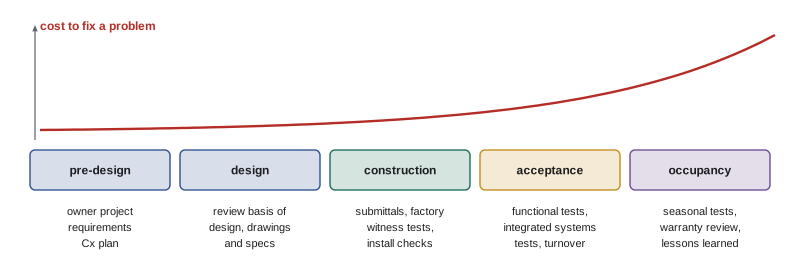
Commissioning runs from the start of a project to the end of its first year:
- Pre-design: develop the OPR with the owner; choose the commissioning authority.
- Design: review the BOD and drawings for commissionability, maintainability and compliance with the OPR; ensure designs include test connections, isolation points, load bank connections and instrumentation.
- Construction: review submittals, witness factory tests, verify installation with checklists, observe start-up, and run functional and integrated tests.
- Acceptance and handover: complete the commissioning report, systems manual and training; confirm all critical issues are resolved.
- Occupancy and warranty: verify performance under real load and seasonal conditions, revisit issues, and conduct a review before the warranty expires.
Commissioning that starts only at construction finds problems when they are expensive to fix. Design-phase reviews catch things such as a generator room too small to service the engines, missing bypass paths that make maintenance impossible without an outage, or a control sequence that cannot recover automatically after a power failure.
Standards and guidelines
Several standards and guidelines define good commissioning practice. ASHRAE Guideline 0 (the commissioning process) and ASHRAE Standard 202 describe the general process for buildings, and ASHRAE Guideline 1.1 covers HVAC systems. Electrical acceptance testing commonly follows the ANSI/NETA Acceptance Testing Specifications (NETA ATS), which set tests and acceptance values for switchgear, transformers, breakers, relays and cables. Data center owners and colocation providers usually add their own detailed requirements.
In the United States, NFPA 4 sets requirements for integrated testing of fire protection and life safety systems; standby generators are tested under NFPA 110; and fire alarm systems are tested under NFPA 72. Some states and jurisdictions require commissioning of building energy systems under energy codes based on ASHRAE 90.1 or the International Energy Conservation Code.
Tracking issues
Every deficiency found during commissioning goes into the issues log, with a description, the system affected, its severity, who is responsible, the date found and its status. Severity levels drive priorities: a critical issue (one that could cause loss of IT load or endanger people) must be fixed and retested before the next level of testing can proceed; a major issue affects performance or redundancy; a minor issue is cosmetic or administrative. The log is reviewed at regular commissioning meetings, and its trends tell the owner whether the project is on track.
from collections import Counter

# Extract of a commissioning issues log: (id, system, severity, status, days open)
log = [
    (1, "UPS", "critical", "closed", 6), (2, "Generator", "major", "closed", 12),
    (3, "Chiller", "major", "open", 21), (4, "CRAH", "minor", "closed", 3),
    (5, "BMS", "major", "open", 30), (6, "Switchgear", "critical", "open", 9),
    (7, "BMS", "minor", "open", 15), (8, "Fire alarm", "major", "closed", 5),
    (9, "EPMS", "minor", "closed", 2), (10, "BMS", "major", "open", 18),
]
by_sev = Counter(sev for _, _, sev, st, _ in log if st == "open")
by_sys = Counter(sysname for _, sysname, _, st, _ in log if st == "open")
print("Open issues by severity:", dict(by_sev))
print("Open issues by system:  ", dict(by_sys))
closed = [d for *_, st, d in log if st == "closed"]
print(f"Closed: {len(closed)} of {len(log)}; mean days to close {sum(closed) / len(closed):.1f}")
blocking = [i for i, _, sev, st, _ in log if st == "open" and sev == "critical"]
print("Open critical issues that block the next commissioning level:", blocking)Open issues by severity: {'major': 3, 'critical': 1, 'minor': 1}
Open issues by system: {'Chiller': 1, 'BMS': 3, 'Switchgear': 1}
Closed: 5 of 10; mean days to close 5.6
Open critical issues that block the next commissioning level: [6]The summary shows a typical pattern: the building management system (BMS) has the most open issues, because controls integrate every other system and are usually the last to be finished. One open critical switchgear issue blocks the next level of testing. Owners track these numbers weekly; a log whose open count keeps rising late in construction signals that handover will slip.
Retro-commissioning and ongoing commissioning
Commissioning does not have to stop at handover. Retro-commissioning applies the process to an existing facility that was never commissioned, or has drifted from its design, often finding energy savings and hidden single points of failure. Re-commissioning repeats it after major changes, such as adding capacity, replacing a chiller plant or changing the cooling technology for high-density AI racks. Ongoing (monitoring-based) commissioning uses data from the BMS and power monitoring system to detect drift continuously (Lesson 10).
How this course is organized
The twelve lessons follow the life of a facility from commissioning to long-term operation:
- Lesson 1 (this lesson): commissioning: purpose, process and people.
- Lesson 2: commissioning levels, test scripts and documentation.
- Lesson 3: electrical systems testing: switchgear, UPS, generators and load banks.
- Lesson 4: mechanical and controls commissioning.
- Lesson 5: integrated systems testing.
- Lesson 6: reliability engineering and availability.
- Lesson 7: reliability modeling: block diagrams, fault trees and simulation.
- Lesson 8: maintenance strategies.
- Lesson 9: operations: staffing, procedures and change control.
- Lesson 10: monitoring and capacity management.
- Lesson 11: incident response and analysis.
- Lesson 12: case study and course project.
Common mistakes
MistakeStarting commissioning only when construction is nearly finished.
InsteadBegin with the OPR before design and review the design for commissionability.
MistakeWriting vague owner requirements.
InsteadState measurable, testable criteria with methods of verification.
MistakeHaving the contractor commission its own work alone.
InsteadUse an independent commissioning authority reporting to the owner.
MistakeLeaving operators out of commissioning.
InsteadInvolve the operations team in testing from the start.
MistakeProceeding to the next test level with open critical issues.
InsteadResolve and retest critical issues first.
Summary and key terms
- Commissioning verifies that systems and the facility meet the owner's requirements before live load.
- It costs about 0.5 to 2 % of construction and prevents outages costing far more.
- The independent commissioning authority leads, with designers, contractors, vendors, operators and the AHJ.
- The OPR, BOD, Cx plan, specifications, scripts, issues log and Cx report drive the process.
- Commissioning runs from pre-design to the end of the warranty year; early reviews save most.
- ASHRAE Guideline 0, Standard 202, NETA ATS and national standards guide practice.
- The issues log tracks every deficiency by severity until it is resolved and retested.
- Commissioning
- A quality process verifying that a facility meets the owner's requirements.
- Commissioning authority
- The independent party that plans and leads commissioning.
- Owner's project requirements
- The owner's measurable needs for the facility.
- Basis of design
- The designers' explanation of how the design meets the OPR.
- Commissioning plan
- The document setting scope, schedule, roles and procedures for commissioning.
- Issues log
- The record of deficiencies and their resolution.
- Submittal review
- Checking contractor equipment data against design and OPR.
- Systems manual
- The documentation explaining how the facility's systems work and are operated.
- Retro-commissioning
- Commissioning an existing facility that was not commissioned or has drifted.
- Authority having jurisdiction
- The body responsible for enforcing codes and approving installations.
Practice problems
Work each problem on paper first, then reveal the answer to check.
Name four kinds of problems commonly found in data center commissioning.
Show answer
For example: wrong breaker settings, generators not sharing load, valves failing to the wrong position, alarms not reaching operators.
Estimate commissioning cost for a US$120 million project at 1.2 %.
Show answer
About US$1.44 million.
Why should the commissioning authority be independent?
Show answer
To report problems to the owner without conflicts of interest.
What is the difference between the OPR and the BOD?
Show answer
The OPR states what the owner needs; the BOD explains how the design meets it.
Rewrite "the UPS must be robust" as a testable requirement.
Show answer
For example: the UPS shall carry 100 % design load on battery for at least 5 minutes at end of battery life, with no transfer to bypass.
Name one problem a design-phase commissioning review can catch.
Show answer
For example: no bypass path for maintenance, or missing load bank connections.
Which standard commonly guides electrical acceptance testing?
Show answer
ANSI/NETA ATS.
What severity of issue must be resolved before the next level of testing?
Show answer
Critical issues.
In the issues log example, which system has the most open issues, and why is that common?
Show answer
The BMS; controls integrate all systems and are finished last.
What is retro-commissioning?
Show answer
Applying commissioning to an existing facility that was never commissioned or has drifted.
Lesson quiz · 5 questions
Score 60% or more to complete this lesson.
Create a free account to save your progress, take quizzes and earn a certificate.