
DCE-430 · Lesson 7 of 12 · 35 min
Seismic, wind and snow design (ASCE 7 and the IBC)
Natural hazards are the loads that most distinguish the structural design of a critical facility from that of an ordinary building. A warehouse that is damaged in an earthquake or a storm can be repaired; a data center that stops working during the disaster may take down hospitals, banks, emergency communications and cloud services used by millions of people. Codes recognize this through importance or risk categories that raise design loads for buildings whose functions matter most, and data center owners frequently go further than the code requires. This lesson explains how snow, wind and seismic loads are determined, how importance affects them, how equipment and racks are protected, and how a changing climate is affecting design data.
Risk categories
The International Building Code (Table 1604.5) and ASCE 7 assign every building a risk category based on the consequences of its failure:
| Risk category | Examples | Snow | Wind | Seismic \(I_e\) |
|---|---|---|---|---|
| I | Low hazard to human life: minor storage, agricultural | Category-specific maps | Category-specific maps | 1.0 |
| II | Most buildings, including typical data centers | Category-specific maps | Category-specific maps | 1.0 |
| III | Large occupancies, schools, buildings whose failure has substantial economic impact | Category-specific maps | Category-specific maps (1,700-year) | 1.25 |
| IV | Essential facilities: hospitals, emergency operations, 911 and emergency communications centers | Category-specific maps | Category-specific maps (3,000-year) | 1.5 |
A typical commercial data center is Risk Category II. Facilities that support emergency communications may be Risk Category IV, and owners often voluntarily design to Risk Category III or IV for resilience. In ASCE 7-22, Risk Category III and IV buildings east of the Rocky Mountains must also be designed for tornado loads where the mapped tornado speed exceeds 60 mph, and Risk Category IV structures in higher seismic design categories have stricter requirements for equipment needed to keep operating after an earthquake.
Worked problem
Cost of a higher category
A data center's seismic base shear is 1350 kips in Risk Category II. What is it in Risk Categories III and IV?
Show solution
- III: \(1350 \times 1.25 = 1690\) kips. IV: \(1350 \times 1.5 = 2025\) kips.
Answer: The design earthquake force rises 30% (25% in the US) for the higher category and 50% for the highest. The added structural cost is usually a small percentage of total project cost, which is why many owners choose the higher category; the larger costs often come from equipment anchorage and certification requirements.
Snow loads
ASCE 7-22 specifies the flat roof snow load as:
where \(p_g\) is the ground snow load for the site from the risk-category-specific maps (or the ASCE Hazard Tool), \(C_e\) the exposure factor (0.8 to 1.2 depending on terrain and roof exposure) and \(C_t\) the thermal factor (1.0 for heated buildings, higher for unheated or well-insulated roofs). Sloped roof, drift and unbalanced loads are added for non-uniform conditions.
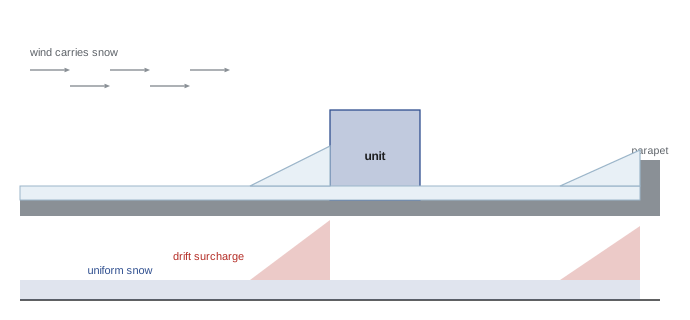
Large flat data center roofs collect snow evenly, but drifts form wherever the roof changes height or has obstructions: against parapets, at steps between roof levels, and around rooftop equipment and penthouses. Wind carries snow from the upwind roof and deposits it in the aerodynamic shadow, forming a roughly triangular drift whose height grows with the length of upwind roof (the fetch) and the ground snow load. Drift loads can be several times the uniform load and are the cause of many roof failures.
Worked problem
Uniform roof snow load
A data center in a location with \(p_g = 40\) psf (Risk Category II map) has a flat roof with \(C_e = 1.0\) and \(C_t = 1.0\). Find the flat roof snow load. If the Risk Category IV map gives \(p_g = 48\) psf, what is the load?
Show solution
- RC II: \(p_f = 0.7 \times 1.0 \times 1.0 \times 40 = 28\) psf.
- RC IV: \(0.7 \times 48 = 33.6\) psf.
Answer: The flat roof snow load is 28 psf in Risk Category II and 34 psf in Risk Category IV, before drift loads are added around parapets and equipment. (ASCE 7 also sets minimum roof snow loads for low-slope roofs.)
Worked problem
Drift load against a rooftop unit
A drift forms against a 10 ft tall rooftop unit, with a height of 5 ft above the uniform snow and snow density of 19 pcf. What is the maximum additional drift load, and how does it compare with the uniform load of 28 psf?
Show solution
- Drift surcharge at its peak: \(5 \times 19 = 95\) psf.
- Total at the face of the unit: \(28 + 95 = 123\) psf.
Answer: The total load beside the unit is 123 psf, more than four times the uniform load. Roof members near equipment, parapets and steps must be designed for these drifts, and closely spaced equipment can create combined drifts.
Wind loads
ASCE 7 calculates the velocity pressure at height \(z\) as:
where \(V\) is the basic wind speed from the risk-category-specific map (for example a 700-year return period for Risk Category II, 1,700 years for III and 3,000 years for IV), \(K_z\) the exposure coefficient for height and terrain, \(K_{zt}\) the topographic factor and \(K_e\) the ground elevation factor. Design pressures then apply gust effect factors and external and internal pressure coefficients for each surface.
Wind pressures are highest at roof corners and edges, where flow separates, often two to three times the pressure on the roof interior. For data centers, wind design covers the main structure, cladding and roofing (which must not peel off and expose equipment to rain), rooftop equipment and its anchorage, louvers and intake screens, and the effects of wind on air intakes and generator exhaust. In hurricane- and tornado-prone regions, owners specify impact-resistant envelopes, hardened rooms for critical equipment and protection for outdoor equipment.
Worked problem
Wind uplift on a rooftop unit
A rooftop unit with a plan area of 8 ft × 20 ft weighs 13.5 kips. The net design uplift pressure on it is 33 psf. Is anchorage needed to resist uplift, using 0.6 times the weight (ASD)?
Show solution
- Uplift: \(33 \times 8 \times 20 = 5280\) lb = 5.3 kips; resisting \(0.6 \times 13.5 = 8.1\) kips.
Answer: Weight resists uplift, but horizontal wind forces create overturning and sliding that must still be resisted by anchors, and lighter units (empty or during installation) or higher pressures at roof corners may need hold-downs. Anchorage is also required for seismic loads in most seismic design categories.
Seismic design
ASCE 7 seismic provisions use risk-targeted design spectral accelerations \(S_{DS}\) and \(S_{D1}\) for the site, adjusted for the site class (ASCE 7-22 provides multi-period spectra and more site classes). For regular buildings, the equivalent lateral force procedure gives the base shear:
where \(T\) is the fundamental period, \(I_e\) the importance factor, \(W\) the effective seismic weight (dead load plus a portion of storage live load and of significant snow), and \(R\) the response modification coefficient of the lateral system (for example \(R = 3.25\) for ordinary steel concentrically braced frames, 6 for special ones). The force is distributed up the height in proportion to weight times height. The seismic design category (A to F), set by the spectral accelerations and risk category, determines which systems are permitted and which detailing is required.
import numpy as np

# equivalent static seismic base shear for a two-level braced steel building
# design spectrum (5% damping), short- and 1-second values for the site and site class
S_short, S_1 = 0.80, 0.30      # design spectral accelerations (g)
h_n = 14.0                     # building height (m)
W = 36000.0                    # seismic weight (kN): structure, roof equipment and part of floor load
R = 3.25                       # response modification / ductility factor for an ordinary braced frame (illustrative)

T = 0.0488 * h_n ** 0.75       # approximate period for braced frames, h in m
Sa = min(S_short, S_1 / T)
print(f"approximate period T = {T:.2f} s, spectral acceleration Sa(T) = {Sa:.2f} g")
for name, I in (("normal (I = 1.0)", 1.0), ("high (I = 1.25)", 1.25), ("post-disaster / essential (I = 1.5)", 1.5)):
    V = Sa * I / R * W
    print(f"{name:36s}: base shear V = {V:6.0f} kN ({V / W * 100:4.1f}% of weight)")

# distribute the I = 1.5 base shear to the two levels in proportion to w*h
w = np.array([20000.0, 16000.0]); h = np.array([7.0, 14.0])
V = Sa * 1.5 / R * W
F = V * w * h / (w * h).sum()
for lvl, f in zip(("level 2 (floor)", "roof"), F):
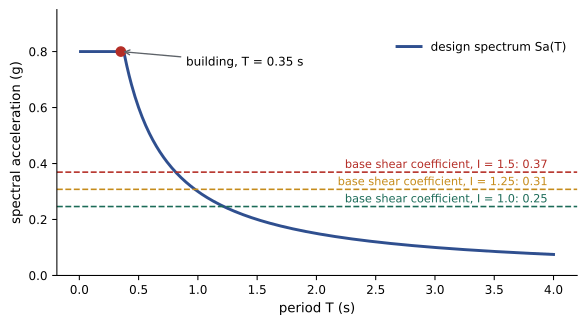
print(f" {lvl:16s}: {f:6.0f} kN")approximate period T = 0.35 s, spectral acceleration Sa(T) = 0.80 g normal (I = 1.0) : base shear V = 8862 kN (24.6% of weight) high (I = 1.25) : base shear V = 11077 kN (30.8% of weight) post-disaster / essential (I = 1.5) : base shear V = 13292 kN (36.9% of weight) level 2 (floor) : 5112 kN roof : 8180 kN
In this illustrative case (design spectral acceleration 0.8 g at the building's 0.35 s period, a reduction factor of 3.25 for a moderately ductile braced frame), the base shear is 25% of the building weight for normal importance and 37% for the highest category. Because the roof carries 16,000 kN at twice the height of the floor, it receives 62% of the lateral force, which is why heavy rooftop equipment increases seismic demand on the whole structure.
Protecting equipment and racks
Most earthquake losses at data centers come not from structural collapse but from damage to non-structural components: unanchored equipment sliding or toppling, racks overturning, raised floors collapsing, pipes and sprinklers breaking and flooding equipment, and ceilings falling. Codes require non-structural components to be anchored and braced for seismic forces that increase with height in the building, because floor accelerations are amplified above the ground.
In ASCE 7-16, the lateral force on a component was:
where \(a_p\) is the component amplification factor, \(R_p\) the component response modification factor, \(I_p\) the component importance factor (1.5 for components needed for life safety or continued operation of essential facilities) and \(z/h\) the relative height of attachment. ASCE 7-22 revised this method, using building-specific amplification and component resonance factors, but the principle is the same. Equipment in Risk Category IV facilities with \(I_p = 1.5\) must be certified, by shake-table testing or analysis, to remain operational after the design earthquake.
Worked problem
Anchorage force for a rooftop chiller
A 55 kip chiller sits on the roof (\(z = h\)) of a Risk Category IV data center with \(S_{DS} = 0.8\). For rigid equipment, take \(a_p = 1.0\), \(R_p = 2.5\), \(I_p = 1.5\). Find \(F_p\) using the ASCE 7-16 formula.
Show solution
- \(F_p = 0.4 \times 1.0 \times 0.8 \times 55/(2.5/1.5) \times (1 + 2) = 17.6 \times 3/1.667 = 31.7\) kips.
- As a fraction of weight: \(31.7/55 = 0.58\).
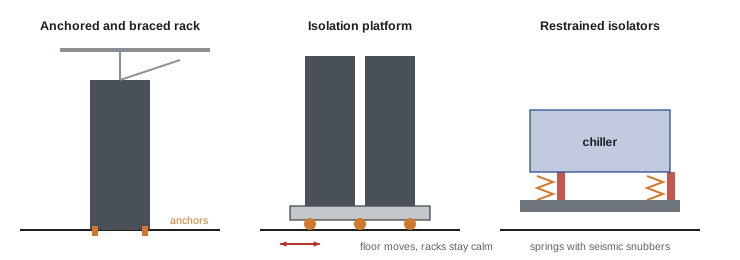
Answer: About 32 kips, 58% of the chiller's weight, must be resisted by its anchors, the dunnage and the roof structure, in any horizontal direction. Anchor bolts, welds and vibration isolators must all be rated for seismic forces; ordinary spring isolators without seismic restraints are a common weak point.
For racks and IT equipment, options include anchoring racks to the slab (with braced, seismically rated racks), bracing rack tops together and to the structure, or mounting racks or whole rows on base isolation platforms that let the floor move beneath them while limiting the acceleration transmitted to servers. In the most seismically active regions, some data centers isolate the entire building on rubber or friction pendulum bearings, so the structure and its contents experience a fraction of the ground acceleration. Pipes, cable trays, busways and sprinkler lines require seismic bracing, and flexible connections where they cross seismic joints or connect to isolated equipment.
Climate change and design data
Snow, wind and rainfall design values in codes have traditionally been based on historical records, assuming the climate is stationary. With a warming climate, extreme precipitation is increasing in many regions, snow loads are changing (decreasing in some places, increasing in others with heavier wet snow), and the intensity and track of hurricanes and severe storms are shifting.
ASCE 7-22 introduced risk-category-specific snow loads, tornado loads, and updated wind and flood requirements, and work on the next edition is examining how to account for climate trends. Building codes are adopted by states and local jurisdictions, often several years after publication, so designers must check which editions apply at each site. Owners of long-lived critical facilities increasingly apply future climate projections, from sources such as federal climate assessments, beyond code minimums.
Because a data center's structure may last 30 to 50 years while its equipment is replaced several times, the structure should be designed with margins for future heavier equipment and more severe climate loads, which cost far less to include at the start than to retrofit.
Lesson 11 extends these hazards to resilience objectives beyond the code minimums, including floods, tornadoes, vehicles and blast.
Common mistakes
MistakeAssuming a data center is always Risk Category IV.
InsteadDetermine the code category from its function; choose a higher one deliberately if the owner wants extra resilience.
MistakeDesigning roofs for uniform snow only.
InsteadInclude drifts at parapets, steps and rooftop equipment.
MistakeUsing interior roof wind pressures at corners and edges.
InsteadApply the higher corner and edge zone pressures to roofing and equipment there.
MistakeMounting equipment on spring isolators without seismic restraint.
InsteadUse seismically rated isolators or snubbers.
MistakeRelying on historical climate data alone for a 50-year structure.
InsteadCheck the applicable code edition and consider future climate projections.
Summary and key terms
- IBC risk categories I–IV set seismic Ie = 1.0, 1.0, 1.25, 1.5 and select category-specific snow and wind maps.
- Flat roof snow load pf = 0.7CeCtpg; drifts add large local loads.
- Velocity pressure qz = 0.00256KzKztKeV² psf, highest effects at roof corners and edges; tornado loads apply to RC III and IV east of the Rockies.
- Seismic base shear V = CsW with Cs = SDS/(R/Ie), distributed by weight and height.
- Non-structural components, racks and equipment must be anchored and braced; forces grow with height.
- Base isolation and rack isolation platforms protect sensitive equipment.
- Climate change is shifting design data; long-lived facilities should include margins.
- Risk category
- IBC classification of buildings by the consequences of failure.
- Essential facility
- A building needed for emergency response or recovery, generally Risk Category IV.
- Ground snow load
- The mapped snow load on the ground at a site.
- Snow drift
- Accumulation of wind-blown snow against obstructions.
- Basic wind speed
- The mapped 3-second gust wind speed for a risk category.
- Site class
- Classification of soil stiffness that modifies seismic ground motion.
- Base shear
- The total horizontal seismic force at the base of a structure.
- Response modification coefficient
- R, reducing elastic forces for ductility and overstrength.
- Seismic design category
- A to F classification setting permitted systems and detailing.
- Base isolation
- Bearings that decouple a structure or equipment from ground motion.
Practice problems
Work each problem on paper first, then reveal the answer to check.
Seismic importance factor for Risk Category III?
Show answer
1.25.
pg = 30 psf, Ce = 0.9, Ct = 1.0. Flat roof snow load?
Show answer
0.7 × 0.9 × 30 = 18.9 psf (check the code minimum for low-slope roofs).
Why do drifts form against rooftop equipment?
Show answer
Wind carries snow across the roof and deposits it in the sheltered zone beside obstructions.
Drift 4 ft high, density 18 pcf. Peak surcharge?
Show answer
72 psf.
Where on a flat roof are wind pressures highest?
Show answer
At corners and edges.
Sa = 0.6 g, I = 1.0, reduction factor 3.0, W = 20,000 kN. Base shear?
Show answer
0.6/3 × 20,000 = 4000 kN.
Why does heavy roof equipment increase seismic demand?
Show answer
It adds weight at the top, where the force distribution (weight × height) concentrates force.
Name three common non-structural earthquake failures in data centers.
Show answer
Unanchored equipment sliding, racks overturning, raised floors collapsing, broken pipes or sprinklers, falling ceilings.
How does base isolation protect equipment?
Show answer
Flexible bearings lengthen the period so much less acceleration reaches the structure or racks.
Why include margins beyond code climate data?
Show answer
The structure lasts decades while climate and equipment loads change; margins are cheap at the start.
Lesson quiz · 5 questions
Score 60% or more to complete this lesson.
Create a free account to save your progress, take quizzes and earn a certificate.