
DCE-430 · Lesson 4 of 12 · 29 min
Soils, earthworks and ground improvement
Lesson 3 sized footings from an allowable bearing pressure and checked settlement against limits. Those numbers come from the geotechnical engineer, and behind them lies the behavior of the ground itself: how soils are classified and tested, why clays settle for years while sands settle at once, how earthworks are planned and controlled, how weak ground can be improved instead of avoided, and which problem soils, from expansive clays to permafrost and the sensitive marine clays of eastern Canada, demand special care. Data centers are unusually sensitive to ground behavior because they combine very large, flat, heavily loaded floors with equipment that tolerates little movement, and because owners want standard designs that can be built anywhere. This lesson gives data center engineers enough geotechnical understanding to read a geotechnical report critically and make sound decisions with it.
Soil types and classification
Soils are mixtures of mineral particles, water and air. Their engineering behavior depends mostly on particle size and, for fine soils, on how the particles interact with water:
- Gravels and sands (coarse-grained, particles larger than 0.075 mm) are free draining, gain strength from friction between grains, compress little, and settle quickly as load is applied. Loose sands can liquefy in earthquakes when saturated.
- Silts are fine but non-plastic; they are frost susceptible, lose strength when wet and erode easily.
- Clays are very fine, plastic soils whose particles bind water. They have low permeability, so water moves out slowly under load, causing consolidation settlement that can continue for years. Some clays swell and shrink with moisture changes.
- Organic soils and peat are highly compressible and unsuitable for supporting structures; they are removed or bypassed.
- Rock ranges from weak, weathered shale to strong granite, and is generally excellent support if sound.
The Unified Soil Classification System (USCS), used in both Canada and the US, assigns two-letter symbols from grain size distribution and the Atterberg limits (the liquid limit and plastic limit, which measure how the soil's consistency changes with water content): for example GW for well-graded gravel, SP for poorly graded sand, CL for low-plasticity clay and CH for high-plasticity clay.
| Field test | What it measures | Typical use |
|---|---|---|
| Borehole with sampling | soil layers, samples for laboratory tests, groundwater level | every site; logs describe each stratum |
| Standard penetration test (SPT) | blows (N) to drive a sampler 300 mm | density of sands, rough strength of clays, liquefaction screening |
| Cone penetration test (CPT) | continuous tip resistance and sleeve friction | detailed stratigraphy, soft soils, liquefaction |
| Test pit | shallow soil profile seen directly | fill, topsoil depth, excavation conditions |
| Shear wave velocity (seismic CPT, MASW) | stiffness of the upper 30 m | seismic site class (Lesson 7) |
| Plate load test | stiffness of fill or subgrade | slab subgrade modulus, compaction verification |
| Thermal resistivity test | how well soil conducts heat | buried cable ampacity (Lesson 2) |
Effective stress and consolidation
The central principle of soil mechanics, stated by Karl Terzaghi in the 1920s, is that soil strength and compression are controlled by effective stress, the total stress minus the pore water pressure:
When a load is applied to a saturated clay, the water in the pores initially carries it as excess pore pressure, because water cannot escape quickly through the tiny pores. As the water slowly drains, the excess pore pressure dissipates, the load transfers to the soil skeleton, and the clay compresses. This time-dependent process is consolidation. The final settlement of a normally consolidated clay layer of thickness \(H\) is
where \(C_c\) is the compression index and \(e_0\) the initial void ratio from laboratory oedometer tests, \(\sigma'_0\) the initial effective stress and \(\Delta\sigma\) the added stress. The time to reach a given average degree of consolidation \(U\) depends on the coefficient of consolidation \(c_v\) and the drainage path length \(H_{dr}\), through the time factor \(T_v = c_v t/H_{dr}^2\): time increases with the square of the drainage path, which is why thick clay layers take so long to settle.
import numpy as np

# Consolidation settlement of a soft clay layer under a data hall slab and fill, and the effect of wick drains
H = 6.0                      # clay layer thickness, m (drained top and bottom)
Cc, e0 = 0.45, 1.20          # compression index and initial void ratio (normally consolidated clay)
sigma0 = 60.0                # initial effective stress at mid-layer, kPa
cv = 1.5                     # coefficient of consolidation, m2/year
for dq in (25, 50, 100):     # added stress from fill and floor loads, kPa
    s = Cc * H / (1 + e0) * np.log10((sigma0 + dq) / sigma0)
    print(f"added stress {dq:3d} kPa: final consolidation settlement {s * 1000:4.0f} mm")

def U_vertical(t, Hdr):
    Tv = cv * t / Hdr ** 2
    return np.sqrt(4 * Tv / np.pi) if Tv < 0.2 else 1 - 8 / np.pi ** 2 * np.exp(-np.pi ** 2 * Tv / 4)

for years in (0.25, 1, 3, 10):
    print(f"after {years:5.2f} years: average degree of consolidation {U_vertical(years, H / 2):.0%} (vertical drainage only)")
# Prefabricated vertical (wick) drains on a 1.5 m triangular grid: radial drainage (Barron, ideal drains)
ch = 2 * cv                                  # horizontal coefficient, often higher than vertical
de, dw = 1.05 * 1.5, 0.066                   # influence diameter and equivalent drain diameter, m
n = de / dw
Fn = np.log(n) - 0.75
for months in (1, 3, 6):
    t = months / 12
    Th = ch * t / de ** 2
    Uh = 1 - np.exp(-8 * Th / Fn)
    Uv = U_vertical(t, H / 2)
    U = 1 - (1 - Uh) * (1 - Uv)
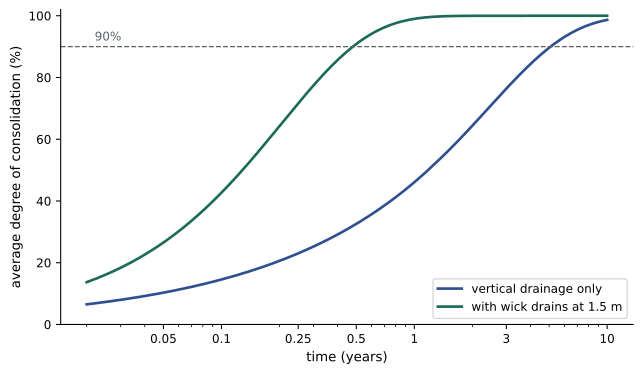
print(f"with wick drains, after {months} months: {U:.0%} consolidated")added stress 25 kPa: final consolidation settlement 186 mm added stress 50 kPa: final consolidation settlement 323 mm added stress 100 kPa: final consolidation settlement 523 mm after 0.25 years: average degree of consolidation 23% (vertical drainage only) after 1.00 years: average degree of consolidation 46% (vertical drainage only) after 3.00 years: average degree of consolidation 76% (vertical drainage only) after 10.00 years: average degree of consolidation 99% (vertical drainage only) with wick drains, after 1 months: 38% consolidated with wick drains, after 3 months: 72% consolidated with wick drains, after 6 months: 91% consolidated
A heavy data hall floor and its fill adding 50 kPa would settle the soft clay by about 320 mm, far beyond the 25 mm tolerated by a slab carrying racks and busways (Lesson 3), and the settlement would continue for a decade. Wick drains, prefabricated vertical drains installed on a grid of about 1.5 m, shorten the drainage path from meters to under a meter, so that 90% of the consolidation happens in about six months. Combined with a temporary surcharge of extra fill, placed to accelerate settlement and then removed before construction, they let the site settle before the building goes on.
Shear strength, bearing and slopes
Soil fails in shear when the shear stress on some surface exceeds its shear strength, given by the Mohr-Coulomb relation in terms of effective stress:
where \(c'\) is cohesion and \(\phi'\) the friction angle. Sands have \(c' \approx 0\) and \(\phi'\) of 30° to 40°; clays loaded quickly, before water can drain, are analyzed with their undrained shear strength \(s_u\), typically 10 to 25 kPa for very soft clays and over 100 kPa for stiff clays. Bearing capacity theory (Terzaghi, Meyerhof, Vesic) uses these parameters to calculate the ultimate bearing resistance of a footing, from which the factored or allowable resistance used in Lesson 3 is derived.
Slopes created by grading (Lesson 1), detention pond banks and excavations must be stable. For a long, uniform slope of dry granular soil, the factor of safety against sliding is simply \(\tan\phi'/\tan\beta\), where \(\beta\) is the slope angle, so a sand with \(\phi' = 34°\) stands at 2H:1V (26.6°) with a factor of safety of 1.35. Water seeping parallel to the slope roughly halves the factor of safety, which is why slopes fail after heavy rain and why drainage is the most effective stabilization measure. Permanent slopes are typically designed for a factor of safety of 1.5, and engineered retaining walls are used where space does not allow stable slopes.
Worked problem
Excavation slope for a fuel tank
A contractor plans a 3.5 m deep excavation in dense sand (\(\phi' = 36°\)) for an underground fuel tank, with sides cut at 1H:1V (45°). Is the slope stable when dry? What about with groundwater seeping out of the face?
Show solution
- Dry: \(FS = \tan 36°/\tan 45° = 0.727/1.0 = 0.73\), less than 1: the slope will ravel and collapse.
- With seepage, roughly half: about 0.36.
- A 1.5H:1V slope gives \(\tan 36°/\tan 33.7° = 1.09\) dry, still marginal for workers below.
Answer: The 1H:1V cut is unstable even dry. The contractor needs flatter slopes (about 2H:1V or flatter in sand, as occupational health and safety regulations typically require for this soil type), shoring or a trench box, and dewatering if groundwater is present. Excavation collapses kill workers every year, so slopes and shoring must follow the provincial or federal occupational safety rules and an engineer's design where required.
Earthworks
Earthworks move, place and compact soil to create the graded surfaces of Lesson 1. On a large campus they can involve hundreds of thousands of cubic meters and are often on the critical path of the schedule. Key concepts:
- Volumes are calculated from survey data by the grid (borrow pit) method, cross-sections along the site, or digital surface comparison in design software.
- Soil bulks when excavated (a cubic meter in the ground becomes 1.1 to 1.4 m³ loose in a truck) and shrinks when compacted (a cubic meter of compacted fill may need 1.1 to 1.2 m³ of cut). Balancing cut and fill must account for these factors.
- Unsuitable materials, such as topsoil, organics and soft or wet clay, are stripped and either stockpiled for landscaping or removed.
- Fill is placed in layers (lifts) typically 200 to 300 mm thick and compacted with rollers to a specified percentage of the maximum dry density from the laboratory Proctor test, at a moisture content near the optimum.
import numpy as np

# Earthworks: cut and fill on a 300 m x 200 m pad from a 20 m grid of existing levels, and compaction control
rng = np.random.default_rng(3)
x = np.arange(0, 301, 20)
y = np.arange(0, 201, 20)
X, Y = np.meshgrid(x, y)
ground = 102.0 + 0.012 * X - 0.008 * Y + 0.4 * np.sin(X / 45) + rng.normal(0, 0.15, X.shape)   # existing levels, m
cell = 20 * 20
def volumes(pad):
    d = (ground[:-1, :-1] + ground[1:, :-1] + ground[:-1, 1:] + ground[1:, 1:]) / 4 - pad   # average depth per cell
    cut = d[d > 0].sum() * cell
    fill = -d[d < 0].sum() * cell
    return cut, fill
for pad in (102.8, 103.2, 103.6):
    cut, fill = volumes(pad)
    print(f"pad level {pad:.1f} m: cut {cut:8,.0f} m3, fill {fill:8,.0f} m3, net {cut - fill * 1.15:9,.0f} m3 after 15% compaction allowance")
# Find the balanced pad level, allowing for compacted fill needing 15% more loose material
levels = np.arange(102.0, 104.5, 0.01)
net = [volumes(p)[0] - 1.15 * volumes(p)[1] for p in levels]
k = int(np.argmin(np.abs(net)))
print(f"balanced pad level about {levels[k]:.2f} m")
# Compaction control: field density against the standard Proctor maximum
max_dry = 2.05                               # t/m3 from the laboratory test
for field in (1.92, 1.96, 2.00):
    rc = field / max_dry
    verdict = "passes" if rc >= 0.95 else "fails"
print(f"field dry density {field:.2f} t/m3: relative compaction {rc:.1%} ({verdict} a 95% specification)")pad level 102.8 m: cut 30,270 m3, fill 17,894 m3, net 9,692 m3 after 15% compaction allowance pad level 103.2 m: cut 18,760 m3, fill 30,384 m3, net -16,181 m3 after 15% compaction allowance pad level 103.6 m: cut 10,910 m3, fill 46,533 m3, net -42,604 m3 after 15% compaction allowance balanced pad level about 102.95 m field dry density 1.92 t/m3: relative compaction 93.7% (fails a 95% specification) field dry density 1.96 t/m3: relative compaction 95.6% (passes a 95% specification) field dry density 2.00 t/m3: relative compaction 97.6% (passes a 95% specification)
Raising the pad by 0.4 m changes the balance by about 26,000 m³, roughly 1,700 truckloads, so the pad level is one of the most valuable decisions in site design. The balanced level here, about 102.95 m, must still satisfy the flood freeboard and drainage criteria of Lesson 1. Compaction is verified in the field with nuclear density gauges or sand-cone tests on every lift, at a frequency set by the specification; a lift that fails is reworked before the next is placed, because poorly compacted fill under a slab causes settlement and cracking that cannot be fixed afterwards.
Ground improvement
When the natural ground is too weak or compressible, the designer can avoid it with deep foundations (piles, Lesson 3) or improve it so that shallow foundations and slabs on grade can be used. For large, heavily loaded floors, ground improvement is often cheaper than a structural slab on piles.
| Method | How it works | Suitable for |
|---|---|---|
| Removal and replacement | excavate weak soil, replace with compacted engineered fill | shallow weak layers, up to about 3 m |
| Preloading and surcharge with wick drains | load the ground in advance to complete consolidation | soft clays where time is available |
| Dynamic compaction | drop a heavy weight (10 to 30 t) repeatedly from 10 to 30 m | loose sands, fills, landfills; not near buildings |
| Vibro-compaction | vibrating probe densifies granular soil | loose clean sands; liquefaction mitigation |
| Stone columns (vibro-replacement) | columns of compacted stone reinforce and drain the soil | soft clays and silts, moderate loads |
| Rigid inclusions | unreinforced grout or concrete columns with a load transfer platform | soft soils under large slabs and tanks |
| Deep soil mixing and jet grouting | mix cement into the soil to form columns or blocks | very soft soils, excavation support, liquefaction |
| Compaction and permeation grouting | inject grout to densify or fill voids | karst voids, remediation under existing structures |
The choice depends on the soil, the depth of the problem layer, the loads, settlement tolerances, schedule, and nearby structures that might be affected by vibration. Ground improvement is usually designed and built by specialist contractors under a performance specification (for example, settlement under the design load not exceeding 25 mm), verified by load tests and monitoring with settlement plates.
Problem soils and conditions
- Expansive clays, common in the Prairies and parts of the US South and West, swell when wet and shrink when dry, lifting and cracking slabs and foundations. Mitigations include removing and replacing the upper soil, moisture control, structural slabs with void forms, and piles founded below the active zone.
- Sensitive marine clays, such as the Leda (Champlain Sea) clay of the Ottawa and St. Lawrence valleys, lose most of their strength when disturbed and have caused large landslides. Sites on these clays need careful slope and excavation design and limits on vibration and fill loads.
- Frost-susceptible soils (silts and silty clays) heave when ice lenses form; foundations go below the frost depth (over 1.5 to 2 m in much of Canada) or sit on non-frost-susceptible fill, and insulated shallow foundations can reduce depth.
- Permafrost in northern Canada must be kept frozen under structures, using elevated buildings, thermosyphons that extract heat in winter, or insulated pads; a heated data hall on permafrost would thaw the ground beneath it without such measures.
- Karst (soluble limestone and gypsum) can contain voids that collapse into sinkholes; investigation with geophysics and probing, and grouting or bridging foundations, are required.
- Liquefiable soils, loose saturated sands in seismic areas, lose strength in earthquakes, causing settlement and loss of bearing; they are densified or bypassed (Lesson 7).
- High groundwater requires dewatering during construction, waterproofing of below-grade spaces, and consideration of buoyancy on tanks and basements.
- Contaminated soils from previous industrial use must be managed under environmental regulations, which can add cost and time (DCE-410).
Common mistakes
MistakeAccepting a single allowable bearing pressure without reading the settlement analysis.
InsteadCheck total and differential settlement for the actual loads and floor area.
MistakeIgnoring time-dependent consolidation of clays.
InsteadEstimate settlement versus time; preload or improve the ground before building.
MistakeCutting excavations steeper than the soil can stand.
InsteadFollow safe slope or shoring requirements and control groundwater.
MistakeBalancing cut and fill without bulking and shrinkage factors.
InsteadApply measured factors and test compaction of every lift.
MistakeUsing standard designs on problem soils without adaptation.
InsteadIdentify expansive, sensitive, frozen or karst ground early and adapt foundations.
Summary and key terms
- Soil behavior depends on grain size and plasticity; USCS classifies soils, and SPT, CPT and laboratory tests characterize them.
- Effective stress controls strength and compression; clays consolidate slowly as excess pore pressure drains.
- Consolidation settlement depends on \(C_c\), \(e_0\) and the stress increase; time grows with the square of the drainage path.
- Wick drains and surcharge accelerate consolidation before construction.
- Mohr-Coulomb strength governs bearing and slope stability; seepage greatly reduces slope safety.
- Earthworks balance cut and fill with bulking and shrinkage factors and verify compaction on every lift.
- Ground improvement and adapted foundations deal with weak ground and problem soils such as expansive clays, Leda clay, permafrost and karst.
- Effective stress
- Total stress minus pore water pressure.
- Consolidation
- Time-dependent compression of saturated clay as water drains.
- Compression index
- The slope of void ratio against the log of effective stress.
- Coefficient of consolidation
- The parameter governing the rate of consolidation.
- Wick drain
- A prefabricated vertical drain that shortens drainage paths.
- Surcharge
- Temporary extra fill placed to accelerate settlement.
- Undrained shear strength
- The strength of clay loaded before water can drain.
- Proctor test
- A laboratory test giving maximum dry density and optimum moisture.
- Relative compaction
- Field dry density as a percentage of the laboratory maximum.
- Ground improvement
- Treatment of weak ground to increase strength or reduce settlement.
Practice problems
Work each problem on paper first, then reveal the answer to check.
What does USCS symbol CH mean?
Show answer
High-plasticity clay.
Effective stress with total stress 150 kPa and pore pressure 50 kPa?
Show answer
100 kPa.
Settlement of a 4 m clay layer with C_c = 0.3, e_0 = 1.0, from 50 to 100 kPa?
Show answer
\(0.3 \times 4/2 \times \log_{10} 2 = 0.18\) m.
If the drainage path halves, how does consolidation time change?
Show answer
It falls to a quarter.
Factor of safety of a dry sand slope with φ' = 32° at 2H:1V?
Show answer
\(\tan 32°/0.5 = 1.25\).
What does seepage parallel to a slope do to its factor of safety?
Show answer
Roughly halves it.
Relative compaction for field density 1.90 t/m³ and Proctor maximum 2.00 t/m³?
Show answer
95%.
Name two ground improvement methods for soft clay.
Show answer
Preloading with wick drains, stone columns, rigid inclusions, soil mixing.
Why is Leda clay a concern?
Show answer
It loses strength when disturbed and is prone to landslides.
How is permafrost protected under a heated building?
Show answer
Elevated floors, thermosyphons or insulated pads keep it frozen.
Lesson quiz · 5 questions
Score 60% or more to complete this lesson.
Create a free account to save your progress, take quizzes and earn a certificate.