
CINE-430 · Lesson 7 of 12 · 34 min
Audio for streaming: loudness, Atmos and stems
Sound is not the cinematographer's department, but a streaming delivery succeeds or fails as a whole. A beautiful HDR master is rejected if its audio is out of sync, too loud or missing a stem, and many sound problems start on set with timecode, slating and the camera department's habits. This lesson gives cinematographers an awareness-level view of streaming audio delivery: how loudness is measured and specified, what mix formats and stems are, how music and effects tracks support localization and how picture and sound stay in sync from the set to the final package. The figures are common published examples; the re-recording mixer and post supervisor follow the current specification for each production.
Why loudness is specified
Before loudness standards, television commercials and programs were often mixed as loud as possible, and viewers had to keep adjusting the volume. Loudness standards fix this by measuring perceived loudness rather than peak level. The measurement method in ITU-R BS.1770 weights frequencies the way people hear them and averages over time with gating that ignores silence. Results are expressed in LKFS (loudness, K-weighted, relative to full scale), which is numerically the same as LUFS. A loudness unit (LU) is a relative difference: going from −27 LKFS to −24 LKFS is a change of 3 LU.
Common loudness targets
Different services and broadcasters use different targets, and they measure in different ways.
| Context | Example target | How it is measured |
|---|---|---|
| Netflix (published sound specification) | −27 LKFS ± 2 LU | Dialogue-gated: measured only where dialogue is present |
| North American broadcast (ATSC A/85; CALM Act in the US, CRTC rules in Canada) | −24 LKFS ± 2 LU | Program loudness over the whole program |
| European broadcast (EBU R 128) | −23 LUFS ± 1 LU in most cases | Program loudness over the whole program |
| Other streamers | Varies; some use −24 or −27 | Program or dialogue-gated, as specified |
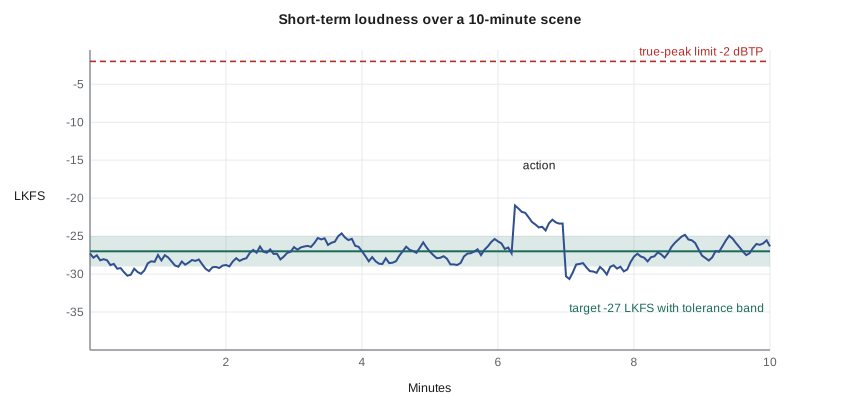
Dialogue-gated measurement looks only at passages with speech, which keeps dialogue consistent while letting music and effects have wide dynamic range. Program loudness averages the whole mix, so a quiet drama and a loud action film are leveled in a different way. Services publish their own targets; for example, Netflix's sound specification has described a −27 LKFS dialogue-gated target with a true-peak limit of −2 dBTP. Confirm current values before relying on them.
Worked problem
How much gain is needed?
A mix measures −24.5 LKFS dialogue-gated. The specification calls for −27 LKFS ± 2 LU. Is it within tolerance, and what change would bring it to target?
Show solution
- Tolerance range: −29 to −25 LKFS.
- −24.5 is louder than −25, so it is out of tolerance.
- Change needed to reach −27: \( -27 - (-24.5) = -2.5 \) LU.
Answer: It fails by 0.5 LU. Reducing the mix by about 2.5 dB brings dialogue to −27 LKFS. The mixer would usually rebalance rather than simply turn everything down, so that effects and music keep their intended impact.
True peak
Loudness measures the average; true peak measures the highest instantaneous level, including peaks between digital samples that can appear after conversion and encoding. True peak is expressed in dBTP. Streaming encoders can raise peaks slightly, so specifications set limits below full scale, such as −2 dBTP or −1 dBTP. A mix that exceeds the limit can distort when encoded or played on some devices.
Worked problem
Peaks after a gain change
A mix has a true peak of −3.4 dBTP. The mixer raises the overall level by 2 dB to meet a loudness target. What is the new true peak, and does it pass a −2 dBTP limit?
Show solution
- New true peak: \( -3.4 + 2 = -1.4 \) dBTP.
- Compare: −1.4 is above −2.
Answer: It fails at −1.4 dBTP. The mixer would use a true-peak limiter or rebalance loud moments rather than simply raising the gain.
Mix formats
Streaming services usually ask for several mixes, depending on the title.
- Immersive mix: Dolby Atmos is common for premium originals. Atmos combines a channel-based bed with audio objects positioned in three-dimensional space, and is rendered by playback devices to the speakers available.
- 5.1 surround: six channels (left, center, right, left surround, right surround and low-frequency effects).
- Stereo: two channels for headphones, laptops and televisions without surround, sometimes made as a dedicated mix rather than an automatic fold-down.
- Near-field or home mixes: some productions make versions tuned for home listening rather than cinemas.
The deliverables list specifies channel layouts, file formats (often 48 kHz, 24-bit uncompressed audio) and which mixes are required.
Stems and music and effects tracks
Stems are sub-mixes of the final mix, separated by category so that the sound can be adjusted or replaced later.
- Dialogue stem: all dialogue, including additional dialogue recording (ADR) and group voices.
- Music stem: score and source music.
- Effects stem: sound effects, Foley and backgrounds.
- Music and effects (M&E): a complete mix without original-language dialogue, used by dubbing studios to create foreign-language versions. A good M&E also includes effects that were recorded with dialogue, such as footsteps or rustle, which must be recreated if they were only on the dialogue tracks.
When the stems are summed at unity gain, they should match the full mix. QC checks this.
Worked problem
Checking stems against the mix
In a test passage, the full mix peaks at −6.0 dBFS. When the dialogue, music and effects stems are played together at unity gain, the peak is −6.0 dBFS and a null test (full mix minus summed stems) leaves residual noise below −90 dBFS. What does this show?
Show solution
- Matching peaks and a residual below −90 dBFS mean the stems add up to the mix within a negligible error.
- A failed null test would show missing or extra elements in the stems.
Answer: The stems are consistent with the full mix. QC uses this kind of check to make sure nothing was lost or doubled when stems were exported.
Sync and timecode
Picture and sound must stay in sync through every stage. Lip sync errors of about one or two frames are noticeable to many viewers, and services reject deliveries with drifting or offset sync. Sync starts on set:
- Jam-sync timecode between cameras and the sound recorder at the start of each day and after power changes.
- Slate every take clearly, with a visible clap or a smart slate, so editors can check sync.
- Record the project frame rate and timecode rate consistently, and avoid mixing drop-frame and non-drop-frame timecode.
- Log any takes with sync problems in the camera and sound reports.
In post-production, the conform and audio teams keep sync through the edit, VFX and mixing, and QC checks sync at several points in each episode.
Worked problem
How big is a one-frame sync error?
At 23.976 fps, how long is one frame in milliseconds, and how long is a two-frame offset?
Show solution
- One frame: \( 1 \div 23.976 \approx 0.0417 \) s, or about 41.7 ms.
- Two frames: about 83.4 ms.
Answer: About 42 ms per frame. A two-frame offset of about 83 ms is enough to look wrong on close-ups, so sync must be checked carefully.
Audio for accessibility and localization
Delivery also includes audio for accessibility and other languages.
- Audio description: a separate mix or track in which a narrator describes important visual information between dialogue for blind and partially sighted viewers. Lesson 8 covers accessibility requirements.
- Dubbed versions: created by dubbing studios from the M&E and translated scripts.
- Dialogue lists and scripts: used by translators and dubbing studios, with timecodes.
The cinematographer's role here is indirect, but visual storytelling decisions affect audio description. Scenes that rely on silent visual details give describers more to describe; very busy sequences may leave little room between dialogue for description.
Where the camera department fits
The camera department supports good sound delivery through simple habits:
- Keep timecode jammed and checked, and report problems quickly.
- Slate clearly, including tail slates and second sticks when needed.
- Note camera speed changes and high-frame-rate shots in reports, so sound and editorial know which shots have no usable sync sound.
- Keep camera noise low, including fan modes and lens motors, and cooperate with the sound department on blocking and placement.
These habits make the conform and mix faster and reduce the risk of sync failures at QC.
Worked problem
Loudness tolerance for two services
A documentary will be delivered to a streamer with a −27 LKFS dialogue-gated target and to a broadcaster with a −24 LKFS program target. The mixer's final stereo mix measures −27.0 LKFS dialogue-gated and −25.8 LKFS program loudness. Does it meet both, assuming ± 2 LU tolerance?
Show solution
- Streamer: −27.0 is on target.
- Broadcaster: −25.8 is within −26 to −22, so it is within tolerance but quieter than target.
Answer: It meets both, but the broadcaster version is near the quiet edge. Many productions make separate deliveries tuned for each target rather than relying on one mix.
Common audio rejections at QC
Audio QC reports for streaming deliveries often repeat the same handful of problems. Knowing them helps the whole team, including the camera department, avoid them.
- Loudness outside tolerance, often because a mix was made to a broadcast target and delivered unchanged to a service with a different target.
- True peaks above the limit after a late gain change or a music replacement.
- Sync drift in long takes, usually from timecode problems on set, mismatched frame rates in the conform or a frame-rate conversion.
- Missing or mislabeled channels, such as a swapped center and low-frequency effects channel in a 5.1 file.
- Stems that do not sum to the full mix, often because a late fix was made to the mix but not the stems.
- Incomplete M&E, where effects recorded with dialogue disappear when dialogue is removed.
- Clicks, dropouts and digital distortion introduced in editing or file conversion.
Each of these can delay delivery. A short conversation between the DP, sound mixer and post supervisor during prep about timecode, frame rates and slating can prevent the most common sync problems before they start.
Worked problem
A drifting sync problem
A long take shot at 23.976 fps with sound recorded against a timecode generator set to 24 fps is synced at the start. By how much will picture and sound drift apart after 10 minutes if the timing mismatch is the 0.1 % difference between 24 and 23.976?
Show solution
- Mismatch: \( 24 \div 23.976 - 1 \approx 0.001 \), or 0.1 %.
- Drift after 600 seconds: \( 600 \times 0.001 = 0.6 \) s.
- In frames: \( 0.6 \times 23.976 \approx 14 \) frames.
Answer: About 0.6 seconds, or 14 frames, after 10 minutes. Matching timecode and frame rates on set prevents this kind of drift, which is very visible on dialogue.
Common mistakes
MistakeLoudness and peak level are the same thing.
InsteadLoudness measures perceived average level; true peak measures the highest instantaneous level.
MistakeEvery service uses −24 LKFS.
InsteadTargets and measurement methods differ; for example, some use −27 LKFS dialogue-gated and broadcast often uses −24 LKFS program loudness.
MistakeRaising the gain to meet loudness never affects peaks.
InsteadGain raises true peaks too, which may break the true-peak limit.
MistakeAn M&E track is just the music.
InsteadM&E contains all music and effects without original-language dialogue, including recreated Foley.
MistakeSync problems are only fixed in the mix.
InsteadSync starts on set with jammed timecode, clear slates and accurate reports.
Summary and key terms
- Loudness is measured with ITU-R BS.1770 in LKFS or LUFS, with gating.
- Examples include −27 LKFS dialogue-gated for some streamers, −24 LKFS for North American broadcast and −23 LUFS in Europe.
- True-peak limits such as −2 dBTP protect against distortion after encoding.
- Streaming mixes may include Dolby Atmos, 5.1 and stereo versions.
- Dialogue, music and effects stems should sum to the full mix; M&E supports dubbing.
- One frame at 23.976 fps is about 42 ms, so small sync errors are visible.
- The camera department supports sound delivery with timecode, slates and reports.
- LKFS
- Loudness, K-weighted, relative to full scale; numerically equal to LUFS.
- Loudness unit (LU)
- A relative difference in loudness; 1 LU equals 1 dB of loudness change.
- Dialogue-gated loudness
- Loudness measured only where dialogue is present.
- Program loudness
- Loudness averaged over the whole program with gating.
- True peak
- The highest instantaneous signal level, including inter-sample peaks, in dBTP.
- Dolby Atmos
- An immersive format combining a channel bed with positioned audio objects.
- Stem
- A sub-mix of one category, such as dialogue, music or effects.
- M&E
- A music and effects mix without original-language dialogue, used for dubbing.
- Timecode jam
- Synchronizing timecode between cameras and sound recorders.
- Null test
- Subtracting summed stems from the full mix to check that they match.
Practice problems
Work each problem on paper first, then reveal the answer to check.
A mix measures −29.6 LKFS against a −27 ± 2 target. Does it pass?
Show answer
No; it is 0.6 LU below the −29 limit.
How much gain brings −22 LKFS to −24 LKFS?
Show answer
−2 dB (or LU).
A true peak of −2.8 dBTP is raised by 1.5 dB. What is the new peak?
Show answer
−1.3 dBTP.
How long is one frame at 25 fps?
Show answer
40 ms.
What are the three main stems?
Show answer
Dialogue, music and effects.
Why must an M&E include recreated Foley?
Show answer
Effects recorded with dialogue would disappear when dialogue is removed.
What does EBU R 128 specify for most programs?
Show answer
−23 LUFS program loudness.
Name two camera habits that help sound delivery.
Show answer
Any two of jamming timecode, clear slating, reporting speed changes and keeping camera noise low.
What does a failed null test suggest?
Show answer
Missing or extra elements in the stems.
What is audio description?
Show answer
A narrated track describing important visual information for blind and partially sighted viewers.
Lesson quiz · 5 questions
Score 60% or more to complete this lesson.
Create a free account to save your progress, take quizzes and earn a certificate.