
CINE-430 · Lesson 11 of 12 · 30 min
The US distribution context: unions, residuals and industry bodies
Technical delivery happens inside a business and legal framework. Who commissions a title, how it is financed, what rules apply to the service and how the people who made it are paid after release all affect production decisions, including technical ones. A series financed partly with public money has extra deliverables. A title made under union agreements carries obligations that continue long after delivery. This lesson looks at that framework. The general ideas apply in both countries, but the institutions and rules are very different, so much of the lesson is specific to where you are viewing it. Laws and regulatory decisions in this area have changed often in recent years; the descriptions below reflect public information at the time of writing (October 2026) and should be checked against current sources before you rely on them.
How streaming deals shape technical requirements
Before looking at each country, it helps to see how deals affect delivery.
- Originals are usually fully financed by the service, which owns or controls worldwide rights and sets all technical requirements.
- Licenses give a service rights in certain territories for a period. The licensor delivers to the service's specification, but may also need versions for other buyers.
- Co-productions and co-financing split rights and costs among partners such as a streamer, a broadcaster, public funders and international co-producers. Each partner's delivery requirements must be met, which can mean several masters, frame rates and audio standards.
- Windows determine when and where a title is shown: theatrical, streaming, broadcast and so on. Each window can add deliverables.
For a cinematographer, the main consequence is that the delivery plan may have to satisfy more than one set of specifications, and the deliverables budget and schedule must cover them.
Unions and guilds
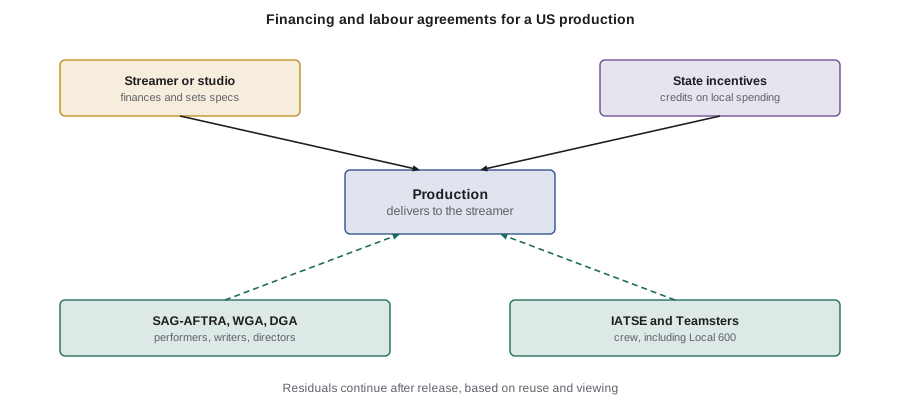
Most scripted productions in the United States work under collective agreements with unions and guilds. These agreements cover minimum pay, working conditions, credits and payments after release.
- SAG-AFTRA represents performers.
- The Writers Guild of America (WGA) represents writers.
- The Directors Guild of America (DGA) represents directors, assistant directors and unit production managers.
- IATSE represents many crew crafts, including camera (Local 600, the International Cinematographers Guild), and the Teamsters represent drivers and other workers.
The 2023 strikes by the WGA and SAG-AFTRA were driven partly by streaming. The new agreements added terms for streaming residuals, including success-based payments for high-budget streaming programs, and rules on artificial intelligence.
Residuals and success-based payments
Residuals are payments to writers, directors, performers and others when a production is reused beyond its initial use. For streaming, agreements set residuals for high-budget subscription video-on-demand (SVOD) programs based on factors such as runtime, budget and the size of the service's subscriber base. The 2023 WGA agreement added a viewership-based bonus for high-budget streaming programs watched by a set share of a service's domestic subscribers in their first 90 days; the 2023 SAG-AFTRA agreement added a similar success bonus for performers. These payments depend on viewing data that services share with the guilds. Details are complex and change with each agreement; the guilds publish current rates.
Worked problem
An illustrative viewership bonus
Under an illustrative rule based on the 2023 WGA terms, a writer whose high-budget streaming episode reaches the viewing threshold receives a bonus equal to 50 % of the fixed residual. If the fixed residual for the episode is 18,000 dollars, what is the bonus?
Show solution
- Bonus: \( 18\,000 \times 0.5 = 9\,000 \) dollars.
Answer: About 9,000 dollars. Actual thresholds, rates and eligibility are set in the current agreement and can differ from this example.
Industry bodies and ratings
The Motion Picture Association (MPA) represents major studios and streaming companies, including Netflix and Amazon, on policy, trade and anti-piracy issues. Its rating system, administered with cinema owners, rates theatrical films; streaming services also use their own maturity ratings and content advisories. The Academy of Motion Picture Arts and Sciences maintains ACES and preservation research, and the Society of Motion Picture and Television Engineers (SMPTE) publishes many of the standards used in delivery, such as ST 2084 and the IMF family.
Incentives and financing
Many US states offer film and television incentives, usually as tax credits or rebates on qualified spending, with requirements for local hiring and reporting. Rates and caps change often and differ widely; for example, California expanded its film and television tax credit program in 2025, and states such as Georgia, New York and New Mexico run large programs. Federal tax rules also allow certain production costs to be deducted. Incentive requirements add reporting and sometimes deliverables, such as state logos in credits.
Worked problem
An illustrative state credit
A series spends 12 million dollars on qualified production in a state offering an illustrative 25 % credit on qualified spending, with a 10 % bonus on spending above 10 million dollars. What is the credit?
Show solution
- Base credit: \( 12 \times 0.25 = 3.0 \) million dollars.
- Bonus: \( (12 - 10) \times 0.10 = 0.2 \) million dollars.
- Total: 3.2 million dollars.
Answer: About 3.2 million dollars under these illustrative terms. Real programs have caps, eligibility rules and audits; check the current rules for the state.
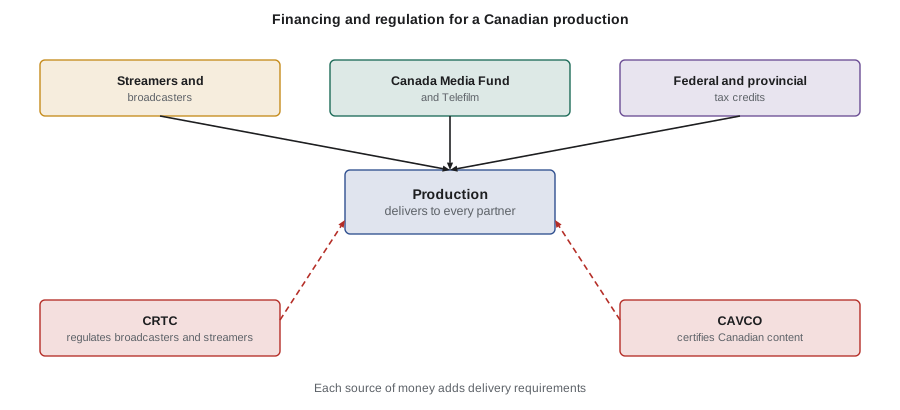
Canadian productions often combine several sources of money: broadcaster and streamer license fees, the Canada Media Fund, Telefilm Canada, federal and provincial tax credits and private investment. Each source brings delivery requirements, such as closed captions and described video, French and English versions, preservation materials and reporting on costs. The federal CPTC is generally 25 % of eligible Canadian labor expenditure, with limits; the Production Services Tax Credit (PSTC) supports foreign productions using Canadian services. Provincial credits vary by province. The cinematographer's camera and post plan should be reviewed against all of these requirements during prep.
Worked problem
An illustrative federal credit
A certified Canadian series has 3.2 million dollars in eligible Canadian labor expenditure. If the CPTC is 25 % of that amount, ignoring caps and other limits, what is the credit?
Show solution
- Credit: \( 3.2 \times 0.25 = 0.8 \) million dollars.
Answer: About 800,000 dollars. Tax credits are often central to Canadian financing plans, which is why certification and spending records matter.
International sales and versions
Titles often travel beyond their home country. International sales and co-productions can require versions with different frame rates, loudness targets, rating edits, dubbed audio and subtitles. Treaty co-productions, such as those Canada has with many countries, may require that certain work be done in each partner country. These requirements should be identified early, because they affect the post schedule and budget.
Worked problem
Budgeting extra deliverables
A co-production must deliver, in addition to the streamer's package, a 25 fps HD version with EBU R 128 audio for a European broadcaster and a French-language version for a Canadian broadcaster. The post supervisor estimates 18,000 dollars for the conversion and QC, and 45,000 dollars for French dubbing and subtitles. If the original deliverables budget is 120,000 dollars, by what percentage do these additions increase it?
Show solution
- Additions: \( 18\,000 + 45\,000 = 63\,000 \) dollars.
- Increase: \( 63\,000 \div 120\,000 = 0.525 \), or 52.5 %.
Answer: About 52.5 %. Extra versions are a major cost, so they should be in the budget from the start rather than discovered at delivery.
Why this matters to the cinematographer
The distribution context can seem far from the camera, but it affects the cinematographer's work in practical ways.
- Financing and certification rules can affect who is hired, including the director of photography.
- Extra partners mean extra deliverables, such as additional frame rates, SDR versions or archive copies, which affect capture and finishing plans.
- Labor agreements set working conditions on set and payments after release, which shape schedules and budgets.
- Accessibility rules affect timed text and audio description, which interact with framing and visual storytelling.
A cinematographer who understands the deal and its obligations can plan the camera and post pipeline to meet them without surprises.
Contracts and the technical team
The rights and obligations described in this lesson are written into contracts: license agreements, co-production agreements, funding agreements and union agreements. These contracts often attach the delivery schedule and technical specifications as exhibits, which makes the technical requirements legally binding. A missed deliverable can delay payment of the final installment of a license fee or a fund's last advance. That is why post supervisors track deliverables closely and why the cinematographer's camera and finishing plan should be checked against the delivery exhibits early, rather than after the grade.
- Ask the producer or post supervisor for the delivery schedule attached to each financing or license agreement.
- Note which items affect picture, such as HDR masters, frame rates, aspect ratios, textless elements and archive copies.
- Flag conflicts between partners' requirements early, such as different frame rates or mastering standards.
- Confirm who pays for each extra version, since this is often negotiated in the agreements.
Working conditions on set
Union agreements also shape the cinematographer's day directly. The IATSE Basic Agreement and Local 600 agreements set rules for overtime, meal breaks and rest periods, and the 2024 agreements strengthened turnaround and rest rules. The DGA agreement sets the duties of assistant directors who schedule the day, and SAG-AFTRA rules govern performers' hours and safety. These rules affect how many set-ups can be scheduled, how long night shoots can run and how much time is available for lighting, which in turn affects the look of the show. CINE-420 covered camera crew agreements in more detail.
In US projects, a streamer or studio usually withholds part of the license fee or production funding until delivery is complete and QC has passed. State incentive programs also require audits and documentation before credits are paid, so delays in technical delivery can delay incentive payments too.
A practical summary for prep
During prep, ask three questions about the business side of any streaming project. First, who are all the partners, and what does each one require at delivery? Second, which rules, such as certification, incentives, accessibility or union agreements, depend on decisions the camera department makes, including who is hired, where work is done and how long days run? Third, which deliverables are tied to payments, so that their deadlines are fixed? Answering these questions early lets the cinematographer plan capture, finishing and archive work that satisfies every partner, without last-minute changes that put the image at risk.
Common mistakes
MistakeA streaming original has only one set of delivery requirements.
InsteadCo-financing, licenses and international sales can add requirements from several partners.
MistakeRegulations for streaming services are settled and stable.
InsteadLaws and regulatory decisions in this area have changed often recently; check current sources.
MistakePayments to talent end when the title is delivered.
InsteadUnion agreements can require residuals and other payments after release.
MistakeIncentives come without strings.
InsteadCredits and funds bring eligibility rules, reporting and sometimes deliverables.
MistakeExtra versions cost little because the master exists.
InsteadConversions, dubbing, subtitles and QC for extra versions can add a large share to the deliverables budget.
Summary and key terms
- Deals, financing, regulation and labor agreements shape delivery requirements.
- Co-productions and international sales add versions with different frame rates, audio and languages.
- Canada regulates online streamers under the Online Streaming Act; the CRTC's 2024 base contributions were stayed and, in 2026, the government said it intends to eliminate them.
- Canadian content certification and tax credits depend on key creative roles, including the DP.
- US productions work under guild and union agreements that set pay, conditions and residuals.
- Industry bodies, standards organizations and incentives add their own requirements.
- Extra deliverables should be identified and budgeted early.
- Online Streaming Act
- The 2023 Canadian law that brought online streaming services under the Broadcasting Act.
- Base contribution
- A required payment by online services to Canadian content funds, set by the CRTC in 2024 and later stayed.
- CAVCO
- The Canadian Audio-Visual Certification Office, which certifies productions for federal tax credits.
- CPTC
- The Canadian Film or Video Production Tax Credit, generally 25 % of eligible Canadian labor.
- Residuals
- Payments to talent when a production is reused beyond its initial use.
- High-budget SVOD
- A category of streaming program in US guild agreements with set residual terms.
- Success-based bonus
- An extra payment when a streaming program reaches a viewing threshold.
- MPA
- The Motion Picture Association, representing major studios and streamers.
- Treaty co-production
- A production made under an agreement between countries, sharing work and benefits.
- Window
- A period and channel in which a title is distributed, such as streaming or broadcast.
Practice problems
Work each problem on paper first, then reveal the answer to check.
What is 5 % of 250 million dollars?
Show answer
12.5 million dollars.
Why might a Canadian DP help a production's certification?
Show answer
The DP is a key creative position that earns a point on the CAVCO scale.
What is 25 % of 2 million dollars of eligible labor?
Show answer
500,000 dollars.
Name two US guilds or unions.
Show answer
Any two of SAG-AFTRA, the WGA, the DGA, IATSE and the Teamsters.
What are residuals?
Show answer
Payments to talent when a production is reused beyond its initial use.
Why do co-productions add deliverables?
Show answer
Each partner may require its own formats, versions and documents.
Extra versions cost 40,000 dollars on a 100,000-dollar deliverables budget. What is the increase?
Show answer
40 %.
Who certifies Canadian productions for the CPTC?
Show answer
CAVCO, part of Canadian Heritage.
What did the 2023 guild agreements add for streaming?
Show answer
Success-based payments for high-budget streaming programs and AI rules.
Why check the current status of streaming regulation?
Show answer
Laws and decisions have changed often and may change again.
Lesson quiz · 5 questions
Score 60% or more to complete this lesson.
Create a free account to save your progress, take quizzes and earn a certificate.