
CINE-430 · Lesson 12 of 12 · 43 min
Capstone: a delivery plan and QC checklist for an HDR streaming series
This capstone brings the course together in a single project. You are the director of photography on a fictional eight-episode drama series, Harbor Lights, commissioned by a global streaming service with HDR delivery. Working with the post supervisor, DIT and colorist, you will build a delivery plan that covers capture, pipeline, mastering, deliverables, audio and timed text coordination, QC and archive, and you will prepare a QC checklist for the picture. The figures are illustrative and chosen to practice the calculations from earlier lessons; on a real project, you would take every value from the service's current specification and your production's own data.
The brief
Harbor Lights is a coastal crime drama.
- Eight episodes of about 50 minutes each, 23.976 fps, main aspect ratio 2.00:1 inside a 3,840 × 2,160 container.
- The service requires a true 4K sensor, 10-bit or greater capture, an example minimum data rate of 240 Mb/s for compressed formats and about 90 % of runtime from approved cameras.
- Deliverables include an HDR master as an IMF Application 2E package with JPEG 2000 picture, PQ, Rec. 2020 container and P3-D65 mastering at 1,000 nits, Dolby Vision metadata, an SDR version derived and trimmed through Dolby Vision, textless elements, a 5.1 mix and a stereo mix at the service's loudness target, M&E, SDH and subtitles in several languages, and an audio description track.
- A Canadian broadcaster co-financed the series and needs an HD SDR file at 29.97 fps with closed captions and described video, plus archive materials.
- The night harbor scenes feature sodium and LED practicals, wet reflections and a lighthouse beam, all of which challenge HDR mastering and QC.
Your job is to anticipate where things can go wrong and plan to prevent it.
Step 1: Capture and camera plan
Start with the camera plan for approval (Lesson 2).
- Main cameras: two approved large-format cameras recording raw at a resolution above 4K, with a 2.00:1 extraction that remains wider than 3,840 pixels.
- Specialty: an approved drone for exteriors, and a compact camera for boat interiors, which is not on the approved list.
- Frame lines: 2.00:1 main frame with 16:9 protection for the broadcaster's version and a center-weighted vertical crop for promotion.
- Tests: lenses, practicals for flicker at 23.976 fps, the lighthouse beam at the planned shutter angle, and wet-surface highlights in HDR.
Worked problem
Runtime rule check
Across the season, the plan expects 360 minutes from the main cameras, 14 minutes from the drone and 26 minutes from the compact camera, with no other exceptions. Does the season meet a 90 % approved-runtime rule, and what should you request?
Show solution
- Total runtime: \( 360 + 14 + 26 = 400 \) minutes.
- Approved: \( 360 + 14 = 374 \) minutes, or \( 374 \div 400 = 93.5 \) %.
Answer: 93.5 %, which passes. Still name the compact camera, its best recording mode and its use in the plan, and request written approval for it.
Worked problem
Daily data volume
Each main camera records raw at about 2,000 Mb/s for 2.5 hours a day. How much original data does the unit create per day, and how much with three verified copies?
Show solution
- Per camera: \( 2\,000 \div 8 = 250 \) MB/s; \( 250 \times 3\,600 \times 2.5 = 2\,250\,000 \) MB ≈ 2.25 TB.
- Two cameras: about 4.5 TB.
- Three copies: about 13.5 TB a day.
Answer: About 4.5 TB of originals and 13.5 TB including copies each day. Over 50 shooting days that is about 225 TB of originals, which matters for the archive plan.
Step 2: Pipeline and monitoring
Next, design the pipeline (Lesson 4).
- Working space: ACES with ACEScct for grading, using one documented ACES version for dailies, VFX and finishing.
- Show look: built during tests in the working space, checked through both SDR and 1,000-nit PQ output transforms.
- On set: SDR monitoring for most of the crew; a calibrated HDR monitor at the DIT station that reaches at least 1,000 nits, with nit readouts on scopes.
- Dailies: SDR dailies for editorial and producers; weekly HDR review of selected scenes with the director and colorist.
- VFX: scene-referred OpenEXR plates in ACES2065-1 with CDLs and the show look as reference.
Worked problem
Highlight check on set
On the HDR monitor, the lighthouse lens reads about 2,400 nits in the PQ signal, the wet harbor reflections peak around 900 nits and the sodium streetlights sit around 600 nits. With a 1,000-nit mastering target, which elements need attention?
Show solution
- Lighthouse at about 2,400 nits: above the mastering peak, so it would be flagged unless rolled off.
- Reflections at 900 nits and streetlights at 600 nits: inside the range.
Answer: The lighthouse needs a soft roll-off within 1,000 nits in the grade, or exposure changes so its detail sits inside the range. Note it for the colorist and QC.
Step 3: Mastering and metadata
Plan the mastering work (Lesson 5).
- Grade HDR first on a 1,000-nit P3-D65 reference display, then run Dolby Vision analysis and trim SDR for the 100-nit target.
- Schedule enough time for SDR trims and a full SDR review.
- Measure MaxCLL and MaxFALL after the final render, and check gamut reports for the sodium and LED practicals.
- Review a sample of scenes on a consumer HDR television in a neutral picture mode.
Worked problem
MaxCLL and MaxFALL from sample measurements
Measurements from the brightest frames of episode 3 give brightest pixels of 980, 1,000 and 720 nits and frame averages of 46, 31 and 188 nits. What are MaxCLL and MaxFALL, and are they reasonable for a 1,000-nit master?
Show solution
- MaxCLL: max(980, 1,000, 720) = 1,000 nits, at the mastering peak.
- MaxFALL: max(46, 31, 188) = 188 nits.
Answer: MaxCLL 1,000 nits and MaxFALL 188 nits, both within the mastering range. The dark night frames contain the brightest highlights, while a daylight frame sets the highest average.
Worked problem
SDR trim schedule
Episodes average 50 minutes with an average shot length of 3.5 seconds. Trims average 18 seconds per shot. How many hours of trims does the season need?
Show solution
- Shots per episode: \( 3\,000 \div 3.5 \approx 857 \).
- Season: \( 857 \times 8 \approx 6\,857 \) shots.
- Time: \( 6\,857 \times 18 \approx 123\,400 \) s ≈ 34.3 hours.
Answer: About 34 hours of trim work, plus review sessions. Book at least a week of suite time for SDR trims and approvals.
Step 4: Deliverables and versions
List the picture deliverables and estimate storage (Lesson 6).
- HDR IMF package per episode with Dolby Vision metadata embedded or attached.
- Supplemental packages for localized title cards and credits.
- Textless elements for all shots with on-screen text.
- For the broadcaster: an HD SDR version at 29.97 fps with 2:3 pulldown or a standards conversion, closed captions in a broadcast format and a described video track.
Worked problem
Master storage
The HDR IMF averages 1,200 Mb/s. How much storage does one copy of the season's IMF picture need?
Show solution
- Season runtime: 400 minutes, or about 6.67 hours.
- Per hour: \( 1\,200 \div 8 = 150 \) MB/s; \( 150 \times 3\,600 = 540\,000 \) MB ≈ 540 GB.
- Season: \( 540 \times 6.67 \approx 3.6 \) TB.
Answer: About 3.6 TB for one copy of the HDR picture, before textless elements, supplemental packages, audio and the broadcaster's version.
Worked problem
Broadcaster runtime
The broadcaster's version uses 2:3 pulldown to 29.97 fps rather than speed-up. Does the runtime change, and how many video frames does a 50-minute episode contain?
Show solution
- Pulldown converts every 4 frames to 5 video frames without changing speed, so runtime stays about 50 minutes.
- Frames: \( 50 \times 60 \times 29.97 \approx 89\,910 \) video frames.
Answer: Runtime stays at about 50 minutes, about 89,910 frames at 29.97 fps. A 25 fps speed-up would have shortened it by about 4 %.
Step 5: Sound and timed text coordination
The DP does not mix sound or write subtitles, but the plan should confirm that the camera department supports them (Lessons 7 and 8).
- Jam timecode at call and after lunch; slate clearly; record speed changes in camera reports.
- Flag shots with on-screen text, such as phone screens, signs and documents, for subtitle placement and forced narratives.
- Keep important on-screen text away from the bottom of the frame where possible.
- Share cut-downs with the audio describer early so they can plan around dialogue density.
Worked problem
Two quick checks
The stereo mix measures −28.2 LKFS dialogue-gated against a −27 ± 2 target, and an English subtitle of 46 characters lasts 2.1 seconds against a 20 cps limit. Do they pass?
Show solution
- Loudness: −28.2 is within −29 to −25, so it passes.
- Reading speed: \( 46 \div 2.1 \approx 21.9 \) cps, above 20.
Answer: The mix passes; the subtitle fails and needs at least \( 46 \div 20 = 2.3 \) seconds or a shorter text.
Step 6: QC plan and checklist
Plan QC at every stage (Lesson 9). Ask the DIT and dailies lab to report technical faults daily, run internal QC at the finishing facility before delivery and keep a log of creative-intent notes, such as grain, flares and the lighthouse's bloom, to declare to the service.
| Check | Method | Pass condition |
|---|---|---|
| Approved capture | Camera reports and metadata | Runtime rule met; exceptions approved in writing |
| Dead or hot pixels | Dailies and finishing review | None visible in final picture |
| Flicker | Practicals and LED tests; manual QC | No unintended flicker in any shot |
| HDR peaks | Automated scan and scopes | No pixels above 1,000 nits; MaxCLL accurate |
| Gamut | Automated gamut report | Colors within P3-D65 or excursions approved |
| Banding | Manual review of night skies and fog | No visible steps in gradients |
| Active picture | Visual check and metadata | 2.00:1 area correct; Dolby Vision L5 accurate |
| SDR version | Calibrated SDR review | Skin, highlights and darks preserved |
| Photosensitivity | Automated flash test | Lighthouse and police lights within guidelines |
| Textless and inserts | Shot list comparison | All texted shots have matching textless versions |
Worked problem
The lighthouse and flash guidelines
The lighthouse beam sweeps past the camera 4 times per second in one shot, filling most of the frame with a bright flash each time. Does this meet a guideline of no more than 3 harmful flashes per second, and what could be done?
Show solution
- 4 flashes per second exceeds 3.
- Options: slow the beam in the shot, reduce the brightness change or area of each flash in the grade, or change the edit.
Answer: It would fail. Plan the beam speed during the shoot, for example 2 sweeps per second, or reduce the flash intensity in the grade.
Step 7: Archive plan
Finally, plan the archive (Lesson 10).
- Archive original camera files, grading projects, LUTs, CDLs, Dolby Vision metadata, masters, VFX finals, audio stems and timed text.
- Write two LTO copies stored in different places, plus a cloud copy of masters and project data.
- Include a look document describing the intended look, references and the lighthouse highlight decisions.
- Meet the broadcaster's and funders' archive requirements as listed in their delivery schedules.
Worked problem
Archive tapes
The archive includes 225 TB of original camera files, 8 TB of masters and versions, 12 TB of VFX and 5 TB of audio, text and documents. On LTO-10 tapes with 28.5 TB usable each, how many tapes are needed for two copies?
Show solution
- Total: \( 225 + 8 + 12 + 5 = 250 \) TB.
- Per copy: \( 250 \div 28.5 \approx 8.8 \), so 9 tapes.
- Two copies: 18 tapes.
Answer: 18 LTO-10 tapes, plus the cloud copy of masters and project data.
Presenting the plan
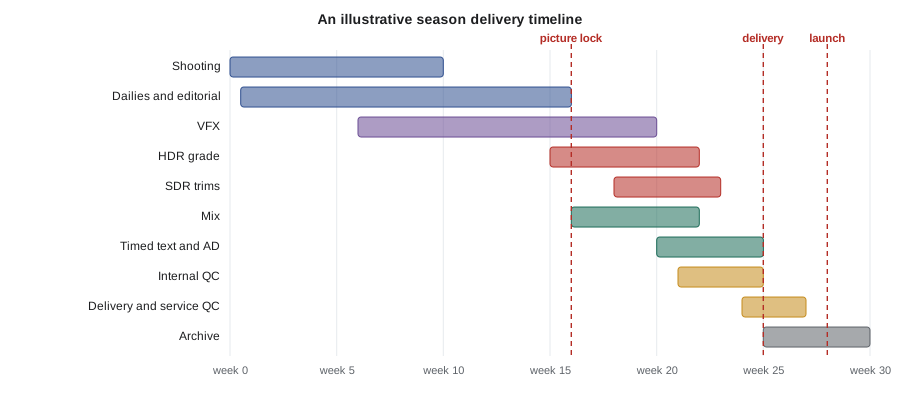
Bring all the steps together in a short delivery plan document for the producers, post supervisor and the service's technical contact. A good plan includes a one-page summary, the camera plan and runtime table, the pipeline diagram and versions, the mastering approach, the deliverables list with owners and dates, the QC checklist and the archive plan. It should list open questions and the dated specification versions it follows. Review it at milestones: before shooting, at picture lock, before the grade and before delivery. A plan that is shared and updated keeps everyone working toward the same result and gives the cinematographer's work the best chance of reaching every viewer as intended.
Common mistakes
MistakeThe delivery plan is the post supervisor's job alone.
InsteadThe DP contributes the camera plan, pipeline, look, highlight decisions and QC prevention steps.
MistakeHDR highlights can be fixed in QC.
InsteadPlan highlights such as practicals and the lighthouse on set and in the grade before QC.
MistakeThe broadcaster's version can be made at the end without planning.
InsteadFrame rate, captions, described video and archive needs should be in the plan from the start.
MistakeArchive planning can wait until after launch.
InsteadArchive volumes, tapes and documents should be planned during prep and budgeted.
MistakeA plan written in prep never needs updating.
InsteadReview and update the plan at each milestone and when specifications change.
Summary and key terms
- The capstone combines capture, pipeline, mastering, deliverables, sound and text coordination, QC and archive.
- A runtime table and written exceptions secure camera approval.
- One documented pipeline drives SDR and HDR monitoring, dailies, VFX and finishing.
- Mastering plans include HDR-first grading, SDR trims, metadata measurement and consumer checks.
- Deliverables include IMF packages, supplemental packages, textless elements and partner versions.
- A QC checklist and daily technical reports prevent most picture failures.
- An archive plan with tapes, cloud copies and a look document protects the work for the future.
- Delivery plan
- A document covering how a production will meet all its delivery requirements.
- Runtime table
- A table showing how much runtime each camera supplies, used for approval.
- Highlight roll-off
- A gradual compression of highlights near the mastering peak.
- Creative-intent log
- A record of intentional choices to declare to QC.
- Look document
- A description of the intended look, references and grading decisions for future use.
- Partner version
- A version made for a co-financier or broadcaster with its own specification.
- Milestone review
- A planned review of the delivery plan at key project stages.
- Internal QC
- Quality control at the finishing facility before delivery.
- Open question
- An unresolved issue listed in the plan for follow-up.
- Dated specification
- The specific version of a requirement document the production follows.
Practice problems
Work each problem on paper first, then reveal the answer to check.
Approved cameras supply 380 of 410 minutes. What share is approved?
Show answer
380 ÷ 410 ≈ 92.7 %.
A raw camera records 1,600 Mb/s for 3 hours. How many terabytes?
Show answer
200 MB/s × 10,800 s = 2.16 TB.
A highlight reads 1,800 nits on a 1,000-nit show. What should happen?
Show answer
Roll it off within 1,000 nits or change exposure.
Frames have peaks of 650, 990 and 870 nits and averages of 70, 40 and 210 nits. Give MaxCLL and MaxFALL.
Show answer
MaxCLL 990 nits; MaxFALL 210 nits.
How many video frames are in 45 minutes at 29.97 fps?
Show answer
About 80,919.
A 40-character subtitle lasts 1.8 seconds. Does it meet 20 cps?
Show answer
40 ÷ 1.8 ≈ 22.2 cps, so no.
How many 28.5 TB tapes hold 120 TB for one copy?
Show answer
120 ÷ 28.5 ≈ 4.2, so 5 tapes.
A strobe-like beam sweeps 2 times per second. Does it meet a 3-flash limit?
Show answer
Yes.
What should a delivery plan list besides deliverables?
Show answer
Owners, dates, open questions and the dated specification versions.
When should the plan be reviewed?
Show answer
Before shooting, at picture lock, before the grade and before delivery.
Lesson quiz · 5 questions
Score 60% or more to complete this lesson.
Create a free account to save your progress, take quizzes and earn a certificate.