
CINE-420 · Lesson 9 of 12 · 27 min
Getting work: reels, résumés, networking and entry routes
Camera crews are freelancers, and most jobs come from people who already know their work. DPs hire operators and 1st ACs they trust; 1st ACs hire 2nd ACs and loaders who have proved reliable; production managers call crew who were recommended. Breaking in means building a reputation from nothing, and staying employed means protecting that reputation on every job. This lesson covers the tools of getting work, from résumés and reels to crew lists and union availability systems, the entry routes into camera departments in Canada and the US, and the habits that turn a first job into a career. It also covers how to handle the uncertainty of freelance work, including slow periods and the temptation to take every offer.
How camera crew get hired
Hiring in camera departments follows the chain of trust described in Lesson 2.
- The producer or director hires the DP, often from people they have worked with or whose work they admire.
- The DP chooses the camera operator and 1st AC, usually from a small group of trusted collaborators.
- The 1st AC chooses the 2nd AC, loader and trainee, with the DP's approval.
- Day players and extra units are filled from the department's contacts, crew lists and union availability lists.
That means relationships matter more than applications. A cold email rarely produces a job directly, but it can lead to a coffee, a day-playing call or a visit to a set, which can lead to work later.
The camera résumé
A camera résumé is short, factual and focused on credits and skills.
- Name, classification and contact details at the top, with your home base and willingness to travel.
- Credits: production title, type, DP or 1st AC you worked under and your role. Recent and relevant credits first.
- Camera systems and equipment you know well, such as specific cinema cameras, lens sets, wireless focus systems and data software.
- Union status, training and certificates, such as safety courses, first aid and driver's licenses.
- References from DPs or 1st ACs who agree to be contacted.
Keep it to one page for assistants, and update it after every job. Never inflate credits; the industry is small and DPs talk.
Reels and portfolios
Operators and DPs need reels, short edited showcases of their best work. Assistants usually do not need reels, but a short profile page with credits and photos of camera builds can help.
- Keep reels short, about one to two minutes, with the strongest work first.
- Show only work you shot or operated, and credit the production and your role.
- Respect confidentiality and get permission before showing unreleased work.
- Tailor reels to the job, such as a narrative reel, a commercial reel or a documentary reel.
- Host reels on a simple website or a video platform with a clear, professional link.
Networking that works
Networking in film is mostly about being useful and being remembered for good reasons.
- Work on student, short and low-budget productions to meet people at the same career stage, who often move up together.
- Visit rental houses, attend equipment demonstrations and camera workshops, where camera crew gather.
- Join professional societies and groups, such as the CSC, ASC events, the SOC and mentorship programs for underrepresented crew.
- Follow up after jobs with a short thank you and an update on availability.
- Day-play whenever possible: a good day on set is the best audition.
- Be generous: recommend other crew when you are booked, and they will often return the favor.
Entry routes in the US
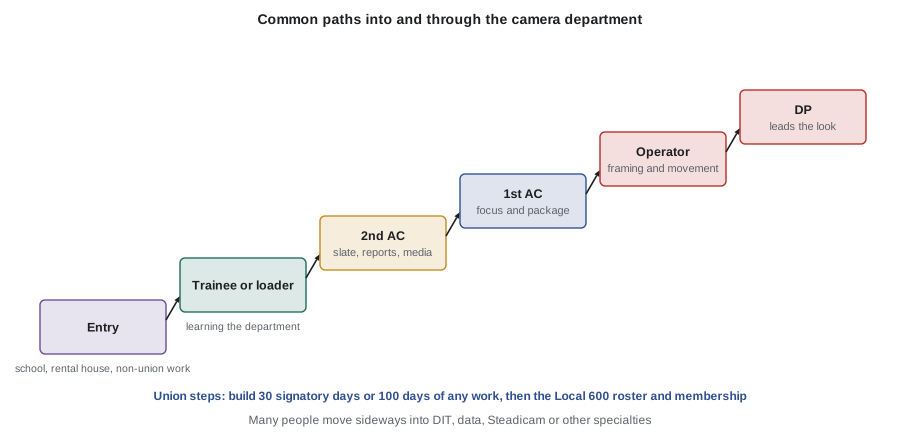
Common routes into US camera departments include the following.
- Film school and community college programs, which provide training, equipment access and early contacts.
- Non-union productions, commercials, music videos and documentaries, which build the days needed for the Local 600 Industry Experience Roster.
- Rental house jobs, where people learn equipment and meet camera crews who prep packages.
- Local 600 training and mentorship opportunities, and programs that support crew from underrepresented groups.
- Work in regional production centers, such as Atlanta, New Mexico and New York, where state incentives create demand for local crew.
- Day-playing as a loader, digital utility or 2nd AC on signatory productions once on the roster.
Contract Services administers the roster and Safety Pass training, and many states' film offices list crew and resources.
Worked problem
How many contacts lead to work?
An early-career 2nd AC estimates that of every 20 people they contact, 6 respond, 2 offer a day-playing call within six months and 1 in 4 day-playing calls leads to a recurring position. How many contacts are needed for one recurring position?
Show solution
- Day-playing calls per 20 contacts: 2.
- Recurring positions per day-playing call: 1 in 4, so 0.25.
- Recurring positions per 20 contacts: 2 × 0.25 = 0.5.
- Contacts for one recurring position: 20 ÷ 0.5 = 40.
Answer: About 40 well-chosen contacts and follow-ups for one recurring position, which shows why steady, polite networking over months matters more than a single burst of emails. These rates are illustrative.
Worked problem
Utilization and annual income
A 1st AC's average day earns an illustrative 750 dollars including overtime. They work 150 days in a good year and 110 in a slow one. What is the difference in gross earnings?
Show solution
- Good year: 150 × 750 = 112,500 dollars.
- Slow year: 110 × 750 = 82,500 dollars.
- Difference: 30,000 dollars, a fall of about 27 %.
Answer: Freelance income depends heavily on days worked, so camera crew plan budgets for slow years and build savings in busy ones.
Choosing jobs and saying no
Early in a career it is tempting to accept every offer. Sometimes that is right; sometimes it harms a career.
- Honor bookings. Canceling one job for a better offer can damage relationships with the people who booked you.
- Use holds carefully: a "first hold" or "second hold" means a production has asked you to keep dates available. Communicate clearly and release holds promptly when plans change.
- Weigh the job: pay, credits, the people you will meet, the skills you will learn and the working conditions.
- Avoid unsafe or exploitative jobs, such as unpaid work beyond student projects, productions with no safety planning or schedules that ignore rest.
- Know your minimum rate and conditions, and be prepared to decline politely.
Staying employed
Once working, the best way to get the next job is to do this one well. DPs and 1st ACs rehire people who are reliable, skilled, calm under pressure and pleasant to spend 12 hours a day with. They also remember people who complained constantly, made the same mistake twice or disappeared when needed. Keep learning new cameras and systems, which change quickly, and take short courses or rental house training when new equipment arrives. Keep a simple record of jobs, contacts and references, and stay in touch with people between jobs without pestering them.
Using crew lists, databases and availability systems
Beyond personal contacts, crew find work through formal lists and services.
- Union availability lists, where members mark their available dates and productions or department heads search for crew.
- Film commission and regional crew directories, which list local crew for visiting productions.
- Online crew platforms and job boards, useful for non-union, commercial and corporate work.
- Rental house notice boards and newsletters, which often list jobs and training.
- Industry groups and mentorship programs, which connect early-career crew with experienced members.
Keep your listings current, with accurate dates, credits and contact details. An out-of-date listing can cost work.
Mentorship
Many successful camera crew credit a mentor who taught them, recommended them and warned them about mistakes. Mentors are often 1st ACs or DPs who see a newcomer's potential on set. Mentorship grows from good work and good questions, not from asking a stranger to be your mentor. Formal mentorship programs run by unions, societies and industry groups also pair newcomers with experienced crew, often with a focus on people from underrepresented groups.
Building a reputation online
Directors, DPs and producers often look up crew online before hiring. Keep a simple, professional website or profile with your credits, contact details and, for operators and DPs, your reel. Keep personal social media separate from your professional presence, and never post confidential production material. A tidy online presence will not get you hired on its own, but a careless one can cost you work.
Handling rejection and quiet periods
Every freelancer has weeks when the phone does not ring and jobs go to someone else. Rejection in film is rarely personal: a DP may have promised a job to a longtime colleague, the budget may have changed or the production may have chosen local crew. Use quiet periods to learn new equipment at rental houses, update your résumé and reel, rest and reconnect with contacts. Keep a list of people to follow up with and track the results, so your effort stays steady even when work is not.
Working in other markets
Many camera crew work in more than one production center during their careers, following work to other cities, provinces, states or countries. Moving markets means building new relationships, learning local agreements and, between Canada and the US, meeting immigration and work permit rules: a Canadian crew member cannot simply work on a US production, or a US crew member on a Canadian one, without the right authorization. Union locals in each market have their own requirements. Plan moves carefully and talk to people who have made them.
Interviews and first calls
Hiring in camera departments is often a short phone call. Be ready with your availability, the cameras and systems you know, recent credits and your rate or agreement level. Ask about the shooting dates, the DP, the camera package, the number of cameras and the deal terms. If you do not know a camera system, say so and explain how you will prepare, such as booking a session at the rental house before the job. Follow up in writing to confirm the details.
Building a specialty
Some crew stand out by developing a specialty, such as Steadicam operating, underwater work, high-speed cameras, remote heads, film loading or advanced data and color management. Specialties take years of training and often expensive equipment, but they can lead to steady work and higher rates. Choose a specialty that matches real demand in your market and that you enjoy, and learn from established specialists before investing heavily.
Saying thank you
A short thank-you message after a job, naming something specific you learned or enjoyed, is remembered. Keep it brief and professional, mention your availability and let people know when you have joined a union or moved up a role.
Common mistakes
MistakeSending long résumés listing every job ever
InsteadKeep a short, factual résumé focused on relevant credits and skills
MistakeInflating credits or roles
InsteadReport credits accurately; DPs and 1st ACs check with each other
MistakeCanceling a booking for a better offer
InsteadHonor bookings and manage holds clearly
MistakeShowing unreleased work without permission
InsteadRespect confidentiality and get permission before using footage
MistakeIgnoring slow years in financial planning
InsteadBudget on realistic days worked and save in busy years
Summary and key terms
- Camera hiring follows a chain of trust from producers to DPs, 1st ACs and their teams.
- Résumés should be short and accurate, listing credits, systems known, training and references.
- Operators and DPs need short, tailored reels showing only their own work.
- Networking works best through useful work, day-playing, rental houses, societies and generous referrals.
- Entry routes include film schools, trainee and permit programs in Canada, and roster building in the US.
- Freelance income varies with days worked, so plan for slow years.
- Honor bookings, manage holds and decline unsafe or exploitative work.
- Reel
- A short edited showcase of an operator's or DP's work
- Day player
- A crew member hired for single days
- Hold
- A request to keep dates available for a possible booking
- Booking
- A confirmed engagement for specific dates
- Crew list
- A list of available crew kept by a union, film commission or service
- Availability list
- A union system that tracks members available for work
- Trainee program
- A structured program that places entry-level crew on productions
- Rental house
- A company that rents camera, lighting and grip equipment to productions
- Utilization
- The share of available days a freelancer actually works
- Referral
- A recommendation from one crew member to a hiring person
Practice problems
Work each problem on paper first, then reveal the answer to check.
Who usually chooses the 1st AC?
Show answer
The DP
Name three items on a camera résumé.
Show answer
Any three of contact details, credits, systems known, union status, training and references
How long should an operator's reel usually be?
Show answer
About one to two minutes
Why are rental houses useful for networking?
Show answer
Camera crews prep packages there, and new equipment is demonstrated there
With 2 day-playing calls per 20 contacts and 1 in 4 calls leading to a recurring job, how many contacts give one recurring job?
Show answer
About 40
At 650 dollars a day, what is the difference between 150 and 110 days a year?
Show answer
26,000 dollars
What is a hold?
Show answer
A request to keep dates available for a possible booking
Why should bookings be honored even when a better offer comes?
Show answer
Canceling damages trust with the people who booked you
Name a Canadian entry route into camera unions.
Show answer
Trainee programs or permit work on union productions
What US system lists people eligible for hire in each Local 600 classification?
Show answer
The Industry Experience Roster
Lesson quiz · 5 questions
Score 60% or more to complete this lesson.
Create a free account to save your progress, take quizzes and earn a certificate.