
CINE-420 · Lesson 8 of 12 · 24 min
Deal memos, contracts and invoices
Freelance camera work runs on paperwork. Before the first day, a deal memo sets out the rate, guarantees, kit rental and terms. On payroll productions, start paperwork sets up tax deductions and confirms the right to work. On non-payroll jobs, the crew member sends an invoice and waits to be paid. Small errors in this paperwork can cost real money: an unclear overtime clause, a missing kit rental line, a wrong tax number or an invoice sent to the wrong person. This lesson explains deal memos, the difference between employee and contractor engagements, the start paperwork for payroll jobs and how to write invoices that get paid on time.
The deal memo
A deal memo is a short agreement between the production and a crew member that records the key terms of the engagement. On union productions it works alongside the collective agreement, which sets the minimums. A typical camera deal memo includes the following.
- Names of the production company and crew member, the production title and the classification, such as 1st AC.
- Start date, expected duration and any prep, travel or wrap days.
- Rate: the hourly or daily rate, and whether it is scale or overscale.
- Guarantee: the minimum hours per day or week and how overtime is calculated.
- Kit or box rental: the equipment, the daily or weekly rate and who insures it.
- Travel and accommodation: per diems, mileage, travel days and lodging on distant locations.
- Screen credit and any special terms, such as a pay rate for prep at the rental house.
- Signatures and the date.
Read deal memos carefully before signing, compare them with what was agreed in conversation and ask for corrections in writing.
Employees and independent contractors
Whether a crew member is an employee or an independent contractor affects taxes, benefits, employment standards and insurance. Most camera crew on scripted productions are employees of the production, often paid through an entertainment payroll company that acts as the employer of record. Some engagements, especially short corporate or commercial jobs, are set up as contractor work with an invoice. The label on the paperwork does not decide the question; tax authorities and courts look at the real relationship, including who controls the work, who owns the tools, who takes financial risk and whether the work is part of the production's business.
Worker status in the US
In the US, the IRS uses a common-law test of control and independence, and states use their own tests for unemployment and wage laws. California's AB 5 applies the strict ABC test, under which most film crew who do work central to the production's business are employees; the 2020 follow-up law, AB 2257, created exemptions for some creative workers but not for typical crew. Crew on most productions are W-2 employees, often hired through entertainment payroll companies, with income tax, Social Security and Medicare withheld and state unemployment and workers' compensation coverage. Contractors receive a Form 1099 if they are paid at least the reporting threshold, which rose to 2,000 dollars for payments made from 2026, and pay self-employment tax on their net earnings. Some senior crew work through loan-out corporations, which employ the crew member and invoice the production.
Start paperwork on payroll jobs
On a payroll production, crew complete start paperwork before or on the first day, often through an online onboarding system run by the payroll company.
- The deal memo and any production-specific agreements, such as confidentiality and social media agreements.
- Tax forms such as Form W-4 and state withholding forms, and Form I-9 to verify the right to work in the US.
- Union information, such as membership status and local number, for benefits contributions.
- Direct deposit details and emergency contacts.
- Kit rental agreements and inventories, if equipment is supplied.
Timecards, usually submitted weekly and approved by the department head, record in and out times and meals. Accurate timecards are essential: they are the basis for overtime, penalties and benefits hours.
Writing an invoice
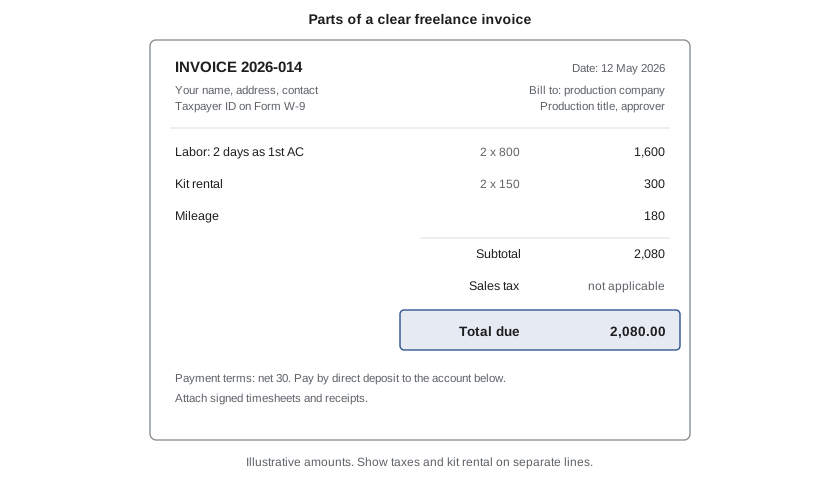
When a crew member works as a contractor or rents equipment outside payroll, they invoice the production. A clear invoice is paid faster.
- Your name or business name, address and contact details, and your tax registration number where required.
- The production company's name and address, the production title and the person who approved the work.
- A unique invoice number and the invoice date.
- Dates worked, rates and quantities for labor, and separate lines for kit rental, expenses and mileage.
- Applicable taxes, shown separately.
- The total due, payment terms such as "net 30", and payment details.
Attach required documents, such as signed timesheets or receipts, and follow the production's accounting instructions. Keep copies of every invoice and track when payment is due.
Worked problem
An invoice for a commercial
A freelance 1st AC in a state that does not tax these services invoices a commercial production for 2 days at an illustrative 800 dollars a day, a kit rental of 150 dollars a day and 180 dollars of mileage. What is the invoice total?
Show solution
- Labor: 2 × 800 = 1,600 dollars; kit: 2 × 150 = 300 dollars; mileage: 180 dollars.
- Subtotal: 1,600 + 300 + 180 = 2,080 dollars.
- No sales tax is added for these services in this state; some states do tax equipment rentals, so check local rules.
Answer: 2,080 dollars. The production will likely request Form W-9 and issue Form 1099 because the payments exceed 2,000 dollars, and the 1st AC pays income and self-employment tax on the net profit.
Sales taxes on freelance work
Sales taxes are one of the biggest differences between freelance work in Canada and the US, so check the rules before sending your first invoice.
Sales tax in the US
In the US there is no federal sales tax, and state rules vary. Most states do not tax personal services such as camera labor, but some tax equipment rentals or certain services, and cities or counties may add their own taxes. Freelancers who rent equipment should check whether their state requires them to register and collect sales tax on rentals. Wages paid through payroll are not subject to sales tax.
Getting paid on time
Payment terms on productions are often 30 days from invoice, and some productions pay later. Late payment is one of the biggest stresses of freelance life.
- Send invoices promptly, ideally on the last day of work, to the correct contact.
- Follow up politely when payment is due, with the invoice number and amount.
- Keep a simple log of invoices, due dates and payments.
- For union work, report late or missing payments to the union, which can enforce the agreement.
- For non-union work, know your options under small claims procedures and keep written records of agreements.
Lesson 12 shows how payment terms affect cash flow over a year.
Negotiating your deal
Negotiation in film is usually brief and polite. Union scale sets the floor, and experienced crew may ask for overscale, extra prep days, kit rental or better travel terms.
- Know the current scale rate and your usual rate before the call.
- Ask what the budget level and agreement are, because low-budget tiers change the minimums.
- Negotiate the package, not just the hourly rate: guarantees, prep, kit rental and travel all matter.
- Be honest about your experience and availability.
- Confirm agreed terms by email and check that the deal memo matches.
Producers and DPs remember crew who are fair and professional in negotiation as well as on set.
Confidentiality and other agreements
Productions often ask crew to sign confidentiality or non-disclosure agreements, social media policies and acknowledgments of safety and harassment policies. Read them before signing. Confidentiality agreements usually forbid sharing scripts, images or information about the production, and breaking them can cost future work and lead to legal claims. If an agreement seems unusually broad, such as limiting future work, ask the union or a lawyer before signing.
Keeping copies
Keep copies of every deal memo, start packet, timecard, pay stub, invoice and tax form, organized by production and year. These records support tax returns, union membership applications, health plan eligibility, pay disputes and loan or mortgage applications. Digital copies backed up in two places are easiest to manage.
Equipment rental agreements
When crew rent their own equipment to a production, a short rental agreement or a clause in the deal memo should cover the items rented, with serial numbers and replacement values; the rental rate and period; who insures the equipment and against what risks; who pays for loss or damage; and how the equipment will be returned. An inventory signed at the start and end of the job protects both sides. Without a written agreement, disputes over damaged or missing equipment can be hard to resolve.
Payroll timing
On payroll productions, wages are usually paid weekly or biweekly, about one or two weeks after the work week ends, once timecards are approved and processed. New crew may wait longer for the first payment while start paperwork is completed. Late or incorrect start paperwork is a common cause of delayed pay, so complete onboarding before the first day whenever possible and check that your banking and tax details are correct.
What to do when a production goes broke
Occasionally a production runs out of money or the production company fails, leaving crew unpaid. Union agreements often require deposits or guarantees to protect wages, and unions pursue unpaid amounts for members. Non-union crew are more exposed. Protect yourself by working with reputable companies, asking about payroll arrangements, invoicing promptly and following up quickly when payment is late.
Credits
Screen credit matters for careers, because credits on résumés and online databases are how people verify experience. Deal memos may state the credit, such as first assistant camera or A camera operator, and some agreements require specific credits. Check end credits when a production is released and ask the production to correct errors where possible.
Contracts in plain language
Most crew deal memos are short and standard, but read every clause. Watch for terms about unpaid prep, flat rates that ignore overtime, kit rental without insurance, broad confidentiality clauses and cancellation terms. If something is unclear, ask before signing.
Common mistakes
MistakeSigning a deal memo that differs from the agreed terms
InsteadCompare the memo with what was agreed and ask for written corrections before signing
MistakeAssuming the label "contractor" decides worker status
InsteadTax authorities and courts look at the real relationship
MistakeLeaving kit rental off the deal memo
InsteadList equipment, rates and insurance responsibility in writing
MistakeSending invoices without numbers or tax details
InsteadUse unique invoice numbers, show taxes separately and include payment terms
MistakeWaiting months before chasing a late payment
InsteadFollow up when payment is due and involve the union for union work
Summary and key terms
- Deal memos record rates, guarantees, kit rentals, travel and credit, and should be checked before signing.
- Most camera crew on scripted productions are employees, often hired through entertainment payroll companies.
- Worker status depends on the real relationship, not the label on the paperwork.
- Start paperwork sets up tax withholding, right-to-work verification, union details and payment.
- Clear invoices include numbers, dates, separate lines, taxes and payment terms.
- Sales tax rules differ: GST, HST and QST in Canada, and state rules in the US.
- Prompt invoicing, follow-up and good records help freelancers get paid on time.
- Deal memo
- A short agreement recording the key terms of a crew member's engagement
- Employer of record
- A company, such as a payroll company, that legally employs crew for a production
- Independent contractor
- A self-employed person who provides services under their own business
- Loan-out corporation
- A company owned by a crew member that employs them and invoices productions
- Timecard
- A record of in and out times and meals used to calculate pay
- Invoice
- A bill sent by a contractor or supplier requesting payment
- Net 30
- Payment terms requiring payment within 30 days of the invoice date
- Input tax credit
- In Canada, a credit for GST or HST paid on business purchases
- Form 1099
- A US form reporting payments to contractors
- Per diem
- A daily allowance for meals and incidental expenses on location
Practice problems
Work each problem on paper first, then reveal the answer to check.
Name four items in a camera deal memo.
Show answer
Any four of names, title, classification, dates, rate, guarantee, kit rental, travel, credit and signatures
What decides whether a crew member is an employee or contractor?
Show answer
The real relationship, such as control, tools, risk and integration, not the label
Why are accurate timecards important?
Show answer
They are the basis for overtime, penalties and benefits hours
An Ontario invoice subtotal is 1,880 dollars. What is the total with 13 % HST?
Show answer
2,124.40 dollars
When must a Canadian freelancer register for GST/HST?
Show answer
When taxable sales exceed 30,000 dollars in four consecutive quarters or a single quarter
What US form does a production usually request before paying a contractor?
Show answer
Form W-9
What does net 30 mean?
Show answer
Payment is due within 30 days of the invoice date
Name two items that should appear on separate invoice lines.
Show answer
Any two of labor, kit rental, expenses, mileage and taxes
Whom should a union member contact about unpaid wages on a union job?
Show answer
The union
What is an employer of record?
Show answer
A company, often a payroll company, that legally employs crew for the production
Lesson quiz · 5 questions
Score 60% or more to complete this lesson.
Create a free account to save your progress, take quizzes and earn a certificate.