
CINE-420 · Lesson 1 of 12 · 27 min
The camera department and how productions are structured
A camera crew is a small team inside a much larger machine. On a feature film or a television series, the camera department may be a dozen people among several hundred, and its work depends on schedules set by producers, decisions made by the director, light shaped by the grip and electric departments and footage handled by post-production. People who build long careers on camera crews understand that machine. They know who decides what, who pays for what and how a request travels from the script to the set. This lesson maps the structure of a production and shows where the camera department sits in it. Later lessons look at each camera role, the agreements that set working conditions and the business side of freelance work. Pay rates and figures in this course are illustrative examples, not quotes from any agreement; always check the current agreement and rate sheets for the production you are working on.
How a production is organized
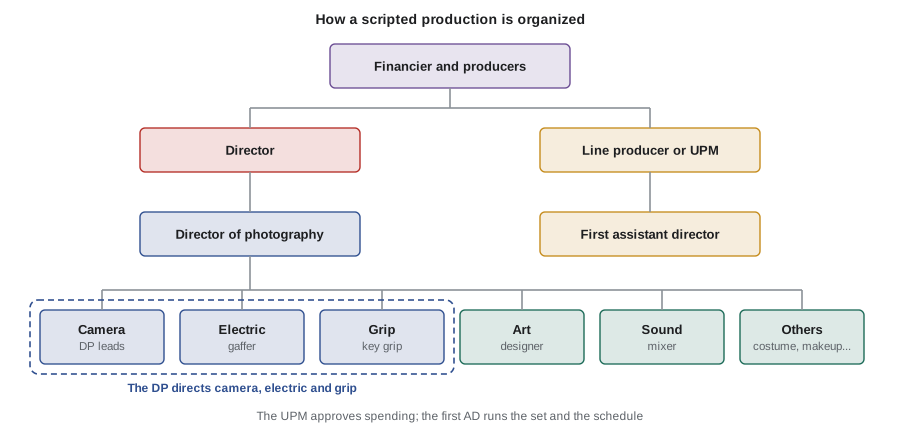
Most scripted productions follow the same basic structure, whether they are a commercial, a series or a feature. At the top are the people who control the money and the creative vision. Below them are departments, each led by a head of department who hires and manages a crew.
- The studio, network, streamer or financier provides the money and approves major decisions such as the budget, key cast and the schedule.
- Producers turn money into a finished film. The line producer or unit production manager (UPM) builds and controls the budget and schedule day to day.
- The director leads the creative work and decides what the audience will see and hear.
- The assistant directors (ADs) run the set and the schedule. The first AD calls the shots on the day, keeps the company on time and leads safety meetings.
- Production departments, each with a head of department: camera, grip, electric, art, costume, hair and makeup, sound, locations, transport, special effects, visual effects and others.
- Post-production: editors, colorists, sound editors and visual effects artists who turn the footage into a finished program.
The camera department sits in the middle of this structure. It takes creative direction from the director and the director of photography (DP), schedules from the ADs, budgets from the UPM and technical requirements from post-production.
The DP and the three lighting and camera departments
The director of photography is the head of the camera department and is responsible for the look of the film: composition, camera movement, exposure and lighting. On most productions the DP also directs the work of two other departments.
- The electric department, led by the gaffer, who designs and runs the lighting and power with a best boy electric and electricians.
- The grip department, led by the key grip, who handles camera support (dollies, cranes, mounts), rigging and the shaping of light with flags and frames.
- The camera department itself, with camera operators, camera assistants, a digital imaging technician (DIT) and others, covered in detail in the next lesson.
Together these three are sometimes called the camera, grip and electric team. Their heads of department meet in prep to plan equipment, crew sizes and rigging, and they work side by side on set. A camera assistant who understands what the grips and electricians need, and when, becomes far more useful on set.
Phases of a production
Camera crews are hired for different phases, and the work changes from phase to phase.
- Development: the script is written and financed. Camera crews are rarely involved, though DPs may be approached early on bigger projects.
- Pre-production (prep): the DP scouts locations, tests cameras and lenses, plans the look and orders equipment. Camera assistants prep the camera package at the rental house, checking every lens, cable and accessory.
- Production (principal photography): the shooting days, when most camera crew are employed.
- Additional photography and reshoots: shorter periods after the main shoot.
- Post-production: the DP may supervise the color grade, and data or DIT work may continue to deliver files to post.
- Wrap: equipment is returned and checked, and paperwork is finished.
Paid prep days matter to camera crews. A first assistant camera (1st AC) on a series might get several prep days at the rental house before the first shooting day, and checkout days are a standard part of many crew deals.
Types of productions and why they matter
The type of production affects budgets, agreements, schedules and crew sizes.
- Feature films: long shooting periods, larger crews and, on bigger budgets, more specialized roles.
- Episodic television and streaming series: long seasons, fast schedules and multiple units; many crew members build steady work here.
- Commercials: short, intense jobs with high day rates and large equipment packages, often run by production companies hired by advertising agencies.
- Music videos: short, creative, often lower-budget jobs that can launch careers.
- Documentaries and unscripted programs: smaller crews and different working practices; camera operators often work alone or in pairs.
- Corporate, live event and branded content: steady work for many freelancers, often non-union.
Many productions sign union or guild agreements that set minimum rates and conditions; others are non-union. Lessons 6 and 7 explain the agreements in more detail.
The production landscape in the US
The United States has the largest production sector in the world. Los Angeles and New York remain the main centers, with large industries in Atlanta, Albuquerque, Chicago, New Orleans and other cities. Many states offer film incentives, such as tax credits or rebates on qualified spending, to attract productions, and the rules change often as states expand, cap or end their programs. Productions also move work to Canada, the United Kingdom and other countries to follow incentives. Production volume rises and falls with streaming budgets, labor disputes and incentives, as the slowdown after the 2023 strikes showed. Crew members often travel between production centers, and some live in one market and work in several.
How decisions and money flow
Understanding who approves what saves a camera crew time and trouble.
- Creative decisions about shots flow from the director to the DP, and then to the camera operator and assistants.
- Equipment decisions start with the DP, are priced by the camera department and are approved by the UPM or line producer, who controls the budget.
- Crew hiring: the DP usually chooses the camera operator and 1st AC, and the 1st AC often chooses the 2nd AC and loader. The production office issues deal memos and payroll paperwork.
- Schedule changes come from the ADs. The camera department plans around the call sheet, which the ADs publish each day.
- Requests for extra crew or equipment on a given day (called "dailies" or day players and additional equipment) are approved by the UPM, usually on the DP's recommendation.
A common early-career mistake is asking the wrong person for a decision, such as asking the director for an extra camera or the AD for a lens. Requests should travel through the department's head.
Worked problem
Sizing the camera, grip and electric team for a series
A series shoots one main unit with two cameras on most days. The DP asks for a camera operator for each camera, a 1st AC and a 2nd AC for each camera, a DIT and a loader. The gaffer asks for a best boy and four electricians; the key grip asks for a best boy, a dolly grip and three grips. How many people are on the camera, grip and electric team, including the DP, gaffer and key grip?
Show solution
- Camera: DP 1, operators 2, 1st ACs 2, 2nd ACs 2, DIT 1, loader 1 = 9.
- Electric: gaffer 1, best boy 1, electricians 4 = 6.
- Grip: key grip 1, best boy 1, dolly grip 1, grips 3 = 6.
- Total: 9 + 6 + 6 = 21.
Answer: 21 people, about two thirds of whom are in grip and electric. The DP leads all three departments.
Worked problem
Prep days and the cost of a camera crew
A 1st AC is hired at an illustrative 60 dollars an hour on a 10-hour guaranteed day for 3 prep days at the rental house and 40 shooting days. What is the straight-time labor cost before overtime and benefits?
Show solution
- Days: 3 + 40 = 43.
- Hours: 43 × 10 = 430 hours.
- Cost: 430 × 60 = 25,800 dollars.
Answer: About 25,800 dollars before overtime, fringes and payroll costs. Prep days are a small share of the total but essential to a reliable camera package.
The call sheet: a daily map of the production
The call sheet, issued by the ADs the evening before each shooting day, tells everyone where to be, when and what will be shot. Camera crew read it closely.
- General crew call time and any department-specific calls, such as an earlier call for camera to build cameras.
- Location address, parking, nearest hospital and safety notes.
- Scenes, script pages, cast and estimated times.
- Special equipment and additional crew booked for the day, such as a crane, a Steadicam operator or an extra camera.
- Weather, sunrise and sunset times.
- Contacts for heads of department and production staff, and, under recent agreements, contact details for the transportation or lodging coordinator.
Reading the call sheet the night before lets the camera department anticipate the day: which lenses will be needed, whether a crane day needs an earlier build and whether a company move will force a camera wrap and reload.
Working relationships across departments
Camera crews work closely with almost every other department.
- Grip: camera support, dollies, cranes and car rigs; grips build and move the platforms the camera rides on.
- Electric: lighting and power for cameras, monitors and the DIT station.
- Sound: boom placement, shadows, wireless channels and slates; camera and sound share timecode and slate information.
- Art and set decoration: sets built for the camera's angles and lenses; reflections and set dressing problems found through the camera.
- Hair, makeup and costume: last looks before takes and continuity of appearance between shots.
- Script supervisor: continuity, slate numbers and camera reports that must agree with the script supervisor's notes.
- Post-production and VFX: file formats, metadata, lens data and visual effects plates.
Courtesy and clear communication across departments build a reputation that gets crew members rehired, which is how most freelance careers grow.
Common mistakes
MistakeAsking the director for an extra camera
InsteadRoute equipment and crew requests through the DP and the UPM, who controls the budget
MistakeIgnoring the call sheet until arriving on set
InsteadRead the call sheet the night before and plan lenses, builds and special equipment
MistakeTreating prep days as optional
InsteadPrep is when the package is checked and problems are found before they cost a shooting day
MistakeThinking the camera department works alone
InsteadCamera works closely with grip, electric, sound, art, script and post every day
MistakeQuoting a rate from memory
InsteadCheck the current agreement and rate sheet; rates and terms change with every agreement
Summary and key terms
- A production is led by financiers, producers and the director, with departments run by heads of department.
- The DP leads the camera department and directs the work of the gaffer's electric department and the key grip's grip department.
- Camera crews are hired for prep, shooting and wrap, and prep days are essential to a reliable package.
- Production types, from features to commercials and documentaries, differ in budgets, schedules and crew sizes.
- Creative decisions flow from director to DP; money decisions are approved by the UPM or line producer.
- The daily call sheet tells crew where to be, what will be shot and what special equipment is booked.
- Good relationships with other departments are the foundation of a freelance career.
- Head of department
- The person who leads a production department and hires its crew
- Director of photography (DP)
- The head of the camera department, responsible for the look of the film
- Gaffer
- Head of the electric department, responsible for lighting and power
- Key grip
- Head of the grip department, responsible for camera support and rigging
- Unit production manager (UPM)
- The production manager who controls the budget and schedule day to day
- First assistant director (first AD)
- The person who runs the set and the shooting schedule
- Call sheet
- The daily document listing call times, location, scenes and crew
- Prep
- The pre-production period when equipment is tested and plans are made
- Day player
- A crew member hired for single days rather than the full production
- Principal photography
- The main shooting period of a production
Practice problems
Work each problem on paper first, then reveal the answer to check.
Who leads the electric and grip departments, and whom do they work with most closely?
Show answer
The gaffer and the key grip, who work most closely with the DP
Who approves the cost of an extra camera for a day?
Show answer
The UPM or line producer, usually on the DP's recommendation
Name three things a camera crew reads on the call sheet.
Show answer
Any three of call times, location, scenes, special equipment, sunrise and sunset, weather and contacts
Why do prep days matter to a camera department?
Show answer
The package is checked and tested so that problems are found before shooting
Which department builds and moves dollies and cranes?
Show answer
The grip department
A series has 2 cameras, each with an operator, 1st AC and 2nd AC, plus a DP, DIT and loader. How many people are in camera?
Show answer
9
Why do Canadian and US productions care so much about local crews?
Show answer
Tax credits and incentives are often based on local labor or spending
Who usually chooses the 2nd AC?
Show answer
The 1st AC, with the DP's approval
What phase of production employs the most camera crew?
Show answer
Principal photography
Why should requests go through the head of department?
Show answer
Heads of department control their budgets and plans, so requests reach the right decision maker
Lesson quiz · 5 questions
Score 60% or more to complete this lesson.
Create a free account to save your progress, take quizzes and earn a certificate.