
CINE-420 · Lesson 10 of 12 · 26 min
The freelance business: taxes, insurance, equipment and loan-outs
Every freelance camera crew member runs a small business, even when most of their income arrives through payroll. They decide what equipment to buy, how to insure it, how to save for slow periods, how to handle taxes on kit rentals and contractor work and, later in a career, whether to incorporate. Good business habits turn uneven freelance income into a stable life; poor habits lead to tax bills that cannot be paid and gear that never earns back its cost. This lesson covers record keeping, taxes, insurance, equipment decisions and incorporation in Canada and the US at a general level.
Record keeping
The foundation of a freelance business is good records.
- Keep every pay stub, tax slip or form, invoice and receipt, organized by year.
- Use a simple spreadsheet or bookkeeping app to track income by source: payroll wages, kit rentals and contractor invoices.
- Track expenses: equipment, repairs, insurance, phone, software, training, union dues and work-related travel.
- Keep a mileage log if you claim vehicle expenses, recording dates, destinations and business purposes.
- Separate business and personal money with a dedicated bank account for kit rentals and invoices.
Records support tax returns, prove income when applying for loans or mortgages and help you understand which parts of your work actually make money.
Income tax and self-employment tax in the US
Camera crew in the US often have more than one kind of income in a year.
- Wages from payroll jobs, reported on Form W-2, with income tax, Social Security and Medicare withheld.
- Self-employment income from contractor invoices and kit rentals, reported on Schedule C, with business expenses deducted.
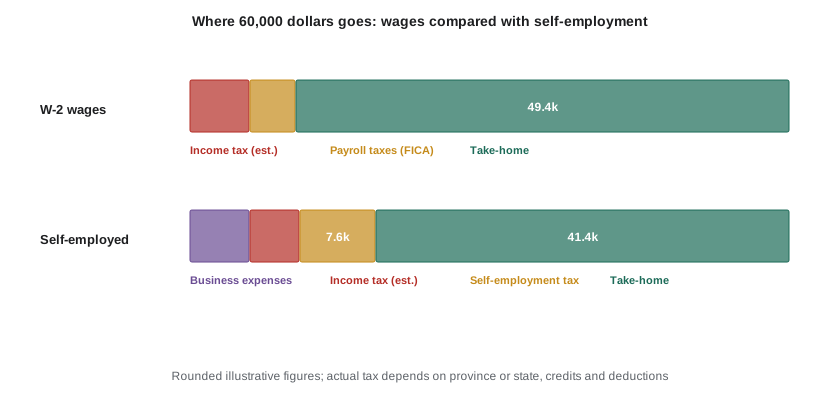
- Self-employment tax of 15.3 % applies to 92.35 % of net self-employment earnings, covering both shares of Social Security and Medicare; the Social Security part stops at the annual wage base, 184,500 dollars in 2026, counting wages first.
- Self-employed people usually pay quarterly estimated taxes to avoid penalties, and safe harbor rules based on the previous year's tax can protect against underpayment penalties.
- Employees generally cannot deduct unreimbursed work expenses on federal returns, so equipment costs are usually deductible only against self-employment or rental income; some states allow more.
Many crew also benefit from retirement accounts for the self-employed, such as a SEP IRA or Solo 401(k), on their self-employment income.
Worked problem
Payroll taxes on self-employment income
A 1st AC has 60,000 dollars of net self-employment income from contractor work and kit rentals in 2026, and no wages. Estimate their self-employment tax.
Show solution
- Earnings subject to the tax: 60,000 × 0.9235 = 55,410 dollars.
- Tax at 15.3 %: 55,410 × 0.153 ≈ 8,477.73 dollars.
Answer: About 8,478 dollars of self-employment tax, before income tax. Half of it is deductible when calculating adjusted gross income.
Setting money aside
Freelancers who receive kit rentals or contractor payments without deductions must set money aside for taxes. A simple rule used by many crew is to move a fixed share of every untaxed payment, such as 25 to 35 %, into a separate savings account. The right share depends on income, deductions and province or state; an accountant can help set it. Crew should also build an emergency fund covering several months of expenses, because work can stop suddenly, as it did during the pandemic and the 2023 strikes.
Insurance
Camera crew need several kinds of insurance.
- Equipment insurance: covers owned gear against theft, loss and damage, including on set and in vehicles. Productions often insure rented kit while it is in their care, but the deal memo should say so.
- Liability insurance: protects against claims for injury or damage caused by your work, required by some productions and rental houses, especially for owner-operators of specialty equipment.
- Health, dental and disability coverage: union plans cover many crew, but non-union freelancers need their own; disability insurance replaces income if injury or illness stops work.
- Vehicle insurance: personal policies may not cover business use, so tell your insurer if you use your vehicle for work.
Shop around: some industry associations and unions offer group insurance plans for members.
Buying versus renting equipment
Owning equipment can earn kit rental income and make you more attractive to hire, but equipment loses value, needs repairs and insurance and can become obsolete quickly.
Worked problem
Does a wireless focus system pay for itself?
A 1st AC can buy a wireless focus system for an illustrative 12,000 dollars. They expect to rent it to productions for 150 dollars a week for 30 weeks a year. Insurance costs 300 dollars a year and repairs average 400 dollars a year. How long until the system pays for itself, before taxes?
Show solution
- Annual rental income: 150 × 30 = 4,500 dollars.
- Annual costs: 300 + 400 = 700 dollars.
- Net income: 4,500 − 700 = 3,800 dollars a year.
- Payback: 12,000 ÷ 3,800 ≈ 3.2 years.
Answer: About 3.2 years, if the system is rented as often as planned and stays current. If productions start supplying the equipment or the technology changes, payback takes longer, so buy gear that is widely requested and holds its value.
Loan-out corporations in the US
Some senior camera crew, especially DPs, work through loan-out corporations, which employ them and contract their services to productions. A loan-out can allow certain business deductions, retirement plans and liability protection, and is sometimes taxed as an S corporation, paying the owner a reasonable salary with the rest as distributions. But loan-outs have costs: accounting fees, payroll filings, state fees and franchise taxes, and California's minimum franchise tax. Union agreements still require benefits contributions on loan-out payments, and some states and payroll companies treat loan-outs differently for withholding. Loan-outs suit mainly crew with high and stable income. Get professional advice before setting one up.
Retirement and long-term savings
Freelancers do not have employer pension plans unless they work under union agreements that contribute to retirement plans. Saving for retirement is therefore a personal responsibility for much of a camera career.
In the US, self-employed people can use a SEP IRA or Solo 401(k) on their self-employment income, and anyone with earned income can contribute to an IRA within limits. Union members may also earn pension credits through plans such as the Motion Picture Industry Pension Plan, and Social Security provides a basic benefit based on earnings.
Small, regular contributions in busy months add up over a long career, and an accountant or financial planner can help choose the right accounts.
Choosing an accountant
An accountant who knows the film industry understands mixed payroll and self-employment income, kit rentals, union dues, per diems and the equipment rules that apply to camera crew. Ask colleagues for recommendations, ask the accountant about their experience with film crew and agree on fees in advance. Bring organized records: an accountant can do much more with a tidy spreadsheet and receipts than with a shoebox of papers, and the time saved often pays for part of the fee.
When work stops
Strikes, pandemics, slowdowns and personal events can stop work for months. Crew who survive these periods usually have savings, low fixed costs and more than one source of income, such as corporate work, rental house shifts, teaching or other skills. Check what support is available: employment insurance or unemployment benefits for payroll workers, union hardship funds and industry charities. Plan before a crisis, not during it.
Equipment depreciation and replacement
Camera equipment loses value as it ages and as new technology arrives. Tax rules allow the cost of equipment to be deducted over several years, through capital cost allowance in Canada or depreciation and expensing rules in the US, when it is used to earn business income. Beyond taxes, plan for replacement: set aside part of kit rental income each year so that a worn or outdated item can be replaced without borrowing. Buying used equipment from reputable sellers can reduce costs, but check its condition and history carefully.
Credit, loans and big purchases
Specialty operators sometimes borrow to buy expensive rigs such as stabilizers or remote heads. Before borrowing, estimate realistic rental demand, the payback period and the risk that the equipment becomes outdated or that work slows. Lenders may ask for two or more years of tax returns from freelancers, which is another reason to keep good records and report all income. A large loan payment can turn a slow month into a crisis, so keep a larger buffer when carrying debt.
Common tax mistakes to avoid
- Not reporting kit rental or cash payments, which tax authorities can trace through production records.
- Claiming personal expenses as business expenses, such as everyday clothing or family travel.
- Missing installment or estimated tax payments, which leads to interest and penalties.
- Losing receipts and records needed to support deductions.
- Forgetting provincial or state tax rules, especially after working in more than one province or state in a year.
- Waiting until the filing deadline to organize a year of records.
Working across borders
Camera crew who work in both Canada and the US, or in several provinces or states, face extra tax complexity. Income earned in another country may be taxed there and at home, with treaty rules and foreign tax credits to prevent double taxation, and work permits are required. US states and Canadian provinces may also tax income earned within them. Keep detailed records of where each day was worked and get advice from an accountant familiar with cross-border film work.
Unemployment insurance for freelancers in the US
Crew paid through payroll as W-2 employees may qualify for state unemployment insurance between jobs, based on wages earned during a base period, under rules that vary by state. Self-employment and 1099 income usually does not count toward unemployment benefits. Many film crew claim benefits during gaps between productions, and some states have specific rules for workers with frequent short jobs. Keep records of every payroll employer, because state agencies use them to calculate eligibility and benefit amounts.
Common mistakes
MistakeSpending kit rental income without setting aside tax
InsteadMove a fixed share of untaxed payments into a tax savings account
MistakeMixing business and personal money
InsteadUse a separate bank account and keep organized records
MistakeBuying expensive gear without a rental plan
InsteadEstimate rental demand, costs and payback before buying
MistakeAssuming personal vehicle insurance covers work
InsteadTell your insurer about business use and check coverage
MistakeIncorporating without advice
InsteadGet professional advice; incorporation and loan-outs suit only some situations
Summary and key terms
- Good records of income, expenses and mileage are the foundation of a freelance business.
- Crew often have both payroll income and self-employment or rental income, taxed differently.
- Self-employed people pay both shares of pension or payroll taxes, with CPP in Canada and self-employment tax in the US.
- Setting aside a share of untaxed income and building an emergency fund protect against tax bills and slow periods.
- Equipment, liability, health, disability and vehicle insurance protect crew and their gear.
- Buying equipment makes sense only when realistic rental demand pays it back.
- Incorporation or loan-outs suit some senior crew but have costs, risks and special rules.
- Self-employment income
- Income from your own business, such as contractor work and kit rentals
- Installments
- Tax payments made during the year when tax is not withheld at source
- Capital cost allowance
- In Canada, the tax deduction for depreciation of business equipment
- Self-employment tax
- In the US, Social Security and Medicare tax paid by the self-employed
- Estimated tax
- In the US, quarterly tax payments on income without withholding
- Emergency fund
- Savings to cover expenses during periods without work
- Liability insurance
- Insurance against claims for injury or damage caused by your work
- Payback period
- The time for an investment's net income to repay its cost
- Personal services business
- In Canada, a corporation providing one person's services that would otherwise be employment, taxed at a high rate
- Loan-out corporation
- In the US, a company that employs a crew member and contracts their services to productions
Practice problems
Work each problem on paper first, then reveal the answer to check.
Name three expenses a freelance camera crew member should track.
Show answer
Any three of equipment, repairs, insurance, phone, software, training, union dues and travel
What share of self-employment income does US self-employment tax apply to?
Show answer
92.35 %
What is the CPP rate for the self-employed in 2026?
Show answer
11.9 % up to the yearly maximum pensionable earnings
A 12,000 dollar system earns 3,800 dollars a year net. What is the payback period?
Show answer
About 3.2 years
Why should freelancers set aside part of untaxed payments?
Show answer
To pay income and payroll taxes owed at filing time
Name two kinds of insurance a camera crew member may need.
Show answer
Any two of equipment, liability, health, disability and vehicle insurance
What risk does the personal services business rule create in Canada?
Show answer
A corporation may be taxed at a high rate with limited deductions
What is a loan-out corporation?
Show answer
A company that employs a crew member and contracts their services to productions
Why build an emergency fund?
Show answer
Work can stop suddenly, as in the pandemic and the 2023 strikes
When might buying equipment take longer to pay back?
Show answer
When rentals are less frequent than planned or the technology becomes outdated
Lesson quiz · 5 questions
Score 60% or more to complete this lesson.
Create a free account to save your progress, take quizzes and earn a certificate.