
CINE-420 · Lesson 3 of 12 · 27 min
Set protocol and etiquette for the camera department
Film sets run on routines that let hundreds of people coordinate without confusion. Some routines are written into safety rules and agreements; others are unwritten customs that experienced crew expect everyone to know. Camera crews sit at the center of the set's attention, because nothing happens until the camera is ready and nothing is finished until the camera has the shot. That makes the camera department's protocol and manners highly visible. This lesson walks through a shooting day from the camera department's point of view, explains the standard calls and routines, and describes the habits that make crew members easy to work with and likely to be hired again.
The shape of a shooting day
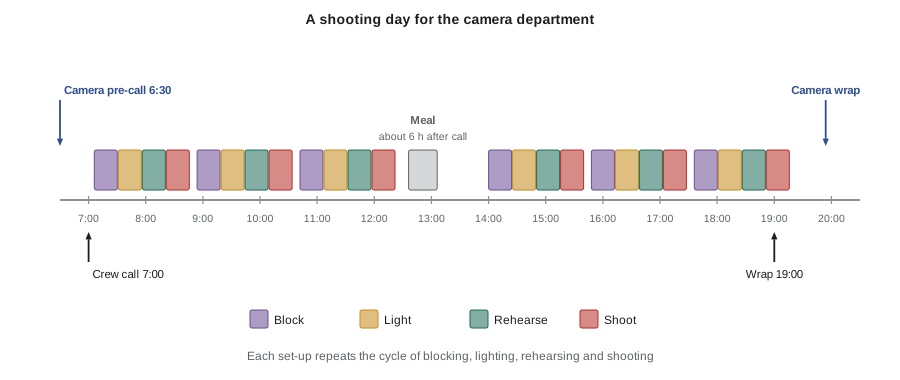
Most scripted shooting days follow the same pattern for each set-up, a single camera position and lighting arrangement.
- Blocking: the director and actors walk through the scene on set while key crew watch. The DP, operator and 1st AC watch closely, and the 2nd AC places marks for actors' positions.
- Marking and second team: the main actors leave for hair, makeup and costume, and stand-ins take their places so lighting and camera can be set.
- Lighting and camera set-up: grip and electric light the set while camera builds the shot, chooses the lens, measures focus and rehearses moves.
- Rehearsal with first team: actors return and rehearse with camera, so focus pullers and operators can refine their work.
- Shooting: takes are recorded until the director and DP are satisfied, with resets between takes.
- Moving on: the AD calls the next set-up, and the cycle starts again.
Each cycle may take an hour or more on a feature and much less on a fast television schedule. Camera crews plan ahead during each cycle so the next lens, accessory or support is ready when the AD moves on.
Standard calls on set
Sets use standard verbal calls so that everyone knows what is happening. The exact words vary, but these are common in Canada and the US.
- "Picture's up" or "this is a take": the next take is about to happen; finish what you are doing and be quiet.
- "Roll sound" and "sound speeding": sound starts recording.
- "Roll camera" and "camera rolling" or "speed": the camera starts recording.
- "Marker": the 2nd AC is about to clap the slate; the operator or 2nd AC may call "mark it" or "marker" before the clap.
- "Action" and "cut": called by the director, or by the first AD or camera crew in some cases, such as second unit or inserts.
- "Checking the gate" or "check the take": on film, the 1st AC checks the camera gate for debris; on digital, the department confirms the take was recorded correctly.
- "Moving on" or "new deal": the set-up is finished and the next one begins.
- "Martini shot" and "Abby Singer": the last and second-to-last shots of the day.
- "That's a wrap": shooting is finished for the day or the production.
Learning these calls and responding promptly is the first sign of a professional.
Communication and radio etiquette
Most crews use walkie-talkies with assigned channels. Camera usually has its own channel, with the AD, grip and electric channels nearby.
- Listen before you speak, keep messages short and identify yourself and the person you are calling.
- Use "go to two" or the channel name to move a long conversation off the main AD channel.
- Never speak on the radio during takes, and turn earpieces down so sound is not picked up.
- Use the department channel for lens changes, battery calls and equipment requests.
- Do not discuss confidential matters, complaints or personal information on radio; others can hear.
Good radio discipline keeps the AD channel clear for the calls that move the day.
The camera cart and staging area
The camera department works from carts and a staging area near set. The 2nd AC usually chooses and organizes it, close enough to reach set quickly but out of the way of other departments and safe from traffic, weather and lighting stands. Lenses, accessories and media are stored in labeled cases and drawers so anyone in the department can find them. Expensive items are never left unattended in public locations. On location the staging area is part of the safety plan: it should be clear of walkways, emergency routes and vehicle paths.
Habits that build a reputation
Experienced crew agree on the habits that make someone easy to work with.
- Be early. Arrive before your call time, ready to work, with your tools and personal gear.
- Watch and anticipate. Follow the rehearsal and the director's notes so you are ready before you are asked.
- Stay close and stay quiet. Be available to your department, but keep conversations away from set and off the radio during takes.
- Own mistakes quickly. Tell your head of department immediately when something goes wrong, such as a missed focus mark or a wrong slate, so it can be fixed.
- Respect other departments' work and gear. Do not move another department's equipment without asking.
- Keep phones away from set except when needed for work, and never post photos from set without permission; most productions have confidentiality agreements and social media policies.
- Respect actors. Avoid unnecessary eye contact or chatter in the actor's line of sight, and keep the set calm during emotional scenes.
These habits are rarely written down, but crew members talk, and reputations travel quickly between productions.
Respect, inclusion and reporting problems
Sets are workplaces covered by employment, human rights and occupational health and safety laws. Harassment, discrimination and bullying are not part of set culture, whatever the pressure or the person's rank. Most productions name a person to receive complaints, and unions and guilds have reporting channels. Camera crews are often in close physical proximity on set and in vehicles, so respecting personal space and boundaries is part of professional conduct. HSE-108 covers workplace violence and harassment prevention in detail.
Rules behind set protocol in the US
In the US, the federal Occupational Safety and Health Act and state plans such as Cal/OSHA require employers to provide safe workplaces, and the Industry-Wide Labor-Management Safety Committee publishes safety bulletins used on many productions. Federal and state anti-discrimination laws apply on productions, and union agreements set out complaint procedures. Many productions hold safety meetings at call and before stunts or special effects, and union crew complete required safety courses through Contract Services.
Worked problem
Timing the camera build before crew call
The 1st AC needs 45 minutes to build two cameras and test wireless focus, and the 2nd AC needs 20 minutes to set up the cart and media before helping. Camera wants to be ready 10 minutes before the first rehearsal at 7:30. When should camera call be?
Show solution
- Latest ready time: 7:30 minus 10 minutes = 7:20.
- Build time is the longer task: 45 minutes, done partly in parallel with the 2nd AC's set-up.
- 7:20 minus 45 minutes = 6:35.
Answer: Camera call around 6:35, which on most productions means asking the AD for a pre-call of about half an hour before general crew call at 7:00.
Worked problem
Turning the set around between set-ups
A director plans 24 set-ups in an 11-hour shooting day, excluding the meal. How many minutes are available per set-up on average, and what does that mean for the camera department?
Show solution
- 11 hours × 60 = 660 minutes.
- 660 ÷ 24 = 27.5 minutes per set-up.
Answer: About 27 minutes per set-up, including blocking, lighting, rehearsal and takes. The camera department must have lenses and accessories ready before the AD calls the next set-up, and lens changes must take seconds, not minutes.
The camera department during a take
During a take, each member of the camera department has a defined position and job.
- The operator frames and moves the camera and watches the edges of the frame for problems.
- The 1st AC pulls focus, usually from beside the camera or from a monitor with a wireless unit.
- The 2nd AC stands by with the slate for second sticks or a tail slate, watches the recording indicator and keeps the path clear for dolly moves.
- The DIT watches exposure and image quality and reports problems to the DP.
- The DP watches the monitors for all cameras and gives notes after the take.
After "cut", the department checks in quickly: the operator reports any frame problems, the 1st AC reports focus, the DIT reports technical issues and the 2nd AC records notes for the camera report. These short reports let the DP and director decide whether to go again.
Working with actors and directors
The camera department works close to actors, sometimes inches from their faces. Keep conversations brief and quiet near actors, avoid moving through their eye line during takes and let the operator or DP speak to actors about marks and positions unless asked otherwise. When an actor misses a mark, the 1st AC and operator adjust without fuss and mention it to the DP, who decides whether to raise it with the director. Directors communicate through the DP and the first AD, and camera crew should avoid offering opinions on performances or story unless asked. Respecting these lines of communication keeps the set calm and focused.
Safety meetings and briefings
Most productions hold a safety meeting at call, led by the first AD, and additional briefings before stunts, special effects, vehicle work, water work, weapons or other hazards. Camera crew attend these briefings, because cameras are often placed close to the hazard. Listen for the location of first aid, emergency exits and muster points, the plan for the hazardous scene and the signals to stop action. If a camera position seems unsafe, raise it with the DP, the key grip or the AD before the take, not after. Any crew member can call "cut" or stop work when someone is in danger.
Leaving a good impression at wrap
The end of the day is when tired crew are most likely to cut corners, and it is also when department heads notice who helps. Help break down and pack equipment carefully, return borrowed items to other departments, check that nothing is left at the location and confirm the next day's call before leaving. Thank the people who helped your department. Small courtesies at wrap are remembered as clearly as good work on set.
Phones, photos and personal gear
Personal phones are useful tools for camera crew, for depth of field apps, lens calculators, sun position apps and messages from the department, but they distract on set. Keep phones on silent, away from the camera during takes and out of sight of actors. Never photograph actors, scripts or sets for personal use without permission.
Common mistakes
MistakeTalking on the radio during a take
InsteadStay silent on the radio during takes and keep earpieces quiet
MistakeMoving another department's equipment without asking
InsteadAsk the department first; their equipment may be placed for safety or a reason you cannot see
MistakeHiding a mistake until dailies
InsteadTell your head of department immediately so it can be fixed while the set is still lit
MistakePosting photos from set on social media
InsteadFollow the production's confidentiality and social media rules and ask permission
MistakeStaging the camera cart in an emergency route
InsteadChoose a staging area clear of walkways, vehicle paths and emergency exits
Summary and key terms
- Each set-up follows a cycle of blocking, lighting, rehearsing and shooting.
- Standard calls such as "roll camera", "marker" and "moving on" coordinate the set.
- Radio discipline keeps the AD channel clear and the takes quiet.
- The camera cart and staging area must be organized, secure and clear of emergency routes.
- Being early, anticipating, staying quiet and owning mistakes build a reputation.
- Harassment, discrimination and bullying are not part of set culture, and productions must provide reporting channels.
- Occupational health and safety laws, production safety guidelines and union agreements sit behind set protocol.
- Set-up
- A single camera position and lighting arrangement for a shot
- Blocking
- Working out the actors' and camera's movements for a scene
- Second team
- Stand-ins who take the actors' places while lighting and camera are set
- First team
- The main actors in the scene
- Marker
- The call before the slate is clapped
- Martini shot
- The last shot of the day
- Abby Singer
- The second-to-last shot of the day
- Pre-call
- A call time for a department before general crew call
- Staging area
- The place near set where a department keeps its carts and equipment
- Check the gate
- On film, inspecting the camera gate for debris after a take
Practice problems
Work each problem on paper first, then reveal the answer to check.
What happens during blocking?
Show answer
The director and actors work out movements while key crew watch and marks are placed
What does "picture's up" mean?
Show answer
A take is about to happen; finish and be quiet
Why should camera crew avoid the AD channel for long conversations?
Show answer
It must stay clear for calls that run the set
What is the martini shot?
Show answer
The last shot of the day
A day has 660 shooting minutes and 24 set-ups. What is the average time per set-up?
Show answer
27.5 minutes
What should you do immediately after missing a focus mark on a take?
Show answer
Tell the 1st AC or DP right away
Give two rules for the camera staging area.
Show answer
Any two of organized, secure, close to set, clear of walkways and emergency routes
Why should crew not post set photos without permission?
Show answer
Productions have confidentiality agreements and social media rules
Who are second team?
Show answer
Stand-ins who take the actors' places during lighting and camera set-up
Which course covers workplace harassment prevention in detail?
Show answer
HSE-108
Lesson quiz · 5 questions
Score 60% or more to complete this lesson.
Create a free account to save your progress, take quizzes and earn a certificate.