
BUS-110 · Lesson 9 of 12 · 36 min
Loans, mortgages and amortization
Most business and personal loans are repaid by a series of equal payments that cover both interest and principal. Each payment first pays the interest that has built up since the last payment; whatever is left reduces the balance. Over time the balance falls, the interest portion shrinks and the principal portion grows. This process is called amortization, and the table that tracks it payment by payment is an amortization schedule. This lesson applies the annuity formulas from lesson 8 to car loans, business term loans and, most importantly, home mortgages, the largest debt most households ever take on.
The loan payment
A loan is the present value of its payments. Given the amount borrowed (PV), the periodic rate (i) and the number of payments (n), the payment is found with the present value annuity formula rearranged for PMT. For a general annuity, i is the equivalent rate per payment interval.
Worked problem
A car loan
A sales representative finances a $30,000 car at 6.9 % compounded monthly over 5 years. What is the monthly payment, and how much interest will she pay in total?
Show solution
- i = 0.069 ÷ 12 = 0.00575; n = 60.
- PMT = $30,000 × 0.00575 ÷ (1 − 1.00575^−60) = $592.62.
- Total paid = 60 × $592.62 = $35,557.20. Interest = $35,557.20 − $30,000 = $5,557.20.
Answer: The payment is $592.62 a month, and the loan costs about $5,557 in interest.
Amortization schedules
An amortization schedule lists, for every payment, the interest portion (the opening balance times the periodic rate), the principal portion (the payment minus the interest) and the closing balance (the opening balance minus the principal portion). Because the payment is rounded to the cent, the final payment is adjusted so that the balance ends at exactly zero.
Worked problem
A short schedule
A business borrows $6,000 at 9 % compounded monthly and repays it with six monthly payments. Build the amortization schedule.
Show solution
- i = 0.09 ÷ 12 = 0.0075. PMT = $6,000 × 0.0075 ÷ (1 − 1.0075^−6) = $1,026.41.
- Payment 1: interest = $6,000 × 0.0075 = $45.00; principal = $1,026.41 − $45.00 = $981.41; balance = $5,018.59.
- Payment 2: interest = $5,018.59 × 0.0075 = $37.64; principal = $988.77; balance = $4,029.82.
- Continue in the same way; the table below shows every row.
- The final payment is $1,026.42, one cent more than the others, to clear the balance exactly.
Answer: Total interest is $158.47. Note how the interest falls and the principal rises with each payment.
| Payment | Amount | Interest | Principal | Balance |
|---|---|---|---|---|
| 0 | $6,000.00 | |||
| 1 | $1,026.41 | $45.00 | $981.41 | $5,018.59 |
| 2 | $1,026.41 | $37.64 | $988.77 | $4,029.82 |
| 3 | $1,026.41 | $30.22 | $996.19 | $3,033.63 |
| 4 | $1,026.41 | $22.75 | $1,003.66 | $2,029.97 |
| 5 | $1,026.41 | $15.22 | $1,011.19 | $1,018.78 |
| 6 | $1,026.42 | $7.64 | $1,018.78 | $0.00 |
A schedule for a long loan has hundreds of rows, which is why it is almost always built in a spreadsheet. The first row's formulas are written once and filled down: interest = previous balance × rate, principal = payment − interest, balance = previous balance − principal.
The balance at any time
It is often necessary to know the balance partway through a loan, for example when it is to be paid off early, refinanced or renewed. There are two equivalent methods. The prospective method finds the present value of the payments still to come. The retrospective method takes the future value of the original loan and subtracts the future value of the payments already made.
Business term loans
Businesses borrow to buy equipment, vehicles and buildings, or to finance an expansion, usually through a term loan repaid over a fixed number of years. Two repayment structures are common. With blended payments, every payment is the same and the split between interest and principal shifts over time, exactly like a mortgage. With fixed principal payments, the business repays the same amount of principal each period plus the interest on the balance, so the payments start high and fall. Fixed principal loans cost less interest, because the balance falls faster, but they put more strain on cash flow in the early years.
Worked problem
Blended or fixed principal payments?
A manufacturer borrows $120,000 at 8 % compounded monthly, repayable quarterly over 5 years. Compare the first payment and the total interest under blended payments and under fixed principal payments.
Show solution
- Equivalent quarterly rate p = (1 + 0.08 ÷ 12)^3 − 1 = 0.0201336; n = 20.
- Blended: PMT = $120,000 × 0.0201336 ÷ (1 − 1.0201336^−20) = $7,348.27 every quarter. Total interest = 20 × $7,348.27 − $120,000 = $26,965.40.
- Fixed principal: principal = $120,000 ÷ 20 = $6,000 a quarter. First payment = $6,000 + $120,000 × 0.0201336 = $8,416.04; the last is $6,000 + $6,000 × 0.0201336 = $6,120.80.
- Total interest with fixed principal = 0.0201336 × ($120,000 + $114,000 + … + $6,000) = 0.0201336 × $1,260,000 = $25,368.37.
Answer: Fixed principal payments save about $1,597 in interest but require $8,416 in the first quarter instead of $7,348. A business with tight cash flow early on may prefer blended payments.
Mortgages
A typical US home mortgage is a 30-year fixed-rate loan: the rate is set for the whole life of the loan, payments are monthly and interest compounds monthly, so the payment is a simple annuity. Fifteen-year fixed loans carry a lower rate and much less total interest. Adjustable-rate mortgages (ARMs) fix the rate for an initial period, such as 5 or 7 years, and then reset it periodically against an index. Most fixed-rate mortgages can be prepaid at any time without penalty, which lets borrowers refinance when rates fall.
| Feature | Typical rule at the time of writing (October 2026) |
|---|---|
| Down payment, conventional loan | As low as 3 %; 20 % avoids private mortgage insurance (PMI) |
| Down payment, FHA loan | 3.5 % with a qualifying credit score |
| Private mortgage insurance | Required on conventional loans with under 20 % down; ends automatically at 22 % equity |
| Common terms | 30-year and 15-year fixed; adjustable-rate loans with 5- or 7-year initial periods |
| Compounding | Monthly, matching monthly payments |
| Prepayment | Usually allowed without penalty on conventional fixed-rate loans |
Worked problem
The mortgage payment
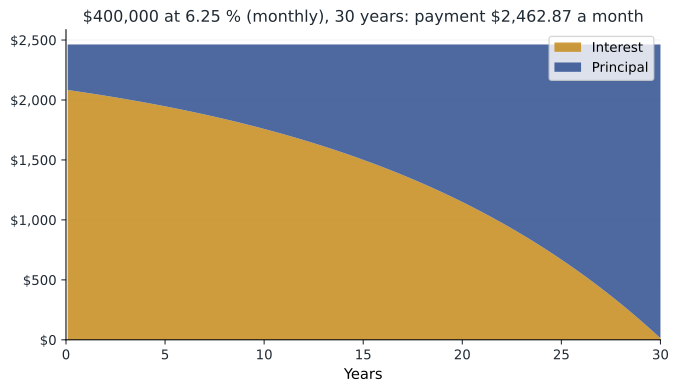
A couple buys a home with a $400,000 30-year fixed mortgage at 6.25 % compounded monthly. What is the monthly payment, and how much of the first payment is interest?
Show solution
- i = 0.0625 ÷ 12 = 0.0052083; n = 360.
- PMT = $400,000 × 0.0052083 ÷ (1 − 1.0052083^−360) = $2,462.87.
- First month interest = $400,000 × 0.0052083 = $2,083.33; principal = $2,462.87 − $2,083.33 = $379.54.
Answer: The payment is $2,462.87. About 85 % of the first payment is interest.
Worked problem
The balance after five years
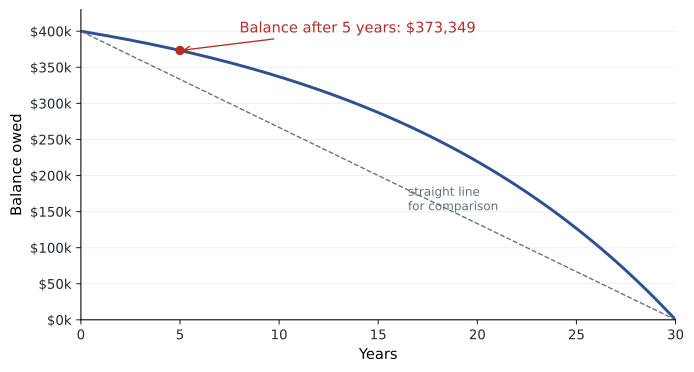
For the same mortgage, what is the balance after 5 years, and how much interest was paid in that time?
Show solution
- k = 60. Balance = $400,000 × 1.0052083^60 − $2,462.87 × (1.0052083^60 − 1) ÷ 0.0052083 = $373,348.88.
- Principal repaid = $400,000 − $373,348.88 = $26,651.12.
- Interest paid = 60 × $2,462.87 − $26,651.12 = $147,772.20 − $26,651.12 = $121,121.08.
Answer: After five years the couple still owes $373,348.88. Of the $147,772 paid, about 82 % was interest.
Paying a loan off faster
Because interest is charged on the outstanding balance, anything that reduces the balance sooner saves interest: a shorter amortization, extra payments, lump-sum prepayments or more frequent payments. The savings are largest early in the loan, when the balance is highest.
Worked problem
Extra monthly payments
The couple adds $200 a month to their $2,462.87 payment. How long does it take to repay the mortgage, and how much interest is saved?
Show solution
- New payment = $2,662.87.
- n = −ln(1 − $400,000 × 0.0052083 ÷ $2,662.87) ÷ ln(1.0052083) ≈ 293.5 payments, or about 24.5 years.
- Interest ≈ 293.5 × $2,662.87 − $400,000 = $381,682.
- Interest with regular payments = 360 × $2,462.87 − $400,000 = $486,633.
- Saving ≈ $486,633 − $381,682 = $104,951.
Answer: An extra $200 a month repays the mortgage about 5.5 years sooner and saves about $105,000 in interest.
Worked problem
30 years or 15 years?
Compare the $400,000 30-year mortgage at 6.25 % with a 15-year mortgage at 5.60 %, both compounded monthly.
Show solution
- 30 years: PMT = $2,462.87; total interest = $486,633.
- 15 years: i = 0.056 ÷ 12 = 0.0046667; n = 180; PMT = $3,289.60.
- Total interest over 15 years = 180 × $3,289.60 − $400,000 = $192,128.
Answer: The 15-year loan costs about $827 more a month but saves about $294,500 in interest.
Refinancing a mortgage
Refinancing replaces an existing mortgage with a new one, usually to get a lower rate or to change the term. It is not free: closing costs such as lender fees, appraisal and title insurance typically run 2 % to 5 % of the loan. A simple test is the break-even period, the closing costs divided by the monthly saving. If the borrower expects to keep the home longer than the break-even period, the refinance is likely to pay off.
Worked problem
The refinancing break-even
After five years the couple owe $373,348.88 at 6.25 % with 300 payments left. They can refinance for the remaining 25 years at 5.25 % compounded monthly, with closing costs of $7,500. What is the new payment and the break-even period?
Show solution
- New payment = $373,348.88 × 0.004375 ÷ (1 − 1.004375^−300) = $2,237.28.
- Monthly saving = $2,462.87 − $2,237.28 = $225.59.
- Break-even = $7,500 ÷ $225.59 ≈ 33.2 months.
Answer: The refinance pays for itself in about 33 months, so it makes sense if they expect to stay in the home for more than about three years.
# Amortization schedule and balance after k payments
def payment(pv, i, n): return pv * i / (1 - (1 + i) ** -n)
def schedule(pv, i, n):
    pmt = round(payment(pv, i, n), 2)
    bal, rows = pv, []
    for k in range(1, n + 1):
        interest = round(bal * i, 2)
        principal = bal if k == n else round(pmt - interest, 2)
        bal = round(bal - principal, 2)
        rows.append((k, round(interest + principal, 2), interest, principal, bal))
    return rows
for row in schedule(6000, 0.0075, 6):
    print(row)
p = 1.02395 ** (1 / 6) - 1          # 4.79% compounded semi-annually, monthly payments
pmt = round(payment(400000, p, 300), 2)
bal60 = 400000 * (1 + p) ** 60 - pmt * ((1 + p) ** 60 - 1) / p
print("Canadian mortgage payment", pmt, "balance after 60:", round(bal60, 2))
i = 0.0625 / 12                      # 6.25% compounded monthly
pmt = round(payment(400000, i, 360), 2)
bal60 = 400000 * (1 + i) ** 60 - pmt * ((1 + i) ** 60 - 1) / i
print("US mortgage payment", pmt, "balance after 60:", round(bal60, 2))(1, 1026.41, 45.0, 981.41, 5018.59) (2, 1026.41, 37.64, 988.77, 4029.82) (3, 1026.41, 30.22, 996.19, 3033.63) (4, 1026.41, 22.75, 1003.66, 2029.97) (5, 1026.41, 15.22, 1011.19, 1018.78) (6, 1026.42, 7.64, 1018.78, 0.0) Canadian mortgage payment 2278.83 balance after 60: 352850.81 US mortgage payment 2462.87 balance after 60: 373348.88
Common mistakes
MistakeUsing the nominal rate divided by 12 for a mortgage compounded semi-annually.
InsteadConvert to the equivalent monthly rate, (1 + j/2)^(1/6) − 1.
MistakeAssuming half the loan is repaid halfway through the amortization.
InsteadEarly payments are mostly interest; compute the balance with the formula.
MistakeAssuming a lower payment means a cheaper loan.
InsteadA longer amortization lowers the payment but greatly increases total interest.
MistakeLeaving the final payment unadjusted in a schedule.
InsteadAdjust the last payment so the balance ends at exactly zero.
MistakeIgnoring prepayment options.
InsteadExtra or more frequent payments early in the loan save the most interest.
Summary and key terms
- A loan is the present value of its payments.
- Each payment covers the interest on the balance first; the rest reduces principal.
- An amortization schedule tracks interest, principal and balance for every payment.
- The balance at any time is the future value of the loan minus the future value of the payments made.
- US fixed mortgage rates compound monthly; payments are a simple annuity.
- Fixed-rate loans keep the same rate and payment for the whole term.
- Shorter amortizations and extra payments save large amounts of interest.
- Amortization
- Repaying a loan through regular payments of interest and principal.
- Amortization schedule
- A table of each payment's interest, principal and resulting balance.
- Amortization period
- The time needed to repay a loan in full at the scheduled payment.
- Term
- The length of the current loan contract, which may be shorter than the amortization period.
- Outstanding balance
- The principal still owed at a given time.
- Prospective method
- Finding a balance as the present value of the remaining payments.
- Retrospective method
- Finding a balance as the future value of the loan minus that of the payments made.
- Down payment
- The part of a purchase price paid from the buyer's own funds.
- Mortgage insurance
- Insurance that protects the lender when the down payment is small.
- Prepayment
- Paying more than the scheduled amount to reduce the balance faster.
Practice problems
Work each problem on paper first, then reveal the answer to check.
What monthly payment repays $18,000 over 4 years at 7.5 % compounded monthly?
Show answer
$435.22.
A loan of $50,000 at 6 % compounded monthly has a payment of $966.64 over 5 years. What is the first payment's interest?
Show answer
$250.00.
In the same loan, what is the principal in the first payment?
Show answer
$716.64.
What is the balance on that loan after 24 payments?
Show answer
About $31,774.
What is the monthly rate for 7.2 % compounded monthly?
Show answer
0.6 %.
Why does an accelerated biweekly plan repay a mortgage sooner?
Show answer
It makes the equivalent of 13 monthly payments a year.
A $300,000 loan at 6 % compounded monthly over 25 years. What is the payment?
Show answer
$1,932.90.
What is the total interest on that loan over 25 years?
Show answer
About $279,870.
What down payment on a $500,000 home avoids PMI on a conventional loan?
Show answer
$100,000 (20 %).
A loan's final payment in a schedule is slightly different from the others. Why?
Show answer
Rounding the payment to the cent leaves a small difference to clear.
Lesson quiz · 5 questions
Score 60% or more to complete this lesson.
Create a free account to save your progress, take quizzes and earn a certificate.