
BUS-110 · Lesson 8 of 12 · 39 min
Annuities
An annuity is a series of equal payments made at regular intervals. Monthly rent, car loan payments, mortgage payments, regular contributions to a retirement plan, lease payments, pension income and bond interest are all annuities. Instead of moving each payment separately with the compound interest formula, annuity formulas move the whole series at once. This lesson introduces the main types of annuity, the formulas for their future and present values, and how to solve for the payment, the term and the rate, by hand and with spreadsheet functions.
Types of annuity
| Type | Defining feature | Example |
|---|---|---|
| Ordinary annuity | Payments at the end of each period | Loan payments, bond interest |
| Annuity due | Payments at the start of each period | Rent, lease payments, insurance premiums |
| Simple annuity | Payment interval equals the compounding period | Monthly deposits at a rate compounded monthly |
| General annuity | Payment interval differs from the compounding period | Quarterly deposits at a rate compounded monthly |
| Deferred annuity | Payments start after a delay | A pension that begins at age 65 |
| Perpetuity | Payments continue forever | A scholarship endowment, preferred share dividends |
The term of an annuity runs from the start of the first payment interval to the end of the last. For an ordinary annuity the first payment comes one period after the start; for an annuity due it comes immediately.
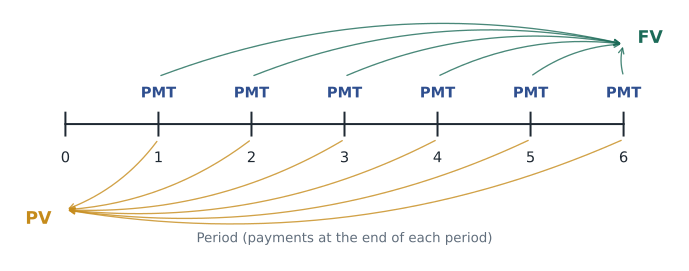
Future value of an ordinary annuity
The future value of an ordinary annuity is the sum of the future values of all the payments at the end of the term. The last payment earns no interest, the second-last earns one period of interest, and so on. Adding them up gives a geometric series with a neat closed form.
Worked problem
Saving in a 401(k)
A 40-year-old contributes $300 at the end of every month to a 401(k) that earns 6 % compounded monthly. How much will she have at 65? How much of it is growth?
Show solution
- i = 0.06 ÷ 12 = 0.005; n = 25 × 12 = 300.
- FV = $300 × (1.005^300 − 1) ÷ 0.005 = $300 × 692.9940 = $207,898.19.
- Total contributed = 300 × $300 = $90,000.
- Growth = $207,898.19 − $90,000 = $117,898.19.
Answer: She will have about $207,898, more than half of it from investment growth.
Annuities due
In an annuity due, every payment is made one period earlier than in the matching ordinary annuity, so every payment earns one extra period of interest. Both the future value and the present value of an annuity due equal the ordinary annuity value multiplied by (1 + i).
Worked problem
Contributing at the start of the month
If the saver in the previous example contributes at the start of each month instead, how much more does she have at 65?
Show solution
- FV due = $207,898.19 × 1.005 = $208,937.68.
- Difference = $1,039.49.
Answer: Paying at the start of each month adds about $1,039, one month of interest on the whole balance.
Present value of an ordinary annuity
The present value of an annuity is the single amount today that is equivalent to the whole series of payments. It is what a lender will advance in exchange for a series of loan payments, or what an investment that pays a fixed income is worth today.
Worked problem
The value of a stream of lease payments
A company leases equipment to a customer for $2,500 at the end of each month for 5 years. If the company could otherwise earn 7.2 % compounded monthly, what is the lease worth today?
Show solution
- i = 0.072 ÷ 12 = 0.006; n = 60.
- PV = $2,500 × (1 − 1.006^−60) ÷ 0.006 = $2,500 × 50.2621 = $125,655.33.
Answer: The lease is worth $125,655.33 today, although the payments total $150,000. The difference is the interest the company earns by waiting.
Finding the payment
Often the future or present value is known and the payment must be found. Rearrange either formula.
Worked problem
A sinking fund
A business wants to have $100,000 in 10 years to expand its premises. How much must it deposit at the end of each month in an account paying 5 % compounded monthly?
Show solution
- i = 0.05 ÷ 12 = 0.0041667; n = 120.
- PMT = $100,000 × 0.0041667 ÷ (1.0041667^120 − 1) = $100,000 × 0.0041667 ÷ 0.647009 = $643.99.
Answer: Monthly deposits of $643.99 will build the $100,000 fund. A fund built up in this way to pay a future obligation is called a sinking fund.
General annuities
When payments and compounding happen at different frequencies, first convert the rate to the equivalent periodic rate per payment interval, using the method from lesson 7. Then use the simple annuity formulas with that rate.
Worked problem
Quarterly payments, monthly compounding
A business deposits $1,500 at the end of every quarter for 8 years into an account paying 6 % compounded monthly. What is the account worth at the end?
Show solution
- i = 0.005 per month; c = 12 ÷ 4 = 3.
- Equivalent quarterly rate p = 1.005^3 − 1 = 0.0150751.
- n = 8 × 4 = 32 payments.
- FV = $1,500 × (1.0150751^32 − 1) ÷ 0.0150751 = $61,108.22.
Answer: The account grows to $61,108.22 from deposits totaling $48,000.
Most US mortgages and car loans are simple annuities, because payments are monthly and interest compounds monthly. General annuities appear when payment and compounding frequencies differ, as in Canadian mortgages and some bond calculations.
Finding the number of payments
When the payment, rate and present or future value are known, the number of payments is found with logarithms. The answer is rarely a whole number; the final payment is then smaller than the others.
Worked problem
How long will the money last?
A retiree has $500,000 invested at 4.5 % compounded monthly and withdraws $3,500 at the end of each month. How long will the money last?
Show solution
- i = 0.045 ÷ 12 = 0.00375.
- PV × i ÷ PMT = $500,000 × 0.00375 ÷ $3,500 = 0.535714.
- n = −ln(1 − 0.535714) ÷ ln(1.00375) = −ln(0.464286) ÷ 0.003743 = 204.98.
Answer: The money lasts about 205 months, or just over 17 years. If the withdrawal were less than the monthly interest of $1,875, the money would last forever.
Finding the interest rate of an annuity has no algebraic solution; it is done by trial and error or, in practice, with a financial calculator or the spreadsheet RATE function.
Perpetuities and deferred annuities
A perpetuity pays forever. Its present value is finite because distant payments are worth very little today. If the payment interval matches the compounding period, the present value is simply the payment divided by the periodic rate.
Worked problem
Endowing a scholarship
A company wants to fund a $5,000 scholarship every year forever, starting one year from now. If the fund earns 4 % compounded annually, how much must it donate?
Show solution
- PV = $5,000 ÷ 0.04 = $125,000.
Answer: A donation of $125,000 funds the scholarship forever, because the $5,000 paid out each year is exactly the interest earned.
A deferred annuity begins after a delay. Value it in two steps: find the present value of the annuity at the start of its term, then discount that amount back to today over the deferral period.
Worked problem
A deferred annuity
What must be invested today at 5 % compounded annually to provide 10 annual payments of $20,000, the first one 6 years from now?
Show solution
- The payments form an ordinary annuity whose term starts 5 years from now (one period before the first payment).
- Value 5 years from now: $20,000 × (1 − 1.05^−10) ÷ 0.05 = $154,434.70.
- Discount 5 years: $154,434.70 ÷ 1.05^5 = $121,003.63.
Answer: Investing $121,003.63 today provides the ten payments.
Comparing payment plans
Annuity values turn a choice between payment plans into a straightforward comparison: convert each plan to its present value at the rate the business can earn or must pay, and choose the plan with the lowest present cost. Totals of payments are misleading, because they ignore when the money is paid.
Worked problem
Cash price or a payment plan?
A printing company can buy a press for $48,000 cash, or pay $1,450 at the start of each month for 3 years. The company can borrow or invest at 7 % compounded monthly. Which option costs less?
Show solution
- The payment plan is an annuity due: i = 0.07 ÷ 12 = 0.0058333, n = 36.
- PV = $1,450 × (1 − 1.0058333^−36) ÷ 0.0058333 × 1.0058333 = $47,234.31.
- Cash price = $48,000. The plan is cheaper by $48,000 − $47,234.31 = $765.69 in present value.
- The payments total $52,200, which makes the plan look worse than it is.
Answer: The payment plan costs $765.69 less in present value terms, so it is the better choice at 7 %. At a lower rate the cash price could win, so the comparison must always use a realistic rate.
Spreadsheet functions
Spreadsheets have built-in functions for annuities: FV(rate, nper, pmt, [pv], [type]), PV(rate, nper, pmt, [fv], [type]), PMT(rate, nper, pv, [fv], [type]), NPER(rate, pmt, pv, [fv], [type]) and RATE(nper, pmt, pv, [fv], [type], [guess]). The rate is the periodic rate, nper is the number of payments, and type is 0 for an ordinary annuity and 1 for an annuity due. Money paid out is entered as a negative number and money received as positive, so =PMT(0.05/12, 120, 0, 100000) returns −643.99: a deposit of $643.99 each month.
# Annuity functions matching the spreadsheet conventions (end-of-period payments)
import math
def fv_annuity(pmt, i, n, due=False): return pmt * ((1 + i) ** n - 1) / i * ((1 + i) if due else 1)
def pv_annuity(pmt, i, n, due=False): return pmt * (1 - (1 + i) ** -n) / i * ((1 + i) if due else 1)
def pmt_for_fv(fv, i, n): return fv * i / ((1 + i) ** n - 1)
def nper(pv, pmt, i): return -math.log(1 - pv * i / pmt) / math.log(1 + i)

print(f"RRSP/401(k) at 65: {fv_annuity(300, .005, 300):,.2f}; due: {fv_annuity(300, .005, 300, True):,.2f}")
print(f"Lease value: {pv_annuity(2500, .006, 60):,.2f}")
print(f"Sinking fund deposit: {pmt_for_fv(100000, .05 / 12, 120):.2f}")
p = 1.005 ** 3 - 1
print(f"Quarterly deposits FV: {fv_annuity(1500, p, 32):,.2f}")
print(f"Months the retirement fund lasts: {nper(500000, 3500, .045 / 12):.1f}")RRSP/401(k) at 65: 207,898.19; due: 208,937.68 Lease value: 125,655.33 Sinking fund deposit: 643.99 Quarterly deposits FV: 61,108.22 Months the retirement fund lasts: 205.0
Common mistakes
MistakeTreating an annuity due as an ordinary annuity.
InsteadMultiply the ordinary annuity value by (1 + i) when payments are at the start of each period.
MistakeUsing the nominal rate divided by the payment frequency for a general annuity.
InsteadConvert to the equivalent rate per payment interval: (1 + i)^c − 1.
MistakeCounting payments as years.
Insteadn is the total number of payments: years × payments per year.
MistakeForgetting the deferral period when valuing a deferred annuity.
InsteadDiscount the annuity value back from the start of its term.
MistakeEntering all amounts as positive numbers in spreadsheet functions.
InsteadEnter money paid out as negative and money received as positive.
Summary and key terms
- An annuity is a series of equal payments at regular intervals.
- Ordinary annuities pay at the end of each period; annuities due at the start.
- FV = PMT[(1 + i)^n − 1] ÷ i; PV = PMT[1 − (1 + i)^(−n)] ÷ i.
- Annuity due values are ordinary values × (1 + i).
- General annuities use the equivalent rate per payment interval.
- Solve for n with logarithms and for i with RATE or trial and error.
- A perpetuity is worth PMT ÷ i; deferred annuities are discounted over the deferral period.
- Annuity
- A series of equal payments at regular intervals.
- Ordinary annuity
- An annuity with payments at the end of each period.
- Annuity due
- An annuity with payments at the start of each period.
- Simple annuity
- An annuity whose payment interval equals the compounding period.
- General annuity
- An annuity whose payment interval differs from the compounding period.
- Term
- The time from the start of the first payment interval to the end of the last.
- Sinking fund
- Regular deposits made to accumulate a future sum.
- Perpetuity
- An annuity that continues forever.
- Deferred annuity
- An annuity whose payments begin after a delay.
- Deferral period
- The time before an annuity's term begins.
Practice problems
Work each problem on paper first, then reveal the answer to check.
$200 is deposited at the end of each month for 10 years at 6 % compounded monthly. What is the future value?
Show answer
$32,775.87.
What is the present value of $1,000 at the end of each year for 8 years at 5 %?
Show answer
$6,463.21.
What is the future value of $500 at the start of each quarter for 5 years at 8 % compounded quarterly?
Show answer
$12,391.66.
What monthly deposit builds $50,000 in 6 years at 4.2 % compounded monthly?
Show answer
About $611.82.
What monthly payment repays a $25,000 loan over 5 years at 6 % compounded monthly?
Show answer
$483.32.
What is the equivalent monthly rate for 6 % compounded quarterly?
Show answer
About 0.49752 %.
A perpetuity pays $1,200 a year at 6 % compounded annually. What is its present value?
Show answer
$20,000.
How many monthly payments of $400 repay $15,000 at 7.2 % compounded monthly?
Show answer
About 42.6, so 42 full payments and a smaller 43rd.
Payments of $1,000 at the end of every year for 5 years, starting 4 years from now, at 5 %. What is the present value?
Show answer
About $3,739.96.
Why is an annuity due worth more than an ordinary annuity with the same payments?
Show answer
Each payment is made one period sooner.
Lesson quiz · 5 questions
Score 60% or more to complete this lesson.
Create a free account to save your progress, take quizzes and earn a certificate.