
BUS-110 · Lesson 3 of 12 · 32 min
Payroll: from gross to net pay
Payroll is the business calculation that most people meet first: the check or deposit that arrives every pay period. For an employer, payroll is also one of the largest costs and one of the most regulated. Amounts must be withheld correctly, sent to the government on time and reported at year end, and mistakes bring penalties and interest. This lesson works through the arithmetic of a pay period, from the hours or salary that make up gross pay to the deductions that leave net pay, and then looks at what the employer pays on top.
Payroll rules in the United States come from three levels: federal law for Social Security, Medicare and federal income tax withholding, plus the Fair Labor Standards Act (FLSA) for minimum wage and overtime; state law for state income tax, state unemployment insurance and often a higher minimum wage; and sometimes city or county law for local income taxes. The figures in this lesson are the 2026 rates at the time of writing (October 2026). They change every January, so always check the current IRS Publication 15 and 15-T and your state's tables before running a real payroll.
Gross pay
Gross pay is what an employee earns before anything is taken off. It is calculated in one of several ways, depending on how the employee is paid.
| Pay basis | How gross pay is calculated | Example |
|---|---|---|
| Annual salary | Salary ÷ number of pay periods in the year | $62,400 ÷ 26 = $2,400 every two weeks |
| Hourly wage | Regular hours × rate, plus overtime hours × overtime rate | 40 h × $22.50 = $900 |
| Piecework | Units produced × rate per unit | 1,250 units × $0.84 = $1,050 |
| Commission | Sales × commission rate, sometimes with a base salary or draw | $40,000 × 3 % = $1,200 |
| Combination | Base salary plus commission or bonus | $1,500 + 2 % of $60,000 = $2,700 |
The number of pay periods matters. Weekly pay gives 52 periods a year, biweekly (every two weeks) gives 26, semi-monthly (twice a month) gives 24 and monthly gives 12. Biweekly and semi-monthly are easy to confuse: a biweekly payroll occasionally has 27 pay dates in a calendar year, while semi-monthly always has exactly 24. To convert an hourly wage to an annual equivalent, a common assumption is 2,080 hours (40 hours × 52 weeks).
Worked problem
Converting between pay bases
An employee earns $58,500 a year. What is her gross pay on a weekly, biweekly, semi-monthly and monthly schedule? What is the equivalent hourly rate, assuming 37.5 hours a week?
Show solution
- Weekly: $58,500 ÷ 52 = $1,125.00.
- Biweekly: $58,500 ÷ 26 = $2,250.00.
- Semi-monthly: $58,500 ÷ 24 = $2,437.50.
- Monthly: $58,500 ÷ 12 = $4,875.00.
- Hours a year = 37.5 × 52 = 1,950; hourly rate = $58,500 ÷ 1,950 = $30.00.
Answer: Her gross pay is $1,125.00 weekly, $2,250.00 biweekly, $2,437.50 semi-monthly or $4,875.00 monthly, equivalent to $30.00 an hour.
Overtime
In the United States, the Fair Labor Standards Act requires overtime of at least one and a half times the regular rate for hours over 40 in a workweek for non-exempt employees. Some states go further: California, for example, requires overtime after 8 hours in a day and double time after 12 hours in a day. Salaried employees can be exempt from overtime if they meet the duties tests and earn above a salary threshold; the thresholds have been the subject of rule changes and court decisions, so check the current federal and state levels. When federal and state rules differ, the rule that is better for the employee applies.
Worked problem
Overtime pay
A non-exempt warehouse worker in Texas earns $22.50 an hour and works 48 hours in one week. Federal law requires overtime at 1.5 times the regular rate after 40 hours. What is his gross pay for the week?
Show solution
- Regular hours = 40; regular pay = 40 × $22.50 = $900.00.
- Overtime hours = 48 − 40 = 8; overtime rate = 1.5 × $22.50 = $33.75.
- Overtime pay = 8 × $33.75 = $270.00.
- Gross pay = $900.00 + $270.00 = $1,170.00.
Answer: His gross pay is $1,170.00. In a state with a daily overtime rule, such as California, the answer could be higher if some days ran over 8 hours.
Statutory deductions
US employers must withhold federal income tax and FICA taxes (Social Security and Medicare) from most employees' pay, together with state income tax in the states that have one and local income tax in the cities and counties that levy it. A few states also require employee contributions to state disability or paid family leave programs.
| Deduction (2026) | Employee rate | Applies to | Annual employee maximum |
|---|---|---|---|
| Social Security (OASDI) | 6.2 % | Wages up to the wage base of $184,500 | $11,439.00 |
| Medicare | 1.45 % | All wages | No maximum |
| Additional Medicare | 0.9 % | Wages above $200,000 (withholding threshold) | No maximum |
| Federal income tax | 10 % to 37 % | Taxable income, based on Form W-4 | No maximum |
| State and local income tax | Varies; none in some states | As set by the state or city | Varies |
Social Security is withheld at 6.2 % of every dollar of wages until the employee's year-to-date wages reach the wage base of $184,500; after that, Social Security withholding stops for the year. Medicare has no ceiling, and an extra 0.9 % is withheld on wages above $200,000. Higher earners therefore see their take-home pay rise late in the year once the wage base is passed.
Income tax withholding
Federal income tax is progressive: each rate applies only to the slice of taxable income within its bracket. For 2026, the rates for a single filer are 10 % on taxable income up to $12,400, 12 % up to $50,400, 22 % up to $105,700, 24 % up to $201,775, 32 % up to $256,225, 35 % up to $640,600 and 37 % above that. The standard deduction for a single filer is $16,100. Employers calculate withholding from the employee's Form W-4 using the wage bracket or percentage method tables in IRS Publication 15-T.
A useful approximation of the IRS method is to annualize: multiply the period's gross by the number of periods, subtract the standard deduction, apply the brackets and divide back by the number of periods. The official percentage method uses adjusted annual wages and slightly different table figures, so actual withholding will differ by a few dollars, but the approximation shows how withholding is built.
Worked problem
A complete pay period
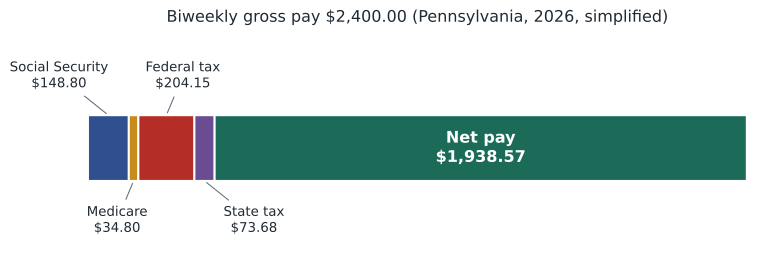
Priya works in Pennsylvania and earns a salary of $62,400 a year, paid biweekly. She files as single with a standard Form W-4 and has no other deductions. Using the simplified annualization method and 2026 rates, find her Social Security, Medicare, federal income tax, state tax and net pay for one period. Pennsylvania taxes wages at a flat 3.07 %.
Show solution
- Gross pay = $62,400 ÷ 26 = $2,400.00.
- Social Security = 6.2 % × $2,400.00 = $148.80.
- Medicare = 1.45 % × $2,400.00 = $34.80.
- Federal income tax: taxable income ≈ $62,400 − $16,100 = $46,300. Tax = 10 % × $12,400 = $1,240, plus 12 % × ($46,300 − $12,400) = $4,068, total $5,308 a year, or $5,308 ÷ 26 = $204.15 a period.
- Pennsylvania tax = 3.07 % × $2,400.00 = $73.68.
- Net pay = $2,400.00 − $148.80 − $34.80 − $204.15 − $73.68 = $1,938.57.
Answer: Priya takes home about $1,938.57 each pay period, about 81 % of her gross pay. Many Pennsylvania municipalities also levy a local earned income tax, which would reduce this further.
# Simplified biweekly payroll, 2026 rates (illustration only)
def brackets(income, table):
    tax, lower = 0.0, 0.0
    for upper, rate in table:
        if income > lower:
            tax += (min(income, upper) - lower) * rate
        lower = upper
    return tax

gross, periods = 2400.00, 26
annual = gross * periods
# Canada (Ontario)
cpp = round((gross - 3500 / periods) * 0.0595, 2)
ei = round(gross * 0.0163, 2)
fed = brackets(annual, [(58523, .14), (117045, .205), (181440, .26), (258482, .29), (1e12, .33)]) - .14 * 16452
on = brackets(annual, [(53891, .0505), (1e12, .0915)]) - .0505 * 12989 + 750
ca = [cpp, ei, round(fed / periods, 2), round(on / periods, 2)]
print("Canada (ON):", ca, "net", round(gross - sum(ca), 2))
# United States (Pennsylvania)
fit = brackets(annual - 16100, [(12400, .10), (50400, .12), (105700, .22), (1e12, .24)])
us = [round(gross * .062, 2), round(gross * .0145, 2), round(fit / periods, 2), round(gross * .0307, 2)]
print("US (PA):", us, "net", round(gross - sum(us), 2))Canada (ON): [134.79, 39.12, 257.1, 138.24] net 1830.75 US (PA): [148.8, 34.8, 204.15, 73.68] net 1938.57
Other deductions
Beyond the statutory deductions, an employee's pay may carry voluntary or contractual deductions. Some reduce taxable income, because they are taken before tax is calculated; others are taken after tax.
| Deduction | Before or after tax | Notes |
|---|---|---|
| Traditional 401(k) or 403(b) contributions | Before income tax | Still subject to Social Security and Medicare |
| Health, dental and vision premiums under a cafeteria plan | Before tax | Usually exempt from income tax and FICA |
| Health savings account (HSA) contributions | Before tax through payroll | Requires a high-deductible health plan |
| Roth 401(k) contributions | After tax | Qualified withdrawals are tax-free later |
| Union dues | After tax | Not deductible on the federal return for most employees |
| Wage garnishments | After tax | Required by a court order or government levy |
Worked problem
A pre-tax deduction
Suppose Priya also contributes 5 % of her gross pay to a traditional 401(k). How much does that reduce her federal and state tax each period, and what does the contribution really cost her? (Pennsylvania does not exclude 401(k) contributions from state wages.)
Show solution
- Contribution = 5 % × $2,400 = $120.00 a period, or $3,120 a year.
- Federal taxable income falls by $3,120, all of which is in the 12 % bracket, saving 12 % × $3,120 = $374.40 a year, or $14.40 a period.
- Social Security, Medicare and Pennsylvania tax are unchanged, because the contribution does not reduce those wages.
- Real cost of the contribution = $120.00 − $14.40 = $105.60 a period.
Answer: A $120 401(k) contribution reduces her take-home pay by only about $106, because federal withholding falls.
The employer's cost
The cost of an employee is more than gross pay. US employers match the employee's Social Security and Medicare taxes (the employer does not match the Additional Medicare Tax), pay federal unemployment tax (FUTA) of 6.0 % on the first $7,000 of each employee's wages, usually reduced to 0.6 % by a credit for state unemployment taxes, and pay state unemployment insurance (SUTA) at a rate based on their layoff history. Workers' compensation insurance is required in almost every state. On top of these come benefits such as health insurance, which for many employers is the largest addition.
Worked problem
The employer's payroll cost
For Priya's biweekly pay of $2,400, what does her employer pay in FICA taxes, and what is the total cost of the period before unemployment taxes and benefits?
Show solution
- Employer Social Security = 6.2 % × $2,400 = $148.80.
- Employer Medicare = 1.45 % × $2,400 = $34.80.
- Total cost = $2,400.00 + $148.80 + $34.80 = $2,583.60.
- As a percentage of gross: $183.60 ÷ $2,400 = 7.65 %.
Answer: The employer pays $2,583.60 for the period before unemployment taxes, workers' compensation and benefits. A common budgeting rule of thumb is that the full cost of an employee runs 20 % to 40 % above salary, mostly because of health insurance.
Remitting and reporting
Withheld amounts are held in trust for the government. Employers deposit federal income tax, Social Security and Medicare, together with their own share, on a monthly or semi-weekly schedule set by the IRS, and report them quarterly on Form 941. At year end the employer issues each employee a Form W-2 and files copies with the Social Security Administration. Independent contractors are not on payroll; payments to them of $2,000 or more in 2026 are reported on Form 1099-NEC. Responsible persons can be held personally liable for unpaid trust fund taxes.
Common mistakes
MistakeCalculating overtime on total hours rather than only the hours above the threshold.
InsteadPay the regular rate for regular hours and the overtime rate only for hours over the limit.
MistakeForgetting that Social Security stops at the wage base.
InsteadStop withholding 6.2 % once year-to-date wages reach $184,500.
MistakeApplying the top tax rate to all income.
InsteadEach rate applies only to the income within its bracket.
MistakeTreating gross pay as the cost of an employee.
InsteadAdd employer payroll taxes, insurance, vacation pay and benefits.
MistakeAssuming a pre-tax contribution reduces take-home pay by its full amount.
InsteadTake-home pay falls by the contribution minus the tax saved.
Summary and key terms
- Gross pay is earnings before deductions; net pay is what the employee receives.
- Count pay periods carefully: 52, 26, 24 or 12 a year.
- Overtime rules depend on where the employee works.
- Social Security, Medicare and income taxes are the main US payroll deductions.
- Income tax is progressive, applied bracket by bracket.
- Pre-tax deductions cost less than their face value.
- Employers pay their own payroll taxes on top of gross pay.
- Gross pay
- Earnings before any deductions.
- Net pay
- Gross pay minus all deductions; take-home pay.
- Pay period
- The interval covered by one pay check or deposit.
- Overtime
- Hours worked beyond the legal threshold, paid at a premium rate.
- Statutory deduction
- A deduction required by law.
- Marginal tax rate
- The rate applied to the next dollar of income.
- Annualization
- Converting a period amount to a yearly figure to apply annual brackets.
- Pre-tax deduction
- A deduction taken before income tax is calculated.
- Remittance
- Payment of withheld amounts to the government.
- Employer contribution
- A payroll tax or premium paid by the employer on top of wages.
Practice problems
Work each problem on paper first, then reveal the answer to check.
An employee earns $49,400 a year paid semi-monthly. What is the gross pay per period?
Show answer
$2,058.33.
An hourly worker earns $19.80 and works 46 hours in a week with a 40-hour threshold. What is gross pay?
Show answer
$970.20.
A salesperson earns $1,200 a month plus 2.5 % commission on sales of $72,000. What is gross pay?
Show answer
$3,000.
What is the Social Security deduction on weekly gross pay of $1,000?
Show answer
$62.00.
What is the Medicare deduction on biweekly gross pay of $1,850?
Show answer
$26.83.
Using the 2026 single brackets, what is federal tax on taxable income of $60,000?
Show answer
$1,240 + $4,560 + 22 % × $9,600 = $7,912.
A worker in a 30 % combined bracket puts $200 into a pre-tax plan. How much does take-home pay fall?
Show answer
$140.
What does an employer pay in FICA on wages of $1,500?
Show answer
$114.75.
Why might take-home pay rise in November for a high earner?
Show answer
Some contributions stop once their annual maximum or wage base is reached.
How many pay dates are there in a semi-monthly payroll?
Show answer
24 a year.
Lesson quiz · 5 questions
Score 60% or more to complete this lesson.
Create a free account to save your progress, take quizzes and earn a certificate.