
BUS-110 · Lesson 5 of 12 · 35 min
Markup, markdown and pricing
Every business that sells goods has to decide what to charge. The price has to cover what the goods cost, contribute to the costs of running the business, and leave a profit, while still being a price customers will pay. Retailers, wholesalers and manufacturers express these decisions through markup, the amount added to cost to reach a selling price, and markdown, the reduction from a regular price to a sale price. This lesson develops the arithmetic of both, shows why the same markup can be quoted as two different percentages, and works through a full buying and selling cycle.
The pricing equation
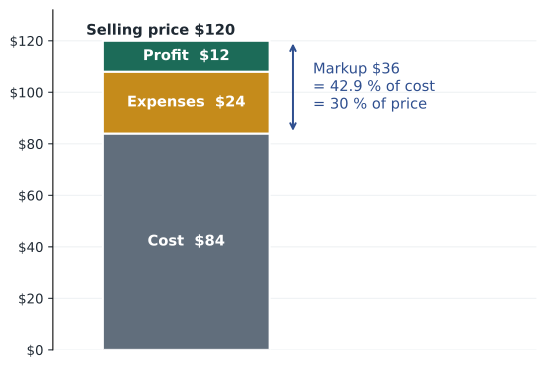
The selling price of an item can be split into three parts: the cost of the item to the seller, a share of the seller's operating expenses (rent, wages, utilities, advertising and so on, sometimes called overhead), and the operating profit.
Here S is the selling price, C the cost, E the operating expenses per unit, P the operating profit per unit and M the markup (also called gross profit or the dollar markup). The markup must cover expenses before any profit is made. A sale at a price above cost but below cost plus expenses still loses money.
Markup on cost and markup on selling price
A dollar markup can be expressed as a percentage of two different bases. Markup on cost uses cost as the base; markup on selling price, which is the same as the gross margin, uses the selling price as the base. Manufacturers and many small businesses think in terms of markup on cost; retailers and accountants usually think in terms of margin on selling price, because financial statements express everything as a percentage of sales.
Because cost is always smaller than selling price, the markup on cost is always the larger of the two percentages. When someone quotes a markup percentage, always ask which base they mean. The two convert into each other with simple formulas, where \( m_c \) is the markup on cost and \( m_s \) the markup on selling price, both as decimals.
| Markup on cost | Markup on selling price (margin) | Selling price of an item costing $100 |
|---|---|---|
| 20 % | 16.7 % | $120.00 |
| 25 % | 20.0 % | $125.00 |
| 33.3 % | 25.0 % | $133.33 |
| 50 % | 33.3 % | $150.00 |
| 60 % | 37.5 % | $160.00 |
| 66.7 % | 40.0 % | $166.67 |
| 100 % | 50.0 % | $200.00 |
| 150 % | 60.0 % | $250.00 |
Worked problem
Pricing from expenses and target profit
A hardware store buys a cordless drill for $84. Its operating expenses average 20 % of selling price, and it aims for an operating profit of 10 % of selling price. What should the selling price be? Express the markup both ways.
Show solution
- S = C + E + P = $84 + 0.20S + 0.10S.
- S − 0.30S = $84, so 0.70S = $84 and S = $120.00.
- Markup M = $120 − $84 = $36. Expenses E = 0.20 × $120 = $24; profit P = 0.10 × $120 = $12.
- Markup on cost = $36 ÷ $84 = 42.86 %. Markup on selling price = $36 ÷ $120 = 30 %.
Answer: The drill should sell for $120.00, a markup of 42.86 % on cost or 30 % on selling price.
Worked problem
Pricing to a target margin
A gift shop buys candles for $27 each and wants a gross margin of 40 % on selling price. What price should it charge? What markup on cost is that?
Show solution
- If the margin is 40 % of S, then cost is 60 % of S: C = 0.60S.
- S = $27 ÷ 0.60 = $45.00.
- Markup on cost = $18 ÷ $27 = 66.7 %, which matches 0.40 ÷ 0.60.
- A common error is to add 40 % to cost: $27 × 1.40 = $37.80, which gives a margin of only 28.6 %.
Answer: The candles should sell for $45.00, a 66.7 % markup on cost.
Worked problem
Working back from a market price
Competing stores sell a pair of headphones for $49.99. A retailer needs a gross margin of 35 % to cover its expenses and profit target. What is the most it can pay for the headphones?
Show solution
- Cost must be 65 % of the selling price: C = 0.65 × $49.99.
- Maximum cost = $32.49.
Answer: The retailer can pay at most $32.49 a pair. If the supplier wants more, it must accept a lower margin, find a cheaper supplier or not stock the product. Working back from the market price in this way is called target costing or retail-minus pricing.
Markdowns
A markdown is a reduction from the regular selling price. Stores mark goods down to clear seasonal stock, to meet competitors, to move damaged or slow-selling goods, or as promotions to bring customers in. The markdown rate is always based on the regular selling price.
A markdown hits profit hard, because the full reduction comes out of the markup. The item still cost the same, and the expenses of running the store do not shrink because a price was cut. A useful benchmark is the break-even price, the price at which the sale covers cost and expenses exactly, with no profit or loss.
Worked problem
The effect of a markdown on profit
The drill from the earlier example (cost $84, expenses $24, regular price $120) is marked down 25 % in a clearance sale. What is the sale price and the operating profit or loss? What is the largest markdown that avoids a loss?
Show solution
- Sale price = $120 × 0.75 = $90.00.
- Operating profit = $90 − $84 − $24 = −$18, a loss of $18.
- Break-even price = $84 + $24 = $108.
- Maximum markdown = ($120 − $108) ÷ $120 = 10 %.
Answer: At $90 the store loses $18 on each drill. Any markdown above 10 % produces an operating loss, even though the sale price is still above cost.
Successive markdowns work like chain discounts: multiply the complements. A coat marked down 20 % and then a further 15 % is selling at 0.80 × 0.85 = 0.68 of its regular price, a total markdown of 32 %, not 35 %.
Worked problem
Successive markdowns
A winter coat regularly priced at $250 is marked down 20 % in January and a further 15 % off the sale price in February. What is the February price and the total markdown?
Show solution
- January price = $250 × 0.80 = $200.00.
- February price = $200 × 0.85 = $170.00.
- Total markdown = ($250 − $170) ÷ $250 = 32 %.
Answer: The coat sells for $170.00 in February, a total markdown of 32 %.
A complete buying and selling cycle
Real products rarely all sell at one price. Some sell at the regular price, some at a markdown, and the last few may be cleared at or below cost. The margin a business actually earns, the realized margin, is therefore lower than the margin built into the regular price. Buyers plan for this by setting an initial markup high enough to absorb expected markdowns.
Worked problem
Realized margin on a seasonal product
A clothing store buys 200 rain jackets at $70 each and marks them up 60 % on cost. It sells 120 at the regular price, 60 at a 25 % markdown, and the last 20 at cost. What is the regular price, the total revenue, the gross profit and the realized gross margin?
Show solution
- Regular price = $70 × 1.60 = $112.00 (a 37.5 % margin on selling price).
- Markdown price = $112 × 0.75 = $84.00.
- Revenue = 120 × $112 + 60 × $84 + 20 × $70 = $13,440 + $5,040 + $1,400 = $19,880.
- Total cost = 200 × $70 = $14,000. Gross profit = $19,880 − $14,000 = $5,880.
- Realized margin = $5,880 ÷ $19,880 = 29.6 %. Average selling price = $19,880 ÷ 200 = $99.40.
Answer: Although the jackets were priced at a 37.5 % margin, the store realized only 29.6 % once markdowns are included.
The calculation can be reversed to set the initial markup. If a buyer expects to sell 60 % of a line at the regular price and the rest at an average of 30 % off, and needs a realized margin of 35 %, the regular price must be high enough that the blended revenue still leaves 35 %. Spreadsheet models of this kind, sometimes called open-to-buy plans, are a core tool for retail buyers.
Pricing in practice
The arithmetic gives a starting price, but pricing decisions also depend on customers and competitors. Cost-plus pricing (cost plus a standard markup) is simple and common in wholesale and contracting. Competitive pricing matches or undercuts rivals. Value-based pricing sets a price by what customers believe the product is worth, which can be far above cost for a strong brand or a specialized service. Psychological pricing uses prices ending in 99 or 95, which shoppers tend to read as noticeably cheaper than the next round number. Price elasticity, the sensitivity of the quantity sold to the price, decides whether a price cut raises or lowers total revenue; lesson 11 returns to this with break-even analysis.
Worked problem
Is a promotion worth it?
A café sells 400 specialty lattes a week at $6.00. Each costs $1.80 in ingredients and cups. The owner considers a 20 % off promotion. How many lattes must she sell at the promotional price to earn the same gross profit as before?
Show solution
- Current gross profit per latte = $6.00 − $1.80 = $4.20; weekly gross profit = 400 × $4.20 = $1,680.
- Promotional price = $6.00 × 0.80 = $4.80; gross profit per latte = $4.80 − $1.80 = $3.00.
- Lattes needed = $1,680 ÷ $3.00 = 560.
Answer: She needs to sell 560 lattes, 40 % more than now, just to stand still. A 20 % price cut needs a 40 % rise in volume here, because it removes almost half of the gross profit on each cup.
# Markup conversions and a markdown check
def margin_from_cost(mc): return mc / (1 + mc)
def cost_from_margin(ms): return ms / (1 - ms)
for mc in (0.25, 0.50, 0.60, 1.00):
    print(f"markup on cost {mc:.0%} = margin {margin_from_cost(mc):.1%}")
C, e_rate, p_rate = 84, 0.20, 0.10
S = C / (1 - e_rate - p_rate)
E = e_rate * S
print(f"price {S:.2f}, break-even {C + E:.2f}, max markdown {(S - C - E) / S:.0%}")
units = [(120, 112.00), (60, 84.00), (20, 70.00)]
revenue = sum(n * p for n, p in units)
print(f"revenue {revenue:,.0f}, realized margin {(revenue - 200 * 70) / revenue:.1%}")markup on cost 25% = margin 20.0% markup on cost 50% = margin 33.3% markup on cost 60% = margin 37.5% markup on cost 100% = margin 50.0% price 120.00, break-even 108.00, max markdown 10% revenue 19,880, realized margin 29.6%
Common mistakes
MistakeAdding the target margin percentage to cost.
InsteadDivide cost by (1 − margin): $27 ÷ 0.60 = $45.
MistakeQuoting a markup without saying whether it is on cost or on selling price.
InsteadState the base; 50 % on cost is only 33.3 % on selling price.
MistakeAssuming any sale above cost is profitable.
InsteadThe price must also cover operating expenses; compare with C + E.
MistakeAdding successive markdowns.
InsteadMultiply the complements: 20 % then 15 % is 32 % in total.
MistakeJudging a product by its planned margin.
InsteadCheck the realized margin after markdowns and clearance.
Summary and key terms
- S = C + E + P, and the markup M = E + P.
- Markup on cost uses cost as the base; markup on selling price (margin) uses the selling price.
- Convert with m_s = m_c ÷ (1 + m_c) and m_c = m_s ÷ (1 − m_s).
- Markdowns are based on the regular selling price and come straight out of profit.
- The break-even price is C + E.
- Realized margins are lower than planned margins when goods are marked down.
- Price cuts need large volume increases to keep gross profit level.
- Markup
- The difference between selling price and cost.
- Markup on cost
- Markup as a percentage of cost.
- Gross margin
- Markup as a percentage of selling price.
- Operating expenses
- The costs of running the business, other than the cost of goods.
- Operating profit
- Selling price minus cost and operating expenses.
- Markdown
- A reduction from the regular selling price.
- Break-even price
- The price that just covers cost and operating expenses.
- Realized margin
- The margin actually earned after markdowns.
- Target costing
- Working back from a market price to the highest acceptable cost.
- Price elasticity
- How strongly the quantity sold responds to a change in price.
Practice problems
Work each problem on paper first, then reveal the answer to check.
An item costs $45 and sells for $72. What is the markup on cost and on selling price?
Show answer
60 % on cost; 37.5 % on selling price.
A 35 % margin on selling price equals what markup on cost?
Show answer
About 53.8 %.
A 75 % markup on cost equals what margin?
Show answer
About 42.9 %.
An item costs $52. What price gives a 20 % margin?
Show answer
$65.
Cost $30, expenses 25 % of S, profit 15 % of S. What is S?
Show answer
$50.
A $160 item is marked down 35 %. What is the sale price?
Show answer
$104.
Cost $66, expenses $18, regular price $105. What is the maximum markdown before a loss?
Show answer
20 %.
Markdowns of 30 % and then 10 %. What is the total markdown?
Show answer
37 %.
A retailer needs a 45 % margin on a product that sells for $39.99. What is the maximum cost?
Show answer
About $21.99.
Gross profit per unit falls from $5 to $4. By what percentage must volume rise to keep gross profit the same?
Show answer
25 %.
Lesson quiz · 5 questions
Score 60% or more to complete this lesson.
Create a free account to save your progress, take quizzes and earn a certificate.