
BUS-110 · Lesson 2 of 12 · 38 min
Percentages and percentage change
Percentages are the language of business. Sales grew 8 %, the margin is 32 %, the tax rate is 13 %, the bank charges 7.2 % interest, inflation is running at 2.4 %, and the market share fell by two percentage points. Each of those statements hides a calculation, and each can mislead if the reader does not know what the percentage is a percentage of. This lesson builds the basic percentage toolkit and then applies it to change, growth, shares and the traps that catch even experienced managers.
The three percentage questions
Every basic percentage problem links three quantities: the base (the whole you are taking a percentage of), the rate (the percentage, written as a decimal in calculations) and the portion (the part). If you know any two, you can find the third.
The hardest part is usually identifying the base. In the statement 'returns were 4 % of sales', sales are the base. In 'the sale price is 25 % off the regular price', the regular price is the base. In 'this year's sales are 12 % above last year's', last year's sales are the base. A good habit is to read the sentence and ask: percentage of what?
Worked problem
The three questions in one store
A clothing store sold $184,000 of merchandise in March. (a) Returns were 4.5 % of sales; how much was returned? (b) Online orders were $46,000; what percentage of sales was online? (c) Gift card sales of $9,200 were 5 % of a target; what was the target?
Show solution
- (a) Portion = rate × base = 0.045 × $184,000 = $8,280.
- (b) Rate = portion ÷ base = $46,000 ÷ $184,000 = 0.25, or 25 %.
- (c) Base = portion ÷ rate = $9,200 ÷ 0.05 = $184,000.
Answer: Returns were $8,280, online orders were 25 % of sales, and the gift card target was $184,000.
Percentage change
Percentage change measures how much a quantity has grown or shrunk relative to where it started. The old value is always the base.
A positive result is an increase and a negative result is a decrease. To find a new value after a known percentage change, multiply the old value by one plus the rate (for an increase) or one minus the rate (for a decrease). To recover an old value from a new one, divide instead.
Worked problem
Sales growth and decline
A software firm's quarterly revenue went from $2.40 million to $2.76 million, then fell to $2.53 million the next quarter. Calculate both percentage changes.
Show solution
- First change = ($2.76M − $2.40M) ÷ $2.40M = $0.36M ÷ $2.40M = 0.15, an increase of 15 %.
- Second change = ($2.53M − $2.76M) ÷ $2.76M = −$0.23M ÷ $2.76M = −0.0833, a decrease of about 8.3 %.
- Overall change from $2.40M to $2.53M = $0.13M ÷ $2.40M = 0.0542, an increase of about 5.4 %.
Answer: Revenue grew 15 %, then fell about 8.3 %, for an overall gain of about 5.4 %. The two changes do not add up to the overall change, because each uses a different base.
The up-and-down trap
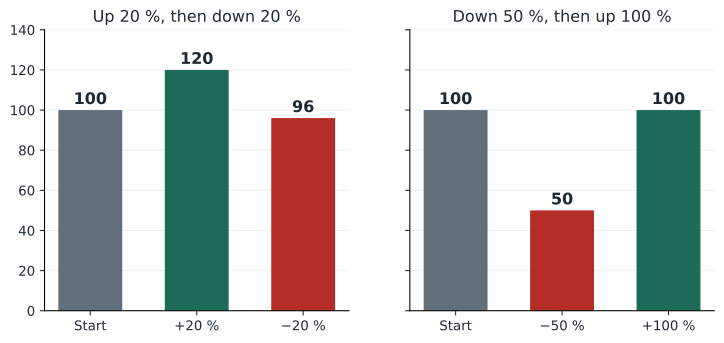
A 20 % increase followed by a 20 % decrease does not return to the starting point. If a price of $100 rises 20 % to $120 and then falls 20 %, the fall is 20 % of $120, or $24, leaving $96. The second percentage applies to a larger base. The same asymmetry explains why an investment that falls 50 % must then rise 100 % just to break even.
Worked problem
Recovering from a loss
A company's share price fell 30 % in a year. What percentage gain is needed to get back to the original price? What if the fall had been 60 %?
Show solution
- After a 30 % fall, the price is 70 % of the original. To return to 100 %, it must rise by 30 ÷ 70 = 0.4286, or about 42.9 %.
- After a 60 % fall, the price is 40 % of the original. The gain needed is 60 ÷ 40 = 1.5, or 150 %.
Answer: A 30 % loss needs a 42.9 % gain to recover; a 60 % loss needs a 150 % gain. Large losses are very hard to make back.
Successive percentage changes
When several percentage changes happen one after another, multiply the factors rather than adding the percentages. A 10 % increase followed by a 5 % increase gives a factor of 1.10 × 1.05 = 1.155, a total increase of 15.5 %, not 15 %. This is the seed of compound interest, which lesson 7 develops in detail.
Worked problem
Three years of price increases
A supplier raised prices 4 % in year one, 6 % in year two and 3 % in year three. An item cost $250 before the first increase. What does it cost now, and what is the total percentage increase?
Show solution
- Combined factor = 1.04 × 1.06 × 1.03 = 1.135472.
- New price = $250 × 1.135472 = $283.87.
- Total increase = 13.5472 %, about 13.5 %, compared with 4 + 6 + 3 = 13 % if the percentages were simply added.
Answer: The item now costs $283.87, a total increase of about 13.5 %.
The average growth rate over several periods is not the simple average of the rates. It is the rate that, applied every period, gives the same overall factor. For the three increases above, the average annual increase is \( 1.135472^{1/3} - 1 \approx 0.0433 \), or about 4.33 % a year. This is called the compound annual growth rate, or CAGR.
Worked problem
Compound annual growth rate
A small business had sales of $480,000 in 2021 and $702,000 in 2026. What was its compound annual growth rate?
Show solution
- Number of years n = 2026 − 2021 = 5.
- Growth factor = $702,000 ÷ $480,000 = 1.4625.
- CAGR = 1.4625^(1/5) − 1 = 1.0790 − 1 = 0.0790, about 7.9 % a year.
- Check: $480,000 × 1.079^5 ≈ $702,000.
Answer: Sales grew at a compound rate of about 7.9 % a year, even though the total growth over five years was 46.25 %.
Percentage points versus percent
When a percentage itself changes, there are two ways to describe the change. If a loan rate rises from 5 % to 6 %, it has risen by one percentage point, but by 20 % in relative terms (1 ÷ 5). Mixing the two up is a common error in news reports and business presentations. Market share, interest rates, margins and unemployment rates should be compared in percentage points; a relative change can be added when it helps.
Worked problem
Describing a change in market share
A grocery chain's market share rose from 12 % to 15 %. Describe the change correctly.
Show solution
- Change in percentage points = 15 − 12 = 3 percentage points.
- Relative change = 3 ÷ 12 = 0.25, an increase of 25 %.
Answer: Market share rose by 3 percentage points, which is a 25 % relative increase. Saying it rose by 3 % would be wrong.
Percentages of a total and weighted percentages
Shares of a total must add to 100 %. When categories are combined, their percentages should be weighted by size rather than simply averaged. A company with a 40 % margin on a small product line and a 10 % margin on a large one does not have an average margin of 25 %.
Worked problem
Weighted margin across product lines
A hardware store has two product lines. Tools bring in $300,000 of sales at a 40 % gross margin; lumber brings in $900,000 at a 10 % margin. What is the store's overall gross margin?
Show solution
- Gross profit on tools = 0.40 × $300,000 = $120,000.
- Gross profit on lumber = 0.10 × $900,000 = $90,000.
- Total gross profit = $210,000 on total sales of $1,200,000.
- Overall margin = $210,000 ÷ $1,200,000 = 0.175, or 17.5 %.
Answer: The overall margin is 17.5 %, not the 25 % simple average, because lumber makes up three quarters of sales.
Percentages in everyday business documents
| Context | Base | Typical statement |
|---|---|---|
| Gross margin | Sales revenue | Gross profit was 38 % of sales |
| Markup | Cost (or sometimes selling price) | We mark up 60 % on cost |
| Commission | Sales made by the salesperson | Commission is 5 % of sales |
| Interest rate | Principal borrowed or invested | The loan costs 7.5 % a year |
| Sales tax | Taxable selling price | Tax is added at the applicable rate |
| Turnover | Average number of employees | Annual staff turnover was 18 % |
| Budget variance | Budgeted amount | Travel was 12 % over budget |
Worked problem
Commission with a tiered rate
A sales representative earns 4 % commission on the first $50,000 of monthly sales and 6 % on sales above $50,000. In June she sold $82,500. What is her commission, and what effective percentage of sales is it?
Show solution
- Commission on the first tier = 0.04 × $50,000 = $2,000.
- Sales in the second tier = $82,500 − $50,000 = $32,500; commission = 0.06 × $32,500 = $1,950.
- Total commission = $2,000 + $1,950 = $3,950.
- Effective rate = $3,950 ÷ $82,500 = 0.0479, about 4.79 %.
Answer: Her commission is $3,950, an effective 4.79 % of sales. Tiered plans reward sales above a threshold without paying the higher rate on every dollar.
Worked problem
Budget variance
A department budgeted $64,000 for travel and spent $71,680. By what percentage is it over budget? The finance team flags any variance above 10 %; will this be flagged?
Show solution
- Variance = $71,680 − $64,000 = $7,680.
- Percentage variance = $7,680 ÷ $64,000 = 0.12, or 12 %.
Answer: Travel is 12 % over budget, above the 10 % threshold, so it will be flagged for review.
Percentages in spreadsheets
In a spreadsheet, a percentage cell stores a decimal. A cell displaying 15 % actually holds 0.15, so a formula should multiply by that cell directly, not by 15 and then divide by 100. Percentage change is usually written =(new−old)/old and formatted as a percentage. When building a table of changes, anchor the base cell with a dollar sign (for example $B$2) if every row should compare with the same starting value.
# Percentage change, successive changes and CAGR
old, new = 2.40, 2.76
print(f"Change: {(new - old) / old:.2%}")
factor = 1.04 * 1.06 * 1.03
print(f"Three increases combined: {factor - 1:.4%}")
start, end, years = 480000, 702000, 5
cagr = (end / start) ** (1 / years) - 1
print(f"CAGR: {cagr:.2%}")
for loss in (0.10, 0.30, 0.50, 0.60):
print(f"Loss {loss:.0%} needs a gain of {loss / (1 - loss):.1%}")Change: 15.00% Three increases combined: 13.5472% CAGR: 7.90% Loss 10% needs a gain of 11.1% Loss 30% needs a gain of 42.9% Loss 50% needs a gain of 100.0% Loss 60% needs a gain of 150.0%
Common mistakes
MistakeUsing the new value as the base for a percentage change.
InsteadThe base for a change is always the old (starting) value.
MistakeAdding successive percentage changes.
InsteadMultiply the growth factors, such as 1.04 × 1.06 × 1.03.
MistakeAssuming a 20 % rise and a 20 % fall cancel out.
InsteadEach change applies to a different base; the result is a 4 % net fall.
MistakeConfusing percentage points with percent.
InsteadA rise from 5 % to 6 % is one percentage point, or a 20 % relative increase.
MistakeAveraging percentages from groups of different sizes.
InsteadWeight each percentage by its base, or recompute from the totals.
Summary and key terms
- Portion = rate × base; identify the base by asking "percentage of what?"
- Percentage change = (new − old) ÷ old.
- Equal percentage rises and falls are not symmetric; recovering a loss L needs a gain of L ÷ (1 − L).
- Successive changes multiply; the compound annual growth rate averages them.
- Changes in rates are described in percentage points, with relative changes added if useful.
- Combined percentages must be weighted by size.
- In spreadsheets, percentage cells hold decimals.
- Base
- The whole that a percentage is taken of.
- Rate
- The percentage, written as a decimal in calculations.
- Portion
- The part that results from applying a rate to a base.
- Percentage change
- The change in a value divided by its starting value.
- Growth factor
- One plus the rate of change.
- Compound annual growth rate
- The constant yearly rate that gives the same overall growth.
- Percentage point
- The arithmetic difference between two percentages.
- Weighted average
- An average in which each value counts in proportion to its size.
- Commission
- Pay calculated as a percentage of sales.
- Variance
- The difference between an actual and a budgeted amount.
Practice problems
Work each problem on paper first, then reveal the answer to check.
What is 7.5 % of $3,600?
Show answer
$270.
$450 is what percentage of $3,000?
Show answer
15 %.
$84 is 12 % of what amount?
Show answer
$700.
A price rises from $64 to $72. What is the percentage change?
Show answer
12.5 %.
A price of $80 falls 15 %. What is the new price?
Show answer
$68.
After a 25 % increase, a wage is $25 an hour. What was it before?
Show answer
$20.
A 10 % rise is followed by a 10 % fall. What is the net change?
Show answer
A 1 % fall.
A loan rate rises from 4 % to 5 %. Describe the change two ways.
Show answer
One percentage point; a 25 % relative increase.
Sales grow from $200,000 to $242,000 over two years. What is the CAGR?
Show answer
10 %.
What gain recovers a 20 % loss?
Show answer
25 %.
Lesson quiz · 5 questions
Score 60% or more to complete this lesson.
Create a free account to save your progress, take quizzes and earn a certificate.