
BLR-330 · Lesson 8 of 12 · 20 min
Boiler outage maintenance
In the middle of the Northgate turnaround Rosa sends Kiera to Riverbend for three days to help Dale's old crew with the Unit 2 spring outage planning meeting, and she comes back with a different picture of outage work. Riverbend's outages are shorter than a refinery turnaround but no less intense: the station must be back on line before the summer peak, and the work list is set by the boiler's condition and by the jurisdiction's inspection rules. Peg Lindqvist, Riverbend's owner's inspector, walks Kiera through the plan. "A refinery is a lot of different equipment," she says. "A boiler is one big piece of equipment with a lot of parts, and fire on one side and water on the other. Everything we do in an outage is about keeping those two apart." This lesson covers how boiler outages are planned and run, what is inspected and maintained on the fire side and the water side, how tube surveys guide repairs, and how the boiler is tested and returned to service.
Why boilers have outages
Boilers are inspected under the pressure equipment laws of the province or state, at intervals the jurisdiction sets, and many inspections need the boiler cold, drained and open. In Louisiana and many other states, the jurisdiction's rules set the intervals for internal and external inspection of power boilers, with longer intervals allowed in some cases where water treatment records support them. Outages are also needed for the work the inspections find: tube failures and thinning, slag and ash build-up, damaged refractory and casing, burner and air system wear, leaking valves and safety valve testing.
Power stations plan outages years ahead, around the electricity market and the grid's needs. A large unit may have a major outage every four to six years, with shorter planned outages between, and forced outages when a tube leak or other failure takes it off line without warning. The cost of an outage is the work plus the energy the unit would have sold, and in a tight market the second can be very large. Outage planning therefore follows the same pattern as a refinery turnaround: scope, work packages, schedules, materials and a close watch on the critical path.
| Outage type | When | Typical scope |
|---|---|---|
| Major planned outage | Every few years | Full internal inspection, tube surveys, large repairs, turbine work |
| Minor planned outage | Yearly or between majors | Inspections due, safety valve tests, known repairs |
| Forced outage | After a failure | Find and repair the failure; inspect nearby tubes |
Shutting down and opening a boiler
A boiler is shut down by stopping the burners, letting the pressure fall through the normal steam path and cooling it in a controlled way, because cooling too quickly can damage thick parts such as drums and headers. Once it is cool enough, it is drained, and the steam and water side is isolated from the other units and from the common steam headers with blinds or locked double valves under the plant's isolation standard. The fuel supply is isolated and locked, the burners are isolated, and the fans and other rotating equipment are locked out.
The furnace and the gas passes are confined spaces with their own hazards: falling slag and ash, poor air, heat, and the danger of someone starting a fan or a burner while people are inside. Before entry, the furnace is ventilated and tested, loose slag is knocked down from outside or under control, and scaffolding or a furnace platform is installed. Drums are entered through their manways after being drained, ventilated and tested, with the rescue arrangements covered in the safety course. At Riverbend the drum entry plan from that course is reused every outage, with updated names and dates.
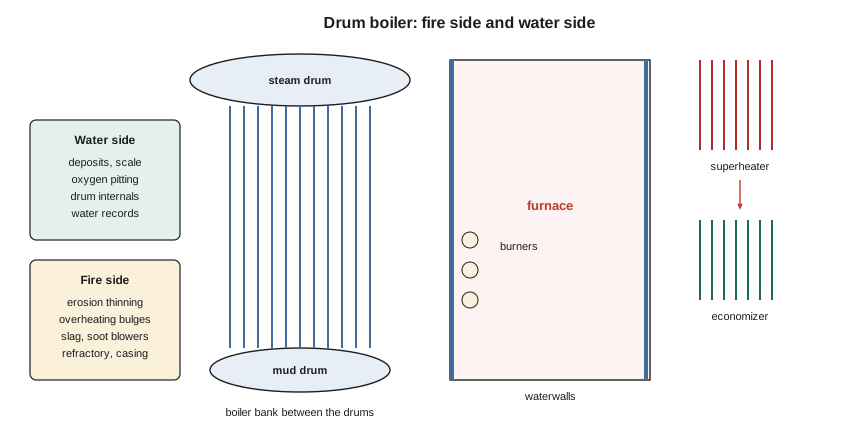
The fire side
The fire side is everything the combustion gas touches: the furnace walls, the superheater and reheater tubes, the boiler bank, the economizer and the air heater. Fire-side inspection looks for tube thinning from erosion and corrosion, bulging and blistering from overheating, cracking at attachments, damage from soot blowers and falling slag, and deposits that insulate the tubes and cause overheating. Burners and their throats are checked for wear and correct alignment, refractory is checked for cracks and missing pieces, and the casing and seals are checked for leaks.
Tube thinning is measured by ultrasonic thickness surveys. The inspection plan sets out which tubes and elevations are measured, often the same locations at every outage, so that the readings show a trend. In areas where tubes wear fastest, such as near soot blowers, around burners and at the bottom of the furnace, the survey is denser. The readings are compared with the minimum wall the design calculation gives and with the owner's replacement criterion, which is set somewhat above the minimum so that tubes are replaced before they become a leak.
Worked problem
A waterwall thickness survey
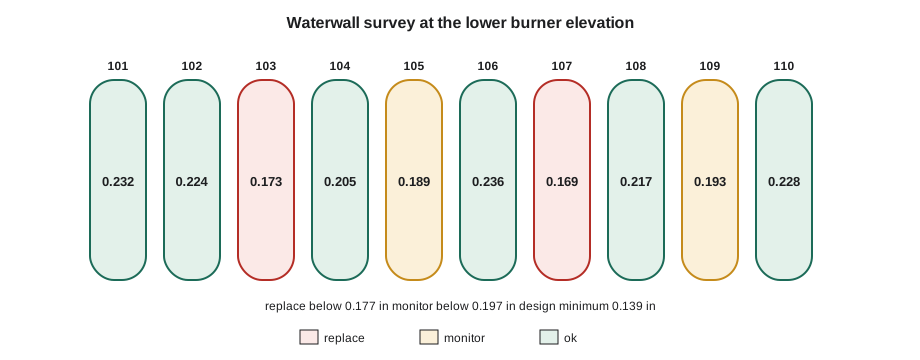
Riverbend's survey of ten waterwall tubes at the lower burner elevation gives the thinnest reading on each tube. The tubes were replaced 20 years ago with a nominal wall of 0.250 in. The design minimum is 0.139 in, and the owner replaces tubes below 0.177 in. Which tubes must be replaced, which should be monitored closely, and what remaining life does each have at its average rate?
Show solution
- The average wear rate is the wall lost divided by the years in service.
- Remaining life to the design minimum is the wall left above the minimum divided by the rate.
- Tubes below the criterion are replaced; tubes within a margin of it are monitored.
Answer: Tubes 103 and 107 are below the criterion and are replaced. Tubes 105 and 109 are flagged to be monitored at the next outage.
# Waterwall tube thickness survey: flag tubes for replacement and estimate remaining life
T_NOM = 0.250         # nominal tube wall (in)
T_MIN = 0.139         # minimum wall from the design calculation (in)
REPLACE_AT = 0.177    # owner's replacement criterion (in), above the code minimum
YEARS = 20          # years since the tubes were new
readings = {101: 0.232, 102: 0.224, 103: 0.173, 104: 0.205, 105: 0.189, 106: 0.236, 107: 0.169, 108: 0.217, 109: 0.193, 110: 0.228}      # tube number: thinnest reading at the survey elevation (in)
flag = []
for tube, t in readings.items():
    rate = (T_NOM - t) / YEARS
    life = (t - T_MIN) / rate if rate > 0 else float("inf")
    action = "REPLACE" if t < REPLACE_AT else "monitor" if t < REPLACE_AT + 0.020 else "ok"
    if action == "REPLACE":
        flag.append(tube)
    print(f"tube {tube:3}: {t:.3f} in  rate {rate:.4f} in/yr  life to minimum {life:4.1f} yr  {action}")
print(f"{len(flag)} tube(s) below the replacement criterion: {flag}")tube 101: 0.232 in rate 0.0009 in/yr life to minimum 103.3 yr ok tube 102: 0.224 in rate 0.0013 in/yr life to minimum 65.4 yr ok tube 103: 0.173 in rate 0.0039 in/yr life to minimum 8.8 yr REPLACE tube 104: 0.205 in rate 0.0023 in/yr life to minimum 29.3 yr ok tube 105: 0.189 in rate 0.0030 in/yr life to minimum 16.4 yr monitor tube 106: 0.236 in rate 0.0007 in/yr life to minimum 138.6 yr ok tube 107: 0.169 in rate 0.0040 in/yr life to minimum 7.4 yr REPLACE tube 108: 0.217 in rate 0.0016 in/yr life to minimum 47.3 yr ok tube 109: 0.193 in rate 0.0028 in/yr life to minimum 18.9 yr monitor tube 110: 0.228 in rate 0.0011 in/yr life to minimum 80.9 yr ok 2 tube(s) below the replacement criterion: [103, 107]
The two tubes below the criterion are not about to fail; each has several years of life left to the design minimum. They are replaced now because the next outage is years away and a tube leak in service costs far more than a planned repair. That is the logic behind every replacement criterion: to act at a planned outage before a failure forces an unplanned one. The tube replacement itself follows the window and tube welding methods taught in the welding course.
The water side
The water side is everything the water and steam touch: the drums, headers, tubes, downcomers and risers, the superheater and the economizer inside. Water-side inspection looks for deposits and scale, which insulate the tubes and cause overheating; corrosion and pitting, often from oxygen during shutdowns; and damage from poor water chemistry, such as caustic gouging and hydrogen damage. Drum internals, which separate steam from water, are checked for loose or missing parts, and the feed and chemical feed lines and blowdown lines inside the drum are checked for damage and plugging.
Deposits are measured by cutting tube samples from the furnace walls and sending them to a laboratory, which reports the weight of deposit per unit area. When deposits pass a limit the boiler is chemically cleaned, usually by a specialist contractor, during an outage. Because a boiler's life depends so much on water chemistry, the water treatment records are part of the inspection, and in some jurisdictions good records allow longer intervals between internal inspections.
Boilers that stand idle for long periods are laid up, either wet with treated water or dry with dehumidified air or nitrogen, to stop oxygen corrosion while they are off. During an outage the boiler is open to air, so the work is planned to keep the open time short, and surfaces are kept dry where possible.
Safety valves and other outage work
Every boiler has safety valves that open to stop the pressure exceeding the maximum allowable working pressure. They are the last line of protection against an explosion, and the jurisdiction requires them to be tested and serviced at set intervals. Many are tested in place during the run with a lifting device or on line with special equipment; others are removed during the outage, overhauled and tested on a bench by an organization authorized to repair them, then reinstalled and sealed. The National Board accredits valve repair organizations, which mark the valves they repair with its repair symbol.
Other outage work is just as routine and just as important. Valves on the steam and water side are repacked or overhauled; boiler casing leaks are sealed; expansion joints are replaced; soot blowers are overhauled; burner parts are replaced; refractory is repaired. Each job has its work package and its place in the schedule, and each is closed out with a record that the jurisdiction's inspector may review.
| Outage task | Who usually does it | Record kept |
|---|---|---|
| Internal inspection of drums and headers | Owner's or jurisdiction's inspector | Inspection report |
| Tube thickness survey | NDE technicians | Thickness map with trends |
| Tube replacements | Boilermakers under a repair procedure | Repair report, NDE, test |
| Safety valve overhaul and test | Authorized valve repair organization | Test certificate and seal |
| Chemical cleaning | Specialist contractor | Cleaning report |
| Hydrostatic test after repairs | Owner and boilermakers, witnessed by the inspector | Test record |
Testing and return to service
When the work is complete, the boiler is closed up and pressure tested if the repairs or the jurisdiction require it. A hydrostatic test after repairs is usually done at a pressure the repair code and the inspector set, often no higher than the safety valve setting, and the inspector examines the repaired areas while it is held. Safety valves are gagged or removed for the test so they do not lift, and the gags must be removed afterwards. Many outage accidents have come from a gag left in place, so the gag list is controlled like a blind list.
The boiler is then filled with treated water, the blinds are removed, the fuel and burner isolations are released under the permit system, and the boiler is fired and brought up slowly to temperature and pressure. During start-up the repaired areas are checked again, safety valves are checked at their set pressure if required, and the water chemistry is brought back into range before the unit goes on line. The outage is closed when the paperwork is complete and the jurisdiction's records are updated.
Kiera's notes from Riverbend list the parallels with Northgate: a work list ranked by risk, a frozen scope, a critical path through the largest jobs, blind and gag lists, permits, hold points and a punch list. The equipment is different; the method is the same.
Common mistakes
MistakeCooling a boiler quickly to start work sooner.
InsteadCool it at the controlled rate; thick drums and headers can crack if cooled too fast.
MistakeReplacing tubes only when they are below the design minimum.
InsteadUse the owner's replacement criterion, which is set above the minimum so tubes are replaced before they leak.
MistakeLeaving a safety valve gag in place after the hydrotest.
InsteadControl gags on a list like blinds, and verify every one is removed before firing.
MistakeIgnoring water treatment records.
InsteadThey show the conditions inside the boiler and are part of the inspection.
Summary and key terms
- Boilers are inspected at intervals the jurisdiction sets; outages also repair what inspections find.
- Outages are planned like turnarounds, with scope, packages, schedules and a critical path.
- The fire side is inspected for thinning, overheating, cracking and deposits; tube surveys give trends.
- Tubes are replaced at a criterion above the design minimum, at a planned outage.
- The water side is inspected for deposits, corrosion and drum internals; water chemistry records matter.
- Safety valves are serviced and tested by authorized organizations; gags are controlled like blinds.
- Fire side
- The parts of a boiler that combustion gas touches.
- Water side
- The parts of a boiler that water and steam touch.
- Replacement criterion
- The owner's wall thickness below which a tube is replaced, set above the design minimum.
- Thickness survey
- Ultrasonic readings at set locations to find thinning and its rate.
- Gag
- A clamp that holds a safety valve shut during a hydrostatic test.
- Lay-up
- Protecting an idle boiler from corrosion, wet or dry.
Practice problems
Work each problem on paper first, then reveal the answer to check.
Tube 105 reads 0.189 in against a criterion of 0.177 in. Why is it monitored rather than replaced?
Show answer
It is still above the criterion, but within the monitoring margin, so it is measured again at the next outage.
Why do some jurisdictions allow longer internal inspection intervals for boilers with good water treatment records?
Show answer
Good water chemistry greatly reduces internal deposits and corrosion, and the records show it was maintained.
What must be done with safety valves before a hydrostatic test?
Show answer
Gag or remove them so they do not lift, and record every gag so it is removed afterwards.
Name two fire-side and two water-side findings.
Show answer
Fire side: erosion thinning, overheating bulges. Water side: scale deposits, oxygen pitting.
Lesson quiz · 5 questions
Score 60% or more to complete this lesson.
Create a free account to save your progress, take quizzes and earn a certificate.