
BLR-330 · Lesson 7 of 12 · 20 min
Columns, trays and internals
C-410 is the Unit 22 fractionator, a column 10 ft in diameter and 125 ft tall with 42 valve trays. For most of the last run its middle section has been flooding: liquid backs up on the trays, the separation gets worse, and operations have had to cut the feed to keep the products on specification. A gamma scan done on the running column showed that several trays in the middle had collapsed or lost panels. The turnaround scope calls for trays 11 to 42 to be replaced with new trays from the vendor, 32 trays in all, and Kiera's crew will do the work from the bottom up. "Trays are like a stack of floors in a building," says Rosa. "If one is in wrong, everything above it is wrong too." This lesson covers how columns work, what goes inside them, how trays and packing are removed, installed and inspected, and how a column job is planned and run.
What a column does
A distillation column separates a mixture into parts with different boiling points. Vapor rises from the bottom, where a reboiler heats the liquid, and liquid flows down from the top, where a condenser and reflux drum return part of the overhead product. On each tray the rising vapor bubbles through the liquid flowing across it, and the lighter components move into the vapor while the heavier ones stay in the liquid. Stacking many trays gives a sharp separation. Columns in refineries, upgraders and chemical plants range from small strippers to towers more than 200 ft tall.
Trays are not the only internals. Columns may be filled with packing instead of trays, either loose random packing or structured packing made of corrugated sheets, which gives a lower pressure drop. Liquid distributors spread liquid evenly over packing. Feed distributors, chimney trays, collector trays, demister pads and vortex breakers each have their job. All of them are installed through manways and must fit the column, be level and be fixed securely, or the column will not separate properly.
Tray parts and how they fit
A tray is built from panels that pass through the column's manways. The panels rest on a support ring welded to the inside of the shell and on support beams for larger diameters, and they are clamped to the ring and to each other with clamps and bolts. One panel in each tray is a manway panel, which can be removed from above or below so that workers can climb through the tray stack. The deck carries the openings that vapor passes through: holes for sieve trays, movable or fixed valves for valve trays, or bubble caps on older trays. Each tray has one or more downcomers, the vertical channels that carry liquid down to the tray below, sealed at the bottom by a weir or a seal pan.
The fit of a tray matters. The deck must be level, within a tolerance the vendor sets, so that liquid flows evenly across it. The weirs must be at the right height, the downcomer clearances must be correct, and every joint between panels must be tight, because gaps let vapor bypass the liquid or liquid leak through. Gaskets are used at some joints. The vendor's installation drawings give the dimensions, tolerances, bolt torques and the order of installation, and the crew follows them exactly.
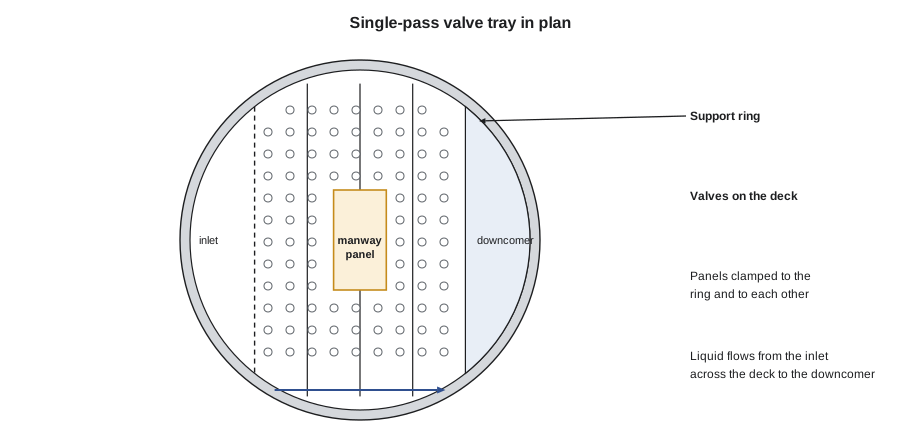
| Part | Job | Common turnaround finding |
|---|---|---|
| Support ring | Carries the tray at the shell | Corrosion, cracked welds, out of level |
| Deck panels | Carry the liquid and the valves | Bent or missing panels after an upset |
| Valves | Open to let vapor through | Stuck, worn or missing valves |
| Downcomer and weir | Carry liquid to the tray below | Wrong clearance, fouling, damage |
| Clamps and bolts | Hold panels to the ring and to each other | Corroded, loose or missing |
| Manway panel | Access through the tray | Left loose or missing after the last job |
Why trays fail
Trays are light structures, designed to carry liquid and the pressure drop of the vapor, not large forces. They are damaged mainly by process upsets. A sudden surge of vapor, from water flashing in a hot column or a fast change in pressure, can lift panels off their rings and fold them like paper. Liquid slugs can do the same. Corrosion of clamps and bolts lets panels shift, and fouling from coke, salts or polymer plugs valves and downcomers. Once one tray is damaged, the trays above it may flood and be damaged in turn.
Before a turnaround, operators and process engineers use tools to find which trays are damaged. A gamma scan passes a radioactive source and a detector down the outside of the running column and measures the density at each level, which shows where liquid is sitting and where trays are missing. Pressure drop readings and product quality data give clues too. The gamma scan of C-410 showed missing or collapsed trays from about tray 28 to tray 34, with flooding above them, which is why the scope covers trays 11 to 42.
Planning the tray job
Tray jobs are planned around access. Everything goes in and out through manways that are typically about 24 in across, so every panel, clamp, tool and person must pass through them. Old trays are removed from the top down or the bottom up, depending on the manway layout and the order the vendor gives, and new trays are installed in the reverse order. Panels are lifted to the manway levels by crane or hoist, passed in and carried across the trays already in place. Inside, the crew works on the tray below, with temporary platforms and fall protection where needed.
Worked problem
Parts and hours for the C-410 retray
Trays 11 to 42 are to be replaced, 32 trays with 8 panels each, including one manway panel. Each panel has 60 valves fitted at the factory and needs 14 clamp sets. The vendor's estimate is 22 crew hours per tray, including removal of the old tray, cleaning the support ring, installation and inspection. Add 10 % spares for panels and clamps. How many panels and clamp sets should be on site, and how many shifts will a crew of 6 or 8 take?
Show solution
- Multiply trays by panels per tray, and add spares.
- Multiply panels by clamps per panel, and add spares.
- Total hours are trays times hours per tray; a shift holds about 11 productive hours per person.
Answer: The program gives 256 panels plus 26 spares and 3,943 clamp sets. At 704 crew hours, a crew of 8 needs about 8 shifts.
# Parts count and hours for retraying a column (illustrative)
TRAYS = 32          # trays to be replaced
PANELS = 8        # deck panels per tray, including the manway panel
VALVES_PER_PANEL = 60
CLAMPS_PER_PANEL = 14
SPARE = 0.10             # spares carried for drops and damage
HOURS_PER_TRAY = 22   # crew hours per tray: remove, clean ring, install, inspect

def with_spare(n):
    return int(n * (1 + SPARE) + 0.999)

panels = TRAYS * PANELS
print(f"Deck panels: {panels} (+ spares {with_spare(panels) - panels})")
print(f"Valve units on new panels: {panels * VALVES_PER_PANEL:,} (factory fitted)")
print(f"Clamps, bolts and nuts: {with_spare(panels * CLAMPS_PER_PANEL):,} sets")
print(f"Manway panels: {TRAYS}")
hours = TRAYS * HOURS_PER_TRAY
for crew in (6, 8):
    shifts = hours / (crew * 11)     # about 11 productive hours in a 12 h shift
print(f"Crew of {crew}: {hours} crew hours = {shifts:.1f} shifts")Deck panels: 256 (+ spares 26) Valve units on new panels: 15,360 (factory fitted) Clamps, bolts and nuts: 3,943 sets Manway panels: 32 Crew of 6: 704 crew hours = 10.7 shifts Crew of 8: 704 crew hours = 8.0 shifts
The spares are not extra work: they are insurance. On a typical retray, panels are dropped, bent in handling or found not to fit a ring that is out of round, and clamps and bolts are dropped through the trays below. Without spares the job stops while parts are flown in. Kiera's crew also carries a stock of the vendor's gaskets for the downcomer joints, and a set of shims for rings that are out of level.
Removing and installing trays
Before the old trays come out, the inspector and the vendor's representative check the column and record the state of the trays, the rings and the shell, often with photographs. The old panels are unclamped, passed out through the manways and taken away. The support rings are cleaned and inspected; corroded ring welds are repaired under a procedure, and rings that are out of level are shimmed or corrected as the vendor directs. The shell between the trays is inspected while it is easy to reach.
New trays are installed from the bottom up, each one checked before the next goes in. The crew sets the panels on the ring, fits the clamps loosely, checks that the deck is level and the weirs and downcomer clearances are right, then tightens the clamps to the specified torque. The manway panel is fitted last on each tray. The vendor's representative, the owner's inspector or both inspect each tray against a checklist before the crew moves up. Measurements are recorded on a tray data sheet: deck levelness, weir height, downcomer clearance and any deviations.
| Tray check | What is measured | Why |
|---|---|---|
| Deck levelness | Height across the deck from a reference | Uneven decks give uneven liquid flow |
| Weir height | Weir top above the deck | Sets the liquid depth on the tray |
| Downcomer clearance | Gap under the downcomer | Too small chokes the liquid; too big lets vapor up the downcomer |
| Clamps | All fitted and tight | Loose clamps let panels lift in an upset |
| Valves | Free to move, none missing | Stuck valves change the tray's capacity |
| Manway panel | Fitted and clamped | A loose panel lets vapor bypass the tray |
Working inside a column is confined space entry in a tall, narrow space with several levels. The entry permit covers the whole column, with attendants at each manway in use, communication between levels and a rescue plan that can bring a person down or out through a manway. Dropped objects are a serious hazard: a bolt dropped from tray 40 is a missile by the time it reaches tray 12. Crews work with tool lanyards, close the trays below with temporary covers where possible and keep people out of the trays directly below active work.
Packed columns and other internals
Columns with packing are worked differently. Random packing is removed by vacuum truck or by hand and replaced by careful loading, often with the column partly filled with water so that the pieces settle without breaking. Structured packing comes in layers, each rotated from the one below, and must be fitted snugly against the shell to stop liquid running down the wall. Liquid distributors above the packing must be level and their holes clear, because a distributor that sends more liquid to one side spoils the whole bed. Packing support grids and hold-down grids are checked for damage and secured.
Other internals have their own checks. Feed distributors and chimney trays are checked for cracked welds and plugged holes. Demister pads are replaced if they are torn or fouled. Vortex breakers at the bottom outlet are checked for damage. On every job, the vendor's drawings and installation instructions are the reference, and anything that does not fit is reported, not forced.
The C-410 job
Kiera's crew starts on the fourth day, once the column has been ventilated and the permit issued. The old trays from 42 down to 11 come out through the three manways in four shifts, with the inspector photographing each level first. On ring 30 the inspector finds a crack along the ring weld for about a quarter of its length, where the collapsing tray tore the ring. It becomes emergent work: a repair procedure is written, Anders welds the ring and it passes its examination before the new tray goes in. The rest of the rings need only cleaning and a few shims.
Installation goes faster than removal. By the twelfth shift trays 11 to 30 are in, checked and signed, and the crew has used 9 spare panels and about 200 spare clamp sets. On tray 34 the vendor's representative finds one weir set 1/4 in low. It is corrected before the tray is signed. Kiera notes that the vendor's check caught it only because it was done tray by tray; finding it at the end would have meant taking out eight trays above it.
Common mistakes
MistakeForcing a panel that does not fit.
InsteadReport it; the ring may be out of level or the panel wrong, and forcing it leaves a gap.
MistakeInstalling all the trays and checking them at the end.
InsteadCheck and sign each tray before installing the one above.
MistakeLeaving the manway panel loose for convenience.
InsteadClamp it like every other panel; a loose panel lets vapor bypass the tray.
MistakeWorking above others without protection.
InsteadUse tool lanyards, cover the trays below and keep people out of the drop zone.
Summary and key terms
- Columns separate mixtures on trays or packing; vapor rises and liquid flows down.
- Trays are built from panels clamped to support rings, with a manway panel and downcomers.
- Trays are damaged mainly by process upsets, corrosion of fixings and fouling; gamma scans locate damage before the shutdown.
- Everything goes in and out through manways; spares of panels and clamps are essential.
- Each tray is checked for level, weir height, downcomer clearance and fixings before the next goes in.
- Packing, distributors and other internals follow the vendor's instructions exactly.
- Column work is confined space entry with a serious dropped-object hazard.
- Tray
- A horizontal deck inside a column on which vapor and liquid contact.
- Downcomer
- The channel that carries liquid from one tray to the next.
- Weir
- The plate at the edge of a tray deck that sets the liquid depth.
- Support ring
- The ring welded to the shell on which a tray rests.
- Gamma scan
- A radiation scan of a running column that shows where liquid and trays are.
- Structured packing
- Corrugated sheets stacked in layers inside a column instead of trays.
Practice problems
Work each problem on paper first, then reveal the answer to check.
Why are new trays installed from the bottom up and checked one at a time?
Show answer
Each tray is a reference for the next, and an error found late would mean removing every tray above it.
Why carry 10 % spare panels and clamps?
Show answer
Panels are dropped, bent or found not to fit, and clamps are lost; without spares the job stops.
What does a gamma scan show?
Show answer
The density at each level of a running column, which shows where liquid is sitting and where trays are missing.
A bolt is dropped from tray 40. What controls should have prevented harm below?
Show answer
Tool lanyards, covers on the trays below and a drop zone kept clear of people.
Lesson quiz · 5 questions
Score 60% or more to complete this lesson.
Create a free account to save your progress, take quizzes and earn a certificate.