
BLR-330 · Lesson 2 of 12 · 20 min
Scope, work lists and the turnaround plan
Kiera's part in the Northgate turnaround began months before Rosa gave her the crew. In March, Heather Quan asked her to walk the Unit 22 exchangers and column C-410 with the owner's planner and mark up the work packages from a boilermaker's point of view: where the rigging would go, which flanges were hard to reach, where scaffold would be needed and what the crew would need on the first shift. "The best turnarounds are won in the office," Heather told her. "By the time the unit shuts down, every job should be written, every part should be on site and everybody should know what they're doing on day one." This lesson follows how the owner builds the scope of a turnaround, how work is ranked and frozen, and how a work package turns a line on a list into a job a crew can do.
Where the scope comes from
The scope of a turnaround is the list of everything that will be done during it. It starts as a long list of requests from many sources. The owner's inspection group lists equipment that is due for internal inspection and repairs found at the last inspection. Operations list equipment that has been troublesome: exchangers that foul, valves that leak, pumps that vibrate. Reliability engineers add work from their studies of failures. Projects add tie-ins for new equipment. Process engineers add catalyst changes and changes to improve the unit. Regulators and insurers may require some work, such as relief valve testing at set intervals.
A first list for a large turnaround can hold thousands of items, and many of them are not really turnaround work. Some can be done with the unit running. Some are improvements that would be nice to have but do not need the shutdown. Some are duplicates. Left unchecked, the list grows until the turnaround cannot be done in the planned time, and the extra work crowds out the work that matters. Every owner therefore runs a process to challenge the scope, often with a scope review board that must approve each item.
| Source | Typical requests | Question the review asks |
|---|---|---|
| Inspection | Internal inspections due; repairs found last time | Is the interval really due, or can it be done on-stream? |
| Operations | Fouled exchangers, leaking valves | Does it limit the unit, and does it need a shutdown? |
| Reliability | Repeat failures, equipment at end of life | What is the risk if we do not do it? |
| Projects | Tie-ins, new nozzles | Is the project approved and are the materials sure to arrive? |
| Regulatory | Relief valve testing, statutory inspections | What does the rule require, and by when? |
Ranking the work by risk
Most owners rank requested work by risk. The risk of not doing an item is judged on two scales: the consequence if it fails, and the likelihood that it will fail before the next turnaround. A common form is a five-by-five matrix, with consequence and likelihood each scored from 1 to 5 and the risk equal to their product. High-risk items are must-do work; low-risk items are deferred or done at a later outage. Items that do not need the unit shut down are moved out of the turnaround and done before or after it.
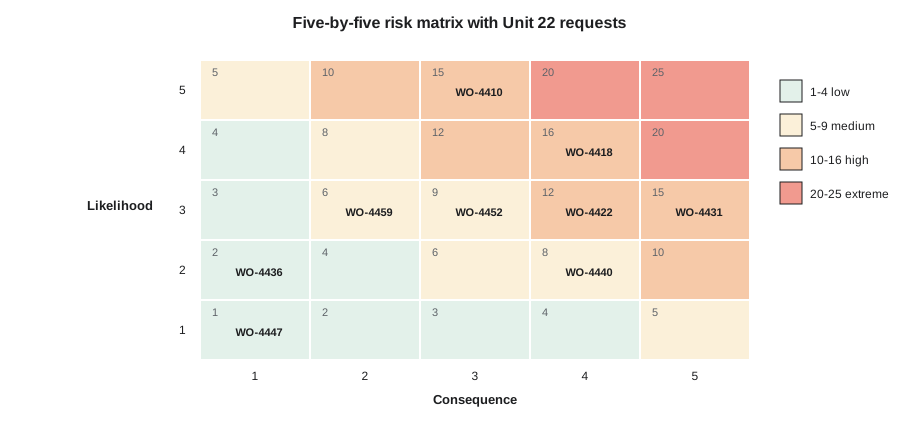
The Northgate matrix uses the same bands as the risk assessments boilermakers fill in on the job: 1 to 4 is low, 5 to 9 medium, 10 to 16 high and 20 to 25 extreme. The consequence scale looks at harm to people, release to the environment, damage to equipment and lost production; the likelihood scale looks at inspection data, past failures and the condition of the equipment. Scoring is a judgment, made by people who know the equipment, and the review board challenges scores that seem high or low.
Worked problem
Ranking part of the Unit 22 work list
Ten requests for Unit 22 have been scored by the review board. Rank them by risk, decide which are must-do, which are done if the schedule allows and which are deferred, and move out any that do not need a shutdown.
Show solution
- Multiply consequence by likelihood for each item.
- Items that do not need a shutdown go to on-stream work or a later outage, whatever their score.
- Of the rest, risk 10 or more is must-do, 5 to 9 is done if the schedule allows, and below 5 is deferred.
Answer: The program below ranks the list. Four items are must-do, including the C-410 trays and the E-2201A bundle that Kiera's crew will work on.
# Rank turnaround work list items by risk = consequence x likelihood (5 x 5 matrix)
# Bands follow the Northgate matrix: 1-4 low, 5-9 medium, 10-16 high, 20-25 extreme.
items = [
    ("WO-4410", "E-2201A bundle fouled, duty down 30 %", 3, 5, True),
    ("WO-4418", "C-410 trays 11-42 damaged, flooding", 4, 4, True),
    ("WO-4422", "V-2204 internal inspection due (API 510)", 4, 3, True),
    ("WO-4431", "Coker drum D-1 skirt crack monitoring", 5, 3, True),
    ("WO-4436", "Repaint pipe rack 7", 1, 2, False),
    ("WO-4440", "Replace leaking PSV on V-2210", 4, 2, True),
    ("WO-4447", "Spare exchanger tube plugging records", 1, 1, True),
    ("WO-4452", "Insulation repair on line 8-P-2215 (CUI suspected)", 3, 3, False),
    ("WO-4459", "E-2203 channel gasket weep", 2, 3, True),
    ("WO-4463", "Upgrade control room chairs", 1, 1, False),
]   # (work order, description, consequence 1-5, likelihood 1-5, needs a shutdown?)

def band(r):
    return "extreme" if r >= 20 else "high" if r >= 10 else "medium" if r >= 5 else "low"

rows = []
for wo, text, c, l, shut in items:
    r = c * l
    if not shut:
        decision = "do on-stream or at a later outage"
    elif r >= 10:
        decision = "must do this turnaround"
    elif r >= 5:
        decision = "do if the schedule allows"
    else:
        decision = "defer"
    rows.append((r, wo, text, band(r), decision))
rows.sort(reverse=True)
for r, wo, text, b, d in rows:
    print(f"{wo}  risk {r:2d} ({b:7})  {text:38}  {d}")
must = sum(1 for r in rows if r[4].startswith("must"))
print(f"{must} of {len(rows)} items are must-do; {sum(1 for r in rows if r[4] == 'defer')} deferred")WO-4418 risk 16 (high ) C-410 trays 11-42 damaged, flooding must do this turnaround WO-4431 risk 15 (high ) Coker drum D-1 skirt crack monitoring must do this turnaround WO-4410 risk 15 (high ) E-2201A bundle fouled, duty down 30 % must do this turnaround WO-4422 risk 12 (high ) V-2204 internal inspection due (API 510) must do this turnaround WO-4452 risk 9 (medium ) Insulation repair on line 8-P-2215 (CUI suspected) do on-stream or at a later outage WO-4440 risk 8 (medium ) Replace leaking PSV on V-2210 do if the schedule allows WO-4459 risk 6 (medium ) E-2203 channel gasket weep do if the schedule allows WO-4436 risk 2 (low ) Repaint pipe rack 7 do on-stream or at a later outage WO-4463 risk 1 (low ) Upgrade control room chairs do on-stream or at a later outage WO-4447 risk 1 (low ) Spare exchanger tube plugging records defer 4 of 10 items are must-do; 1 deferred
Look at what happens to the insulation repair on line 8-P-2215. Its risk is medium, because corrosion under insulation is suspected, but the work does not need the unit down: insulation can be stripped and the pipe inspected with the line in service. Moving it out of the turnaround does not mean ignoring it; it goes on the on-stream work list with its own date. The same is true of the paint and the chairs, which should never have reached a turnaround list.
Scope freeze and emergent work
At a set date before the turnaround, often a few months ahead, the scope is frozen. After the freeze, adding work needs the approval of the turnaround manager, because every addition takes planning time, materials and space in the schedule. Work removed after the freeze is just as disruptive if crews and materials have been arranged for it. A firm scope freeze is one of the strongest signs of a well-run turnaround.
Not all work can be known before the unit is opened. When a vessel is opened and inspected, the inspector may find corrosion, cracking or damaged internals that need repair. This emergent work, also called discovery work, is expected, and good plans set aside time and money for it based on past turnarounds. Some owners pre-plan likely repairs as contingent work packages, written in advance and held until the inspection shows whether they are needed. Emergent work follows a formal path: it is written up, assessed by the inspector and engineer, approved, planned, scheduled and given a permit before anyone touches it.
| Kind of work | When it is known | How it is handled |
|---|---|---|
| Planned scope | Before the scope freeze | Fully planned work package, in the schedule |
| Contingent work | Planned in advance, triggered by inspection | Package written and held; released if the finding occurs |
| Emergent work | Found during the turnaround | Written up, assessed, approved, planned and permitted before starting |
| Scope added late | After the freeze, before the shutdown | Turnaround manager's approval; often refused |
The work package
Each job on the turnaround is described in a work package, written by a planner. A good package lets a crew that has never seen the equipment do the job safely and correctly. It contains the scope of work in plain steps, the equipment drawings and data sheets, the isolation and blind list, the permits needed, the rigging plan for heavy lifts, the scaffold requests, the materials and gaskets with their stock codes, the special tools, the bolt torques, the inspection and test plan with its hold points, the estimated hours by trade and the place of the job in the schedule.
Kiera's March walkdown was a check on the packages for her future crew. With the owner's planner she found that the E-2201A package called for a hydraulic bundle extractor but did not say where it would sit; the pipe rack beside the exchanger leaves only a narrow gap. She found that the C-410 package listed new tray panels but not the extra clamps the old rings would need where they had corroded. And she found that one blind on the list was on a flange that was buried in insulation, so a scaffold and an insulation crew would be needed before the blinding crew could reach it. Each finding went back to the planner, and by July the packages had been updated.
Walkdowns like this are one of the most useful things a tradesperson can do before a turnaround. Planners work from drawings and databases; the people who will do the work see what the drawings miss. A walkdown checks access, rigging points, scaffold needs, the condition of bolts and flanges, the location of laydown space and the route for equipment. Every problem found in March is a delay that does not happen in September.
Materials and long-lead items
A turnaround cannot wait for parts. Materials with long delivery times, such as replacement exchanger bundles, tray sets, special alloy pipe and large valves, are ordered many months ahead, sometimes more than a year. Bulk materials such as gaskets, bolts and studs are ordered by the package and staged by job before the shutdown. On the first day of execution, each crew should find its gaskets, bolts and tools in a labeled crate at its job, not in a warehouse across the site.
Material control is a large part of turnaround planning. Every gasket and stud must be the right material for the service, and positive material identification is often required for alloys. Spare gaskets are carried for each joint, because a gasket damaged on the way to the job is a delay. Kiera checks her crew's crates with the warehouse lead a week before the shutdown and finds one gasket of the wrong rating for the E-2203 channel; a correct one is pulled from stock that afternoon.
Estimating and the turnaround budget
Each package carries an estimate of the hours needed by each trade. Estimates come from past turnarounds, standard estimating data and the planner's judgment, and they are adjusted for the conditions: work at height, in confined spaces, in heat or cold, or with restricted access takes longer. The hours for every package are added up to build the manpower plan, and the hours and materials together make the budget. During the turnaround, progress is measured against these hours, which is the subject of the capstone lesson.
The plan also includes allowances for emergent work and for the time it takes to start each job: travel, permits, toolbox meetings and the walk to the work. On a large site these can take a surprising share of each shift. Planners who forget them build schedules that cannot be met. Heather's estimate for Crew 7 assumes about eleven productive hours in each twelve-hour shift, which is optimistic for the first few days and fair once the crew has settled in.
Common mistakes
MistakeAdding work to the turnaround because it is convenient.
InsteadOnly work that needs the shutdown belongs in it; the rest goes on the on-stream list.
MistakeStarting emergent work as soon as it is found.
InsteadEmergent work must be assessed, approved, planned and permitted first.
MistakeLeaving the walkdown to the planners.
InsteadThe crew that will do the work sees access, rigging and scaffold problems the drawings miss.
MistakeAssuming the materials are right because they are in the crate.
InsteadCheck gasket ratings, stud materials and quantities against the package before the shutdown.
Summary and key terms
- Scope comes from inspection, operations, reliability, projects and regulatory needs, and must be challenged.
- Work is ranked by risk, consequence times likelihood, with high-risk items as must-do.
- Work that does not need a shutdown is moved to on-stream lists.
- The scope is frozen before the turnaround; emergent and contingent work follow formal paths.
- A work package holds everything a crew needs: steps, drawings, isolations, permits, rigging, materials, torques, the inspection plan and hours.
- Walkdowns by the people who will do the work catch problems early.
- Scope
- The list of all work to be done in a turnaround.
- Scope freeze
- The date after which work can be added only with special approval.
- Contingent work
- Work planned in advance and done only if an inspection finding calls for it.
- Work package
- The planned instructions, drawings, permits, materials and estimates for one job.
- Walkdown
- A visit to the equipment to check the plan against what is actually there.
- Long-lead item
- Material with a long delivery time that must be ordered well before the turnaround.
Practice problems
Work each problem on paper first, then reveal the answer to check.
A request to repaint a pipe rack reaches the turnaround list. What should happen to it?
Show answer
It does not need the unit shut down, so it moves to the on-stream maintenance list.
Why do owners freeze the scope months before the shutdown?
Show answer
Every change after the freeze needs new planning, materials and schedule space, and late changes cause confusion and delay.
During the walkdown Kiera finds a blind location buried in insulation. What does the package need?
Show answer
A scaffold and an insulation removal step before the blinding crew can reach the flange.
What risk score does an item with consequence 4 and likelihood 3 get, and which band is it in?
Show answer
12, which is high on the Northgate matrix.
Lesson quiz · 5 questions
Score 60% or more to complete this lesson.
Create a free account to save your progress, take quizzes and earn a certificate.